
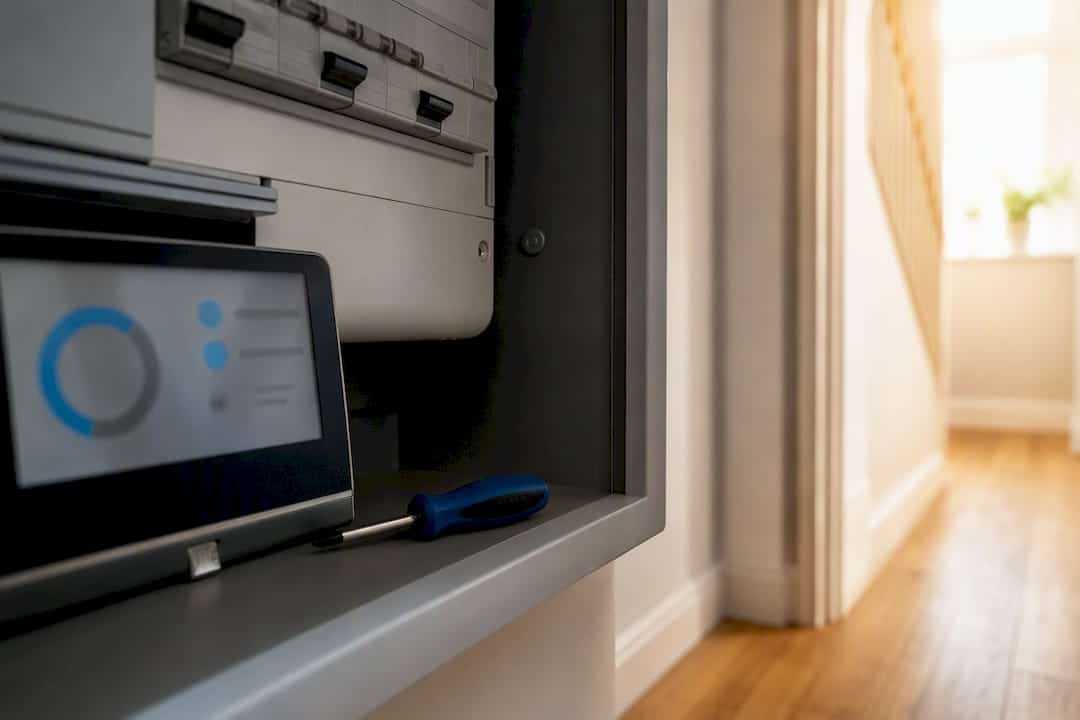
Ten changes, done together, typically cut a UK household’s electricity use noticeably and save anywhere from tens to a few hundred pounds a year: air-drying clothes, cutting hot water waste, killing standby power, switching to LEDs, running full appliance loads, maintaining the fridge, draught-proofing, adjusting heating controls, and using smart meter data to catch better tariffs. None of these need a tradesperson. The detailed breakdown below shows exactly how to do each one.
TL;DR:
- Air-drying clothes can reduce household electricity bills significantly, as tumble dryers are often the most energy-intensive appliances.
- Regular maintenance of fridges and freezers, including coil cleaning and defrosting, helps keep their efficiency high, cutting ongoing power costs.
- Using a smart meter to monitor real-time energy use and shifting high-load tasks to off-peak tariffs can produce noticeable savings, especially with electric vehicles or heat pumps.
- Upgrading to LED bulbs and turning lights off when not needed offers quick payback, especially combined with replacing old bulbs and improving habits.
- Implementing simple, low-cost measures like draught-proofing and adjusting heating controls can cut heating energy use without affecting comfort.
Table of Contents
- 10 ways to save electricity at home, ranked by impact
- Use your EPC and smart meter to prioritise upgrades
- Choosing energy-efficient appliances when you replace one
- Are solar panels worth it for reducing electricity bills?
- Home automation systems that actually cut consumption
- Why heating and cooling system maintenance still matters
- An honest note on what actually moves the needle
- Get a tailored plan instead of guessing which upgrade pays off
- Sources
- FAQ
10 ways to save electricity at home, ranked by impact
The order below runs from free behavioural changes to small upgrades and basic maintenance. Start at the top if you want results with zero spend.
1. Air-dry clothes instead of using the tumble dryer
A tumble dryer is one of the hungriest appliances in most homes, often costing more per cycle than a full wash and rinse combined. Fit an airer near a radiator or by a window with good airflow, and run it in the same room as a dehumidifier if condensation is a problem. Reserve the dryer for genuinely wet weather emergencies rather than routine laundry days.
2. Cut hot water waste, especially in the shower
Heating water accounts for a large share of domestic energy use, and showers are usually the biggest culprit after the boiler itself. Shaving two minutes off a daily shower, fitting a low-flow shower head, and lagging your hot water cylinder with an insulation jacket all reduce how hard your heating system has to work. A cylinder jacket costs very little and typically pays for itself within a year through reduced heat loss.
3. Only boil the water you actually need
Filling a kettle to the brim for one cup of tea wastes both water and the electricity used to heat it. Fill to the level marked on the kettle, or just above the element, and you’ll notice the difference on quieter energy bills within a few weeks. It sounds trivial until you multiply it by every kettle-boil, every day, for a year.
4. Switch off standby and unplug idle chargers
Devices left on standby, phone chargers left plugged in with nothing attached, and games consoles idling in “quick start” mode all draw power around the clock. A single smart plug or extension lead with a physical switch lets you kill an entire entertainment unit at the wall in one go. Pro Tip: Put your television, set-top box, and games console on one switched extension lead, then make switching it off part of your bedtime routine, the same way you’d lock the front door.
5. Swap remaining bulbs for LEDs and turn lights off
If any room in the house still has old halogen or incandescent bulbs, replacing them with LEDs is one of the fastest paybacks available. LEDs use a fraction of the electricity of older bulbs and last many times longer, so the swap earns its cost back quickly even before you factor in the habit of switching lights off when you leave a room. Combine the two, new bulbs and better habits, and lighting stops being a meaningful line on your bill.
6. Only run the washing machine and dishwasher when full
Both machines use roughly the same amount of water and electricity whether the drum is half empty or packed, so running half-loads doubles your cost per item washed. Wait until you have a full load, and drop the temperature to 30°C for most washing rather than the default 40°C or 60°C setting. Most modern detergents work perfectly well at lower temperatures unless you’re dealing with genuinely soiled kit or bedding.
7. Keep your fridge and freezer running efficiently
A fridge or freezer runs every hour of every day, so small inefficiencies compound fast. Dusty condenser coils on the back or underside of the appliance and thick ice build-up inside a freezer both force the compressor to work harder than it should, and routine maintenance measurably improves performance. Vacuum the coils twice a year, defrost when ice gets thicker than roughly half a centimetre, and check the door seal still grips a piece of paper snugly when closed.
8. Draught-proof doors, windows, and letterboxes
Cold air sneaking in through gaps around external doors and windows makes your heating system run longer to compensate, which shows up on your electricity bill if you have electric heating or a heat pump. A simple foam or brush draught excluder fitted to the bottom of an external door, sealing strips around window frames, and a letterbox brush are all inexpensive fixes. If you’re weighing up whether an old, draughty door is worth replacing entirely, upgrading tired interior and exterior doors can meaningfully cut heat loss in older properties.
9. Get your thermostat and heating controls right
Turning your thermostat down by even one degree typically trims your heating costs without a noticeable comfort difference, and a programmable thermostat with setback timing avoids heating an empty house during the day. If you have a combi boiler, check the flow temperature: many are set too high from installation, and lowering it (typically to around 60°C for hot water and lower still for heating-only circuits) improves efficiency without affecting how warm the house feels. Loft insulation and gap-filling around pipework work alongside these controls rather than instead of them.
10. Check your smart meter data and shift high-load tasks
Your smart meter’s in-home display shows exactly where and when electricity gets used, which is the fastest way to spot a fridge running too cold or a heater left on overnight. Pair that visibility with awareness of time-of-use tariffs, particularly if you’re likely to add an electric vehicle or heat pump, since shifting laundry, dishwashing, and EV charging to cheaper off-peak windows can noticeably reduce a bill without cutting a single appliance from use.
- Run the dryer, dishwasher, and washing machine only when full.
- Fit a cylinder jacket and draught excluders before winter, not during it.
- Check your fridge seal and defrost the freezer every few months.
- Review your tariff whenever you add a new electric appliance.
Use your EPC and smart meter to prioritise upgrades
Not every home benefits from the same fix first, and this is where an Energy Performance Certificate earns its keep. An EPC lists specific recommended upgrades with indicative installation costs and estimated annual savings, ranked so you can see which measure pays back fastest for your particular property rather than guessing.
Households with at least one low-carbon technology, such as an electric vehicle or heat pump, are roughly five times more likely to be on a modern smart tariff than those without, according to Which?’s analysis of smart tariff adoption.
Your smart meter’s in-home display shows usage in pounds and pence in near real time, and suppliers are required to explain how to use it when it’s installed.
- Request your EPC or check existing recommendations before committing to any upgrade spend.
- Ask your supplier for a smart meter if you don’t already have one, then review the in-home display weekly for the first month.
- Test a time-of-use tariff for a billing cycle if you own an EV or heat pump, then compare the total against your current deal.
Pro Tip: Before switching tariffs, track two weeks of your smart meter’s half-hourly data to see when your household’s usage actually peaks. Shifting a two-hour peak is far more valuable than switching tariffs blind.
Choosing energy-efficient appliances when you replace one
When an appliance finally gives up, the energy label on the new one only tells half the story. Two fridges in the same efficiency band can still have very different real-world running costs depending on their capacity and how a household uses them, so it’s worth checking the kWh-per-year or kWh-per-100-cycles figure on the label rather than relying on the letter grade alone. A larger appliance run infrequently can cost less to operate than a smaller one used constantly, and matching capacity to household size matters as much as the label itself.
This is especially relevant for washing machines, dishwashers, and fridge-freezers, since these run daily or near-daily and their running costs accumulate fast. When replacing a boiler, tumble dryer, or any appliance with a heating element, that running-cost figure deserves more attention than the purchase price, because the electricity cost over a ten-year lifespan will usually dwarf the difference in sticker price between models.
Are solar panels worth it for reducing electricity bills?
Solar panels shift a household from buying all its electricity from the grid to generating a share of it on-site, which reduces reliance on peak-rate grid electricity during daylight hours. The savings depend heavily on roof orientation, shading, panel capacity, and how much of your usage happens during daylight rather than evening hours, so the payback period varies considerably from one property to the next.
Battery storage extends the benefit by letting a household use solar-generated electricity in the evening rather than exporting it back to the grid for a lower return, though it adds meaningfully to the upfront cost. For anyone considering solar as part of a wider energy strategy, an Energy Performance Certificate already factors renewable generation into its recommendations, which makes it a sensible starting point before committing to a specific solar quote. Properties with south-facing roofs and minimal shading see the strongest case; north-facing or heavily overshadowed roofs often make other efficiency measures a better first investment.
Home automation systems that actually cut consumption
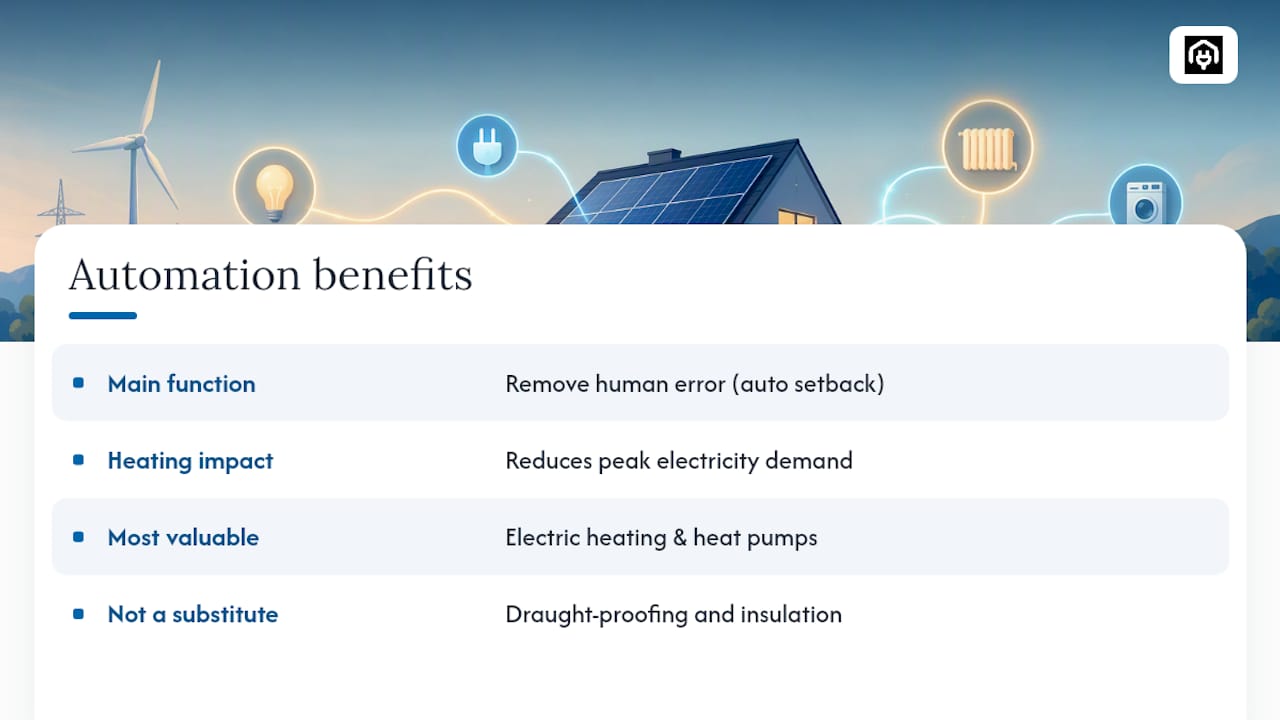
Smart heating controls, occupancy-based lighting, and app-controlled plug sockets all aim to remove the human error that wastes electricity, namely forgetting to turn things off. A smart thermostat that learns your household’s schedule and applies setback automatically during empty hours removes the guesswork that a manual timer often gets wrong.
The genuine value shows up most clearly in heating. Trials involving advanced controls and machine learning have demonstrated real reductions in peak electricity demand by spreading heating loads more intelligently across the day rather than letting every system fire up at the same peak-demand moment. That matters more for electrically heated homes and heat pump owners than for standard gas central heating, since electricity peak pricing bites harder than gas.
Automation isn’t a substitute for the fabric-first basics of draught-proofing and insulation. It works best layered on top of a well-insulated home with efficient appliances already in place, amplifying savings that already exist rather than creating them from nothing.
Why heating and cooling system maintenance still matters
A boiler, heat pump, or air conditioning unit that hasn’t been serviced in years typically works harder than it should to deliver the same result, and that inefficiency shows up directly in energy bills. For heat pumps specifically, correct commissioning, calibrated weather compensation, and a proper handover to the resident are critical to whether the system delivers its intended savings; a poorly commissioned system can underperform badly even with the right hardware installed.
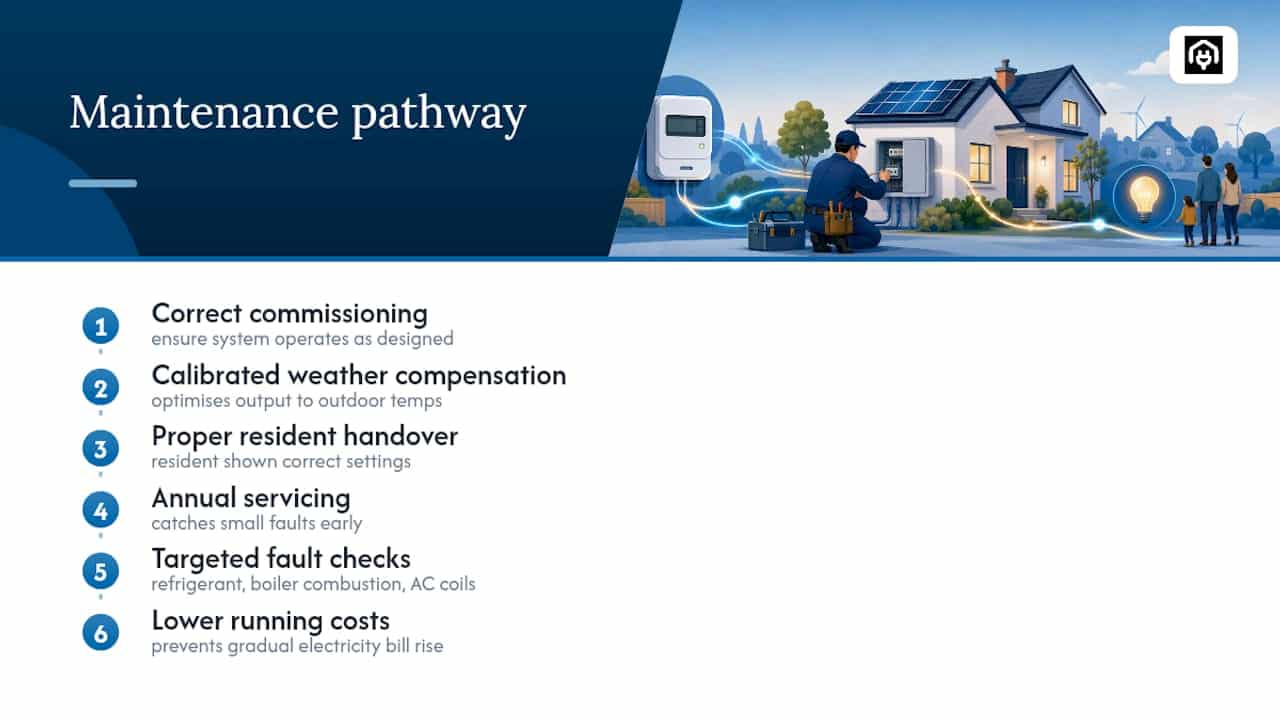
Annual servicing catches the small faults that quietly increase running costs: a heat pump refrigerant charge slightly out, a boiler burning inefficiently, or air conditioning coils clogged with dust that force the compressor to run longer for the same cooling effect. None of these faults are dramatic on their own, but left unchecked over several years they add up to a meaningfully higher electricity bill than a well-maintained system would produce.
An honest note on what actually moves the needle
The government’s shift from SAP to the Home Energy Model reflects something that’s been true in practice for years: a building’s real energy performance depends on the interaction of fabric, systems, and behaviour, not any single fix in isolation. That’s exactly why this list mixes free habit changes with small upgrades rather than pushing one silver bullet.
Households chasing the biggest single win often overlook the compounding effect of several small, free changes made consistently. A full washing machine load and a properly lagged cylinder will rarely make headlines, but together with an honest look at your EPC recommendations, they usually deliver better short-term value than waiting for a major retrofit you can’t yet afford.
— Danny
Get a tailored plan instead of guessing which upgrade pays off
The ten tips above cost nothing beyond a bit of discipline, but knowing which structural upgrade to prioritise next, loft insulation, cylinder lagging, or heating controls, is harder to judge without proper figures. A Domestic Energy Performance Certificate gives you a ranked list of recommendations specific to your property, complete with indicative costs and estimated annual savings, rather than generic advice that may not suit your home’s construction or heating system.
If you’re planning renovation work, extending a property, or need figures to support a mortgage or planning application, a SAP calculation provides the detailed energy performance modelling that lenders, planners, and installers actually rely on. Homeenergymodel produces both, giving landlords, homeowners, and buyers a clear, evidence-based starting point rather than a generic checklist. Request a quote for a Domestic EPC or SAP calculation to find out which upgrades will genuinely move your bill.
Sources
FAQ
What are the 10 best ways to save electricity at home?
The highest-impact actions are air-drying clothes, cutting hot water waste, switching off standby devices, using LEDs, running full appliance loads at lower temperatures, maintaining your fridge, draught-proofing, adjusting thermostat and heating controls, and using smart meter data to spot better tariffs. Combined, these behavioural and low-cost changes typically deliver the biggest reduction for the least effort.
How much can I actually save by doing these tips?
Savings vary by household, but combining behavioural changes with small upgrades like a cylinder jacket or LED swap consistently reduces electricity use more than any single fix alone. An EPC gives property-specific estimated savings for each recommended upgrade, which is far more reliable than a generic household average.
Do smart meters actually help reduce electricity bills?
Smart meters themselves don’t save electricity, but the in-home display shows real-time usage in pounds and pence, which helps households spot waste and consider time-of-use tariffs. Households with electric vehicles or heat pumps benefit most, since shifting charging or heating to off-peak hours can meaningfully cut costs.
Is it worth getting an EPC just to save on electricity?
Yes, because an EPC ranks recommended upgrades by cost and estimated saving, rather than leaving you to guess which improvement pays back fastest. Homeenergymodel’s Domestic EPC service provides this tailored breakdown for your specific property.
What is the single easiest change to reduce power consumption at home?
Switching off standby devices and unplugging idle chargers is the easiest change, since it costs nothing and takes seconds once it becomes a habit. Pairing it with a full LED lighting swap delivers a fast, low-effort combination that most households notice within one or two billing cycles.