
A geothermal system uses the stable heat stored beneath the ground to warm a building, provide hot water, and cool it in summer, all through a ground-source heat pump connected to a buried loop or well. It runs far more efficiently than a gas boiler because it moves existing heat rather than generating it from fuel, but it demands a higher upfront investment and enough land or drilling access to install the ground loop.
TL;DR:
- Installing a vertical borehole system is significantly more expensive than trenching, but it provides more stable temperatures suitable for smaller plots.
- The typical lifespan of the heat pump units is around 25 years, while the ground array can last 50 to 100 years, offering long-term durability.
- Geothermal systems have a coefficient of performance between 3.2 and 4.2, delivering three to four units of heat per unit of electricity in ideal conditions.
- A proper property assessment, including heat loss and ground conditions, is essential to determine system size, performance, and payback potential accurately.
- Geothermal is best suited for well-insulated homes with outdoor space; it is less practical for small urban terraces or short-term homeowners.
Table of Contents
- How does a geothermal system work?
- What types of geothermal system exist?
- What does installing a geothermal system involve?
- How efficient is a geothermal system, and how long does it last?
- How much does a geothermal system cost, and does it pay back?
- What are the benefits and drawbacks of geothermal heating and cooling?
- Where does geothermal heating suit UK homes and policy?
- What should you do before commissioning a geothermal system?
- Is geothermal heating actually the future, or just the expensive option?
- Get feasibility right before you commit to geothermal
- Sources
- FAQ
How does a geothermal system work?
A geothermal system, more precisely called a ground-source heat pump (GSHP), works by borrowing heat that the ground has already stored and boosting it to a temperature useful for a home. Below a couple of metres, ground temperature stays fairly constant year round, typically between 10°C and 15°C in the UK, regardless of whether it is snowing or sweltering outside.
The process starts with a loop of pipe buried in trenches or boreholes, filled with a water and antifreeze mixture. That fluid circulates continuously, absorbing warmth from the surrounding soil or rock as it passes through. Once it reaches the heat pump unit inside the property, the real engineering begins.
Inside the pump, a refrigerant cycle does the heavy lifting:
- Evaporator: the ground loop fluid passes over a heat exchanger and warms a refrigerant, causing it to evaporate into gas.
- Compressor: the gas is compressed, which raises its pressure and temperature significantly.
- Condenser: the hot gas releases its heat into the home’s water or air distribution system, then condenses back to liquid.
- Expansion valve: the liquid refrigerant drops in pressure and cools, ready to absorb more heat from the ground loop again.
That upgraded heat then feeds into radiators, underfloor heating, or a hot-water cylinder, depending on how the property is set up. Underfloor heating suits ground-source systems particularly well because it works efficiently at the lower flow temperatures a heat pump produces, unlike old high-temperature radiator systems designed around boilers.
Geothermal systems can also cool a building by running the same cycle in reverse, pulling heat out of the house and depositing it back into the ground. The Institution of Civil Engineers explains that storing summer heat underground this way actually improves the ground’s temperature going into winter, giving the system a small efficiency boost when the heating season starts again. It is one of the most underappreciated features of geothermal heating and cooling, since most conventional systems treat heating and cooling as entirely separate problems.
What types of geothermal system exist?
Not every geothermal system taps the same depth or the same heat source, and the differences matter enormously for cost, feasibility, and planning.
- Shallow geothermal (ground-source heat pumps): operating from around 10 metres down to 500 metres, shallow systems draw on the fairly steady 10 to 25°C found close to the surface. The British Geological Survey confirms this is the depth range used by domestic and small commercial GSHPs across most of the UK.
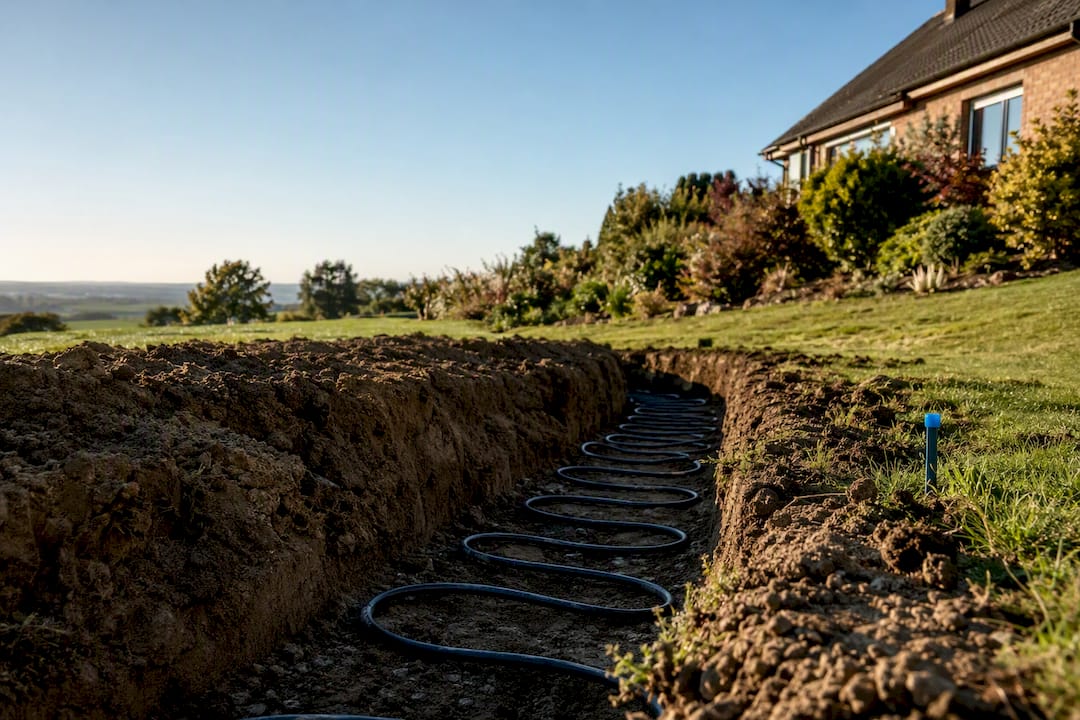
- Horizontal slinky loops: coiled pipe laid in shallow trenches, usually 1 to 2 metres deep. They are cheaper to install than boreholes but need a sizeable garden, and their performance varies more with the seasons.
- Vertical boreholes: drilled straight down, often 50 to 150 metres, these probes cost more to install but deliver more stable year-round temperatures and suit smaller plots, according to Which?’s analysis of ground-source heat pumps.
- Deep geothermal: systems reaching beyond 500 metres, sometimes several kilometres, used for district heating networks or, where temperatures are high enough, electricity generation. Ground temperature can reach roughly 90°C at 3,000 metres and 140°C at 5,000 metres in parts of the UK, per BGS data.
- Closed-loop vs open-loop: closed-loop systems circulate fluid through sealed pipework and never touch groundwater directly, making them the standard choice for UK homes. Open-loop systems pump groundwater itself through a heat exchanger, which needs a productive aquifer and is subject to abstraction licensing, as the BGS notes in its assessment of deep geothermal resources.
- Specialist deep architectures: hot sedimentary aquifers, doublets (a pair of wells, one extracting and one re-injecting), coaxial single-well systems, and engineered geothermal systems (EGS) that fracture rock to improve permeability. DESNZ and Arup’s geothermal review describes these as viable mainly where geology and predevelopment economics align, typically for district-scale heat rather than individual homes.
- Mine-water geothermal: flooded former mine workings hold warm water that can be pumped and used much like an open-loop system, an option gaining traction in former coalfield areas of the UK.
For almost every homeowner reading this, the relevant category is shallow, closed-loop GSHP. Deep geothermal and mine-water schemes matter more to property developers and local authorities planning district heat networks.
What does installing a geothermal system involve?
Installation splits into two distinct jobs: putting a loop or well into the ground, and fitting the heat pump and its plumbing inside the property.
Outside, the ground loop dictates most of the disruption and cost:
- Horizontal slinky loops need trenches across a garden roughly 1.5 times the floor area being heated, ruling them out for small plots.
- Vertical boreholes need drilling rig access but only a small surface footprint once complete.
- Ground investigations, including thermal conductivity testing, determine loop length and depth before any digging starts.
- Planning permission is rarely needed for a domestic closed-loop system, though open-loop and mine-water schemes require Environment Agency abstraction consent.
Inside, the installer fits the heat pump unit, a buffer tank or hot-water cylinder, circulation pumps, and controls that manage flow temperature and defrost cycles. Existing radiators often need upgrading to larger units, or replacing with underfloor heating, because GSHPs work best delivering heat at 35 to 45°C rather than the 60 to 70°C a gas boiler produces.
Pro Tip: Ask any installer for a heat loss survey of the property before quoting loop size. Undersizing the ground array is the single most common cause of disappointing performance, and it is far cheaper to fix on paper than to redrill after installation.
A typical domestic project runs from initial site survey through ground investigation, design, drilling or trenching, and internal fit-out, often taking several weeks once work begins, with lead times for surveys and permits adding more before a spade goes in the ground.
How efficient is a geothermal system, and how long does it last?
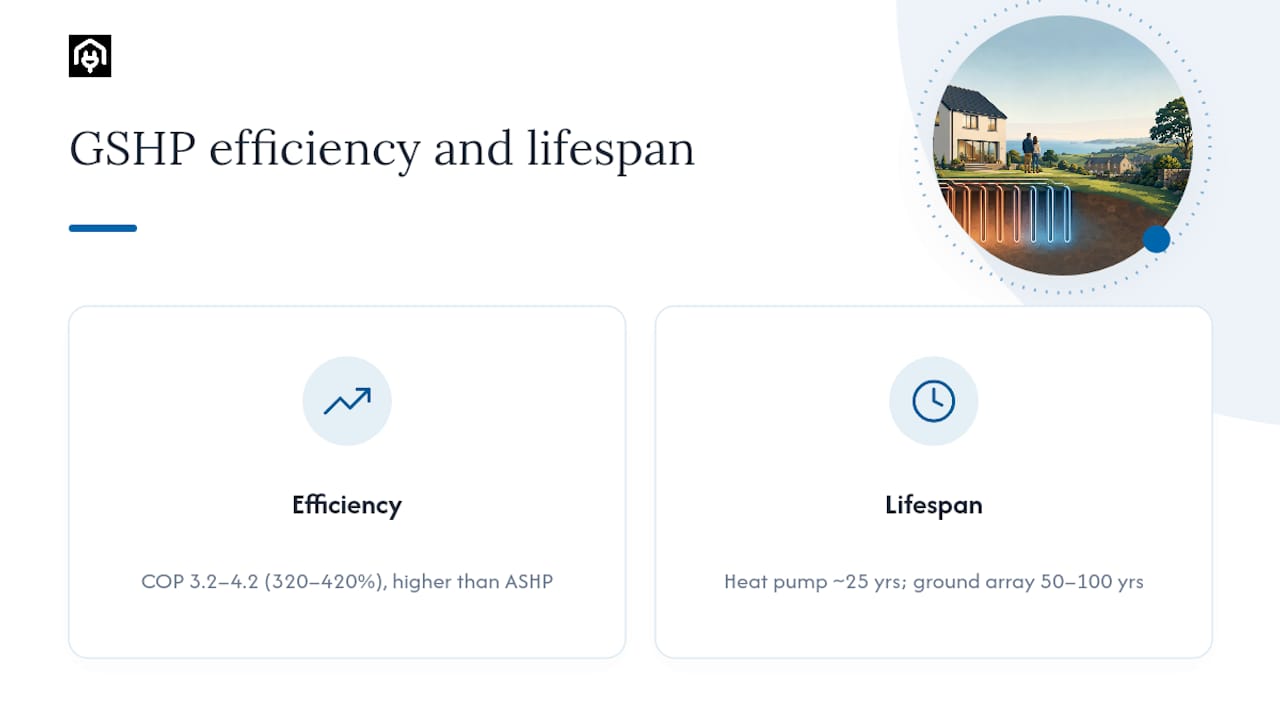
Efficiency is where geothermal systems earn their reputation. Domestic GSHPs typically achieve a coefficient of performance, or COP, of 3.2 to 4.2, meaning 320 to 420% efficiency, according to Which?’s review of the technology. For every unit of electricity a GSHP consumes, it delivers three to four units of heat, since it is moving thermal energy rather than converting fuel into it.
That COP range consistently sits above what air-source heat pumps achieve, because ground temperature stays far steadier through winter than outdoor air temperature does. An air-source unit’s efficiency drops on the coldest days precisely when heating demand peaks; a ground-source system barely notices the difference, since the ground several metres down does not swing with the weather.
Lifespan is the other headline figure. The heat pump unit itself, the compressor and its associated mechanical parts, typically lasts around 25 years before needing replacement. The ground array, whether trenched loop or borehole, can last 50 to 100 years, effectively outliving several generations of the heat pump equipment connected to it. That longevity is a major part of the long-term economic case, since replacing a heat pump every couple of decades is a far smaller outlay than redoing the groundworks.
For a household switching from an oil or LPG boiler, the efficiency gap translates into a meaningful drop in running costs even before accounting for carbon savings, though the exact figure depends heavily on current fuel prices and household heat demand. Readers weighing a ground-source heat pump against alternatives should treat COP as a starting point for comparison, not a guaranteed bill outcome.
How much does a geothermal system cost, and does it pay back?
Groundworks dominate the price of any geothermal installation, and vertical boreholes cost considerably more than horizontal trenching because drilling rigs, casing, and specialist contractors are expensive to mobilise. A slinky loop across a large garden is usually the cheaper route where land allows it.
Several factors determine whether the extra upfront spend pays off over time:
- Fuel comparison: switching from oil, LPG, or electric resistance heating tends to show faster payback than switching from mains gas, since gas remains relatively cheap per unit of heat in most of the UK.
- Heat demand: a well-insulated, newly built property needs a smaller, cheaper system and sees quicker returns than a draughty older home.
- Grants and incentives: government schemes for heat pump installation change periodically, so current eligibility and rates are best confirmed directly with an installer or the relevant scheme administrator.
- System sizing: an oversized system wastes capital; an undersized one struggles on the coldest days and relies on backup heating.
Payback estimates that circulate online are only ever a starting point. DESNZ and Arup’s own modelling work stresses that economic viability depends heavily on long-term electricity price assumptions and the accuracy of the site’s ground survey, and a poor survey can erode expected savings even when the heat pump itself performs at its rated COP. Ongoing maintenance costs stay modest, mainly annual servicing of the heat pump’s mechanical parts, since the buried loop itself needs essentially no upkeep once installed.
What are the benefits and drawbacks of geothermal heating and cooling?
Weighing a geothermal system fairly means looking past the efficiency headline to the practical realities of owning one.
Benefits:
- High efficiency (320 to 420% COP) cuts running costs compared with fossil-fuel heating in most scenarios.
- Low operational carbon, since electricity increasingly comes from a decarbonising grid, unlike gas or oil combustion.
- Combined heating and cooling from one system, useful as UK summers grow warmer.
- A ground array that can outlast the building’s original heating equipment several times over.
Drawbacks:
- Higher capital cost than a gas boiler or even an air-source heat pump, concentrated in the groundworks.
- Land disturbance during trenching, or drilling access requirements for boreholes, which can rule out tight urban plots.
- Open-loop and mine-water systems carry abstraction licensing and, in rare cases, contamination risk if not properly managed, requiring Environment Agency oversight.
- Refrigerant handling at end of life needs professional disposal, since some refrigerants used in heat pumps carry their own environmental impact if released.
Geothermal is generally not the right call for a small terraced house with no garden and no borehole access, or for a household planning to move within a few years, since the capital cost needs time and stable occupancy to pay back.
Where does geothermal heating suit UK homes and policy?
Shallow ground-source heat pumps work across the great majority of UK properties, since the technology depends on stable ground temperature rather than any unusual geology. Deep geothermal is a different story entirely, viable mainly in specific granite areas like Cornwall or in sedimentary basins where naturally higher underground temperatures make district-scale heat or power generation worthwhile.
A few practical points shape what a homeowner or developer can realistically expect:
- The DESNZ and Arup review models shallow geothermal reaching commercial deployment sooner than deep geothermal, which faces a longer path toward 2030 to 2032 due to drilling risk and predevelopment cost.
- The Energy Saving Trust describes shallow GSHPs as an established technology with a developed UK supply chain, in contrast to deep geothermal’s niche status.
- Open-loop and mine-water schemes need Environment Agency abstraction consent before drilling, adding a regulatory step that closed-loop systems skip.
- Geothermal installations feed directly into building energy assessments, since heat pump performance data must be modelled accurately for an EPC or under the incoming Home Energy Model to reflect true running costs and carbon output.
Accurate modelling matters more than most homeowners expect. Get the assumptions wrong, and a property’s certificate can understate or overstate what a geothermal system genuinely delivers.
What should you do before commissioning a geothermal system?
A feasibility survey should always come before any commitment to a geothermal installation, and it needs to answer specific questions rather than a general “is this possible” enquiry.
Ask any installer to confirm:
- Ground conditions and thermal conductivity for the specific plot, not a generic regional estimate.
- Whether the garden or access allows trenching, or whether boreholes are the only realistic option.
- The heat loss figure for the property, since this drives loop sizing and equipment selection.
- Any Environment Agency consent needed if open-loop or mine-water is being considered.
Geothermal installations change a property’s heat demand and delivery profile substantially, which means the building’s energy assessment needs to reflect the new system properly. That is where a Home Energy Model or EPC calculation earns its keep, capturing the heat pump’s real performance rather than defaulting to boiler-era assumptions.
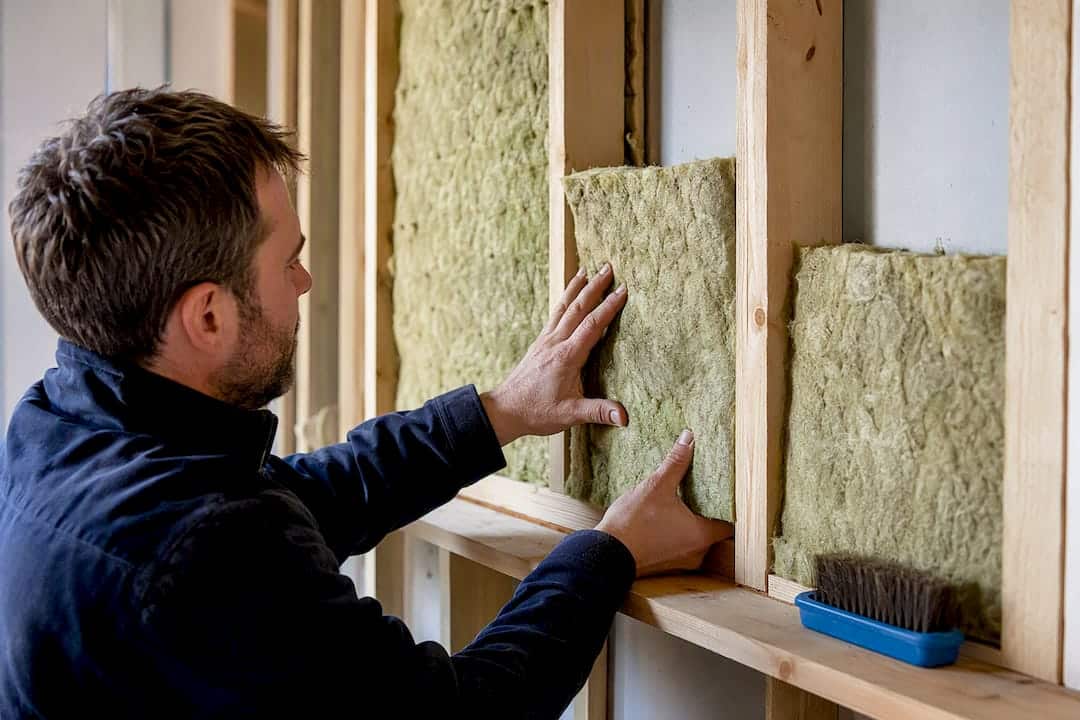
Fabric-first measures, insulation, draught-proofing, glazing, should usually come before or alongside a geothermal decision, since a smaller heat demand means a smaller, cheaper system. Geothermal becomes genuinely worth pursuing once a property’s heat loss is under control and land or drilling access is confirmed.
Is geothermal heating actually the future, or just the expensive option?
Geothermal heating deserves more attention in the UK’s decarbonisation conversation than it currently gets, but it is not a universal answer. For a well-insulated home with garden space or borehole access, a ground-source heat pump is arguably the single best heating technology available today, better winter performance than air-source, and a ground array that will outlive several boilers’ worth of replacements.
I would recommend it to homeowners doing a substantial renovation, and to developers building new stock where groundworks are already planned. I would not recommend it as a bolt-on retrofit for a small urban terrace with no outdoor space. Pair it with solar PV where possible, and get proper Home Energy Model planning done early. That sequencing, fabric first, then sizing, then technology choice, saves more money than any single piece of equipment ever will.
— Danny
Get feasibility right before you commit to geothermal
Groundworks, borehole depth, and loop sizing all hinge on numbers most homeowners cannot generate themselves, which is exactly the gap Homeenergymodel closes. Rather than guessing at payback from a generic online calculator, a proper Home Energy Model assessment models your specific property’s heat demand and shows how a ground-source system would actually perform against the Future Homes Standard.
Before requesting a quote, have your property’s floor area, current heating system, and any existing insulation upgrades ready, since these drive the accuracy of any feasibility figure you receive. If you also need to understand how the system will affect your current or future Energy Performance Certificate, Homeenergymodel’s EPC guidance covers exactly what changes when a heat pump replaces a boiler. Start by requesting a quote for a Home Energy Model report tailored to your property.
Sources
For readers who want to go deeper than this explainer, the British Geological Survey’s geothermal technologies overview sets out UK subsurface temperature data by depth. The DESNZ and Arup geothermal review covers cost modelling and deployment timelines in detail. Which?’s consumer guide explains efficiency and lifespan figures in plain terms, while the Energy Saving Trust offers practical UK installation advice. Readers interested in building system integration more broadly may also find value in this technical guide to building energy efficiency.
- Geothermal technologies — British Geological Survey
- Ground source heat pumps explained — Which?
- Geothermal energy review and cost estimations — DESNZ / Arup (Annex)
- Geothermal energy explained — Institution of Civil Engineers (ICE)
FAQ
What is the downside of geothermal heating?
The main downside is upfront cost, since drilling boreholes or trenching a garden is expensive, and not every property has the land or access needed for installation.
Does the UK have any geothermal energy?
Yes. Shallow ground-source heat pumps are widely used across UK homes, and deep geothermal projects exist in specific areas like Cornwall’s granite, with more sites under development according to BGS assessments.
Is geothermal an HVAC system?
Yes, a ground-source heat pump functions as a heating, ventilation, and cooling system in one unit, since it can both heat and cool a building by reversing its refrigeration cycle.
Is geothermal heating expensive?
Installation costs more upfront than a gas boiler or air-source heat pump, mainly due to groundworks, though running costs are typically lower thanks to a COP of 320 to 420%. Accurate Home Energy Model modelling helps clarify the real cost picture for a specific property before committing.