
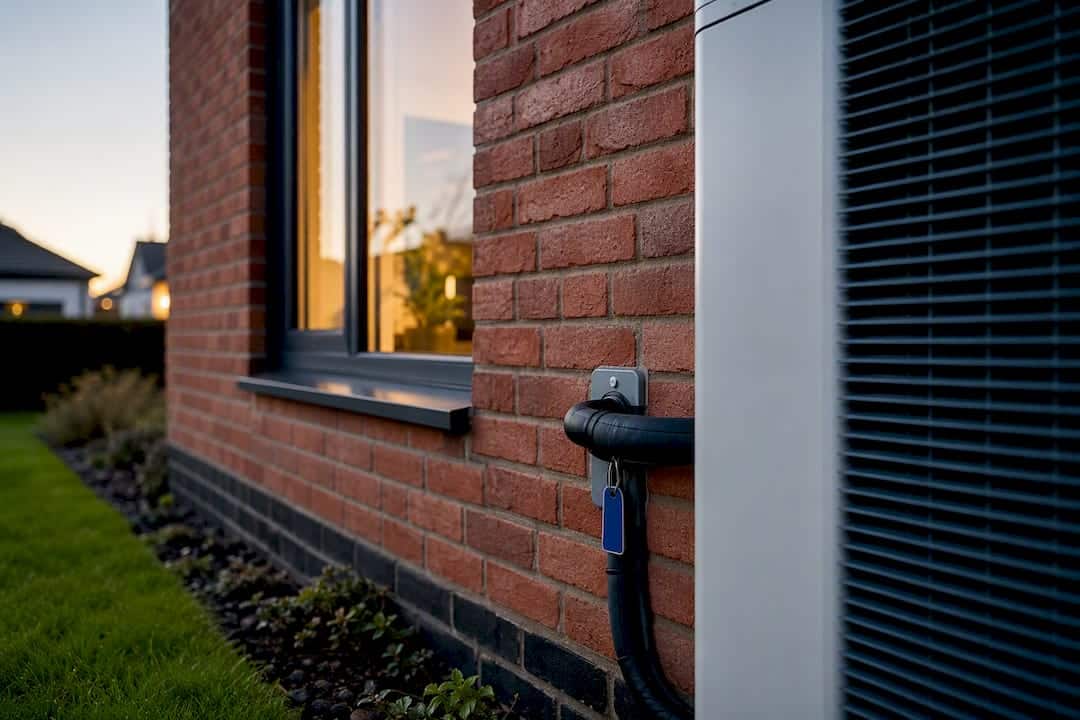
An air source heat pump extracts heat from outdoor air and uses it to provide central heating and hot water for a home. It runs on electricity rather than gas or oil, typically feeding radiators, underfloor heating, or a hot water cylinder. For well-insulated properties, it’s one of the most reliable ways to cut carbon emissions and, in many cases, reduce running costs too.
TL;DR:
- Most homes will need radiator upgrades or better insulation to optimize efficiency, as heat pumps operate best at lower flow temperatures.
- The total installed cost averages around £12,000, but grants like the £7,500 Boiler Upgrade Scheme can significantly reduce net expenses if installed by an MCS-certified installer.
- Proper siting of the outdoor unit is critical for airflow and noise compliance, particularly for properties with limited outdoor space or strict noise restrictions.
- Savings on running costs vary widely, especially for homes switching from oil or LPG, with potential reductions of over 50% depending on installation quality and tariffs.
- Choosing an air-to-water system qualifies for grants and delivers full-house heating and hot water, whereas air-to-air systems are limited to space heating and cooling.
Table of Contents
- What is an air source heat pump at a glance?
- How does an air source heat pump work?
- What types of air source heat pump are there?
- What are the benefits and downsides of air source heat pumps?
- Is an air source heat pump right for my home?
- What does an air source heat pump cost, and what grants are available?
- What does installation and maintenance involve?
- How much can an air source heat pump save on running costs?
- How do I get an air source heat pump installed?
- Why does an air source heat pump matter for your EPC and the Home Energy Model?
- Should you get an air source heat pump now?
- Where can I check grants and technical rules?
- Sources
- FAQ
What is an air source heat pump at a glance?
An air source heat pump (ASHP) pulls heat from the outside air, even in cold weather, and transfers it indoors using a refrigerant cycle. The technology has matured considerably, but the headline numbers still catch homeowners off guard.
- Typical installed cost: around £12,000, though consumer research puts the range at £7,000 to £13,500 depending on property size and extra works
- Boiler Upgrade Scheme grant: commonly £7,500 for eligible homeowners in England and Wales, bringing net cost down significantly
- Efficiency: a Seasonal Coefficient of Performance (SCOP) typically around 3, meaning roughly three units of heat produced per unit of electricity used
- Installer standard: must be MCS-certified to access government grants, and usually registered with a consumer protection scheme such as RECC or HIES
- Space and noise: the outdoor unit needs clear airflow and sits within noise limits, so siting matters as much as sizing
Pro Tip: Ask any installer to show you their MCS certification number before you sign anything. It’s the single fastest way to confirm they can actually deliver grant-eligible work.
How does an air source heat pump work?
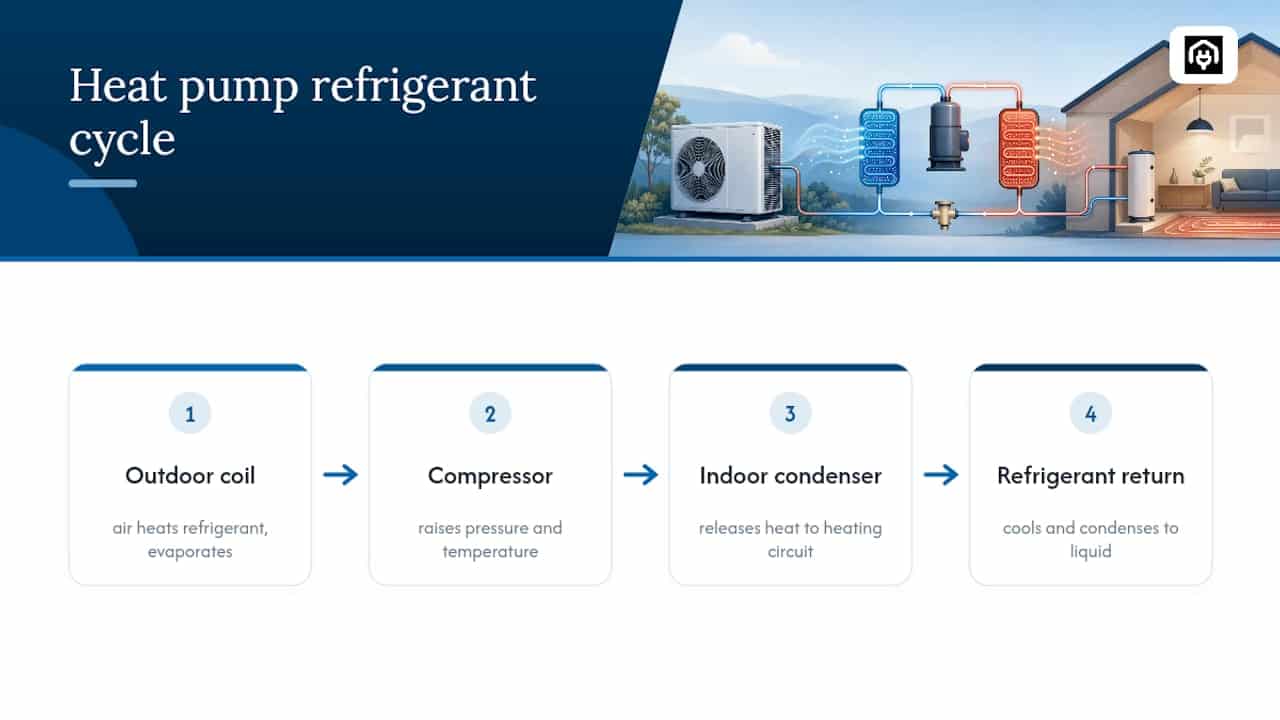
The refrigerant cycle is the heart of the system, and it’s simpler than most people expect. Outdoor air, even at temperatures close to freezing, still holds usable heat energy. A fan draws this air across an outdoor coil containing refrigerant, which absorbs the heat and evaporates into a gas.
That gas passes through a compressor, which raises its pressure and, with it, its temperature. This compressed, hot gas then moves through a condenser inside the home, where it releases heat into the central heating circuit, whether that’s radiators, underfloor pipes, or a hot water cylinder. The refrigerant cools, condenses back into liquid, and cycles round again. Energy Saving Trust describes this as the core mechanism behind every ASHP on the market, regardless of brand or size.
Efficiency here is measured two ways. Coefficient of Performance (COP) is a snapshot figure, showing output versus electricity input under specific test conditions. Seasonal Coefficient of Performance (SCOP) is more useful because it averages performance across a full year, accounting for colder months when the pump works harder. Field data from Expertsure shows modern systems commonly return three to four units of heat for every unit of electricity consumed, though real-world results depend heavily on installation quality and the tariff a household is on.
One detail catches out a lot of homeowners moving from a gas boiler: flow temperature. Gas systems often run at 70°C or higher; heat pumps typically operate at 35°C to 45°C for best efficiency. That lower flow temperature means radiators may need upsizing, or the property may benefit more from underfloor heating, which is naturally suited to gentler, steadier heat output.
What types of air source heat pump are there?
Not every ASHP does the same job, and picking the wrong category is a common and costly mistake.
- Air-to-water: heats water that circulates through radiators, underfloor systems, and a hot water cylinder. This covers whole-house heating and hot water, and it’s the type that usually qualifies for Boiler Upgrade Scheme grants.
- Air-to-air: heats (and often cools) air directly, blown into rooms via a fan coil unit. It’s effective for space heating and summer cooling but doesn’t typically provide domestic hot water, which limits its BUS eligibility.
- Monobloc: all the refrigeration components sit in a single outdoor unit, with only water pipes running into the house. Simpler to install and easier to service.
- Split systems: the compressor sits outside while an indoor unit handles the refrigerant-to-water heat exchange. This can suit properties with limited outdoor space but adds a small indoor footprint.
Distinguishing air-to-water from air-to-air matters because grant eligibility and hot water provision hinge almost entirely on that distinction, not on brand or price point.
What are the benefits and downsides of air source heat pumps?
The trade-offs are real, and pretending otherwise does homeowners no favours.
Benefits:
- High efficiency compared with direct electric heating or oil boilers, particularly when paired with a well-designed system
- Lower carbon emissions than fossil fuel heating, and further reductions when paired with solar panels
- Fewer moving parts than a combustion boiler, generally meaning lower long-term maintenance
- A lifespan often exceeding 20 years with proper servicing
Downsides:
- Higher upfront cost than a like-for-like gas boiler replacement, even after grant funding
- Lower flow temperatures may require radiator upgrades or better insulation to maintain comfort
- The outdoor unit needs space and generates some operational noise, which matters for terraced or tightly packed properties
- Some homeowners dislike the visual impact of an external unit on a wall or in a garden
Two myths deserve correcting. First, ASHPs do work below freezing. Modern units are designed to extract heat even in sub-zero conditions; efficiency drops slightly but the system keeps functioning. Second, a heat pump is not automatically cheaper to run than gas. On a standard variable electricity tariff, savings depend on the property’s insulation, the system’s SCOP, and the price gap between electricity and gas per unit.
Is an air source heat pump right for my home?
Before committing, work through this checklist honestly.
- Check your insulation and EPC rating. Homes with poor insulation lose heat faster than a low-flow-temperature system can comfortably replace, so cavity wall and loft insulation should usually come first.
- Assess your radiators. Older, undersized radiators may need replacing or supplementing, particularly in larger rooms, since heat pumps run cooler than gas boilers.
- Consider underfloor heating where practical. It pairs naturally with the lower flow temperatures ASHPs produce, especially during renovations or extensions.
- Confirm outdoor space and noise limits. The unit needs airflow clearance and must sit within permitted noise thresholds; recent planning updates have eased many restrictions, though listed buildings, conservation areas, and some flats still carry extra conditions worth checking.
- Get an electrical survey. Your consumer unit and supply capacity need assessing before installation, particularly if you’re also adding an EV charger or solar battery.
What does an air source heat pump cost, and what grants are available?
Cost is where most homeowners stall, so the numbers deserve a straight answer. Installed prices sit around £12,000 on average, with Which? reporting a realistic range of £7,000 to £13,500 depending on property size, system type, and whether radiators or pipework need upgrading.
The Boiler Upgrade Scheme grant, typically £7,500 for eligible homeowners in England and Wales, cuts that net cost substantially, but only when installed by an MCS-certified engineer.
- Confirm your installer’s MCS certification and their registration with a consumer protection scheme such as RECC or HIES
- Check devolved-nation schemes separately. Home Energy Scotland and Nest in Wales offer regional grants and loans that sit alongside, or sometimes instead of, national funding
- Ask whether any temporary VAT relief applies at the time of your quote, since these windows shift and dates should always be checked against current guidance
- Request an itemised quote breaking down unit cost, labour, radiator or cylinder upgrades, and electrical work separately, so you can compare installers on a like-for-like basis
Extra works, particularly insulation improvements or radiator swaps, are often the biggest variable in final price, and the biggest driver of how well the system performs afterwards.
What does installation and maintenance involve?
Installation isn’t a same-day job, and setting realistic expectations avoids frustration later.
- Survey. An accredited installer assesses insulation, radiator sizing, outdoor space, and electrical capacity, usually taking a few hours on site.
- Design and quote. The installer sizes the system to your property’s heat loss and confirms whether grant funding applies.
- Installation. Straightforward jobs take two to three days; properties needing radiator upgrades, a new hot water cylinder, or electrical works can stretch to a week or more.
- Commissioning. The installer sets flow temperatures, tests the system, and hands over documentation, including performance specifications you’ll need later.
Once running, expect an annual service, similar in principle to boiler servicing, and warranties commonly ranging from two to ten years depending on manufacturer and installer. Well-maintained systems often last 20 years or more, comparing favourably against the 10 to 15 year typical lifespan of a gas boiler.
How much can an air source heat pump save on running costs?
Savings hinge on three variables working together: the system’s SCOP, your electricity tariff, and what fuel you’re replacing. A property switching from oil or LPG, both relatively expensive per unit of heat, tends to see the strongest savings. Replacing an old electric storage heater setup often shows dramatic improvement too, since ASHPs are far more efficient at converting electricity into usable heat.
- Homes replacing gas heating see more variable results, since gas remains comparatively cheap per unit against standard electricity tariffs, per Ofgem usage data
- Dr Jan Rosenow notes that savings above 50% versus gas are achievable, but only with high-quality installation and a favourable tariff
- Pairing an ASHP with solar panels and a battery can reduce daytime electricity costs further, particularly for hot water heating scheduled around solar generation
A well-sized system in a well-insulated three-bed home, replacing oil or LPG, is where the numbers work hardest in the homeowner’s favour.
How do I get an air source heat pump installed?
Turning interest into action follows a fairly predictable sequence, and skipping steps tends to cost money later.
- Book a survey with an MCS-certified installer to establish heat loss, radiator needs, and siting options.
- Check grant eligibility for the Boiler Upgrade Scheme and any regional schemes before committing to a quote.
- Get at least three written quotes, each itemising unit cost, labour, and any additional works separately.
- Compare expected SCOP figures, not just headline unit cost, since a cheaper system with poor real-world efficiency can cost more over its lifetime.
Ask each installer what SCOP they expect for your specific property, what warranty covers the compressor versus labour, and which consumer protection scheme they’re registered with. Be wary of anyone quoting without a proper survey, or pushing a decision within a single visit.
Pro Tip: If a quote arrives suspiciously low with no mention of radiator sizing or heat loss calculations, that’s a red flag, not a bargain.
Why does an air source heat pump matter for your EPC and the Home Energy Model?
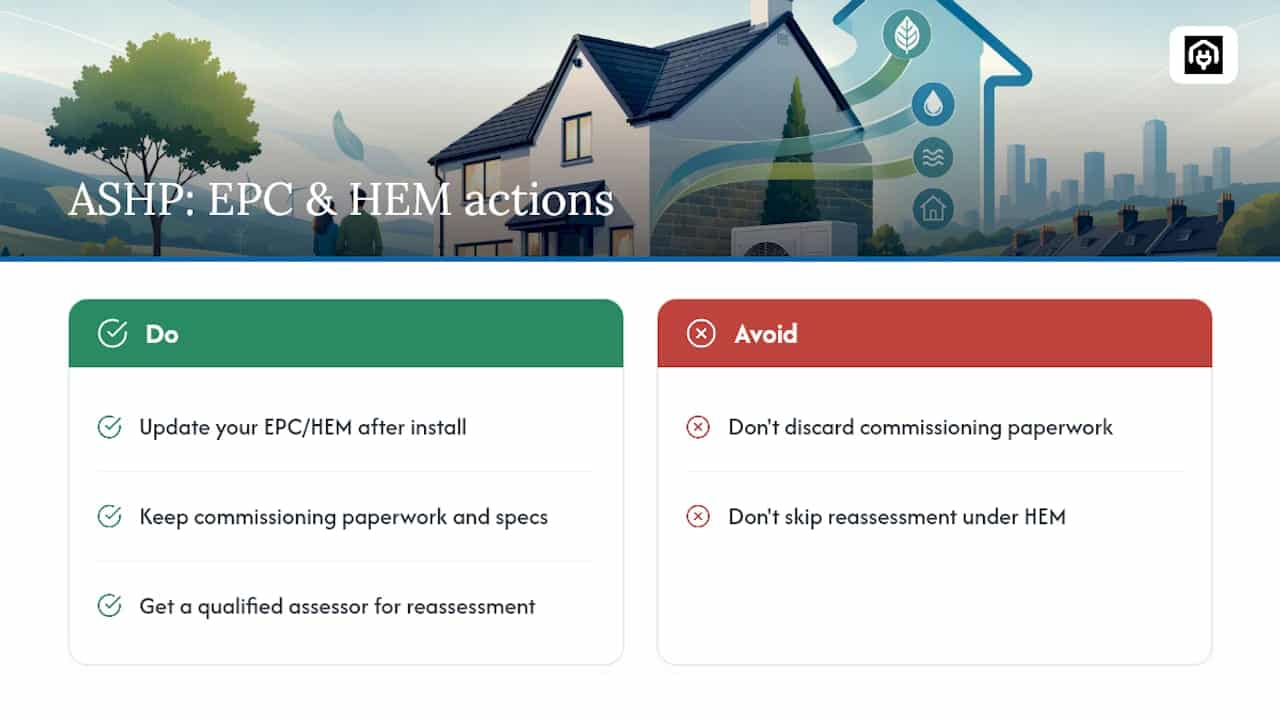
Installing an ASHP can improve your Energy Performance Certificate rating, since it typically scores better than fossil fuel heating on the carbon and efficiency metrics EPCs measure. Updating your EPC or HEM assessment after installation captures that improvement and helps demonstrate compliance as standards tighten.
The Home Energy Model, replacing SAP from 2025, models energy performance with greater accuracy than its predecessor, particularly for low-carbon heating systems like heat pumps. Keep your installer’s commissioning paperwork and technical specifications safely. You’ll need them when a qualified assessor reassesses your property under the new methodology.
Should you get an air source heat pump now?
The strongest candidates are homes currently on oil or LPG, with decent insulation already in place, and owners planning to stay put for a decade or more. If your loft and walls aren’t insulated, fix that first. Use an MCS-certified installer, claim the Boiler Upgrade Scheme grant where eligible, and update your EPC or HEM record once the system is commissioned.
Where can I check grants and technical rules?
For grant eligibility, consult gov.uk’s Boiler Upgrade Scheme guidance and installer standards, alongside consumer guidance from Which?.
Homeowners weighing up whether their property qualifies for grant funding, or wanting to understand how a heat pump installation will affect their energy assessment, can review 7 types of Home Energy Models for landlords to see how HEM reporting applies to different property types, or explore Home Energy Model explained for a fuller breakdown of how the new methodology assesses low-carbon heating.
Sources
- Boiler Upgrade Scheme — GOV.UK
- Gov
- Air source heat pump costs and savings — Which?
- Are heat pumps worth it in the UK? — Expertsure
- Air source heat pumps: costs, savings and benefits — Energy Saving Trust
FAQ
What are the downsides of air source heat pumps?
The main downsides are higher upfront installation cost, the need for radiator or insulation upgrades in older properties, and outdoor unit space and noise considerations. Efficiency also drops slightly in very cold weather, though the system continues working.
What does Martin Lewis say about air source heat pumps?
Martin Lewis has generally advised homeowners to weigh insulation quality and electricity tariff carefully before switching, since savings versus gas heating aren’t guaranteed for every household. The consensus among consumer finance commentators is that heat pumps suit well-insulated homes replacing oil, LPG, or electric heating far more reliably than those on efficient gas systems.
Why is my electric bill so high with an air source heat pump?
High bills usually stem from an undersized system working harder than necessary, poor insulation causing heat loss, or a standard electricity tariff that doesn’t reflect the running pattern of a heat pump. Checking your system’s actual SCOP against its design specification, and reviewing your tariff, are the first steps to diagnosing the issue.
Do you still need a boiler with an air source heat pump?
No, a correctly sized air-to-water heat pump replaces a gas or oil boiler entirely, handling both space heating and hot water. Some hybrid systems retain a boiler for backup during extreme cold, but this isn’t standard for most UK residential installations.