
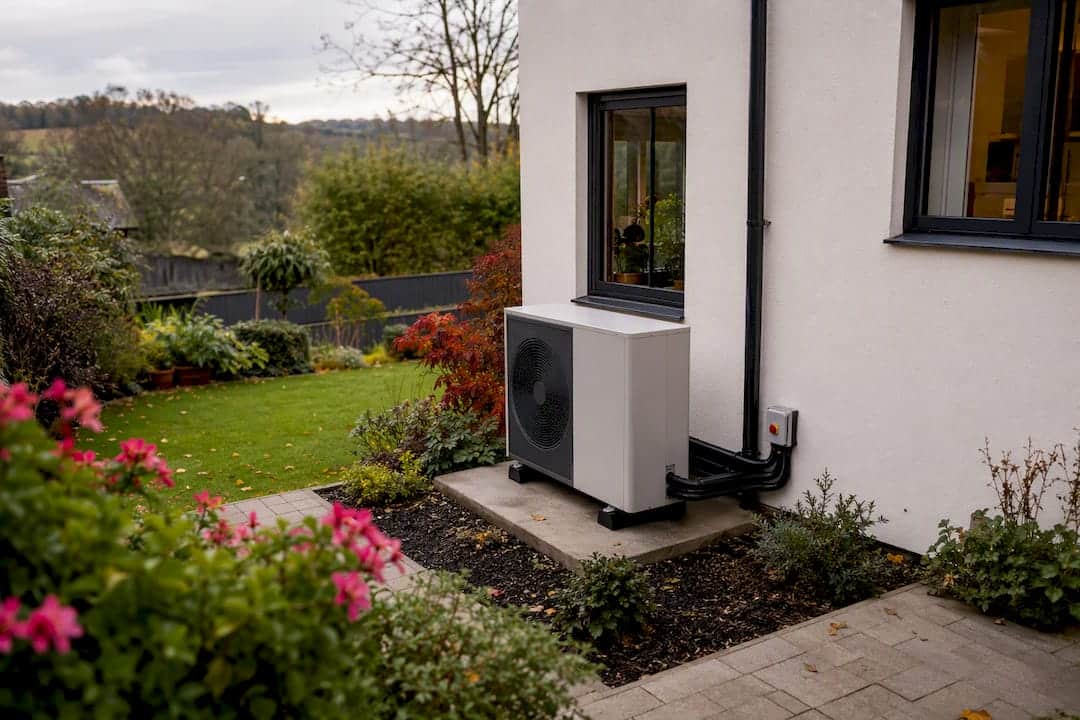
A heat pump is an electric appliance that moves existing heat from the air, ground or water into a building rather than generating new heat by burning fuel. It runs on the same principle as a fridge, just in reverse, and for every unit of electricity it consumes, it typically delivers three to four units of usable heat.
Three things matter most before going further:
- Typical efficiency: most systems return an SCOP of 3 to 4, meaning a well-installed heat pump produces several times more heat energy than the electrical energy it uses.
- When the sums work: total cost of ownership typically reaches parity with an 85% efficient gas boiler once SCOP hits around 3.3, and the right electricity tariff shifts that balance further in your favour.
- A quick suitability check: insulation standard, radiator sizing and available outdoor space all determine whether a property is ready.
The sensible next step is a proper suitability survey rather than a guess based on a neighbour’s system or a brochure figure.
Key Takeaways
A heat pump moves three to four units of heat per unit of electricity used, and reaching SCOP 3.3 or higher is what makes it cheaper to run than a gas boiler over its lifetime.
| Point | Details |
|---|---|
| It moves heat, not fuel | A heat pump extracts existing heat from air, ground or water using a refrigeration cycle, rather than burning gas or oil. |
| SCOP is the number that matters | UK systems average an SCOP near 3.9, well above the 3.3 parity point against gas boilers. |
| Preparation drives performance | Insulation, radiator resizing and lower flow temperatures are what separate a high-SCOP system from a disappointing one. |
| Tariffs change the maths | Time-of-use or heat-pump-specific tariffs can cut running costs by 19% to 21% against flat-rate pricing. |
| Certification and paperwork protect you | Use an MCS-certified installer and keep commissioning records for future EPC or Home Energy Model checks. |
Table of Contents
- What is a heat pump and how does it work in practice?
- What types of heat pumps are available?
- How efficient is a heat pump really?
- How much does a heat pump cost to install and run?
- Is my property suitable for a heat pump?
- Do I need planning permission for a heat pump?
- What should you ask an installer before booking a survey?
- How does a heat pump affect your EPC or Home Energy Model rating?
- How often does a heat pump need servicing, and how long does it last?
- What are the biggest myths about heat pumps?
- How do heat pumps compare with gas boilers and electric heaters?
- Why a proper assessment matters before you commit
- Frequently asked questions
- Sources
What is a heat pump and how does it work in practice?
A heat pump works through a four-stage refrigeration cycle, the same loop that keeps a fridge cold and a summer air conditioner cool, just run to push heat into a building instead of out of it.
- Evaporation – a refrigerant fluid, kept at low pressure, absorbs low-grade heat from the outside air, the ground or a body of water. Even air at 0°C carries enough thermal energy to warm the refrigerant and turn it into a gas.
- Compression – an electric compressor squeezes that gas, and compressing a gas raises its temperature sharply. This is the step that actually consumes the electricity.
- Condensation – the now hot, high-pressure gas passes through a heat exchanger, releasing its heat into the building’s water or air circuit, warming radiators, underfloor pipes or a hot water cylinder. The refrigerant condenses back into a liquid as it gives up that heat.
- Expansion – the liquid passes through an expansion valve, its pressure drops, its temperature falls, and the cycle starts again.
The International Energy Agency’s technical breakdown describes this same evaporator, compressor, condenser and expansion valve sequence as the mechanical heart of every heat pump, regardless of size or source.
Pro Tip: Think of it as running your fridge backwards. A fridge pulls heat out of your food and dumps it into your kitchen through the coils at the back. A heat pump pulls heat out of the garden air and dumps it into your living room.
The output side of that cycle is where COP and SCOP come in. COP (coefficient of performance) is a snapshot figure, heat delivered against electricity used at one moment. SCOP (seasonal COP) averages that ratio across a full year, including cold January mornings and mild October afternoons, and typically lands between 3.0 and 4.0 for a properly specified UK installation.
What types of heat pumps are available?
The technology splits into four broad categories, and the right one depends heavily on the property, the plot, and the budget.
- Air-source heat pumps draw heat from outdoor air using an external unit similar in size to an air conditioning box. They suit most UK homes, terraced, semi-detached or detached, because they need only a small patch of external wall or garden space. Air-source systems are the most commonly fitted type and generally the cheapest to install.
- Ground-source heat pumps extract heat from buried pipework, either shallow trenches or deep boreholes. They deliver more stable performance through winter because ground temperature barely fluctuates, but a ground-source installation needs significant land or a drilling rig, which pushes up cost and disruption.
- Water-source heat pumps draw from a nearby river, lake or borehole and suit rural or waterside properties with the right access rights. They are less common but can be highly efficient where the resource exists.
- Air-to-air and hybrid systems either heat air directly through a fan coil, useful for open-plan or commercial spaces, or pair a heat pump with an existing gas boiler, letting the boiler cover the coldest peaks while the heat pump does most of the seasonal work.
Terraced and semi-detached homes almost always favour air-source. Detached properties with land, or commercial sites with room for boreholes, can justify ground-source. Hybrid setups often make sense for older, harder-to-insulate buildings mid-retrofit.
How efficient is a heat pump really?
COP tells you the efficiency at a single point in time; SCOP tells you what actually happens across a UK heating season, and it’s the number that determines your annual running cost. A heat pump quoted at COP 4.5 on a mild autumn afternoon might only average SCOP 3.2 over the year once frosty nights are factored in.
Real-world figures back this up: the UK’s Heat Pump Monitor project has tracked an average SCOP of 3.9 across live installations, a healthy number that beats the pessimistic estimates often quoted online.
What actually moves that number:
-
Flow temperature – the lower the water temperature sent to radiators or underfloor pipes, the easier the compressor has to work, and the higher the SCOP.
-
Radiator sizing – undersized radiators force the system to run at higher flow temperatures to compensate, which erodes efficiency.
-
Insulation standard – a well-insulated property needs less heat overall, so the heat pump spends more time working gently rather than straining at peak demand.
-
Tariff structure – a time-of-use or heat-pump-specific tariff, where cheaper overnight electricity powers thermal storage or pre-heating, can cut running costs by around 19% to 21% compared with a flat-rate tariff.
Pro Tip: Ask your installer to model the system at a 45°C flow temperature rather than 55°C or 60°C. Resizing a handful of radiators to allow that lower flow temperature is often the single biggest lever on lifetime SCOP.
How much does a heat pump cost to install and run?
Installation costs vary by system type and property size, but air-source units generally sit at the lower end of the market, with ground-source systems costing considerably more once drilling or trenching is included, reflecting the extra groundworks rather than the heat pump unit itself.
The figure that matters more than the sticker price is total cost of ownership. Policy modelling shows that a heat pump reaches lifetime cost parity with an 85% efficient gas boiler once it achieves an SCOP of around 3.3 under standard electricity pricing, a threshold that most well-installed systems clear comfortably given the UK average sits near 3.9.
Carbon Brief’s household-level analysis puts this in pounds and pence: a system running at SCOP 3.9 can save a typical home somewhere between £130 and £200 a year on energy bills compared with gas heating, alongside a carbon emissions cut of roughly 85%.
Grants and incentive schemes shift the upfront calculation further. Worth checking:
- Current scheme uptake and eligibility data through the Boiler Upgrade Scheme statistics.
- Homeenergymodel’s guide to government energy grants for a practical breakdown of what’s currently on offer.
- Broader context on where heat pumps sit among other low-carbon options through renewable heating types for UK homes.
Is my property suitable for a heat pump?
Suitability comes down to four checks, including ventilation and indoor air quality, and getting them right before installation is what separates a system that hits SCOP 3.9 from one that limps along at 2.5. For detailed guidance, see our step by step air quality assessment for homes.
- Insulation standard – loft and cavity wall insulation reduce the total heat the property needs, which lowers the demand a heat pump must meet on the coldest days.
- Draught proofing – gaps around doors, windows and floorboards let warmth escape faster than a heat pump, running at a gentler pace than a gas boiler, can replace it.
- Existing heat distribution – older radiators sized for a 70°C boiler flow temperature often need resizing, or replacing with underfloor heating, to work efficiently at the 35°C to 45°C flows a heat pump prefers.
- Available space – air-source units need external wall or ground space with airflow clearance; ground-source needs a garden, field or borehole access.
Government guidance is consistent on this point: verify insulation and radiator sizing before installation, and treat energy-efficiency upgrades as part of the project rather than an optional extra.
Pro Tip: A proper site survey should include a room-by-room heat loss calculation, not just a look at the boiler cupboard. Insist on it before signing anything.
Do I need planning permission for a heat pump?
Most domestic air-source installations in the UK fall under permitted development, meaning no planning application is needed, though listed buildings, conservation areas and certain siting distances from a boundary can trigger exceptions worth checking locally before ordering equipment.
Noise is the other practical hurdle. Modern air-source units typically run at a low hum, but siting still matters. Keep the outdoor unit away from a neighbour’s bedroom wall and avoid mounting it directly beside a boundary fence where sound reflects.
Certification matters as much as siting. Installers should hold MCS accreditation or equivalent, which is often the qualifying condition for grant schemes and gives you documented proof of a competent installation for building control and future EPC assessments.
What should you ask an installer before booking a survey?
A worthwhile installer conversation covers specifics, not just a headline price.
- What SCOP do they estimate for your property, and on what flow temperature is that estimate based?
- What warranty applies to the compressor and the wider system, and who provides ongoing servicing?
- Who carries out commissioning, and will you receive commissioning documentation?
A proper survey should include a full heat loss calculation, a check of every radiator against the proposed flow temperature, an assessment of siting options for the outdoor unit or ground loop, and a realistic yield estimate rather than a rounded-up guess.
- Compare quotes on identical assumptions: same flow temperature, same radiator scope, same warranty length.
- Treat an unusually low quote with caution if it skips the heat loss calculation. Homeenergymodel’s sizing guide explains why undersizing is the most common and costly installation mistake.
How does a heat pump affect your EPC or Home Energy Model rating?
A heat pump’s declared efficiency, and the flow temperature it’s set to run at, feed directly into how an assessor models a property’s energy performance. Get those inputs wrong on paperwork and the resulting rating undersells what the system actually delivers.
- Assessors need accurate system details, not estimates, to reflect a heat pump correctly in either an EPC or a Home Energy Model assessment.
- Homeenergymodel’s guide to how heat pumps interact with UK standards covers the regulatory side in more depth for landlords and developers.
- Keep commissioning certificates, warranty documents and installer paperwork on file. Future assessments and compliance checks will ask for exactly this evidence.
How often does a heat pump need servicing, and how long does it last?
A heat pump needs considerably less hands-on maintenance than a gas boiler, but “low maintenance” doesn’t mean “no maintenance.” An annual service check, typically covering refrigerant pressure, filter cleaning, and a look at the outdoor unit’s condenser coils for debris or leaf build-up, keeps efficiency close to its rated SCOP rather than letting it drift downward unnoticed.
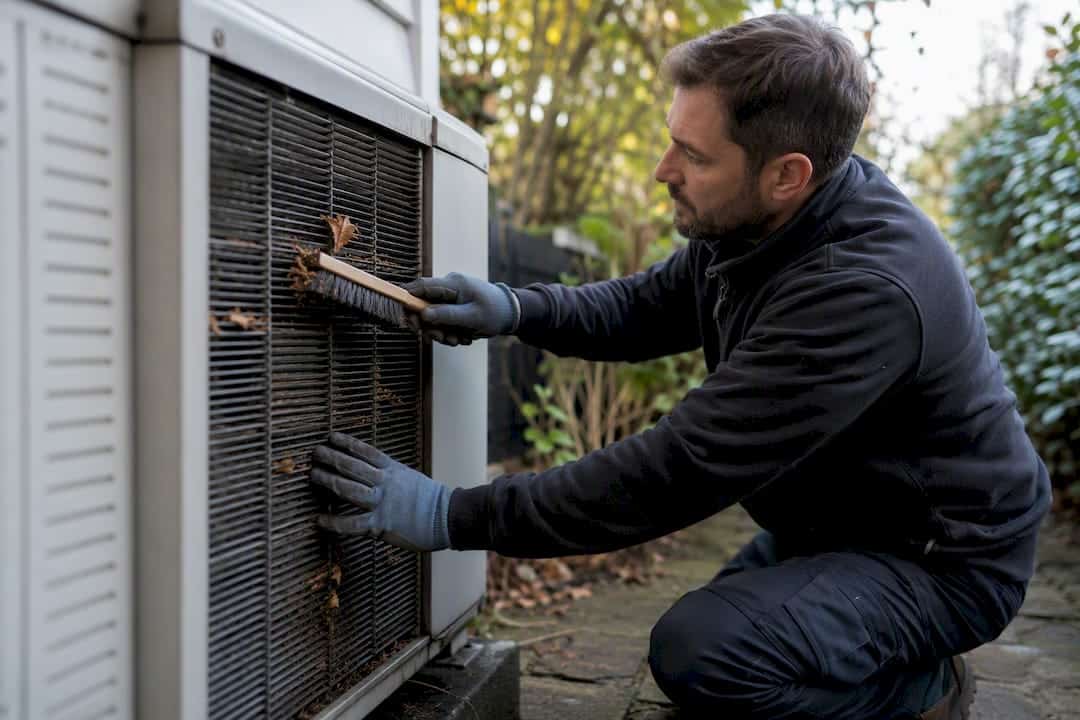
Most manufacturers recommend a professional service once a year, similar in frequency to a boiler service, though the tasks differ. There’s no combustion to check, no flue to inspect, but the refrigerant circuit and electrical components still need periodic attention. Homeowners can handle basic upkeep themselves between visits: keeping the outdoor unit clear of leaves, snow or overgrown shrubs, and checking that airflow around it isn’t obstructed.
Lifespan-wise, a well-maintained air-source heat pump typically runs for 15 to 20 years, broadly comparable to a modern gas boiler, though the compressor, the component doing the heavy lifting in the refrigeration cycle, is usually the part that eventually needs replacing rather than the whole unit. Ground-source systems tend to last longer on the ground loop side, sometimes 25 years or more, because buried pipework degrades far more slowly than above-ground mechanical parts.
Warranty terms are worth scrutinising closely at the point of purchase. Compressor warranties often run five to seven years as standard, with extended cover available. A system serviced annually and kept within its designed flow temperature range is far less likely to need early compressor replacement than one running hot to compensate for undersized radiators.
What are the biggest myths about heat pumps?
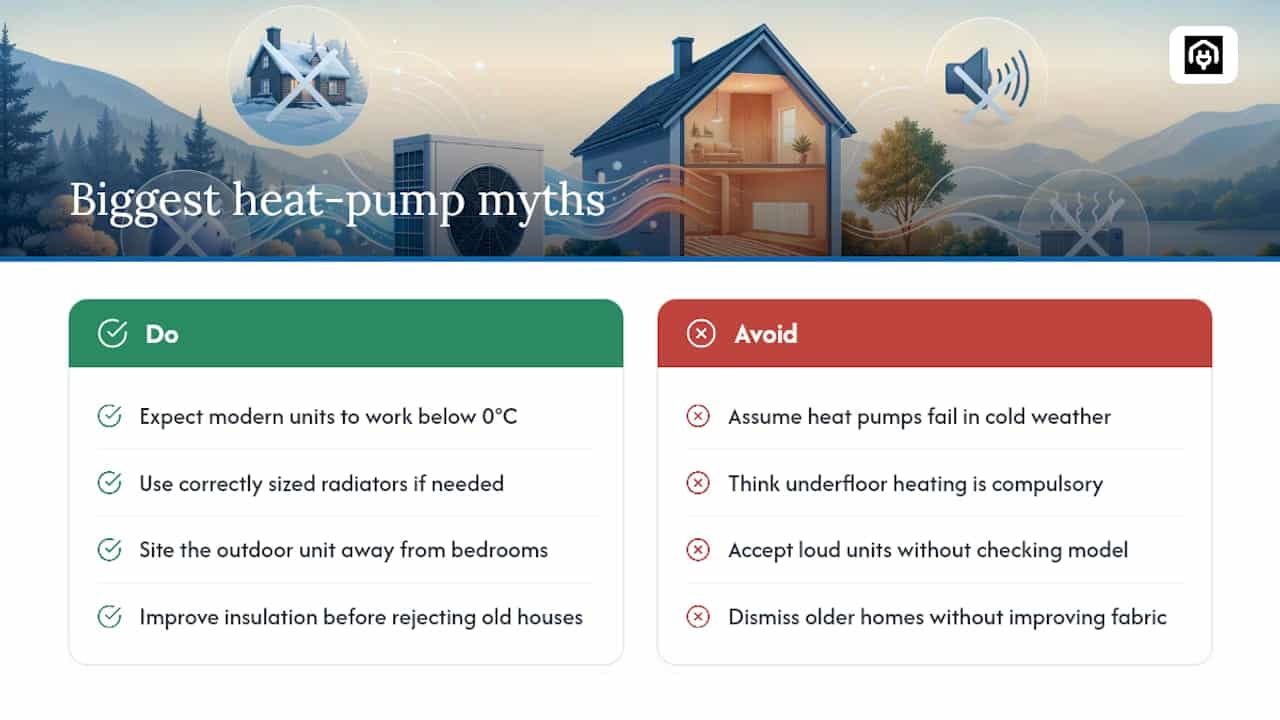
Several persistent claims about heat pumps don’t survive contact with the data.
“Heat pumps don’t work in cold weather.” Modern air-source units continue extracting heat from air even at sub-zero temperatures. Performance dips somewhat in deep winter, but a correctly specified system still keeps a well-insulated home warm through a typical UK cold spell.
“You need underfloor heating for a heat pump to work.” Underfloor heating suits the low flow temperatures heat pumps prefer, but it isn’t compulsory. Many UK installations run successfully on resized radiators, often larger than the originals but still conventional wall-mounted units.
“Heat pumps are too noisy to live with.” Older units earned this reputation, but current air-source models run quietly enough that sensible siting, away from bedroom windows and boundary fences, resolves most concerns before they start.
“Old houses can’t have a heat pump.” Age isn’t the barrier; heat loss is. A Victorian terrace with solid walls and no cavity insulation will struggle with any heating system until the fabric is improved. Once insulation and draught proofing are addressed, older properties can perform just as well as modern builds.
“Heat pumps always cost more to run than gas.” This depends entirely on the SCOP achieved and the tariff used. Systems hitting the SCOP 3.3 parity point or above, particularly on a smart tariff, routinely match or beat gas running costs, especially as electricity and gas price gaps narrow.
How do heat pumps compare with gas boilers and electric heaters?
Set against a gas boiler, a heat pump wins decisively on emissions and holds its own on running cost once it clears that SCOP 3.3 threshold. A modern gas boiler tops out around 85% to 90% efficiency, meaning it wastes 10% to 15% of the fuel burned as unavoidable heat loss. A heat pump, by contrast, delivers 300% to 400% efficiency because it isn’t converting fuel to heat, it’s relocating existing heat, which is why the comparison so often favours electricity despite gas typically costing less per kilowatt hour.
Direct electric heating, panel heaters or immersion-only hot water, sits at the opposite end of the efficiency scale. Electric resistance heating converts electricity to heat at roughly 100% efficiency, respectable on paper but three to four times less efficient in practice than a heat pump doing the same job, because it generates heat rather than moving it. Running costs on direct electric heating are correspondingly steep, which is why it tends to suit only occasional-use spaces like a garden office or an infrequently heated spare room, not whole-house heating.
The practical trade-off is upfront cost against running cost. Gas boilers remain cheaper to install and familiar to most tradespeople. Heat pumps cost more initially and demand a proper suitability check, but they cut emissions by around 85% and, once installed correctly, tend to win the lifetime cost argument as gas prices and carbon costs continue their long-term trajectory.
Why a proper assessment matters before you commit
Ask most property owners what changed their view of heat pumps, and it usually isn’t the technology, it’s the survey. A heat loss calculation that flags three undersized radiators, or a flow temperature assumption that was quietly too high, is the difference between a system that performs and one that disappoints.
Decisions built around purchase price alone routinely backfire. Whole-house thinking, insulation, radiator sizing, flow temperature, tariff choice, is what actually determines whether a heat pump delivers on its promised efficiency.
If you’re weighing up a heat pump, commission a proper survey before comparing quotes on price alone. It’s the step that makes every other number in this article mean something for your specific property.
Frequently asked questions
What is a heat pump and how does it work in one sentence?
A heat pump is an electric appliance that extracts heat from outside air, ground or water and moves it indoors through a refrigeration cycle, rather than generating heat by burning fuel.
How does a heat pump function on a cold winter day?
It still extracts heat from outdoor air even below freezing, though its coefficient of performance dips slightly, an efficiently sized system with correctly set flow temperatures still keeps a well-insulated home comfortable.
What is a heat pump used for beyond space heating?
Alongside heating rooms, most systems also supply domestic hot water, and some air-to-air models double as summer cooling, functioning much like a reversible air conditioner.
Are heat pumps compatible with existing radiators?
Often yes, provided the radiators are resized or upgraded to suit the lower flow temperatures a heat pump prefers. A sizing check before installation avoids under-delivering.
Does installing a heat pump require planning permission?
Most domestic installations fall under permitted development in the UK, though listed buildings, conservation areas and boundary distance rules can create exceptions worth checking beforehand.
How do I know if my property is a good fit?
Check insulation standard, existing radiator sizing, and available outdoor space, then commission a proper site survey with a full heat loss calculation before comparing installer quotes.
Sources
- Gov
- Factcheck: What it really costs to heat a home in the UK with a heat pump — Carbon Brief
- iScience (policy modelling paper on heat pumps and TCO) — DOI link
- How a heat pump works — The Future of Heat Pumps (IEA)