
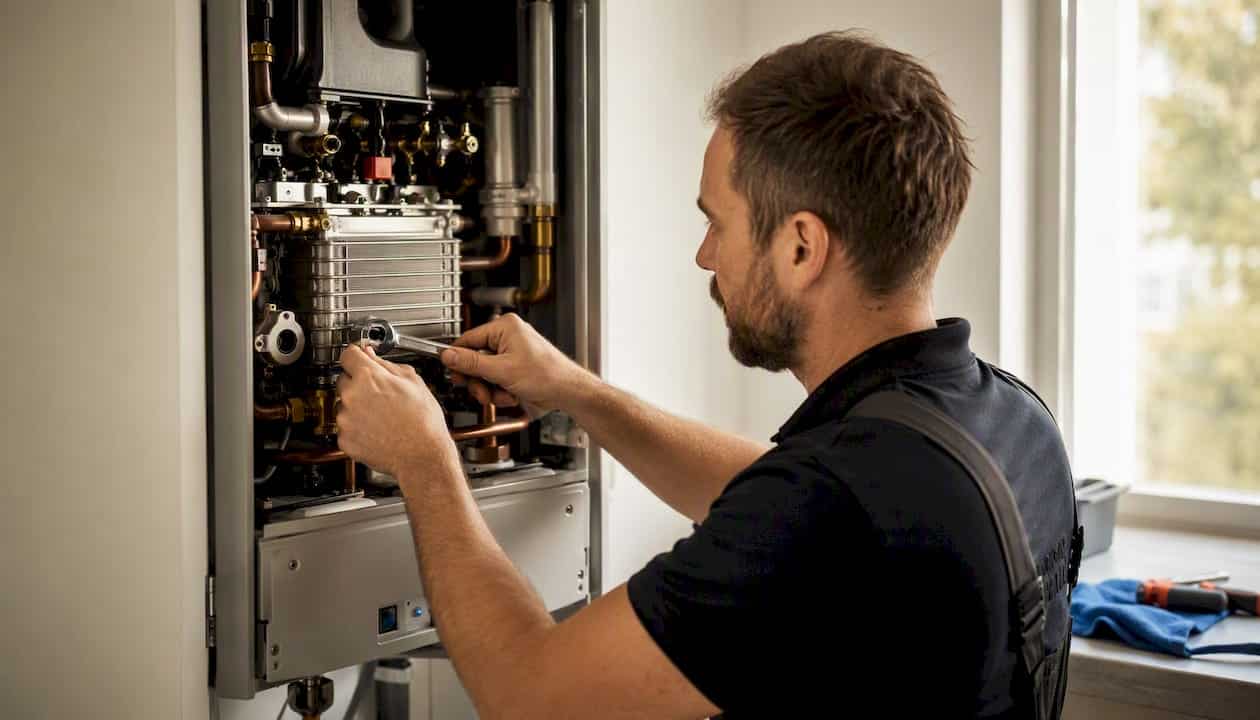
A heat exchanger transfers thermal energy between two fluids without allowing them to mix. In a combi boiler, combustion gases pass heat through a metal wall to the domestic water circuit; in a mechanical ventilation with heat recovery (MVHR) unit, warm stale air from inside the property transfers its heat to incoming fresh air before being expelled. The device appears in almost every heating, cooling and ventilation system in UK buildings, yet its role is rarely explained clearly.
Key takeaways
Heat exchangers transfer thermal energy between two fluid circuits without mixing them, and their specification, condition and material choice directly influence the energy performance of UK homes and buildings.
| Point | Details |
|---|---|
| Core function | Transfers heat between two fluids without mixing, keeping circuits chemically separate. |
| Condensing efficiency | Condensing heat exchangers reduce flue-gas temperatures to as low as ~50°C, recovering latent heat that non-condensing units waste. |
| Maintenance priority | Annual cleaning, magnetic filter servicing and water-quality checks preserve transfer efficiency and prevent premature failure. |
| Safety rule | Suspect a fault? Switch off, ventilate, and call a Gas Safe registered engineer before restarting any combustion appliance. |
| HEM/EPC relevance | Correct specification and documented component choices support better modelled outcomes under the Home Energy Model. |
Table of Contents
- What do heat exchangers do, and how do they work?
- What types of heat exchangers are there?
- Where are heat exchangers used in practice?
- Why do condensing boilers have a different heat exchanger?
- How can you tell if a heat exchanger is failing?
- How should heat exchangers be maintained and replaced?
- What are the advantages and limitations of heat exchangers?
- How do heat exchangers affect UK home energy ratings?
- An editorial perspective on heat exchangers and UK energy performance
- Sources
What do heat exchangers do, and how do they work?
Heat exchangers move energy, not fluid. Two separate fluid streams pass on either side of a thermally conductive surface, and heat travels from the hotter stream to the cooler one through conduction and convection. No mixing occurs, which is precisely the point: the two circuits remain chemically and physically separate while energy transfers between them.
The physics relies on two mechanisms working together. Conduction moves heat through the solid wall separating the fluids. Convection carries heat from the bulk of each fluid to that wall surface. The rate of transfer depends on three variables: the temperature difference between the two streams, the surface area available for transfer, and the thermal conductivity of the wall material.
Flow arrangement has a significant effect on performance:
- Counterflow: the two fluids travel in opposite directions. The hot fluid meets the coolest part of the cold fluid last, maintaining a temperature gradient along the full length of the exchanger. This arrangement typically achieves the highest thermal efficiency.
- Parallel flow: both fluids enter at the same end and travel in the same direction. The temperature difference narrows quickly, limiting how much heat can be extracted.
- Crossflow: the fluids travel at right angles to each other, common in air-handling units and radiator cores. Performance sits between counterflow and parallel flow for most applications.
Pro Tip: Cleaning the fin surfaces on an air-side heat exchanger, or fitting a magnetic filter on a heating circuit, can restore meaningful heat-transfer performance without any component replacement. Fouled surfaces and suspended magnetite particles both act as insulation.
What types of heat exchangers are there?
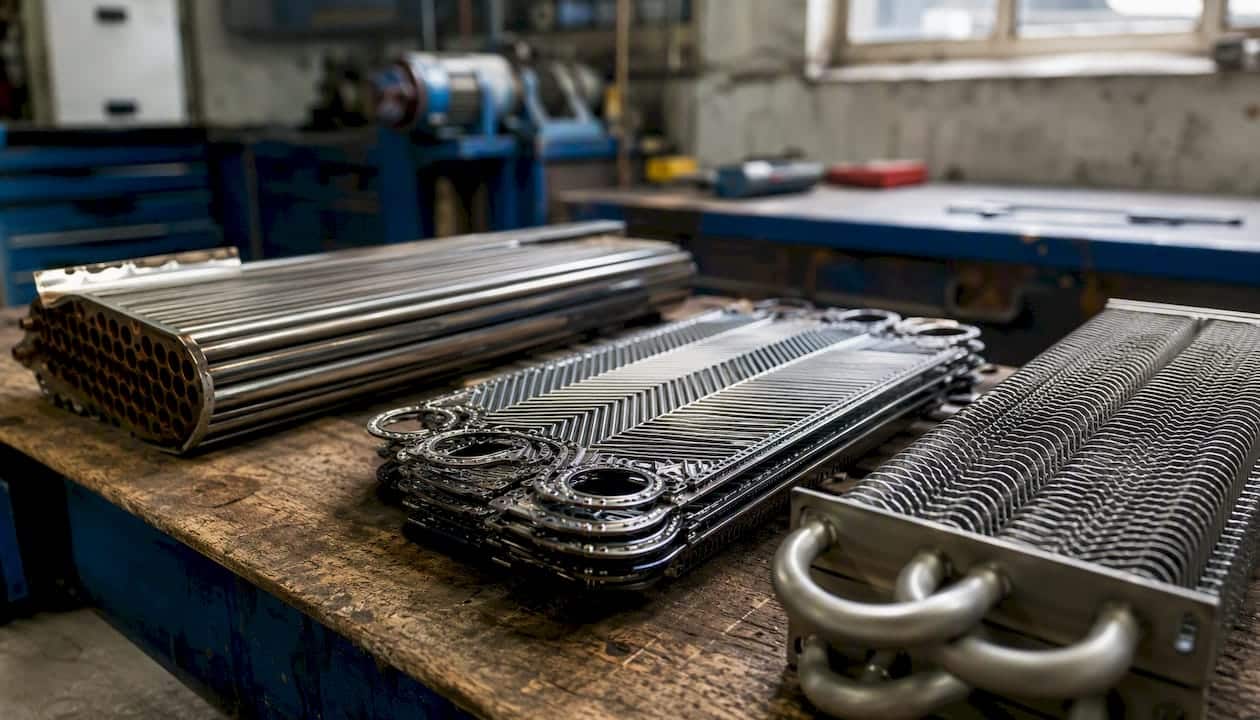
Types of heat exchanger are classified by their physical design, and the correct choice depends on temperature differential, available space, fluid cleanliness and whether the unit needs to be dismantled for servicing. The five types most relevant to UK domestic and commercial buildings are described below.
Shell-and-tube
A bundle of tubes sits inside a cylindrical shell. One fluid flows through the tubes; the other flows around them inside the shell. Shell-and-tube units handle high pressures and large flow rates, making them standard in industrial plant, district heating substations and larger commercial buildings. They are robust but bulky.
Plate and brazed-plate
Corrugated metal plates are stacked together, creating narrow channels that alternate between the two fluid streams. Flat plate and brazed-plate heat exchangers deliver substantially higher heat transfer per unit area than shell-and-tube equivalents, because thin high-conductivity plates and induced turbulence in narrow channels maximise contact. Gasketed (demountable) units allow the plates to be separated for cleaning and inspection; brazed units are compact and sealed, suited to combi boilers and applications where space and pressure demands rule out a gasketed assembly.
Finned-tube coils
A tube carrying refrigerant or hot water passes through a bank of thin metal fins. Air flows across the fins, picking up or depositing heat. Radiators, fan-coil units and air-conditioning evaporator/condenser coils all use this principle. The fins multiply the effective surface area on the air side, compensating for air’s poor thermal conductivity.
Air-cooled and dry coolers
These reject heat directly to ambient air without a secondary water circuit. They appear on the rooftops of commercial buildings as dry coolers and on the outside of split air-conditioning units as condenser coils.
Microchannel units
Compact aluminium assemblies with very small internal passages. Originally developed for automotive air-conditioning, microchannel units are increasingly used in heat pumps and refrigeration plant where weight and refrigerant charge need to be minimised.
Material choice matters across all types. Stainless steel resists acidic condensate in condensing boilers. Copper offers high thermal conductivity for domestic heating coils. Aluminium is lightweight and cost-effective for air-side applications but requires careful water-chemistry management to avoid corrosion.
| Feature | Shell-and-tube | Plate/brazed-plate | Finned-tube coil |
|---|---|---|---|
| Heat transfer per unit area | Moderate | High | Moderate (air side) |
| Space requirement | Large | Compact | Moderate |
| Maintenance difficulty | Moderate | Low (brazed) / Low-moderate (gasketed) | Low to moderate |
| Typical application | Industrial, district heating | Combi boilers, HIUs | Radiators, HVAC coils |
Where are heat exchangers used in practice?
Heat exchangers appear wherever heat must move between fluids without contamination risk. In a boiler, the heat exchanger transfers combustion-gas heat to water; in a combi boiler, a brazed-plate secondary exchanger diverts primary circuit heat to produce instant domestic hot water without the two circuits ever meeting. That separation is not incidental: it prevents combustion products from entering the drinking-water supply.
Common applications in UK buildings include:
- Combi and system boilers: primary and secondary heat exchangers for space heating and domestic hot water
- Radiators and fan-coil units: finned-tube coils transferring hot-water circuit heat to room air
- Air-conditioning condensers and evaporators: refrigerant-to-air heat exchange for cooling and heat-pump operation
- MVHR cores: counterflow heat-recovery cores that transfer warmth from extract air to incoming fresh air, reducing ventilation heat loss in well-insulated homes
- District heating heat interface units (HIUs): plate exchangers that decouple the district network from individual flat circuits
- Refrigeration and process cooling: shell-and-tube or plate units in cold stores, data centres and manufacturing plant
- Greywater heat recovery: drain-water heat recovery devices can recover up to around 40% of drainwater heat in simultaneous-flow configurations, reducing hot-water energy demand
Heat exchangers are also the energy-balancing heart of HVAC systems, enabling heat-pump integration and passive heat recovery strategies that directly affect building energy ratings. Scale ranges from tiny microchannel units for electronics cooling to multi-tonne assemblies in large commercial plant.
For homeowners considering the most efficient way to heat a house, the heat exchanger specification inside a boiler or heat pump is one of the most consequential component choices.
Why do condensing boilers have a different heat exchanger?
Condensing heat exchangers recover additional energy by allowing water vapour in the flue gas to condense before it leaves the appliance. Standard non-condensing boilers exhaust flue gases at roughly 120–200°C; efficient condensing units reduce that temperature to as low as approximately 50°C when operating with low return temperatures. The difference represents latent heat that would otherwise be lost up the flue.
That recovery comes with a material consequence. When flue gases cool below their dew point, the condensate produced is mildly acidic. Cast iron and mild steel, standard in older non-condensing heat exchangers, corrode rapidly under these conditions. Condensing heat exchangers therefore require stainless steel or aluminium construction to resist the acidic condensate on the flue-gas side.
Key implications for installers and homeowners:
- Condensing mode only activates when return water temperatures are low enough (typically below about 55°C); oversized radiators or underfloor heating circuits help achieve this
- Condensate drainage must be correctly installed and kept clear; a blocked condensate pipe causes the boiler to lock out
- Replacing a non-condensing boiler with a condensing model requires checking that the new heat exchanger material is compatible with the system’s water chemistry and inhibitor specification
How can you tell if a heat exchanger is failing?
A deteriorating heat exchanger in a boiler or HVAC system usually gives several warning signs before complete failure. Recognising them early reduces both repair costs and safety risk.
Common symptoms include:
- Loss of heating or hot water output without an obvious pressure or ignition fault
- Unexplained water leaks around the boiler casing or beneath the unit
- Discoloured or cloudy hot water, which can indicate cross-contamination between circuits
- Changes in flue appearance, such as excessive steam or visible soot
- Unusual noises (banging, kettling or gurgling) that persist after bleeding radiators
- Carbon monoxide alarm activation, which requires immediate action
Safety steps when a fault is suspected:
- Switch off the appliance at the programmer and isolate the gas supply if safe to do so
- Ventilate the space and evacuate if a CO alarm has sounded
- Do not attempt to restart the appliance until a Gas Safe registered engineer has inspected it
- Contact the Gas Emergency Service on 0800 111 999 if gas is smelt or a CO alarm sounds
A qualified engineer will carry out a flue-gas analysis, pressure test and visual inspection of the heat exchanger body. Cracks in a cast-iron or stainless-steel primary exchanger are not always visible externally; combustion-gas spillage testing is the definitive check.
How should heat exchangers be maintained and replaced?
Routine maintenance is the most cost-effective way to preserve heat-exchanger performance. Fouling on either the water side (scale, magnetite) or the air side (dust, grease) acts as an insulating layer and reduces transfer efficiency measurably.
Recommended maintenance steps:
- Annual boiler service: a Gas Safe engineer should inspect and clean the primary heat exchanger, check the condensate trap and verify flue integrity
- Magnetic filter check: inspect and clean the magnetic filter on the heating circuit at each service; replace the system inhibitor if levels are low
- Descaling: in hard-water areas, periodic chemical descaling of the domestic hot-water heat exchanger in a combi boiler prevents scale build-up that restricts flow and reduces output
- Air-side cleaning: clean fin surfaces on fan-coil units, MVHR cores and air-handling units at least annually; blocked fins reduce airflow and heat-transfer rate
- Gasket inspection: on gasketed plate heat exchangers, inspect gaskets for signs of weeping or deterioration at each planned maintenance visit
- Water-quality testing: test system water for pH, inhibitor concentration and total dissolved solids annually; poor water quality accelerates corrosion and fouling
When replacement is necessary, the scope of work depends on the appliance type. Replacing a primary heat exchanger in a wall-hung condensing boiler typically requires draining the primary circuit, removing the burner assembly, fitting the new exchanger, refilling and pressure-testing, and recommissioning the flue. Labour and parts costs vary by boiler model and installer; obtaining two or three quotes from Gas Safe registered engineers is advisable.
Important: never attempt to replace a heat exchanger in a sealed combustion appliance without the appropriate Gas Safe registration. Incorrect reassembly can cause combustion-gas spillage, which is a life-safety risk. For non-combustion applications such as plate heat exchangers in district heating HIUs, a competent heating engineer should still carry out the work; electrical isolation and system drainage are required before any disassembly.
For a structured approach to assessing your property’s energy systems before commissioning work, Homeenergymodel’s energy assessment checklist provides a practical starting point.
What are the advantages and limitations of heat exchangers?
Heat exchangers offer clear efficiency and safety benefits, but they are not maintenance-free and their performance degrades when poorly specified or neglected.
Principal advantages:
- Energy recovery without mixing: heat transfers between circuits while keeping fluids chemically separate, protecting water quality and preventing contamination
- Compact energy transfer: plate and brazed-plate designs achieve high thermal performance in a small footprint, which matters in plant rooms and domestic boiler cupboards
- Flexibility: the same principle scales from a greywater recovery coil beneath a shower tray to a multi-megawatt industrial cooler
- Condensing efficiency: in boilers, a correctly specified secondary heat exchanger enables latent-heat recovery that materially reduces gas consumption
Limitations and trade-offs:
- Fouling: deposits on heat-transfer surfaces reduce efficiency over time; water-side fouling from scale or magnetite and air-side fouling from dust both require active management
- Corrosion: mismatched materials and poor water chemistry accelerate corrosion, particularly in condensing applications where acidic condensate contacts the flue-gas side
- Pressure drop: narrow channels in plate exchangers create resistance; pump sizing must account for this, especially when retrofitting into existing systems
- Maintenance cost: gasketed units require periodic gasket replacement; brazed units cannot be opened and must be replaced when fouled beyond recovery
- Material-application mismatch: specifying a copper exchanger in a condensing application, or an aluminium unit with untreated water, shortens service life significantly
Matching material to application is the single most important specification decision. Stainless steel for condensing flue-gas contact, copper for domestic heating coils in non-condensing circuits, and aluminium for dry air-side duties each represent the appropriate choice for their respective conditions.
How do heat exchangers affect UK home energy ratings?
Heat-exchanger efficiency and correct specification are directly relevant to Home Energy Model (HEM) assessments for UK properties. HEM, which is set to replace SAP as the methodology underpinning Energy Performance Certificates (EPCs), models heat generation, distribution and recovery at a component level. A condensing boiler operating in full condensing mode, an MVHR unit with a high-efficiency counterflow core, and a correctly specified plate heat exchanger in a district heating HIU all contribute to a better modelled outcome than their less efficient equivalents.
Using plate heat exchangers to hydraulically decouple new high-efficiency boilers from legacy distribution systems protects the new boiler from contamination carried in older pipework and allows staged refurbishment without replacing the entire distribution system at once. This approach is particularly relevant for landlords managing older stock where full system replacement is not immediately viable.
Practical recommendations for homeowners and landlords:
| Action | Relevance to HEM/EPC outcome |
|---|---|
| Specify a condensing boiler with stainless-steel heat exchanger | Improves modelled seasonal efficiency; supports lower flue-gas temperature operation |
| Install MVHR with a high-efficiency counterflow core | Reduces ventilation heat loss credit in HEM; improves EPC rating in airtight new builds |
| Fit greywater heat recovery on shower drain | Recognised in HEM as a hot-water energy-saving measure |
| Use a plate heat exchanger to decouple circuits | Protects new boiler efficiency; enables accurate modelling of primary and secondary circuits |
| Document component specifications | Provides evidence for EPC assessor; avoids default (lower) assumptions in HEM |
For landlords wanting to understand how these component choices translate into assessed performance, Homeenergymodel’s guide to home energy models for landlords sets out the relevant assessment variants. Homeowners seeking a broader view of how to increase energy efficiency will find that heat-exchanger upgrades sit alongside insulation and glazing as measurable contributors to EPC improvement.
Understanding home heating systems in energy efficiency assessments helps property owners frame component choices within the wider modelling context, rather than treating each upgrade in isolation.
An editorial perspective on heat exchangers and UK energy performance
The heat exchanger is probably the most consequential component in a domestic heating system that most homeowners have never thought about. Boiler manufacturers market output, controls and connectivity; almost nobody leads with the heat exchanger specification. Yet it is the component that determines whether a condensing boiler actually condenses in practice, whether a combi delivers consistent hot-water output, and whether a system survives ten years without a premature failure caused by corrosion or fouling.
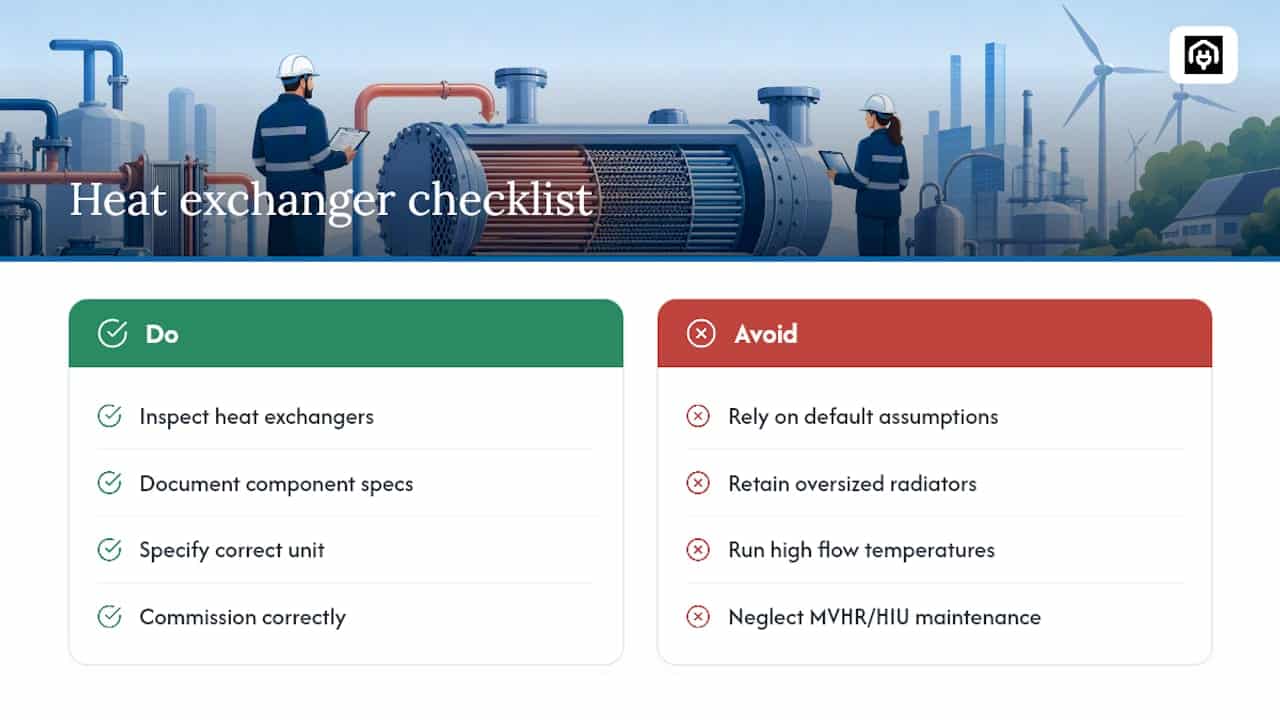
The practical gap this creates is significant. A homeowner who installs a new condensing boiler but retains oversized radiators set to high flow temperatures may never achieve condensing operation, because the return temperature never drops low enough for condensation to occur. The boiler is rated as condensing on paper; in practice it runs as a non-condensing appliance. That distinction matters for energy bills and for HEM/EPC modelling, where default assumptions may not reflect actual operating conditions.
The same logic applies to plate heat exchangers in district heating HIUs and MVHR cores in new-build flats. Specifying the right unit is step one; commissioning it correctly and maintaining it are steps two and three. An MVHR core clogged with dust recovers a fraction of the heat it was designed to capture. A plate exchanger in a HIU scaled with hard water delivers reduced output and shortened life.
The actionable conclusion is straightforward: inspect, document and specify correctly. Before commissioning any energy assessment or EPC, gather the specifications of the heat exchangers in the property’s heating and ventilation systems. An assessor working with real component data will model better outcomes than one relying on defaults. For landlords facing tightening EPC requirements, that documentation could be the difference between a compliant and a non-compliant rating without any physical upgrade at all.
Homeenergymodel’s Home Energy Model explained guide is a practical starting point for understanding how component-level choices feed into assessed performance.
Sources
The following sources provide authoritative technical detail and UK policy context for readers wanting to go further:
- Types of heat exchanger
- Domestic heating by gas: boiler systems – guidance for installers and specifiers
- Heat Exchangers in Hydronic and Plumbing Systems
- Module 108: Applying plate heat exchangers to integrate high-efficiency boilers into legacy systems – CIBSE Journal
- What is a heat exchanger in a boiler? A full guide.