

TL;DR:
- Accessing government energy grants in the UK is critical due to tightening EPC standards, high energy costs, and upcoming retrofit obligations. Property owners must carefully check eligibility, prepare documentation, and select registered installers to successfully navigate schemes like ECO4, GBIS, and the Boiler Upgrade Scheme in 2026. Proper planning, avoiding double funding, and completing projects before VAT changes in March 2027 are essential for maximizing financial support and compliance.
Accessing available government energy assistance has never been more pressing for UK property owners, landlords, and developers. With minimum EPC requirements tightening, energy bills remaining high, and retrofit obligations looming, understanding the full energy grant funding guide landscape in 2026 is no longer optional. Schemes such as ECO4, the Great British Insulation Scheme (GBIS), and the Boiler Upgrade Scheme offer significant financial support, but eligibility rules, application processes, and funding restrictions are complex. This guide to government energy grants cuts through the confusion and gives property owners a clear, practical path from eligibility checking to post-installation compliance.
Table of Contents
- Key takeaways
- Types of government energy grants available in 2026
- Checking eligibility and preparing your documentation
- How to apply and manage the installation process
- Pitfalls and mistakes to avoid
- What to expect after a grant-funded installation
- My perspective on navigating energy grants in 2026
- How Homeenergymodel can support your grant journey
- FAQ
Key takeaways
| Point | Details |
|---|---|
| Know your scheme | ECO4, GBIS, and the Boiler Upgrade Scheme each target different property types and owner circumstances. |
| EPC rating is central | Most grants require a property to fall within EPC bands D to G before measures are approved. |
| Avoid double funding | Specific government grants cannot be combined on the same measure, making careful planning before application critical. |
| Installer compliance matters | Only MCS-registered or PAS 2035/2030-accredited installers can certify eligible measures for grant funding. |
| VAT window is closing | The 0% VAT rate on qualifying energy-saving materials ends 31 March 2027, directly affecting total project costs. |
Types of government energy grants available in 2026
UK property owners have three principal energy efficiency grants to consider in 2026, each with distinct eligibility rules, funding structures, and timelines.
ECO4
The Energy Company Obligation 4 (ECO4) scheme runs until 31 December 2026, targeting households on means-tested benefits or those referred through Local Authority Flex (LA Flex) routes. Properties must typically sit within EPC bands D to G to qualify. Crucially, ECO4 eligibility depends on property assessment alignment rather than applicant preference. The retrofit package offered reflects what the property qualifies for under the qualifying actions rules, not necessarily what the owner wants to install.
The LA Flex route is particularly useful for landlords whose tenants do not receive qualifying benefits. Local authorities can declare households as eligible based on low income or other vulnerability indicators. This expands access considerably for the private rented sector.
Great British Insulation Scheme (GBIS)
GBIS targets properties in Council Tax bands A to D in England, or bands A to E in Scotland and Wales, with EPC ratings of D or below. Unlike ECO4, GBIS funds a single insulation measure per property rather than a full retrofit package. It is delivered via energy suppliers and focuses on loft, cavity wall, and solid wall insulation. For landlords with a portfolio of lower-rated properties, GBIS can address fabric efficiency quickly without the full eligibility scrutiny ECO4 demands.
Boiler Upgrade Scheme (BUS)
The Boiler Upgrade Scheme supports the replacement of gas boilers with low-carbon heating. Recent amendments have expanded the scheme to support air-to-air heat pumps and heat batteries, alongside simplifications to certification requirements intended to reduce installer burden and improve access. Installers must deduct the grant amount from the upfront customer cost rather than applying for reimbursement separately, which means the funding is immediate but installer selection is critical.

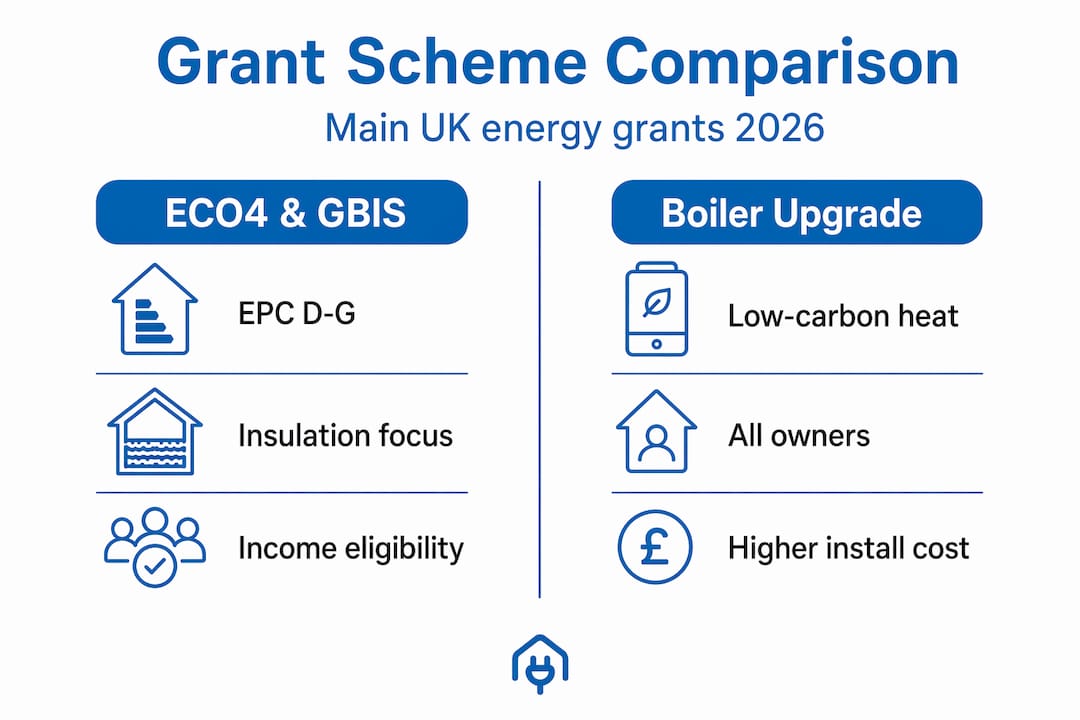
Scheme comparison at a glance
| Scheme | Target property | Measure type | Eligibility route |
|---|---|---|---|
| ECO4 | EPC D to G | Full retrofit package | Benefits or LA Flex |
| GBIS | EPC D and below | Single insulation measure | Council Tax band |
| Boiler Upgrade Scheme | Most residential properties | Heat pump or heat battery | No income test |
For a broader overview of energy saving grants in England, Homeenergymodel provides updated guidance on qualification and application routes for 2026.
Checking eligibility and preparing your documentation
Preparation before submitting any application significantly improves the chances of approval and avoids delays once a project begins.
Eligibility checks to complete before applying:
- Confirm the property’s current EPC rating. Most energy efficiency grants require a band D or below. If no current EPC exists, one must be commissioned before the application can proceed.
- Identify whether the occupant or owner qualifies via a means-tested benefit such as Universal Credit, Pension Credit, or Child Tax Credit for ECO4.
- If benefit eligibility does not apply, contact the local authority to explore the LA Flex declaration route, particularly relevant for privately rented properties.
- For GBIS, verify the property’s Council Tax band using the Valuation Office Agency’s register.
- Confirm the property is not a new build, as most grant schemes exclude properties constructed within the past decade.
Documentation typically required:
- A valid EPC certificate (lodged on the national EPC register within the last ten years)
- Proof of benefits entitlement or a local authority eligibility declaration
- Land Registry title documents or a recent tenancy agreement for landlords
- Planning permission documents if structural works such as external wall insulation are included
Using an EPC compliance checklist at this stage helps identify gaps in documentation before the installer carries out their survey. Missing documentation is one of the most common reasons applications stall mid-process.
Pro Tip: When managing a portfolio of properties, stagger applications across different properties to avoid grant processing bottlenecks. Confirm each property’s EPC band and eligibility route independently before starting any application, as assumptions based on similar properties frequently lead to errors.
How to apply and manage the installation process
The application process for most government energy grants is installer-led rather than applicant-led. This distinction catches many property owners off guard.
- Identify a registered installer. For ECO4 and GBIS, installers must be Trustmark-registered and comply with PAS 2035/2030 standards. For BUS, installers must hold Microgeneration Certification Scheme (MCS) accreditation. A list of approved installers is available via each scheme’s managing body.
- Commission a property survey. The installer visits the property to assess its current condition, measure fabric performance, and carry out heat-loss calculations where relevant. This survey determines which measures qualify.
- Validate the EPC. The installer or an independent assessor confirms the current EPC rating aligns with scheme requirements. If the property has undergone recent works, an updated EPC may be needed before the application can advance.
- Receive and approve the installer’s proposal. The installer submits a retrofit plan detailing the qualifying measures, projected costs, and grant deductions. For BUS, the grant is deducted directly from the quoted price at this stage.
- Submit the application and await approval. The installer lodges the application with the relevant scheme administrator. Approval triggers a voucher or notification authorising the works.
- Installation and certification. Works are carried out to PAS 2035/2030 or MCS standards. Certification is submitted to the scheme administrator. Contracts should specify certification submission responsibilities and timing aligned with installer obligations to prevent disputes over project completion.
- Post-installation EPC. A new EPC is lodged once works are complete, confirming the improvement in the property’s energy rating.
- Grant payment. The installer receives reimbursement from the scheme. For BUS, this reflects the amount already deducted from the customer invoice.
The grant application process spans approximately 13 weeks end-to-end across survey, approval, installation, and payment stages. Planning ahead of a tenancy change or property sale is advisable to avoid disruption.
Pro Tip: Request written confirmation from the installer of every certification deadline and scheme submission date before signing any contract. Delays in certification submission can invalidate a grant approval entirely, leaving the property owner liable for the full installation cost.
Pitfalls and mistakes to avoid
Even well-prepared applicants can encounter grant refusals or project failures through avoidable errors. The following issues account for the majority of problems encountered during energy grant applications.
Double funding conflicts. The government has confirmed that ECO4 measures funded by specified grants are disqualified from ECO4 to prevent double funding. Schemes explicitly excluded include BUS and several Warm Homes schemes. Documenting grant funding measure-by-measure before starting any project is the only reliable way to avoid this conflict.
Assuming eligibility without confirmation. ECO4 applications fail when the installer’s property survey reveals the measures proposed do not qualify under the scheme’s rules. Eligibility is assessed at measure level, not property level. A property can qualify by EPC band but still be refused funding if the proposed measure falls outside the qualifying actions list.
Missing the VAT window. The 0% VAT rate on energy-saving materials such as heat pumps and solar panels ends on 31 March 2027, reverting to 20%. For projects including these technologies, completing installation before that date can save thousands of pounds. This deadline should be factored into project scheduling from the outset.
Certification lapses and procurement errors. Installer-led projects sometimes fail because contracts do not specify when certification must be submitted relative to the grant approval window. Procurement contracts should explicitly align with grant certification and installation requirements per PAS 2035/2030 and MCS standards.
Homeenergymodel’s guide to prioritising energy upgrades for landlords covers how to map measures across multiple properties to reduce these risks.
What to expect after a grant-funded installation
Completing a grant-funded upgrade is not the end of the process. Property owners should verify outcomes and plan for ongoing compliance.
| Post-installation step | What to check | Why it matters |
|---|---|---|
| New EPC lodgement | Confirm the rating has improved to the expected band | Required for lettings compliance and scheme verification |
| Warranty documentation | Collect all installer warranties per PAS 2035 requirements | Protects against defect claims and validates certification |
| Scheme completion notification | Receive written confirmation from scheme administrator | Confirms grant payment processed and project closed |
| Financial savings review | Compare pre and post energy bills over six months | Validates the retrofit’s performance against modelled projections |
| Future funding eligibility | Check updated EPC against forthcoming scheme criteria | ECO4 closes in December 2026; successor schemes are expected |
The post-installation EPC is particularly significant. For landlords, a confirmed improvement in rating directly affects lettings compliance under the upcoming Minimum Energy Efficiency Standards (MEES) changes. A lodged EPC in band C or above places a property in a strong position ahead of anticipated 2028 requirements for new tenancies.
Property owners should also maintain all certification documentation, including MCS or PAS 2035 completion certificates, for at least ten years. These records are frequently requested during property transactions, compliance audits, and future grant applications.
My perspective on navigating energy grants in 2026
In my experience working across UK property compliance, the most common reason property owners miss out on grant funding is not ineligibility. It is under-preparation. Many assume the installer handles everything and arrive at the process without a current EPC, without evidence of benefit entitlement, and without any understanding of which measures actually qualify.
What I have found is that the best outcomes come from starting with a proper EPC assessment and aligning the retrofit plan to what the scheme rules allow, not what the owner wants. The ECO4 scheme in particular is designed around qualifying actions rules. If the measures proposed do not fit those rules, no amount of chasing will make the application succeed.
I have also seen genuine financial harm caused by grant stacking errors. Property owners who proceed without checking double funding exclusions can end up losing grant approval entirely after works have started. The government response on the ECO4 Order changes in early 2026 made these exclusions explicit. Reading that guidance before committing to any multi-measure project is time well spent.
The VAT window closing in March 2027 adds another layer of urgency. Projects involving heat pumps or solar should be scoped and scheduled now, not next year.
— Danny
How Homeenergymodel can support your grant journey
Homeenergymodel provides UK landlords and developers with authoritative guidance on energy performance assessments, EPC compliance, and retrofit planning. Whether verifying eligibility ahead of an ECO4 application or preparing a property for the incoming Home Energy Model assessment methodology, professional energy modelling simplifies every stage of the process. Explore the full range of energy modelling services for landlords to understand how each service type supports grant eligibility, compliance planning, and property performance improvements. For those seeking to understand how assessments affect EPC ratings and grant outcomes, the EPC certificates guide offers clear, London-focused detail on certification and property compliance.
FAQ
What is the ECO4 scheme and when does it end?
ECO4 is a government-backed energy efficiency scheme delivered through obligated energy suppliers, targeting households on means-tested benefits or via local authority referrals. It runs until 31 December 2026 and prioritises properties with EPC ratings in bands D to G.
Can a property receive funding from both ECO4 and the Boiler Upgrade Scheme?
No. Measures funded through the Boiler Upgrade Scheme are excluded from ECO4 to prevent double funding. Property owners must document which scheme funds each individual measure before committing to a project.
How long does a grant-funded installation take from start to finish?
The process typically spans around 13 weeks end-to-end, covering survey, EPC validation, installer certification, approval, installation, and final payment from the scheme administrator.
What EPC rating is needed to qualify for most energy grants?
Most major schemes including ECO4 and GBIS require the property to hold an EPC rating of band D or below at the time of application. A current, lodged EPC certificate is required before any application can proceed.
Does the 0% VAT rate on heat pumps apply to all grant-funded projects?
The 0% VAT rate applies to qualifying energy-saving materials regardless of grant funding, but it expires on 31 March 2027. Projects involving heat pumps or solar panels should be scheduled to complete before that date to benefit from the saving.