

TL;DR:
- Most UK homeowners may not fully understand that an EPC reflects a home’s energy efficiency, running costs, and CO2 emissions. The upcoming Home Energy Model will introduce four metrics instead of a single rating, emphasizing fabric, heating, smart readiness, and costs, with significant regulatory changes for landlords. Acting early on energy improvements can ensure compliance, reduce costs, and increase property value amid these evolving standards.
Most UK homeowners have seen the colourful A-to-G chart on a property listing without fully understanding what it means for their costs, compliance obligations, or property value. The EPC meaning for a house goes well beyond a simple energy label. An Energy Performance Certificate (EPC) is a legal document that reflects how efficiently a home uses energy, what it costs to run, and how much CO2 it emits. With significant regulatory changes arriving under the Home Energy Model, understanding your EPC rating is no longer optional knowledge.
Table of Contents
- What is an energy performance certificate (EPC) and why does it matter?
- Understanding the EPC rating scale and what it means for your home
- The upcoming Home Energy Model (HEM) and its impact on energy performance certificates
- What the HEM means for landlords and meeting minimum energy efficiency standards
- How energy assessors evaluate your home and tips for improving your EPC rating
- Why understanding EPC meaning is more important than ever for UK homeowners and landlords
- Discover how the Home Energy Model can help you navigate UK energy regulations
- Frequently asked questions
Key Takeaways
| Point | Details |
|---|---|
| EPC basics | An EPC rates your home’s energy efficiency from A (best) to G and is legally needed for sale or rent. |
| Average ratings | Most UK homes rate D, meaning opportunities for savings and upgrades exist. |
| Home Energy Model | From 2027, EPCs will use four separate metrics providing a more detailed energy picture. |
| Landlord compliance | Rental properties must reach EPC C by 2030, emphasizing early improvements. |
| Assessment tips | Ensure clear access and apply recommended improvements for an accurate, better rating. |
What is an energy performance certificate (EPC) and why does it matter?
An EPC is a standardised assessment of a residential property’s energy efficiency, produced by an accredited domestic energy assessor. The certificate covers how well the property retains heat, the efficiency of its heating system, and the likely fuel costs a typical occupant would face. It also includes a list of recommended improvements and the potential rating the home could achieve if those improvements were made.
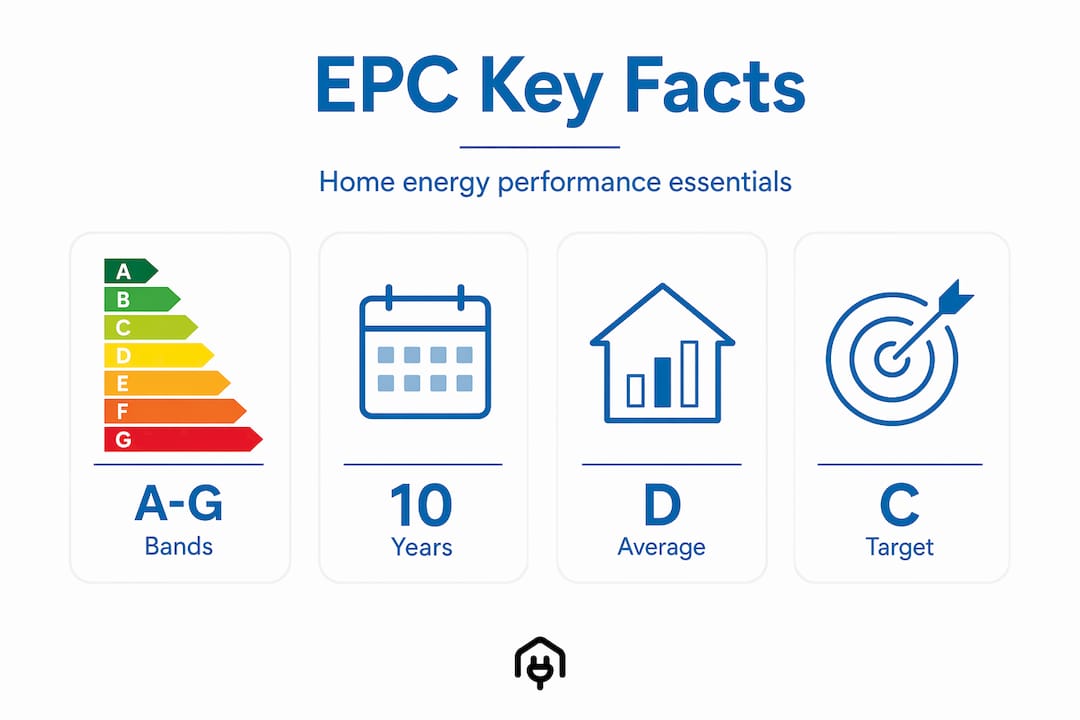
EPC ratings explained show that certificates rate properties on a scale from A to G. An A-rated property scores 92 or above, indicating the highest level of energy efficiency, while a G rating covers scores between 1 and 20, the least efficient end of the scale. The certificate is legally required when constructing, selling, or letting a property in England and Wales.
Key facts about EPCs every homeowner and landlord should know:
- Valid for 10 years from the date of issue. A new assessment is only required after expiry or when improvements are made and a higher rating is sought.
- Legally required before marketing a property for sale or rental. Failure to provide a valid EPC can result in fines.
- Publicly accessible via the government’s EPC register, meaning buyers, tenants, and lenders can view ratings independently.
- Not the same as a home survey. An EPC does not assess structural condition, damp, or building defects. It focuses solely on energy performance.
Understanding how energy use is measured gives further context to the methodology behind these ratings and why two visually similar properties can receive markedly different scores.
Understanding the EPC rating scale and what it means for your home
The EPC rating scale runs from A at the top to G at the bottom, with each band corresponding to a score range and an estimated annual fuel cost. The higher the band, the lower the running costs and the smaller the property’s carbon footprint.
| EPC band | Score range | Typical annual energy cost | Efficiency level |
|---|---|---|---|
| A | 92 to 100 | Very low | Most efficient |
| B | 81 to 91 | Low | Highly efficient |
| C | 69 to 80 | Moderate | Good |
| D | 55 to 68 | Average | Moderate |
| E | 39 to 54 | Higher | Below average |
| F | 21 to 38 | High | Poor |
| G | 1 to 20 | Very high | Least efficient |
The average UK property holds a D rating, and only 1 to 2% of homes achieve an A rating. That gap represents a significant opportunity. Homeowners with lower-rated properties may qualify for government grants of up to £30,000 through schemes such as the Great British Insulation Scheme and the Boiler Upgrade Scheme to fund energy improvements.
What does this mean in practical terms? A property moving from E to C typically sees meaningful reductions in annual heating bills, improved thermal comfort, and stronger appeal to buyers or tenants. It can also unlock mortgage products with preferential rates, as some lenders now offer green mortgages tied to EPC ratings.
The following improvements tend to have the greatest impact on rating:
- Loft insulation to at least 270mm
- Cavity wall or solid wall insulation
- Double or triple glazing replacing single-pane windows
- A modern condensing boiler or heat pump installation
- Smart heating controls including room thermostats and TRVs
Exploring energy performance guidance in detail helps identify which measures deliver the strongest rating gains for specific property types.
Pro Tip: Before commissioning improvements, check the “potential rating” section of your current EPC. It identifies the specific measures that would push your property into a higher band, saving you from investing in upgrades that may not shift your rating.

The upcoming Home Energy Model (HEM) and its impact on energy performance certificates
The current EPC methodology, based on SAP (Standard Assessment Procedure) and RdSAP for existing dwellings, is set to be replaced by the Home Energy Model (HEM). This is arguably the most significant change to the way homes are assessed in over two decades.
HEM launches in H2 2027, replacing SAP and RdSAP with a new framework that produces four separate EPC metrics rather than a single A-to-G band. This shift reflects a broader recognition that one number cannot adequately capture a home’s energy performance.
| Metric | What it measures | Why it matters |
|---|---|---|
| Fabric performance | Insulation, walls, roof, floor, windows | Shows how well the building retains heat |
| Heating system | Efficiency and type of heating technology | Reflects running costs and carbon impact |
| Smart readiness | Controls, automation, grid interaction | Indicates future-proofing and flexibility |
| Energy cost | Estimated annual energy spend | Practical cost indicator for occupants |
The transition period will run until at least October 2029. During this time, legacy A-to-G ratings will appear alongside the new HEM metrics, giving homeowners and landlords time to understand the new system.
The key changes under HEM include:
- More granular assessment using actual property data rather than default assumptions
- Separate heating system metric that specifically penalises gas boilers relative to heat pumps
- Smart readiness score rewarding homes with smart controls and the ability to interact with the grid
- Greater accuracy for unusual or older property types that SAP often assessed poorly
Read the full Home Energy Model explained guide to understand how HEM methodology differs from the current approach and what it means for your assessment.
What the HEM means for landlords and meeting minimum energy efficiency standards
For landlords, the regulatory picture is changing significantly. The Minimum Energy Efficiency Standards (MEES) already prohibit letting properties rated F or G. The next major step is far more demanding.
By 1 October 2030, all private rentals must achieve an EPC rating of C or above, with investment caps raised to £10,000 per property. Early upgrades are strongly recommended given HEM’s stricter approach to heating system ratings.
One detail many landlords overlook is this: under HEM, gas boilers are expected to be capped at Band D on the heating system metric. A property currently rated C under SAP could potentially slip to D under HEM if its heating system is the limiting factor. That is a compliance risk that appears without any physical change to the property.
Landlords should take the following steps now:
- Obtain a current SAP-based EPC if one is not already in place or if the existing one is approaching expiry.
- Assess the heating system separately and consider whether a heat pump or hybrid system makes economic sense given the new metric.
- Prioritise fabric improvements such as insulation and glazing, which benefit both the current SAP rating and the future HEM fabric metric.
- Secure an EPC C rating before October 2029 to lock in compliance under the legacy system for up to 10 years.
- Budget for the £10,000 investment cap and explore available grants to reduce out-of-pocket costs.
Pro Tip: If your property achieves EPC C before the HEM transition in 2027, that certificate remains valid for 10 years under the legacy methodology. This is one of the clearest strategic advantages available to landlords right now.
Understanding the types of home energy models for landlords helps clarify which assessment route is most appropriate for different property portfolios.
How energy assessors evaluate your home and tips for improving your EPC rating
An accredited domestic energy assessor visits the property, collects data on construction type, insulation levels, heating systems, windows, and lighting, and enters this into approved software to generate the EPC. The quality of the assessment depends heavily on access and transparency.
Assessors need clear access to lofts, meter cupboards, and hot water cylinders. Direct measurements improve accuracy, and obstructing these areas can lead to conservative default assumptions that lower the rating. A poorly prepared property is often rated lower than it actually performs.
Key areas assessors evaluate:
- Wall construction and insulation including cavity, solid, or timber frame
- Loft and roof insulation depth and coverage
- Windows and doors including glazing type and draught-proofing
- Heating system type, age, controls, and fuel type
- Hot water system including cylinder insulation and solar thermal panels
- Lighting proportion of fixed low-energy fittings
Small, targeted improvements can make a meaningful difference. Replacing a standard boiler with a modern condensing model, adding loft insulation, or installing a room thermostat and programmer may collectively move a property from E to D or D to C, depending on the starting point.
Pro Tip: Take photographs of any insulation, new boiler installation certificates, or window installation guarantees before the assessor arrives. Providing documentary evidence of improvements helps the assessor apply the correct values rather than relying on default figures that may undervalue your upgrades.
Practical guidance on preparing for an assessment is available through the home energy assessment tips resource, which covers preparation steps for different property types.
Why understanding EPC meaning is more important than ever for UK homeowners and landlords
There is a tendency to treat EPCs as administrative paperwork, something obtained to satisfy a solicitor or letting agent and then filed away. That view is no longer adequate, and the approaching regulatory changes make it genuinely costly.
The shift to HEM marks a fundamental change in how the UK measures home energy performance. For the first time, a gas boiler will be rated as a liability on a headline metric, not just a less desirable option. Properties that look compliant today may not look compliant in 2027 without any change to their physical fabric. That is a material risk for landlords holding properties close to the C/D boundary.
The financial case for acting early is straightforward. Fabric improvements such as insulation retain their value across both SAP and HEM assessments. A landlord who invests in wall and loft insulation now reduces their heating costs, raises their SAP rating, improves their HEM fabric metric, and satisfies future MEES requirements in a single set of works. Waiting until 2029 means competing for installer capacity alongside thousands of other landlords facing the same deadline.
For homeowners not subject to MEES, the EPC still matters more than many realise. Mortgage lenders increasingly price products around EPC ratings, and buyers are more informed than ever. A D-rated home with a clear improvement pathway sells differently from one with no documented performance data. Engaging with energy saving steps early builds value that compounds over time, both financially and in terms of comfort.
The EPC is not a static document. It is a snapshot of performance at a point in time, and the methodology behind that snapshot is about to change significantly. Understanding both the current rating and the direction of travel under HEM gives homeowners and landlords a practical advantage that passivity does not.
Discover how the Home Energy Model can help you navigate UK energy regulations
Homeenergymodel.co.uk provides in-depth, practical resources for homeowners and landlords navigating the transition from SAP to HEM. Whether you need to understand the full Home Energy Model methodology or are looking for guidance specifically tailored to energy models for landlords, the site offers clear, regulation-aligned guidance to support informed decision-making. From interpreting your current EPC to planning upgrades that satisfy both current MEES requirements and future HEM metrics, the guide to improving energy performance covers the practical steps that matter most. With compliance deadlines approaching and the methodology changing, accessing accurate information now is the most cost-effective step any property owner can take.
Frequently asked questions
What does EPC mean for my house?
An EPC rates your home from A to G based on estimated fuel costs and CO2 emissions, giving a clear picture of energy efficiency and highlighting where improvements could reduce running costs.
How long is an EPC valid for a house?
EPCs are valid for 10 years from the date of issue, after which a new assessment is required before selling or renting the property.
What changes will the Home Energy Model bring to EPCs?
Starting in H2 2027, EPCs will show four metrics covering fabric performance, heating system, smart readiness, and energy cost, replacing the single A-to-G band from SAP.
What is the MEES deadline for landlords regarding EPC ratings?
By 1 October 2030, all private rental properties in England and Wales must hold an EPC rating of C or above, with a maximum investment cap of £10,000 per property for compliance works.