
TL;DR:
- Understanding EPC costs involves accounting for assessment fees, compliance upgrades, and indirect project expenses that often exceed initial estimates. Budgeting accurately requires differentiating direct, indirect, and upgrade costs while considering contract types and future regulation changes. Strategic planning and multiple quotes help property owners reduce expenses, improve energy ratings, and increase property value effectively.
For any UK property owner, landlord, or investor, understanding what is EPC cost means more than knowing a single price. EPC costs span the initial assessment fee, any compliance upgrades required to meet minimum energy ratings, and the contractual decisions that shape your total outlay. Many people budget for the certificate alone and are caught off guard by the wider financial picture. This guide covers every layer of EPC expenditure, from typical assessment fees to retrofit liabilities, so you can plan with confidence and avoid costly surprises.
Table of Contents
- Key takeaways
- What is EPC cost? Certificates and typical price ranges
- EPC cost breakdown: direct, indirect, and compliance expenses
- EPC contract types and cost risk management
- Managing EPC costs and improving property value
- My perspective on EPC cost transparency
- Plan your EPC costs with confidence
- FAQ
Key takeaways
| Point | Details |
|---|---|
| EPC assessment fees | Certificates typically cost between £60 and £120, with property size and location as the main variables. |
| Indirect costs matter | Indirect project expenses can account for 15 to 35% of total EPC project costs and are frequently underestimated. |
| Upgrade costs vary widely | Compliance improvements range from £300 for loft insulation to over £22,000 for external wall insulation. |
| Contract type affects risk | Fixed-price contracts offer cost certainty at a premium, while time-and-materials contracts shift financial risk to the owner. |
| Retrofit liability affects value | Surveyors advise factoring retrofit liabilities of up to £28,000 into property purchase price negotiations. |
What is EPC cost? Certificates and typical price ranges
An Energy Performance Certificate rates a property’s energy efficiency on a scale from A (most efficient) to G (least efficient). In England and Wales, an EPC is legally required when a property is built, sold, or let, and it remains valid for ten years. The certificate is produced by an accredited domestic energy assessor who inspects the property and calculates its rating using standardised methodology.
The average EPC assessment fee sits between £60 and £120 for most residential properties in the UK. Smaller flats tend to fall at the lower end of that range, while larger detached homes, HMOs, and commercial properties attract higher fees. Geography also plays a significant role. EPC costs in London typically sit toward the upper end of the price range due to higher assessor overhead and travel costs across the capital.
Several factors influence where your property lands within that price bracket:
- Property size and type. Larger properties require longer inspection times, increasing the assessor’s fee.
- Property age and construction. Older or non-standard construction types may require additional checks, adding time.
- Location. Rural or remote properties may carry a travel surcharge on top of the base fee.
- Commercial versus residential. Commercial EPCs follow a different methodology and are generally priced higher, often from £150 upwards.
- Urgency. Same-day or expedited certificates can attract a premium from some assessors.
Assessors must be accredited through a recognised body such as Elmhurst Energy or Stroma Certification. The digital certificate is lodged on the national EPC register automatically once issued, so you receive both a paper copy and an online record.
EPC cost breakdown: direct, indirect, and compliance expenses
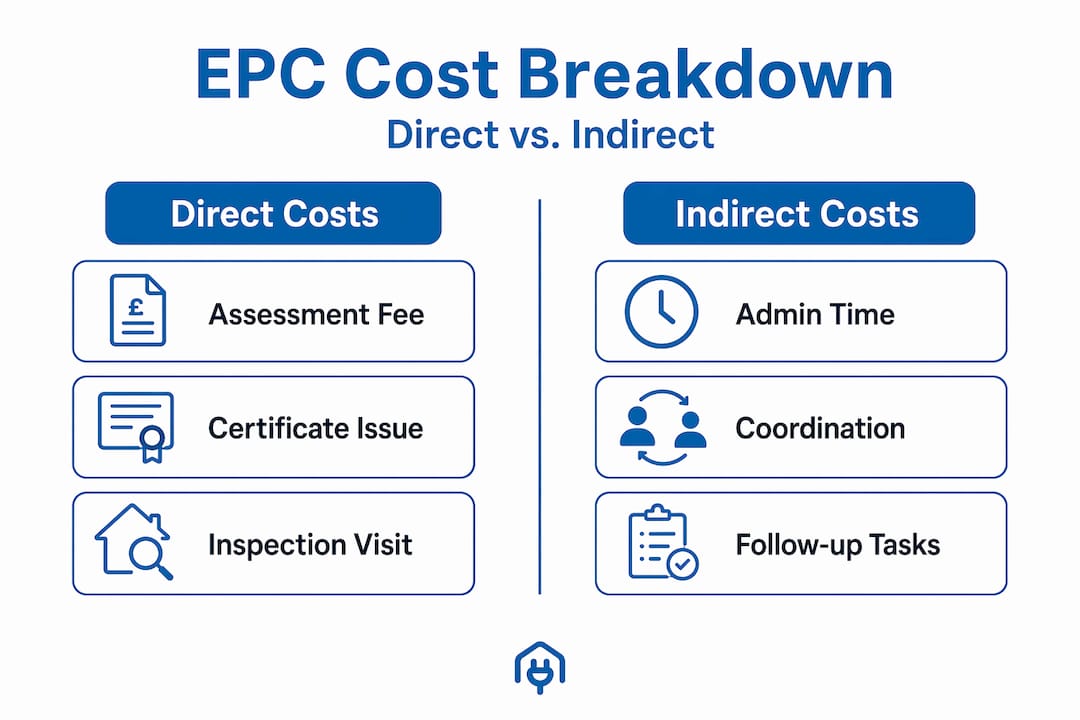
Understanding the full EPC cost breakdown requires separating three distinct layers of expenditure. Conflating them is the most common budgeting error property owners make.
Direct costs are the visible expenses: the assessor’s fee, any supporting materials, and the inspection itself. For a residential EPC assessment, this is a single transaction. For larger retrofit or construction projects falling under EPC contracts (Engineering, Procurement, and Construction), direct costs also include equipment supply, installation labour, and materials.
Indirect costs cover everything that enables the project to happen but does not appear in the main works specification. Indirect expenses contribute 15 to 35% of total EPC project cost. This includes site setup, project management fees, permits and planning applications, administration, mobilisation, and demobilisation. Many property owners overlook these entirely when budgeting.
Compliance upgrade costs are where expenditure can escalate significantly. If a property does not meet the required EPC rating, the owner must invest in energy efficiency improvements. Typical costs in the UK break down as follows:
| Improvement type | Typical cost range |
|---|---|
| Loft insulation | £300 to £600 |
| Cavity wall insulation | £1,500 to £3,500 |
| External wall insulation | £8,000 to £22,000 |
| Double glazing (full property) | £4,000 to £10,000 |
| Air source heat pump | £8,000 to £15,000 |
| Solar PV panels | £5,000 to £9,000 |
These figures come from UK landlord compliance data published for 2026, reflecting current installer pricing. For landlords facing multiple upgrades across a portfolio, these figures compound rapidly. The current minimum standard for rented properties in England and Wales requires an EPC rating of at least E, with proposals to raise this to C by 2030 under pending legislation. Navigating these regulatory changes early is critical to avoiding last-minute expenditure.
For property investors, retrofit liabilities of £20,000 to £28,000 should be factored into purchase price negotiations where the current EPC rating is below the anticipated future standard. Surveyors increasingly recommend this approach as part of standard acquisition due diligence.
EPC contract types and cost risk management
The term “EPC contract” applies in two distinct contexts for property stakeholders. The first is the domestic energy assessment contract, which is typically straightforward. The second is the Engineering, Procurement, and Construction contract structure used for large-scale energy projects such as solar installations, heat pump networks, or major retrofit programmes. Both involve a core decision: fixed-price or time-and-materials.
Fixed-price EPC contracts transfer cost risk to the contractor, but this certainty comes at a cost. Contractors typically price in a risk premium of 15 to 30% to cover unforeseen circumstances. For property owners who need predictable budgets, or those whose lenders require cost certainty, fixed-price arrangements are the more practical choice.
Time-and-materials contracts offer transparency. You pay for actual hours worked and materials consumed, with no built-in risk premium. However, time-and-materials contracts shift financial risk to the owner, meaning any project delays, complications, or scope changes directly increase your bill.
| Contract type | Cost certainty | Risk position | Best suited for |
|---|---|---|---|
| Fixed price | High | Risk transferred to contractor | Lender-funded projects, tight budgets |
| Time and materials | Low | Risk held by owner | Flexible scopes, phased works |
| Hybrid (GMP) | Medium | Shared | Larger programmes with some unknowns |
GMP, or Guaranteed Maximum Price, is a hybrid model where the contractor sets a ceiling but passes savings back to the owner. It suits larger retrofit programmes where some scope uncertainty exists but overall exposure needs capping.
Pro Tip: For straightforward domestic energy upgrades such as insulation or a new boiler, a fixed-price contract from a vetted installer protects your budget. Reserve time-and-materials arrangements for phased retrofit work where the full scope is genuinely unknown at the outset.
Managing EPC costs and improving property value
Knowing the numbers is only half the picture. The other half is applying that knowledge to reduce expenditure and protect or increase property value. Here is a practical sequence for doing exactly that.
-
Obtain the current EPC rating. Check the national EPC register before commissioning a new assessment. If a valid certificate exists and is less than ten years old, you may not need to pay for a new one immediately.
-
Get at least three quotes. Assessor fees vary. Collecting multiple quotes takes thirty minutes and can save £30 to £50 on the assessment alone. Use accredited assessors only.
-
Review the certificate’s recommendations. Every EPC includes a list of suggested improvements with indicative cost and rating impact. Use this as your initial prioritisation framework.
-
Model the cost versus rating improvement. Not every upgrade delivers the same rating uplift per pound spent. Loft insulation typically offers the strongest cost-to-improvement ratio for properties without existing coverage.
-
Check eligibility for government support. The Great British Insulation Scheme and the Boiler Upgrade Scheme both offer grants that can significantly reduce out-of-pocket compliance costs in 2026.
-
Factor upgrade costs into acquisition pricing. For investors, negotiating purchase prices to reflect the cost of bringing a property to the required standard is now standard practice among experienced buyers.
-
Plan upgrades in stages. A phased approach allows budgets to spread across financial years and avoids the disruption of simultaneous works across multiple systems.
Pro Tip: Ask the energy assessor what single measure would move the property’s rating by the most. Assessors can model this during the visit at no extra charge, and the answer often contradicts the homeowner’s assumptions. Cavity wall insulation, not solar panels, is frequently the most cost-effective first step.
Landlords who prioritise energy upgrades strategically tend to spend less overall. Properties reaching EPC C or above also command stronger tenant retention, reduced void periods, and, in many cases, higher rental yields. The financial argument for compliance goes beyond avoiding fines.
My perspective on EPC cost transparency
I have spent years reviewing how property owners approach EPC project expenses, and the pattern is consistent. Most people budget accurately for the certificate itself and underestimate everything else by a significant margin.
The indirect cost problem is real. Overlooking indirect costs leads to claims and budget overruns that are almost entirely avoidable with proper upfront planning. When I see a landlord budget £5,000 for a retrofit and spend £7,500, it is rarely because the insulation cost more than expected. It is because they did not account for scaffolding, project management, or the two weeks of void the works created.
The other issue I keep seeing is over-reliance on single-point estimates. A quote is not a budget. Probabilistic cost modelling gives a far more realistic picture of what a project might cost under different scenarios, particularly for larger energy efficiency programmes. This is not just a tool for developers. Any landlord spending more than £10,000 on compliance works would benefit from asking their contractor for a best-case, mid-case, and worst-case cost scenario.
My advice is to treat EPC cost planning as you would any other investment appraisal. Build in contingency. Stage your commitments. And get your indirect cost assumptions on paper before any work begins.
— Danny
Plan your EPC costs with confidence
Homeenergymodel brings together practical guidance, compliance updates, and cost planning resources specifically designed for UK property owners, landlords, and investors. The EPC cost breakdown guide covers the full range of assessment fees, compliance expenditure, and financial implications in detail. Landlords can also explore targeted advice on planning energy upgrades to manage costs across a portfolio. For those ready to take the next step, the platform provides resources for booking an EPC assessment and securing competitive quotes from accredited assessors across the UK.
FAQ
How much does an EPC cost in the UK?
An EPC assessment typically costs between £60 and £120 for a residential property, with larger homes and commercial properties attracting higher fees. Location also affects pricing, with London costs tending toward the upper end of the range.
What does EPC cost include beyond the assessment fee?
The full EPC cost picture includes the assessor’s fee, any required energy efficiency upgrades (such as insulation or glazing), and indirect project expenses such as project management and permits. Compliance upgrade costs can range from a few hundred pounds to over £20,000 depending on the measures required.
How often do you need to renew an EPC?
An EPC is valid for ten years. A new certificate is required when selling or letting a property if the existing certificate has expired or if significant energy improvements have been made that may affect the rating.
Can landlords negotiate purchase prices based on EPC upgrade costs?
Yes. Surveyors recommend factoring retrofit liabilities of £20,000 to £28,000 into purchase price negotiations for properties with low EPC ratings, making it a practical tool for investors managing compliance budgets.
What is the minimum EPC rating for rented properties in England?
The current minimum EPC rating for rented properties in England and Wales is E. The government has proposed raising this requirement to C by 2030, which would affect a significant proportion of the existing rental stock and increase average compliance costs considerably.