

You might be surprised to learn that over 250,000 UK households already use Smart time-of-use tariffs to shift their energy consumption and cut bills. This isn’t some distant future scenario; demand flexibility is here, transforming how homes interact with the electricity grid. Whether you’re a homeowner looking to reduce costs or a landlord preparing for stricter Energy Performance Certificate standards, understanding demand flexibility is essential. This guide explains what it means, how it works, and why it matters for your property in 2026.
Table of Contents
- Understanding Demand Flexibility And Why It Matters
- How UK Households Participate In Demand Flexibility Today
- The Demand Flexibility Service And Its Impact On UK Energy Use
- Regulatory Changes And Compliance: What Landlords And Homeowners Need To Know
- Explore Home Energy Models And Improve Your Property’s Efficiency
Key takeaways
| Point | Details |
|---|---|
| Demand flexibility reduces bills | Shifting energy use to off-peak times cuts costs and earns rewards through smart tariffs and flexibility schemes. |
| Technology enables participation | Smart meters, heat pumps, EV chargers, and intelligent appliances make flexible energy management practical for households. |
| Regulations drive adoption | Landlords must meet EPC C standards by 2030, with smart readiness metrics favouring demand flexibility technology. |
| Grid benefits are substantial | Household flexibility supports grid stability, reduces reliance on expensive peak generation, and helps integrate renewables. |
| Aggregators expand access | Smaller households can join flexibility services through aggregators that pool capacity for market participation. |
Understanding demand flexibility and why it matters
Demand flexibility means managing when and how you use electricity to reduce costs and support the grid. Rather than consuming power whenever convenient, you shift usage to times when electricity is cheaper and cleaner. This simple concept unlocks significant savings whilst helping balance supply and demand across the energy system.
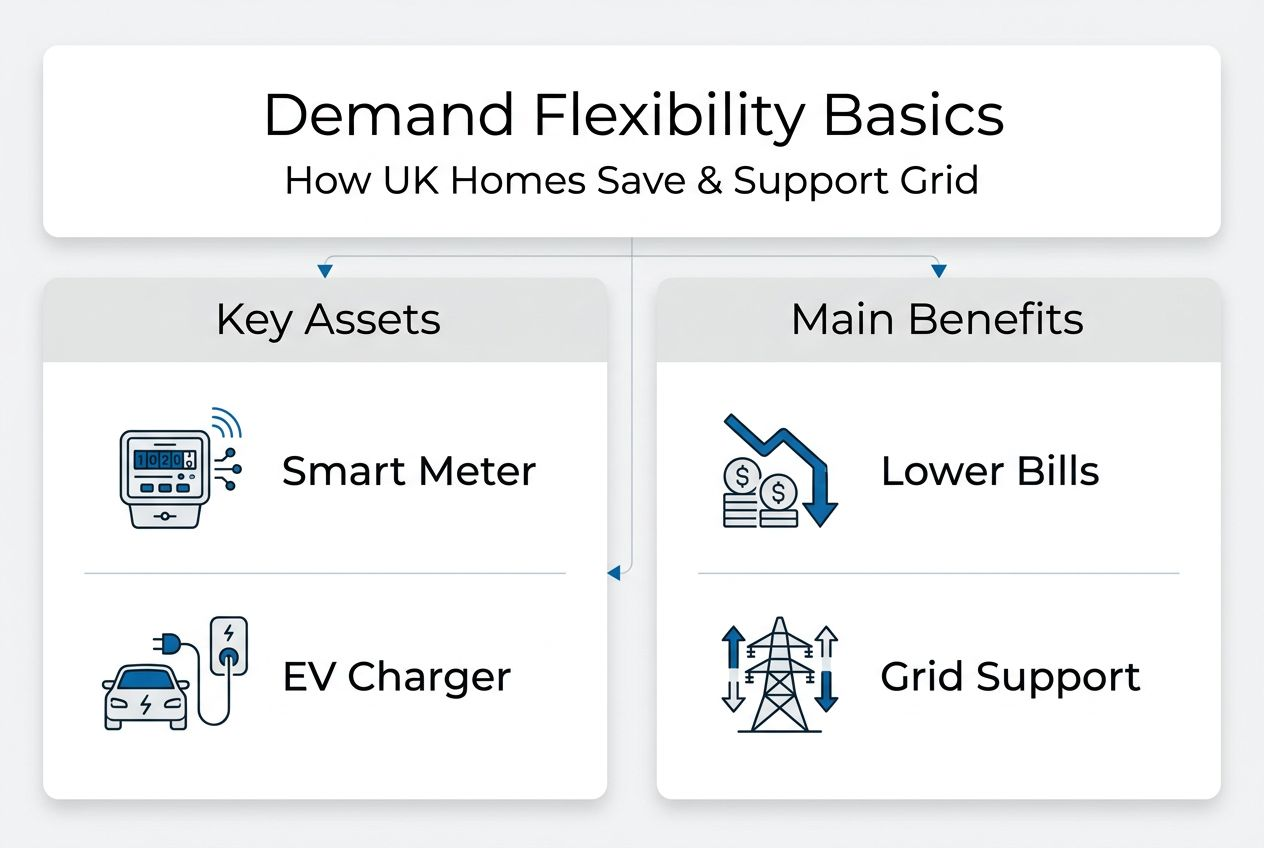
Smart meters and time-of-use tariffs are the primary enablers. Your meter tracks consumption in half-hourly intervals, allowing suppliers to charge different rates throughout the day. Peak periods cost more; off-peak periods cost less. The price signals encourage you to shift flexible loads away from expensive times.
Typical flexible home assets include:
- EV chargers that automatically charge overnight when rates drop
- Heat pumps programmed to warm your home during cheaper periods
- Smart washing machines and dishwashers scheduled for off-peak operation
- Battery storage systems that charge when electricity is cheap and discharge during peaks
- Smart thermostats that optimise heating patterns around tariff structures
Household flexibility is moving beyond traditional tariffs into sophisticated services where you’re paid for adjusting consumption during specific events. This benefits both your household budget and the wider energy system. When thousands of homes shift demand simultaneously, grid operators avoid firing up expensive backup generators and reduce carbon emissions.
Pro Tip: Start with simple changes like shifting laundry times to off-peak hours. Even without smart appliances, manual adjustments can save £100-200 annually on typical household bills.
The relevance for UK homes in 2026 is clear. Energy prices remain volatile, government regulations increasingly reward efficiency, and technology makes participation straightforward. Understanding demand flexibility isn’t optional anymore; it’s essential for managing costs and meeting compliance requirements.
How UK households participate in demand flexibility today
Current adoption trends reveal substantial growth in flexible energy technologies and services. Approximately 250,000 households now use Smart time-of-use tariffs, whilst 300,000 employ autonomous energy management systems that automatically adjust consumption based on price signals and grid needs. These numbers demonstrate that demand flexibility has moved from niche early adopters to mainstream practice.
Homeowners leverage various assets to participate. Heat pumps and EV chargers are particularly effective for flexibility services because they represent significant loads that can shift timing without compromising comfort or convenience. A typical EV charger might delay charging by two hours to capture cheaper rates, whilst a heat pump can pre-heat your home before peak pricing begins.
Aggregators play a crucial role in democratising access. These companies pool capacity from hundreds or thousands of smaller households, creating a combined flexible load large enough to participate in wholesale markets and grid services. You sign up through an app, grant the aggregator permission to adjust specific devices within parameters you set, and receive payments for your contribution. The technology handles everything automatically.
Benefits accumulate across multiple dimensions:
- Direct bill savings from shifting consumption to cheaper tariff periods
- Payments for participating in flexibility events and grid services
- Reduced carbon footprint by consuming more renewable energy
- Enhanced grid stability that prevents blackouts and reduces infrastructure costs
- Increased property value through efficient appliances and smart home features
The following table compares adoption rates and typical savings across different flexibility technologies:
| Technology | UK Households | Annual Savings | Flexibility Potential |
|---|---|---|---|
| Smart ToU tariffs | 250,000 | £150-250 | Moderate (manual shifting) |
| Autonomous systems | 300,000 | £200-350 | High (automated optimisation) |
| EV smart charging | 180,000 | £100-180 | High (large shiftable load) |
| Heat pump scheduling | 90,000 | £120-200 | Moderate (thermal storage) |
| Battery storage | 45,000 | £250-400 | Very high (bidirectional flow) |
These technologies often work together. A household with solar panels, battery storage, an EV charger, and a heat pump can orchestrate all assets through smart appliances that communicate and optimise collectively. The combined flexibility potential far exceeds individual components.

Participation requires minimal effort once systems are configured. Most homeowners report setting preferences initially, then forgetting about the technology as it operates autonomously. The financial returns justify the modest upfront investment in compatible devices and tariff switches.
The demand flexibility service and its impact on UK energy use
The UK Demand Flexibility Service (DFS) demonstrated how coordinated household participation can significantly impact grid operations. The DFS ran from January to March 2023, allowing National Grid ESO to access additional power during peak demand by incentivising consumers to reduce usage at specified times. This real-world trial validated the concept and provided valuable data on household behaviour.
Eligibility was straightforward. Households with smart meters received discounts for reducing usage during DFS events, typically lasting one to two hours during evening peaks. Suppliers notified participants in advance, giving time to plan adjustments. The financial incentive was compelling; households earned approximately £10 per event for saving electricity, with some earning over £100 across the trial period.
Practical participating behaviours included:
- Delaying cooking or using microwave instead of oven during events
- Pausing EV charging for the duration of the event window
- Reducing heating temporarily or pre-warming homes before events
- Avoiding use of washing machines, dishwashers, and tumble dryers
- Switching off non-essential appliances and devices
- Relying on battery storage if available
The DFS supported grid stability by reducing peak demand when supply was tightest and most expensive. Instead of firing up costly gas peaker plants or importing electricity at premium rates, National Grid accessed distributed flexibility from thousands of homes. This approach proved more economical and environmentally friendly than traditional solutions.
The trial’s success has informed ongoing development of demand side response mechanisms that will become increasingly important as the UK integrates more renewable generation. Wind and solar create variable supply that requires flexible demand to balance effectively. Future iterations of DFS or similar schemes will likely offer year-round participation with more sophisticated automation.
Pro Tip: Stay informed about future DFS or similar schemes through your energy supplier’s communications. Early participants often receive better rates and more generous incentives as programmes launch.
The wider energy market impact extends beyond immediate cost savings. DFS validated that UK households can collectively provide gigawatts of flexible capacity, comparable to large power stations. This capacity reduces the need for expensive infrastructure investments and accelerates the transition to renewable energy by solving the intermittency challenge.
Regulatory changes and compliance: What landlords and homeowners need to know
Regulatory pressure is mounting for property owners to improve energy performance. Landlords must ensure properties meet EPC C standards by October 2030 unless exempt, representing a significant compliance deadline that affects hundreds of thousands of rental properties. This requirement fundamentally changes investment priorities and property management strategies.
The EPC regime uses a two-step methodology focusing on fabric performance and heating or smart readiness metrics. Fabric performance covers insulation, glazing, and air tightness. The heating or smart readiness metric evaluates how efficiently the property generates and manages heat, including consideration of demand flexibility technologies. This dual approach recognises that modern energy efficiency requires both passive measures and active management.
Comparing traditional standards with new requirements reveals substantial differences:
| Aspect | Traditional EPC | New EPC C Standard |
|---|---|---|
| Focus | Static energy rating | Dynamic performance + smart readiness |
| Technology role | Limited consideration | Central to compliance pathway |
| Flexibility features | Not assessed | Contributes to smart readiness metric |
| Compliance timeline | Gradual voluntary uptake | Mandatory by October 2030 |
| Enforcement | Weak penalties | Substantial fines for non-compliance |
Demand flexibility technology directly supports the smart readiness metric. Properties equipped with smart thermostats, heat pumps with scheduling capabilities, EV charging points, and energy management systems score higher than those relying solely on basic heating controls. This creates a clear incentive for landlords to invest in flexibility-enabling technologies as part of their compliance strategy.
Landlords should follow these numbered steps to prepare:
- Assess current EPC ratings for all properties and identify those below C standard requiring upgrades
- Upgrade fabric performance first through insulation, glazing improvements, and draught-proofing to maximise efficiency gains
- Adopt efficient heating technology such as heat pumps or smart controls that contribute to both heating efficiency and smart readiness metrics
- Monitor compliance regularly through updated EPC assessments as improvements are completed and technology is installed
- Document all upgrades and retain evidence for compliance verification and potential exemption applications
Understanding energy performance standards helps prioritise investments. Some properties may reach EPC C through fabric improvements alone, whilst others require comprehensive technology upgrades. The most cost-effective pathway depends on property characteristics, existing systems, and budget constraints.
Implementing compliant home energy habits and workflows ensures ongoing performance meets regulatory expectations. Technology installation alone isn’t sufficient; properties must demonstrate actual energy efficiency through consumption patterns and management practices. This operational dimension of compliance will likely receive increased scrutiny as regulations mature.
The regulatory landscape continues evolving. Future updates may tighten standards further, introduce dynamic compliance monitoring, or expand smart readiness requirements. Staying ahead of minimum standards protects property values and rental income whilst positioning portfolios for upcoming changes.
Explore home energy models and improve your property’s efficiency
Now that you understand demand flexibility and its regulatory implications, exploring detailed home energy models helps translate knowledge into action. Our comprehensive guides explain different types of home energy models specifically for landlords, covering assessment methodologies, compliance pathways, and technology integration strategies that support both EPC requirements and demand flexibility goals.
The Home Energy Model explained for UK properties provides technical depth on how the new government methodology assesses building performance, replacing SAP with more sophisticated calculations that better reflect real-world energy use and smart technology benefits. Understanding these models empowers informed decisions about upgrades and investments.
Our energy performance guide offers practical frameworks for improving building efficiency through coordinated fabric improvements, heating system upgrades, and demand flexibility technology. These resources combine regulatory compliance with financial optimisation, helping you maximise returns whilst meeting standards.
What is demand flexibility in simple terms?
Demand flexibility means changing when and how you use electricity to save costs and support the energy grid. Instead of running appliances whenever convenient, you shift usage to times when electricity is cheaper and cleaner. Smart meters and time-of-use tariffs make this practical by charging different rates throughout the day, rewarding you for avoiding peak periods.
How can I participate in demand flexibility as a homeowner?
Use smart meters and efficient appliances like heat pumps or EV chargers that can adjust energy use automatically. Consider joining flexibility schemes through your energy supplier or work with aggregators if you have compatible devices. Many programmes require minimal setup and operate autonomously once configured, delivering savings without ongoing effort.
What are the benefits of demand flexibility for UK landlords?
Demand flexibility helps meet EPC C compliance deadlines by contributing to smart readiness metrics and improves property value through modern, efficient technology. It offers potential bill savings that make properties more attractive to tenants and generates additional income through participation in flexibility services. Understanding energy performance standards shows how flexibility features enhance compliance pathways.
Will demand flexibility increase my energy bills?
When managed well, demand flexibility typically lowers bills by shifting usage to cheaper times and earning payments for grid services. Locational and time-of-use electricity pricing could save up to £200 per household annually by 2040 according to recent research. New tariffs and pricing structures aim to protect consumers from price spikes whilst rewarding flexible behaviour, creating net savings for most participants.