
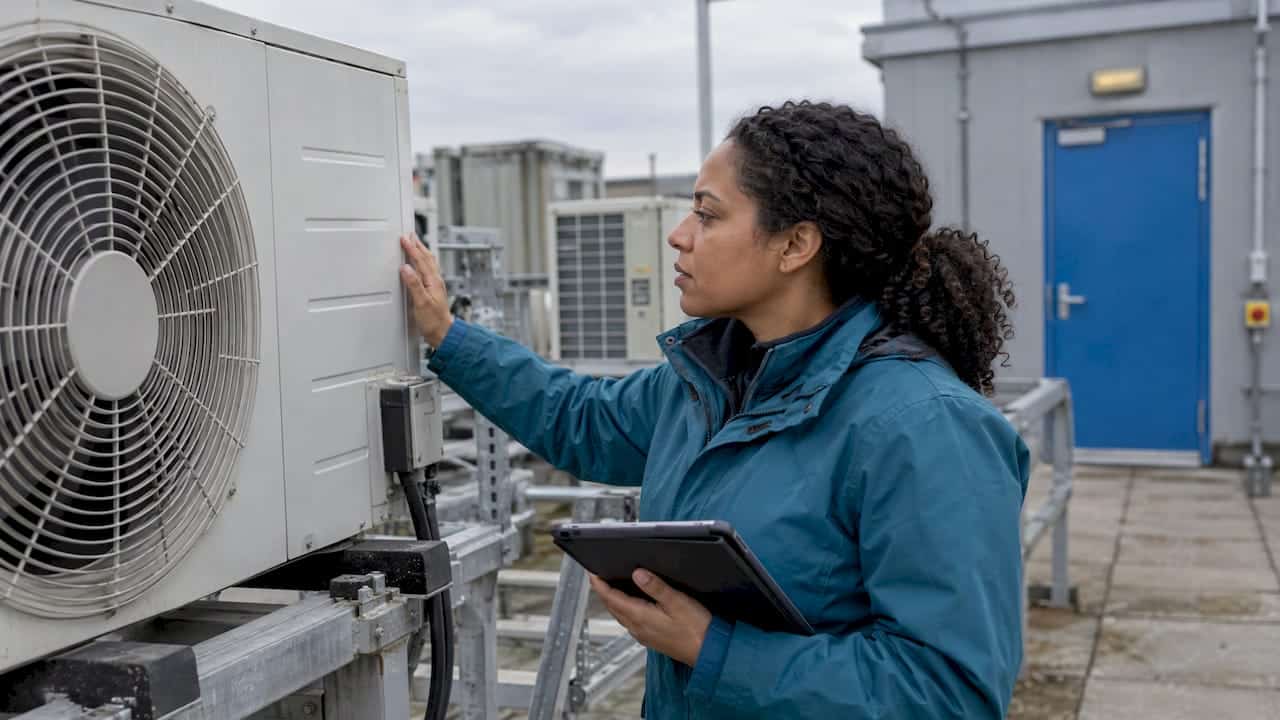
There is no single fixed price for a TM44 inspection. The fee depends on the assessor and on how many air conditioning units a building has, how easy they are to reach and how complete the records are. Small sites with a few split units sit at the low end of what assessors quote. Large buildings with central plant and many units cost considerably more. A quote request through our TM44 inspection service is the quickest way to get a figure for your own building, because the number of units and the access arrangements decide the price.
This guide explains what the fee covers, what moves it up or down, who has to pay it, what a missing report can cost, and how to get the most from the report once you have it.
TL;DR
- A TM44 inspection is the legal air conditioning inspection for England and Wales. It is required at least every 5 years for systems with an effective rated output above 12kW, and the person controlling the system must arrange it.
- The assessor’s fee varies with the assessor you choose, as GOV.UK states. In practice it follows the number and accessibility of units, not floor area.
- Having no valid report can bring a £300 fine, with a further £200 if no report is produced within 7 days, so the inspection fee is usually the smaller cost.
- Gathering unit details and arranging access before the visit shortens the time on site.
- Several small units owned or operated by one business can add up past 12kW and trigger the duty.
Table of Contents
- What a TM44 inspection is
- What does a TM44 inspection cost?
- What pushes the price up or down
- What the report includes
- What happens if you do not have a report
- How to get an accurate quote
- Getting value from the report
- Worked example: a small office
- Our view on TM44 costs
- Request a TM44 inspection quote
- FAQ
- Sources
What a TM44 inspection is
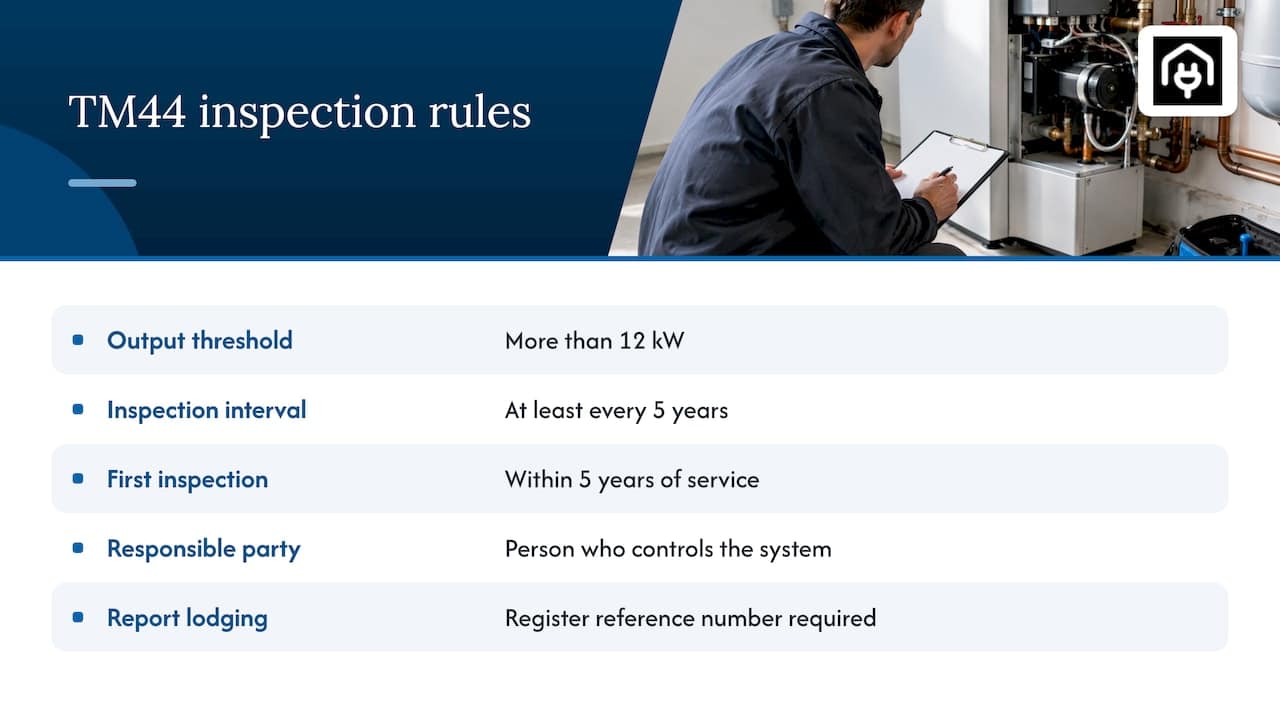
TM44 is the name commonly used for the inspection of air conditioning systems required by the Energy Performance of Buildings (England and Wales) Regulations 2012. GOV.UK’s guide to air conditioning inspections, updated on 5 November 2026, sets the rule: any system with an effective rated output of more than 12kW must be inspected by an accredited energy assessor at least every 5 years. The first inspection is due within 5 years of the system being put into service. The report must then be lodged on the Energy Performance of Buildings Register, where it receives a reference number.
Effective rated output is the cooling capacity of the system, shown on the manufacturer’s data plate. Where one business operates several units, their outputs are added together. Three 5kW wall-mounted splits come to 15kW and are inside the rule, even though no single unit looks large.
The duty falls on the person who controls the system. In a single-occupier building that is the occupier. In a multi-let building it depends on the lease and on who operates the plant, so a tenant sharing a ceiling cassette system may be the responsible party without realising it. Residential buildings are not covered. The rules in Scotland differ, so this article covers England and Wales only.
What does a TM44 inspection cost?
GOV.UK is plain about it: you are charged for the inspection, and the fee varies depending on the energy assessor you choose. No official tariff exists. Assessors quote per job, and quotes reflect the building rather than a standard rate.
As a working guide, quotes for a small site with a handful of split units are usually a few hundred pounds. Costs rise with the number of units and the complexity of the installation, and very large buildings with extensive plant can run into the thousands. Treat any single figure you see online as a rough marker. Published ranges differ from one provider to another, they are not official, and they date quickly.
What matters more than the headline figure is what the quote includes. A complete quote should cover:
- the site visit and inspection of the accessible parts of the system;
- the written report with recommendations;
- lodgement of the report on the national register;
- the valid reference number you need as proof of compliance.
The lodgement step is part of making the inspection legal. A report that is not lodged does not give you a reference number, so check it is covered before comparing prices.
What pushes the price up or down
Assessors generally price on the number of units and how accessible they are. Floor area and total cooling load play a smaller part. These are the factors that usually decide the fee.
Number and type of units
Every indoor and outdoor unit has to be identified and assessed. A small office with two or three splits is quick. A floor-by-floor installation with dozens of cassettes, or a centralised system with chillers, air handling units and ductwork, takes far longer.
Access to plant
Since 2015 the duty applies to the accessible parts of a system, so an assessor does not have to open sealed plant. Inaccessible units still count towards the 12kW threshold, however. Locked plant rooms, risers with no key holder, roof access that needs permits and out-of-hours entry all add time, and time is what the fee pays for.
Quality of records
The inspection looks at maintenance, controls and system sizing. If data plates are missing or unreadable and there is no asset register, the assessor has to establish the details on site. A building with a clear schedule of units, installation dates and maintenance history is quicker to inspect.
Number of sites
A portfolio of similar buildings can often be arranged as a batch, which makes scheduling more efficient. Ask for all sites to be quoted together instead of one at a time.
What the report includes
The cost buys a defined document, not just a visit. Under the GOV.UK guide the report must cover at least:
- the likely efficiency of the system, with suggestions for improvement;
- faults identified and suggested actions;
- how well the equipment is maintained;
- how adequate the installed controls and settings are;
- the size of the installed system compared with the cooling load;
- whether the system can optimise its performance under typical operating conditions;
- a summary of findings and key recommendations.
It must also record the building address, the assessor’s name and employer, the inspection date, the accreditation scheme and the reference number generated when it is lodged. Keep the report: the local authority can ask to see it, and Trading Standards enforces the rule.
What happens if you do not have a report
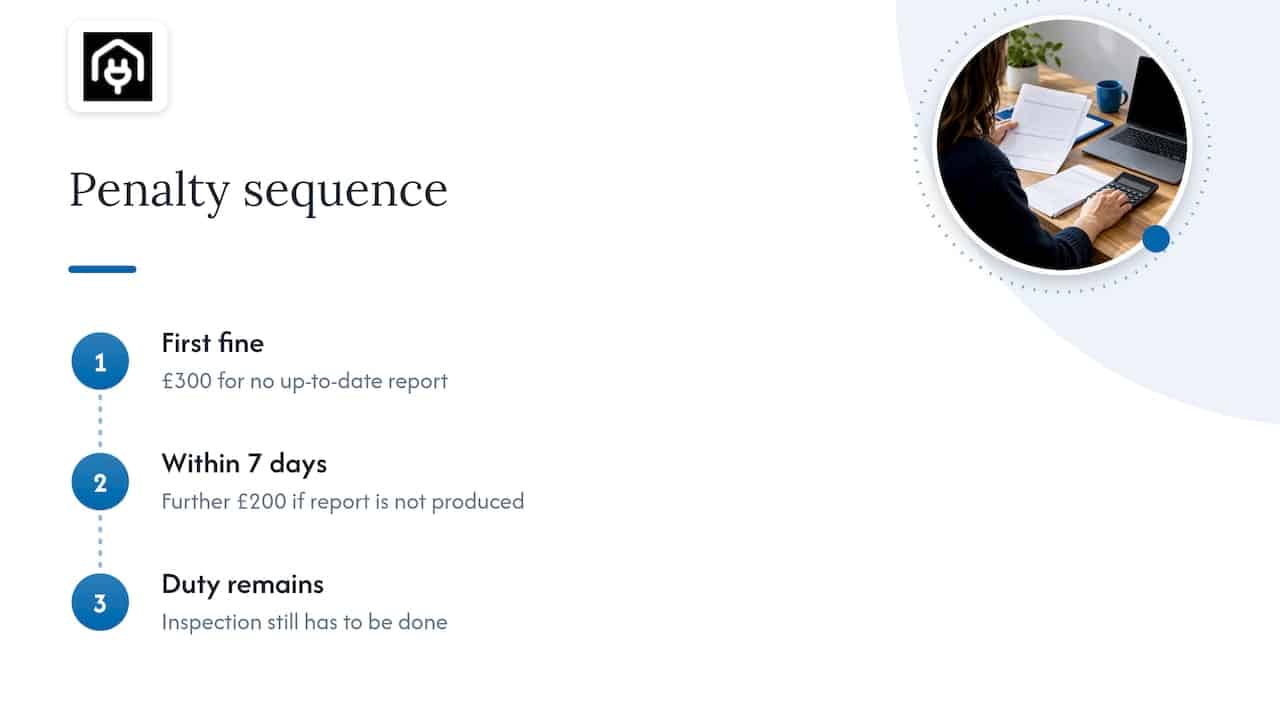
The Federation of Small Businesses says that landlords and building owners with no up-to-date air conditioning inspection report can be fined £300, plus a further £200 if no report is produced within 7 days of the first fine. GOV.UK confirms that a penalty applies if inspections are not carried out every 5 years. A fine does not remove the duty. The inspection still has to be done, so you pay the fee as well.
For a landlord with several units across a building, the practical conclusion is simple. Arranging the inspection before a penalty arrives costs less and avoids the enforcement process altogether.
How to get an accurate quote
A good quote needs a short list of facts. Collect these first and the figure you get back will be firm rather than an estimate.
- List every unit. Note the make, model, location and effective rated output from each data plate. Add the outputs up per operator to confirm the 12kW threshold is passed.
- Establish who is responsible. Check the lease or management agreement. The controller of the system is the one who must commission the report.
- Find the last report. If a report exists, its date sets the next deadline. Reports last 5 years from the inspection date.
- Arrange access. Confirm keys, plant room entry, roof access and any out-of-hours requirements before the visit.
- Gather maintenance records. Service sheets, refrigerant logs and control settings help the assessor complete the report quickly.
- Ask for the full scope in writing. The quote should state that the assessor is accredited, that the report is lodged on the register and that the reference number is issued.
We handle TM44 requests through an online quote form. The form is where you submit the building details above, so the quote reflects the actual installation.
Getting value from the report
The law requires the inspection. It does not require you to act on the recommendations. Even so, the report is useful. As the Federation of Small Businesses notes, TM44 inspections show how energy-efficient a system is and where money can be saved, which helps landlords identify when less efficient systems are worth replacing.
The usual findings are practical and low cost: controls and set-points adjusted, servicing brought up to date, leaks addressed, and units sized more sensibly for the load they serve. Where the report points to an older system, it gives you evidence for a replacement decision. Owners who want to go further on keeping equipment running efficiently between inspections can read about HVAC predictive maintenance, which uses monitoring data to spot faults early.
Space that overheats is a separate question from air conditioning efficiency. Our guides on overheating assessment under TM52 and TM59 cover it, and the TM44 guide explains how the inspection fits alongside the other compliance reports a building may need.
Worked example: a small office
Take a ground-floor office with three 5kW wall-mounted splits, all operated by the one tenant. Combined, they provide 15kW, which is above the 12kW threshold, so a TM44 inspection is required. The tenant:
- lists the three units from their data plates and confirms the 15kW total;
- checks the lease, which makes the tenant the operator of the equipment;
- confirms there is no earlier report and so the first inspection is overdue;
- gives the assessor access during working hours and supplies the service records;
- receives the lodged report with its reference number and files it for the next 5 years.
Three accessible units and good records make this a short visit, which is why such sites sit at the lower end of what assessors quote. The same tenant with locked plant and no records would take longer to inspect and would be quoted more.
Our view on TM44 costs
Most people ask about price first, and the price is the less important part. The thing that decides whether a TM44 job goes smoothly is preparation. A tidy unit list, a named responsible person and access arranged in advance turn a vague estimate into a firm quote.
We built our TM44 service around the same compliance detail that sits behind the rest of our guidance on EPCs, SAP calculations and energy standards. Owners and managers who handle these requirements together tend to find the whole process easier to track, because the same property details feed several reports.
Our advice is to treat the inspection as a useful audit and not as a box to tick. The report tells you what your system is doing, and the recommendations are often simple to carry out. Submit the building details through our quote form and you will have a clear next step.
Danny
Request a TM44 inspection quote
If your building has air conditioning above 12kW in total, our TM44 inspection page sets out the service and gives you a form to request a quote. We also offer commercial EPCs, which suit owners who need both reports for the same building.

Have the unit list and access details ready when you submit the form. The quote then reflects your actual installation.
FAQ
Do I need a TM44 inspection?
Yes, if you control an air conditioning system or a group of systems with a combined effective rated output above 12kW in a building in England or Wales. The inspection must be repeated at least every 5 years. Residential buildings are not covered by the requirement.
How often does a TM44 report need renewing?
At least every 5 years. The first inspection is due within 5 years of the system being put into service. The new report must be lodged on the Energy Performance of Buildings Register to count.
Who pays for the inspection?
The person who controls the system is responsible for arranging and paying for it. In a let building, that depends on the lease and on who operates the plant. Check the agreement before commissioning the report, so the right party instructs the assessor.
Is the inspection fee the same for every assessor?
No. GOV.UK states that the fee varies depending on the assessor you choose. Quotes follow the number of units and how easy they are to reach, so a building with good records and open access is generally cheaper to inspect.
Sources
- Air conditioning inspections for buildings: a guide to air conditioning inspections, GOV.UK
- Get your air conditioning system inspected, GOV.UK
- How landlords can support net zero targets, Federation of Small Businesses