

TL;DR:
- The Smart Export Guarantee is a UK government scheme that provides payments to small-scale generators exporting low-carbon electricity to the grid, mainly solar PV systems. Property owners must install certified systems, record exports with smart meters, and choose from tariffs offered individually by energy suppliers, with rates varying and often tied to import arrangements. In Year 5, the scheme paid nearly £57 million to over 270,000 installations, predominantly solar PV, with actual earnings influenced by system size, location, and tariff conditions.
Nearly every new solar installation in the UK now benefits from payments through the Smart Export Guarantee, yet many property owners and landlords still have only a vague idea of how it actually works or what it pays. The SEG scheme has quietly become one of the most accessible financial incentives in the UK property sector, yet confusion around tariff types, eligibility, and realistic returns persists. This guide cuts through that confusion, explains the mechanics clearly, and shows how landlords and property owners can make better-informed decisions about solar and other low-carbon technology installations.
Table of Contents
- What is the Smart Export Guarantee?
- How does SEG work for UK property owners?
- Understanding mandatory and tied SEG tariffs
- The real impact: SEG uptake, export volumes and financial outcomes
- Why SEG returns are often misunderstood—and what savvy landlords should do
- Connect SEG to your property’s wider energy strategy
- Frequently asked questions
Key Takeaways
| Point | Details |
|---|---|
| SEG rewards low-carbon exports | The Smart Export Guarantee pays property owners for exporting low-carbon electricity like solar PV to the National Grid. |
| Tariff type affects earnings | Mandatory and tied tariffs have different rules, so check the conditions to ensure you get the advertised rate. |
| Solar PV dominates SEG | Nearly all SEG participants use solar PV, reflecting its popularity and compatibility with the scheme. |
| Returns are significant but variable | SEG paid out nearly £57 million in 2024-2025, but actual earnings depend on export volumes and your chosen tariff. |
| Review your energy strategy | Integrating SEG with wider energy efficiency initiatives will maximise the value of your property investments. |
What is the Smart Export Guarantee?
The Smart Export Guarantee, or SEG, is a government-backed scheme that ensures small-scale generators receive payment for low-carbon electricity they export to the National Grid. According to Ofgem, the SEG scheme pays small-scale generators for exporting low-carbon electricity to the National Grid, covering technologies such as solar photovoltaic (PV), wind, hydro, micro combined heat and power (micro-CHP), and anaerobic digestion.
The SEG launched in January 2020, replacing the now-closed Feed-in Tariff (FiT). The FiT offered guaranteed rates set by the government, whereas the SEG requires energy suppliers to offer export payments but allows them to set their own rates. This is an important distinction. Rates under the SEG vary between suppliers and can change over time, which means property owners need to stay informed rather than assuming a fixed return.
To be eligible, generators must:
- Use a qualifying low-carbon technology (solar PV, wind, hydro, micro-CHP, or anaerobic digestion)
- Have a system with a capacity of 5 megawatts (MW) or less (50kW for micro-CHP)
- Have an export meter installed to record the exact volume of electricity sent to the grid
- Hold a valid Microgeneration Certification Scheme (MCS) certificate or equivalent for their installation
Any electricity supplier with 150,000 or more domestic customers is classified as an SEG licensee and must participate in the scheme. Understanding the energy saving trust explained resources available alongside SEG eligibility is also worthwhile, particularly for landlords assessing multiple properties. For those wondering whether their property falls under exemptions from current energy regulations, the EPC exemption rules offer useful guidance on where those boundaries lie.
Key point: The SEG is not a single national tariff. It is a legal requirement on large suppliers to offer at least one export tariff. The rate, structure, and conditions are set by each supplier individually.
How does SEG work for UK property owners?
Once a qualifying technology is installed and certified, the process of accessing SEG payments follows a clear sequence. Understanding each stage helps property owners avoid delays and missed payments.
- Installation and certification. Ensure the system is installed by an MCS-accredited installer and that the MCS certificate is issued. This is a prerequisite for SEG eligibility.
- Export meter installation. A smart meter capable of recording half-hourly export data must be in place. Many suppliers require this before registering a generator.
- Choose a SEG licensee. Review the available tariffs from qualifying suppliers. Compare both the rate per kilowatt-hour (kWh) and any conditions attached.
- Register with the supplier. Submit an application along with your MCS certificate and installation details. The supplier will verify eligibility and set up the account.
- Receive payments. Payments are made periodically, typically monthly or quarterly, based on the volume of electricity exported as recorded by the smart meter.
SEG licensees must offer at least one export tariff to any eligible small-scale generator, which means no qualifying generator can be turned away from the scheme entirely, though the rates on offer will differ.
The scale of SEG uptake is substantial. By the end of SEG Year 5, there were 270,395 installations registered, with 99.98% being solar PV. This confirms solar PV as the overwhelmingly dominant technology under the scheme. For property owners considering which technology to invest in, this concentration is telling. Solar PV delivers consistent, measurable returns and the installation base is well understood by suppliers and assessors alike.
For those interested in how solar installations affect overall property energy ratings, the guide on solar PV and energy ratings provides detailed context on the relationship between panel installations and Energy Performance Certificate scores.
Pro Tip: Maximising the size and south-facing orientation of a solar PV installation directly increases the volume of electricity exported and, therefore, the SEG income generated. Even small adjustments to panel placement can meaningfully improve annual yield figures.
Understanding mandatory and tied SEG tariffs
One of the most commonly misunderstood aspects of the SEG is the distinction between mandatory and tied tariffs. Both exist within the scheme, and both are legitimate, but they carry very different implications for property owners.
SEG licensees can offer both mandatory and tied tariffs; tied tariffs are conditional on arrangements such as importing electricity from the same supplier or purchasing certain products. Understanding this difference before committing to any agreement is essential.
| Tariff type | Available to | Conditions | Typical rate |
|---|---|---|---|
| Mandatory | All eligible generators | None | Lower, universally available |
| Tied | Existing customers | Must import from same supplier or meet other criteria | Often higher, but conditional |
Mandatory tariffs are exactly what they sound like. Any eligible generator can access them regardless of who supplies their imported electricity. These rates tend to be more modest because there is no additional customer relationship generating value for the supplier.
Tied tariffs typically offer higher rates per kWh but require the generator to fulfil specific conditions. The most common condition is that the property must also purchase its imported electricity from the same supplier. Some tied tariffs require the purchase of a linked product, such as a home battery storage system or a specific energy management device. If those conditions change, such as switching away from the supplier for import electricity, the generator may lose access to the higher tied rate and fall back to a mandatory tariff or need to reapply elsewhere.
This has real consequences for landlords managing multiple properties or those who switch energy suppliers regularly. For a detailed look at how these structures interact with wider property energy costs, the guide on electricity tariffs for landlords and the overview of energy tariff structures both provide practical insight. If a review of current supplier arrangements suggests that switching could yield a better deal overall, the guide to switching suppliers and SEG explains how to manage the transition without losing SEG registration.
Pro Tip: Before signing up to a tied tariff, calculate the total cost of meeting its conditions, including import electricity costs from that specific supplier, not just the export rate offered. A higher export rate does not always mean a better overall outcome.
The real impact: SEG uptake, export volumes and financial outcomes
The headline figures from SEG Year 5 paint a clear picture of the scheme’s current scale and financial significance.
In SEG Year 5, £56.97 million was paid to registered installations, with 443.1 GWh of electricity exported to the National Grid. These are not trivial numbers. They represent real income flowing back to property owners across the UK as a direct result of generating and exporting low-carbon electricity.

| Metric | SEG Year 5 figure |
|---|---|
| Total registered installations | 270,395 |
| Proportion that are solar PV | 99.98% |
| Total electricity exported | 443.1 GWh |
| Total payments made | £56.97 million |
| Average payment per installation | Approximately £211 |
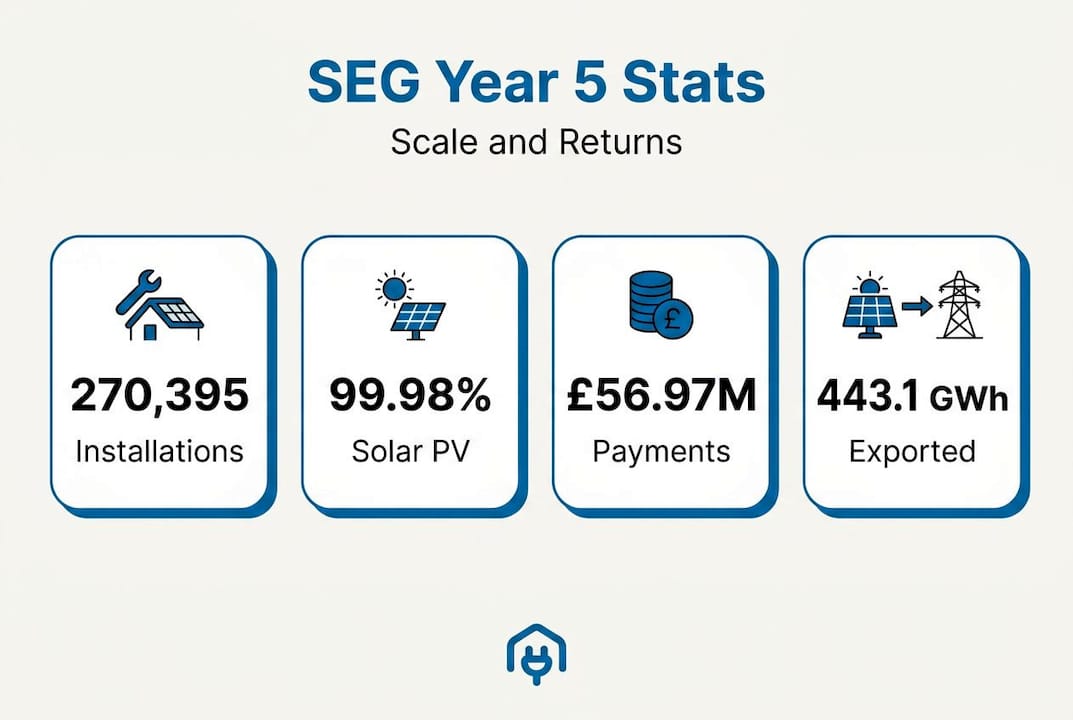
Breaking those figures down, the average payment per installation across Year 5 comes to approximately £211. However, this average masks considerable variation. Properties with larger systems, better orientation, or battery storage that allows more strategic exporting will see higher returns. A well-positioned 4kWp solar PV system on a south-facing roof in southern England might export significantly more than a similarly sized system in northern Scotland or on a partially shaded east-facing roof.
Key factors that influence actual SEG income include:
- System size: Larger systems generate and export more electricity
- Location: Solar irradiance varies significantly across the UK
- Self-consumption patterns: The less electricity consumed on-site, the more is available for export
- Battery storage: Storing surplus generation for export during higher-tariff periods can increase income
- Tariff rate secured: Rates vary between suppliers and tariff types
In perspective: £56.97 million paid out across 270,395 installations in a single year shows the SEG is generating meaningful income for property owners at scale. For landlords weighing up the return on a solar installation, this data provides a realistic baseline.
For a fuller picture of how SEG income interacts with overall energy costs at property level, the guide on energy bills and SEG is a useful companion. Landlords seeking to combine SEG with other financial incentives will also find the overview of renewable incentives for landlords informative.
Why SEG returns are often misunderstood—and what savvy landlords should do
There is a persistent gap between what property owners expect from SEG and what they actually receive. This gap does not arise from the scheme being poorly designed. It arises from a tendency to evaluate SEG on headline tariff rates alone, without accounting for the full picture.
The value of a SEG tariff may be tied, meaning it depends on other behaviours, such as who supplies imported electricity or linked product purchases, so the headline rate may not be broadly available. A landlord who sees a tariff advertising 15p per kWh for exports may discover, after reading the small print, that this rate requires importing electricity from the same supplier at a rate that makes the overall deal less attractive than a lower export rate on a mandatory tariff.
The most effective approach is to assess SEG not as a standalone income source but as one component of a broader energy strategy. Landlords who integrate solar PV with battery storage, time-of-use import tariffs, and smart energy management systems consistently report better overall outcomes than those who simply install panels and take the first available export deal. Understanding time of use tariffs is particularly relevant here, as the ability to shift export to higher-value periods can meaningfully increase annual income from the same physical installation.
There is also the question of what SEG does to a property’s Energy Performance Certificate rating. Solar PV installations can improve EPC scores, which is directly relevant to landlords facing tightening minimum energy efficiency standards. A property with a better EPC rating carries lower regulatory risk, greater tenant appeal, and often a stronger resale or rental value. Treating solar PV as purely an income-generating asset undervalues its contribution to long-term property performance.
Before committing to a SEG tariff, landlords should ask: Is this a mandatory or tied tariff? What are the specific conditions attached? How does the export rate compare once import costs from the required supplier are factored in? How often can the rate change? What happens to registration if the supplier relationship ends?
The landlords who extract the most value from SEG are those who treat it as part of a considered energy investment strategy rather than a passive benefit that arrives automatically.
Connect SEG to your property’s wider energy strategy
Understanding SEG is only part of the picture. Landlords and property owners who want to maximise returns need to assess how solar PV and export income fit within the broader energy performance of each property. The types of home energy models for landlords provides a practical framework for evaluating how different interventions, including solar PV, interact with the fabric and systems of a building. For those newer to the subject, the home energy model explained breaks down the methodology that will replace SAP as the UK’s standard energy assessment tool from 2025 onwards. Landlords who want to go further and model the performance of specific properties before committing to installation costs will find the energy simulation guide an invaluable starting point. Taking a whole-property approach to energy planning, rather than viewing SEG as an isolated scheme, is the clearest path to confident, compliant, and profitable property management.
Frequently asked questions
Who qualifies for the Smart Export Guarantee?
Property owners qualify for SEG if they generate low-carbon electricity using technology such as solar PV, wind, hydro, micro combined heat and power, or anaerobic digestion, and export it to the National Grid. The system must also be MCS-certified and have an export meter in place.
How much can I earn from SEG payments?
Earnings depend on the volume of electricity exported and the tariff secured; in SEG Year 5, £56.97 million was paid across all registered installations, giving an average of approximately £211 per installation, though larger or better-positioned systems earn considerably more.
What is the difference between mandatory and tied SEG tariffs?
Mandatory tariffs must be offered to all eligible generators regardless of their import arrangements, while tied tariffs are conditional upon meeting extra criteria such as importing electricity from the same supplier. Tied tariffs often advertise higher rates but the conditions attached can reduce the net benefit.
Is SEG only for solar PV installations?
The SEG covers several technologies, but 99.98% of registered installations by the end of Year 5 were solar PV, making it by far the dominant technology under the scheme.
Can SEG payments work alongside other government incentives?
SEG can often be used in combination with other schemes such as the Boiler Upgrade Scheme or local authority grants, but it is important to check individual terms carefully, as some incentives carry conditions that could affect eligibility or overlap with SEG requirements.
Recommended
- London’s Guide to EPC: What You Need to Know to Boost Property Value – Home Energy Model
- London’s Ultimate Guide to Energy Performance Certificates: Enhance Your Property’s Efficiency – Home Energy Model
- EPC Essentials: How London Property Owners Can Improve Their Ratings – Home Energy Model
- 7 Key Renewable Energy Incentives for UK Landlords
- 7 Key Advantages of Home Solar Systems for UK Homeowners – Skyenergi