

What does an EPC rating mean for your property?
An Energy Performance Certificate (EPC) gives a property an energy efficiency rating from A to G, where A is the most efficient and G the least. The rating reflects the building’s fabric and fixed services, not how any particular occupant uses the property. Understanding the meaning of EPC rating is straightforward once you know what the scale represents and how it is calculated.
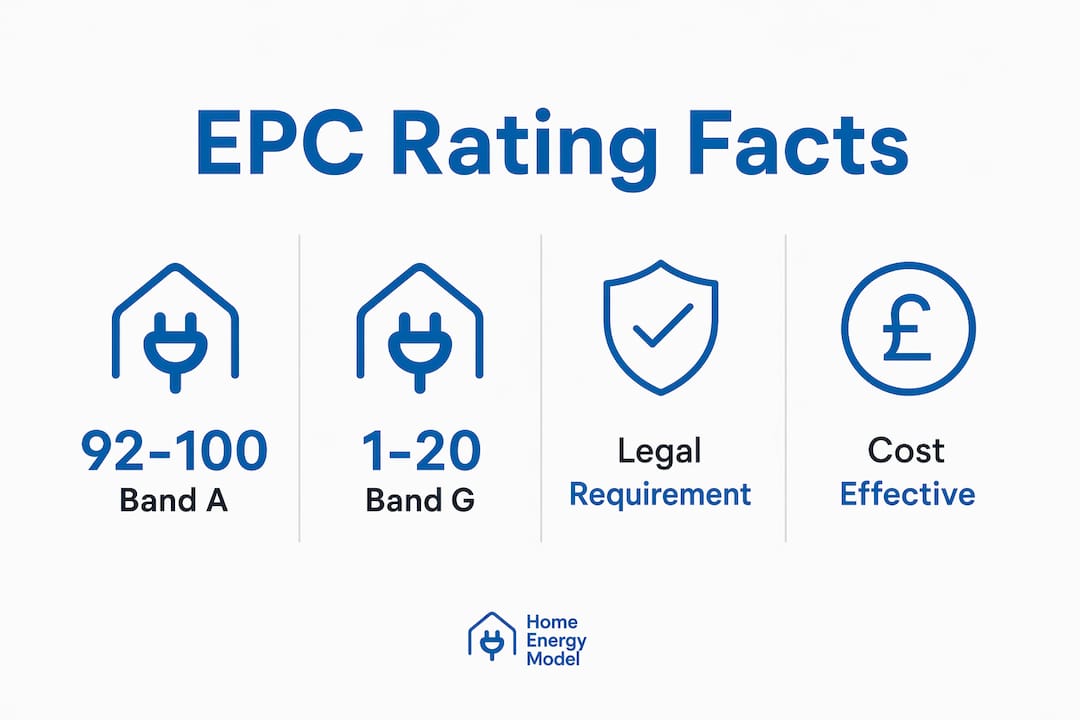
The rating derives from a SAP (Standard Assessment Procedure) score, which runs from 1 to 100. Each letter band corresponds to a defined score range:
- A: top band score range
- B: second band score range
- C: mid-band score range
- D: mid-lower band score range
- E: lower mid band score range
- F: low band score range
- G: bottom band score range
These SAP score ranges are set by the UK government and apply to all domestic properties in England and Wales. A higher score means lower estimated fuel bills and a smaller carbon footprint. EPCs are mandatory for building, selling, or renting any property in the UK and remain valid for 10 years.
The certificate also carries a potential rating, showing an improved band a property could reach if recommended cost-effective improvements were implemented. This distinction between current and potential rating is one of the most practically useful elements of the document for owners planning upgrades.
Pro Tip: Many homes in England and Wales generally have a mid-spectrum EPC rating. Government proposals aim to raise the minimum for rental properties in coming years, so landlords with lower-rated stock should plan ahead.
What else does an EPC tell you beyond the headline rating?
The letter grade is only the starting point. An EPC contains several additional layers of information that make it a useful planning tool.
- Environmental Impact Rating (EIR): A secondary A–G rating based on the property’s estimated CO₂ emissions. It appears on the certificate but is not the headline metric for domestic properties.
- Estimated running costs: Annual figures for heating, hot water, and lighting based on standard occupancy assumptions. These are modelled estimates, not predictions of actual bills, because occupant behaviour such as thermostat settings and usage hours is not factored in.
- Recommendation report: A list of cost-effective improvements and further measures, each with an indicative cost, typical annual saving, and the rating the property would achieve after implementation.
- Potential rating: The band achievable if all cost-effective recommendations are carried out.
- Property details: Floor area, property type, and the main construction features assessed during the survey.
The recommendation report is often the most overlooked section. There is no legal obligation to act on any of the suggestions, but the report provides a prioritised, costed roadmap for improving efficiency and reducing bills. Owners who read it carefully are better placed to decide which upgrades offer the best return.
When are you legally required to have an EPC?
EPCs are a legal requirement in three circumstances: when a property is built, when it is sold, and when it is let. The obligation falls on the seller or landlord, not the buyer or tenant.
- Marketing obligation: The EPC rating must appear in all commercial media, including property listings, brochures, and websites, from the earliest point of marketing.
- Free provision: A valid EPC must be made available free of charge to any prospective buyer or tenant who requests information about the property or arranges a viewing.
- Final transfer: The seller or landlord must give a copy of the EPC to the person who ultimately becomes the buyer or tenant.
- Penalties: Failure to comply with EPC regulations in England and Wales can result in financial penalties. The specific fine level depends on the property type and the nature of the breach.
- Validity and renewal: An EPC is valid for 10 years. If substantial energy efficiency improvements are made, owners should commission a new assessment to reflect the updated rating, since the existing certificate will not automatically change.
- Exemptions: Certain property types are exempt, including listed buildings where compliance would unacceptably alter their character, and buildings used as places of worship.
For landlords, the Minimum Energy Efficiency Standards (MEES) add a further layer. Properties in England and Wales must currently hold at least an E rating before a new tenancy can be granted, unless a valid exemption is registered. Guidance on navigating EPC exemptions is available for landlords with properties that fall below the threshold.
How do you get an EPC and what does it cost?
Only a qualified domestic energy assessor (DEA) can produce a valid EPC for a residential property. Assessors must be accredited by an approved scheme, and their certificates are lodged on the national EPC register maintained by the government.
- Booking: Property owners can find an accredited assessor through the government’s official service or by contacting an accreditation scheme directly.
- The survey: An assessor visits the property and collects data on construction, insulation, heating systems, windows, and lighting. A typical domestic survey takes between 45 minutes and an hour, depending on property size.
- Cost: Fees vary by property size, type, and location. There is no fixed national rate, so obtaining more than one quote is advisable.
- Existing certificates: Before commissioning a new assessment, owners can check whether a valid EPC already exists by searching the national EPC register. Certificates issued within the last 10 years remain legally valid.
- Commercial properties: Non-domestic EPCs require a non-domestic energy assessor with the appropriate accreditation level for the building type. The process and cost differ from residential assessments.
Homeenergymodel provides guidance on domestic EPC assessments and can help property owners understand what to expect from the process.
How to interpret your EPC rating and its recommendations
Reading an EPC accurately requires understanding two things: what the letter band means in practice, and what the SAP score tells you within that band.

Two properties can share the same letter rating yet have meaningfully different SAP scores. A property at the top of Band D (SAP 68) is considerably more efficient than one at the bottom (SAP 55), even though both certificates display the same letter. Buyers and landlords should check the SAP score alongside the band to get a fuller picture.
The rating is an asset rating, meaning it reflects the building’s physical characteristics under standard occupancy conditions. Actual energy bills will differ based on how the property is used. This is a deliberate design choice: the EPC measures the building’s potential, not any individual’s habits.
For domestic properties, the headline metric is the Energy Efficiency Rating (EER). For non-domestic buildings, the certificate focuses on a CO₂-based index rather than energy cost, which means interpreting commercial EPCs requires a different frame of reference. Commercial property owners should not apply domestic EPC logic to their buildings.
The recommendation report divides suggested measures into two categories. Cost-effective improvements are those where the expected savings outweigh the installation cost over a reasonable period. Further improvements go beyond cost-effectiveness but achieve higher efficiency standards. Acting on cost-effective measures first is the logical starting point for most owners. A better rating can improve marketability, support higher rental values, and reduce the risk of non-compliance as minimum standards tighten. For landlords seeking a structured approach, Homeenergymodel’s guide on improving EPC ratings covers the most effective upgrade pathways.
What the Home Energy Model means for EPC ratings from 2025 onwards
The Standard Assessment Procedure (SAP) has underpinned EPC calculations for residential properties for decades. From 2025, the UK government is replacing SAP with the Home Energy Model (HEM), a new methodology aligned with the Future Homes Standard.

| Feature | SAP-based EPC | Home Energy Model EPC |
|---|---|---|
| Primary metric | Energy cost (EER) | Updated asset rating with broader metrics |
| Retrofit guidance | Based on SAP assumptions | More granular, fabric-first recommendations |
| Alignment | Existing building stock | Future Homes Standard and net zero targets |
| Calculation accuracy | Standardised, less granular | More detailed modelling of building performance |
| Applicability | Current domestic EPCs | New builds and future retrofit assessments |
The Home Energy Model aims to produce more accurate asset ratings by using more detailed inputs about building fabric, heating systems, and energy sources. This matters for property owners because ratings calculated under HEM may differ from those produced under SAP, even for the same property. A home that currently holds a C rating under SAP could receive a different score once HEM calculations are applied.
For landlords and developers, the transition brings both opportunity and uncertainty. Properties built or assessed under HEM will be evaluated against more demanding standards, reflecting the government’s net zero commitments. Owners planning significant renovations should factor in HEM requirements rather than optimising solely for current SAP-based ratings.
Practical preparation steps include:
- Commissioning an up-to-date EPC before HEM becomes the standard, to establish a clear baseline.
- Reviewing the existing recommendation report and prioritising fabric improvements such as insulation and draught-proofing, which perform well under both methodologies.
- Consulting an accredited assessor familiar with HEM requirements, particularly for new build or major retrofit projects.
- Monitoring government guidance on the transition timeline, as implementation dates may be phased.
Homeenergymodel’s detailed resource on the Home Energy Model’s impact on UK properties covers the methodology changes in full and is updated as government guidance evolves.
Key takeaways
An EPC rating runs from A (SAP 92–100) to G (SAP 1–20), measuring a building’s energy efficiency based on its fabric and fixed services under standard occupancy conditions, not actual usage.
| Point | Details |
|---|---|
| EPC rating scale | Ratings run from A (SAP 92–100), B (81–91), C (69–80), D (55–68), E (39–54), F (21–38), to G (1–20). |
| Asset rating principle | The certificate measures building potential under standard occupancy, not occupant behaviour or actual bills. |
| Legal obligation | EPCs are mandatory when building, selling, or letting; the rating must appear in all marketing materials from the outset. |
| Validity and renewal | Certificates are valid for 10 years; a new assessment is needed after substantial energy efficiency upgrades. |
| Home Energy Model transition | SAP is being replaced by the Home Energy Model from 2025, which will affect how EPC ratings are calculated for new and retrofitted properties. |