

TL;DR:
- Combining no-cost behavior adjustments with fabric-first upgrades can significantly lower UK household energy bills. EPC guidance and grants like ECO and BUS help prioritize cost-effective measures and reduce upfront costs. Using home energy assessments and smart meters optimizes savings while avoiding costly, ineffective upgrades.
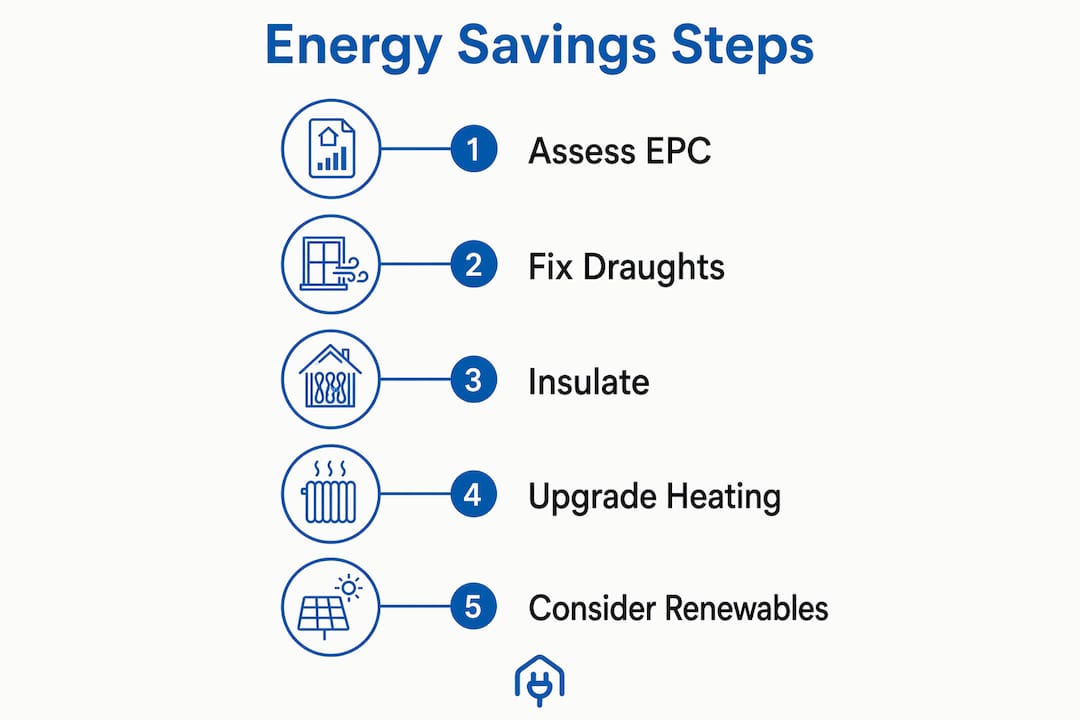
The fastest way to reduce your electricity bill is to combine no-cost behaviour changes with fabric-first upgrades prioritised by your Energy Performance Certificate (EPC) or the upcoming Home Energy Model (HEM). Ofgem advises treating the EPC as a practical roadmap rather than a compliance label, and that framing is the right starting point for any homeowner or property professional.
Start here — three immediate actions:
- Lower your thermostat by 1°C and set a heating schedule rather than leaving it on continuously.
- Replace remaining incandescent or halogen bulbs with LEDs.
- Switch appliances off standby; unplug chargers and devices not in use.
Pro Tip: Before spending anything, read your EPC’s recommended measures page. It lists cost-effective improvements in priority order, with indicative savings and payback periods already calculated for your property type.
Table of Contents
- What drives UK power bills: kWh, standing charges and tariffs
- No-cost and low-cost actions you can take today
- Home improvements that deliver the largest reductions in energy use
- How heating controls and smart meters can cut your bills
- Grants, schemes and finance options available in the UK
- How to use an EPC and the Home Energy Model as a savings roadmap
- How to estimate savings and payback on common measures
- How to find and vet trusted installers
- Common mistakes that waste money when reducing power bills
- Key takeaways
- Why the roadmap approach consistently outperforms ad hoc upgrades
- How Homeenergymodel can help you reduce your power bills
- Useful sources and further reading
What drives UK power bills: kWh, standing charges and tariffs
Every electricity bill has two components: a unit rate (pence per kWh) and a daily standing charge. The unit rate is the one you can actually influence through behaviour and upgrades; the standing charge is fixed regardless of consumption.
Appliance use and heating demand account for the largest share of kWh consumption in most UK homes. Running a tumble dryer, leaving an electric shower on longer, or heating poorly insulated rooms all push the unit total up. Time-of-use tariffs, such as Economy 7 or Octopus Agile, add a third variable: the price per kWh changes depending on when you use electricity.
- Unit rate: typically varies by supplier and tariff; check your bill or supplier app for your current rate.
- Standing charge: a fixed daily cost covering grid connection, regardless of usage.
- Time-of-use tariffs: off-peak periods (often overnight) can be significantly cheaper, rewarding flexible demand.
Pro Tip: A smart meter and its in-home display show real-time kWh cost, making it immediately clear which appliances are the biggest contributors to your bill. Suppliers install them free of charge.
No-cost and low-cost actions you can take today
GOV.UK’s energy-saving guidance groups actions into no-cost, low-cost and spend-to-save categories. The no-cost tier is where most households leave money on the table.
- Set your washing machine to 30°C; most modern detergents perform equally well at lower temperatures.
- Close curtains and blinds at dusk to retain heat and reduce heating demand.
- Lower your combi-boiler flow temperature to around 55–60°C; Ofgem lists this as one of the most overlooked quick wins.
- Fit draught excluders to external doors and letterboxes.
- Insulate your hot water cylinder with a British Standard jacket if it lacks one.
Statistic: The government’s Warm Homes Plan projects that an owner-occupier home with average gas and electricity consumption could save £130 annually by upgrading to a heat pump and adopting a time-of-use tariff.
Pro Tip: Sequence matters. Fix draughts and insulate before upgrading heating systems. Reducing heat loss first means any new boiler or heat pump is sized correctly and runs more efficiently.
Home improvements that deliver the largest reductions in energy use
Insulation and air-sealing consistently deliver the best return per pound spent. Loft insulation, cavity wall fill and floor insulation reduce the amount of heat the building loses, which directly cuts heating demand regardless of the fuel type.
| Measure | Typical installed cost | Indicative annual saving | Approximate payback |
|---|---|---|---|
| Loft insulation | — | — | 2–3 years |
| Cavity wall insulation | — | — | 3–5 years |
| Heat pump (air source) | — | — | Varies |
Figures are indicative ranges for a typical UK semi-detached home; actual costs and savings depend on property size, construction type and occupancy.
The sequencing principle is firm: fabric first, then heating systems, then renewables. Fitting solar panels to a poorly insulated home reduces bills less than addressing the thermal envelope first. Solid wall insulation carries a long payback, but for pre-1920 solid-brick properties it is often the only viable route to a meaningful EPC rating uplift.
Pro Tip: Planning permission is not usually required for loft or cavity wall insulation, but solid wall insulation and some glazing changes in conservation areas or listed buildings may need consent. Confirm with your local planning authority before commissioning work.
How heating controls and smart meters can cut your bills
Better controls often deliver bigger practical savings than a boiler swap alone, at a fraction of the cost.

| Control type | Typical cost | Key benefit |
|---|---|---|
| Smart thermostat (e.g. Hive, Nest) | — installed | Remote scheduling; learns occupancy patterns |
| Thermostatic radiator valves (TRVs) | £15–£40 per radiator | Room-by-room temperature control |
| Basic programmable room thermostat | — | Scheduled on/off; prevents overheating |
| Smart meter + in-home display | Free from supplier | Real-time consumption data; enables tariff switching |
Smart meters are available free from energy suppliers and help households monitor consumption to adjust behaviour and switch to better tariffs. Once installed, a smart meter also enables access to time-of-use tariffs, which reward shifting demand to off-peak hours.
- Set heating to come on 30 minutes before the household wakes, not overnight.
- Use TRVs to keep unoccupied rooms at a lower temperature (around 15°C).
- Check your smart meter’s in-home display weekly to spot unexpected consumption spikes.
Pro Tip: If your property has Economy 7 storage heaters, a smart meter is particularly valuable. It records overnight consumption separately, letting you verify whether the off-peak rate is genuinely cheaper for your usage pattern.
Grants, schemes and finance options available in the UK
Upfront cost is the primary barrier to most energy upgrades. Several current UK schemes reduce or eliminate that barrier.
| Scheme | What it covers | Who qualifies |
|---|---|---|
| Boiler Upgrade Scheme (BUS) | £9,000 off a heat pump for oil-heated homes | Owner-occupiers in England and Wales |
| Energy Company Obligation (ECO) | Insulation and heating upgrades | Low-income and fuel-poor households |
| Warm Homes: Local Grant (WH:LG) | Insulation, solar PV, clean heat | Low-income owner-occupiers; £0.5bn allocated Apr 2025–Mar 2028 |
| Consumer Loans (Warm Homes Plan) | Solar, batteries, heat pumps | All owner-occupiers; low- and zero-interest |
Funding scale: The government has committed £4.4bn to low-income home upgrade grants under the Warm Homes Plan, with solar PV accounting for approximately 40% of Warm Homes: Local Grant installations to date.
Eligibility checklist:
- Check GOV.UK’s Help to Heat page for ECO eligibility based on benefits and income.
- Contact your local council for Warm Homes: Local Grant availability in your area.
- Use a MCS-accredited installer to access BUS grant funding.
- Watch for cold-call scams offering “free grants” without paperwork or accreditation checks.
How to use an EPC and the Home Energy Model as a savings roadmap
Treat an EPC as a priority list, not a pass/fail score. An EPC rates a property from A to G and includes recommended improvements with indicative costs, typical savings and the projected rating after each measure. The Home Energy Model (HEM) is the government’s next-generation methodology replacing SAP, offering more granular modelling of occupancy patterns, heating systems and renewable generation.
How to use your EPC effectively:
- Read the “Recommendations” section, not just the rating letter.
- Prioritise measures marked as cost-effective over those listed as “further improvements.”
- Commission a new EPC after completing major works. An updated certificate is the only official way to verify a rating uplift, which affects property value and rental marketability.
- If selling or letting without a valid EPC, a fixed penalty of £200 may apply.
The HEM assessment goes further than a standard EPC by modelling dynamic occupancy and time-of-use energy patterns. For properties undergoing significant retrofit, a full HEM assessment through a service such as Homeenergymodel’s assessment service provides a more precise upgrade sequence and savings estimate. Learn more about EPC ratings and what they mean for your property’s efficiency and value.
Pro Tip: EPC modelled savings are estimates based on standard occupancy assumptions. Actual savings depend on how the property is used. A household that heats to 23°C will not achieve the savings projected for a 19°C assumption.
How to estimate savings and payback on common measures
The core calculation is straightforward: annual saving (£) = kWh saved per year × unit rate (£/kWh). Divide the installation cost by the annual saving to get the payback period in years.
- Find your current unit rate on your bill (typically shown as p/kWh).
- Identify the estimated kWh saving for the measure from your EPC recommendations page.
- Multiply kWh saving by your unit rate to get the annual cash saving.
- Divide installation cost by annual saving for payback years.
| Measure | Estimated kWh saving/year | Example annual saving at 24p/kWh | Typical cost | Payback |
|---|---|---|---|---|
| LED bulbs (whole house) | 200 kWh | — | — | Under 2 years |
| Loft insulation top-up | 600 kWh | — | — | 2–3 years |
| EPC assessment | N/A | Enables targeted savings | £65–£120 | Immediate |
Sensitivity notes: payback periods lengthen if unit rates fall and shorten if they rise. Households with higher-than-average consumption (larger families, home workers) typically see faster payback on insulation measures. Occupancy changes, such as a property becoming a rental, alter the baseline assumptions entirely.
How to find and vet trusted installers
Choose installers with TrustMark or MCS accreditation for heating and renewables work. MCS accreditation is a prerequisite for accessing the Boiler Upgrade Scheme grant; Gas Safe registration is legally required for any gas boiler work.
Questions to ask every installer:
- Can you provide your TrustMark or MCS registration number?
- Do you carry public liability insurance, and can you show the certificate?
- Will you provide an itemised written quote with product specifications?
- What warranty covers the installation, and who backs it if your company closes?
- Will you arrange or recommend a post-installation EPC to confirm the rating uplift?
Red flags to watch for:
- Unsolicited cold calls or doorstep visits offering “free government grants.”
- Requests for large cash payments upfront before work begins.
- No written contract or itemised quote.
- Pressure to sign the same day.
- No verifiable accreditation number on request.
Common mistakes that waste money when reducing power bills
The most expensive mistake is replacing a boiler before addressing insulation. A new boiler in a poorly insulated home runs more efficiently than the old one, but it still heats a leaky building. Fix the envelope first.
- Skipping controls before hardware: fitting a heat pump without smart controls or TRVs reduces its efficiency and increases running costs.
- Relying on an outdated EPC: an EPC more than ten years old, or one predating major works, does not reflect the property’s current performance.
- Buying large renewables before reducing demand: solar panels on a high-demand home generate proportionally less benefit than on a well-insulated one.
- Ignoring tariff switching: staying on a standard variable tariff when a time-of-use tariff suits your usage pattern costs money every month.
Pro Tip: Be sceptical of payback claims shorter than two years for measures costing more than £1,000. Independent modelling tools and your EPC recommendations page are more reliable than installer sales projections.
Key takeaways
Combining behaviour changes with EPC-prioritised fabric upgrades is the most cost-effective route to lower UK power bills, with grants and low-interest finance available to reduce upfront barriers.
| Point | Details |
|---|---|
| Start with behaviour changes | Thermostat scheduling, LEDs and standby reduction cost nothing and deliver immediate savings. |
| Fabric before systems | Insulate and draught-proof before upgrading boilers or installing heat pumps to maximise efficiency gains. |
| Use your EPC as a roadmap | The recommendations page lists cost-effective measures with indicative payback periods specific to your property. |
| Check grant eligibility | BUS, ECO and Warm Homes: Local Grant can significantly reduce upfront costs; verify via GOV.UK before committing. |
| Use Homeenergymodel for HEM assessments | A professional HEM assessment provides a more precise upgrade sequence and savings estimate than a standard EPC alone. |
Why the roadmap approach consistently outperforms ad hoc upgrades
Most households that struggle to reduce their bills have invested in the wrong measures in the wrong order. A new boiler fitted before cavity wall insulation, solar panels installed before demand is reduced, a smart thermostat controlling a poorly zoned system: each of these delivers a fraction of its potential saving because the underlying problem was not addressed first.
The EPC and HEM exist precisely to prevent this. They model the whole building as a system and rank measures by cost-effectiveness, not by what an installer happens to sell. The shift in 2026 policy toward low-interest consumer loans reflects the same logic: the barrier is not awareness of what works, it is the upfront cost of doing it in the right sequence.
The practical implication is clear. Get an EPC or HEM assessment before spending anything significant. Use the recommendations page as a sequenced plan. Check grant eligibility before committing to finance. And commission a new EPC after major works, both to verify the improvement and to protect property value.
How Homeenergymodel can help you reduce your power bills
Homeenergymodel offers a direct route from reading this guide to acting on it. The service covers domestic EPC assessments, Home Energy Model (HEM) modelling, and retrofit prioritisation for both homeowners and property professionals across the UK. Rather than working from a generic checklist, an assessment through Homeenergymodel produces a property-specific upgrade sequence with modelled savings estimates aligned to the latest HEM methodology.
For landlords managing multiple properties, the home energy models for landlords resource explains which modelling approach suits different portfolio types. For homeowners ready to act, the home energy assessment service is the practical next step: book an assessment, receive a prioritised upgrade plan, and start reducing bills with confidence.
Useful sources and further reading
The following official sources cover eligibility, scheme details and technical definitions relevant to UK energy efficiency:
- Ofgem: Save money on your energy bill — practical guidance on behaviour changes, smart meters and heating controls, with links to switching tools and grant schemes.
- GOV.UK: Boiler Upgrade Scheme — current grant levels, eligibility criteria and how to apply for heat pump funding.
- GOV.UK: Warm Homes Plan — full detail on the government’s consumer offer, including loans, grants and renter protections.
- GOV.UK: Warm Homes: Local Grant statistics — funding allocations and installation data for the targeted low-income grant programme.
- Energy Saving Trust: EPC guide — plain-language explanation of EPC ratings, costs and what the certificate contains.
- GOV.UK: Find ways to save energy in your home — property-specific improvement recommendations tool for England and Wales.
- Smart Energy GB — information on smart meter installation, in-home displays and how to request one from your supplier.