
Switching remaining halogen and incandescent bulbs to LEDs, adopting a room-zoning habit, and fitting a passive infrared (PIR) sensor in your hallway are the three highest-value moves to reduce your light bill. The Energy Saving Trust estimates that replacing halogen spotlights with LEDs alone could save around £45 a year per household, cutting roughly 35kg of CO₂ in the process. Lighting typically accounts for a notable portion of a home’s electricity use, so the savings are real and achievable within days of acting.
Three things you can do in under 30 minutes right now:
- Check each room for any remaining halogen or incandescent bulbs and note the fitting type (B22, E27, GU10).
- Switch off lights in any unoccupied room and make a note of how many you left on by habit.
- Buy one LED replacement for your most-used fitting and test it this evening.
Table of Contents
- What no-cost habits cut your lighting use immediately?
- Which bulbs should you buy, and how do you choose?
- How do controls cut your lighting bills further?
- How much can lighting changes actually save you?
- What are the most common lighting myths?
- Key takeaways
- Why lighting-first is the right starting point
- How Homeenergymodel can give you a personalised savings picture
- Further reading and UK sources
What no-cost habits cut your lighting use immediately?
The cheapest way to save on your electric bill requires no purchase at all. Turning lights off when leaving a room is the single most immediate action, and Ofgem’s household energy advice lists it alongside thermostat adjustments as one of the simplest everyday wins.
Beyond the obvious, room zoning makes a meaningful difference. Rather than lighting an entire open-plan kitchen-diner for a single task, use a focused task light over the worktop and leave the main ceiling array off. The same logic applies to hallways: a PIR sensor replaces the habit of leaving a light on “just in case.” Bathrooms benefit from the same approach.
Natural daylight is free. Pulling back curtains fully, keeping window sills clear of clutter, and positioning a reading chair near a window rather than under a lamp all reduce the hours you need artificial light. In winter, this matters less, but the habit formed in spring and summer carries through.
- Turn off lights on leaving any room, even briefly.
- Use a task light for kitchen prep instead of the full ceiling array.
- Fit a PIR sensor in the hallway to replace habitual leaving-on.
- Open curtains fully each morning and use daylight for reading where possible.
- Create a quick exit checklist: lights, appliances, thermostat.
Pro Tip: Place a small sticky note on your front door for the first two weeks: “Lights off?” One prompt is enough to build the habit, and you can remove it once the routine sticks.
The Energy Saving Trust’s lighting guidance and Ofgem both support these behavioural changes as fast, zero-cost wins that complement bulb upgrades.
Which bulbs should you buy, and how do you choose?
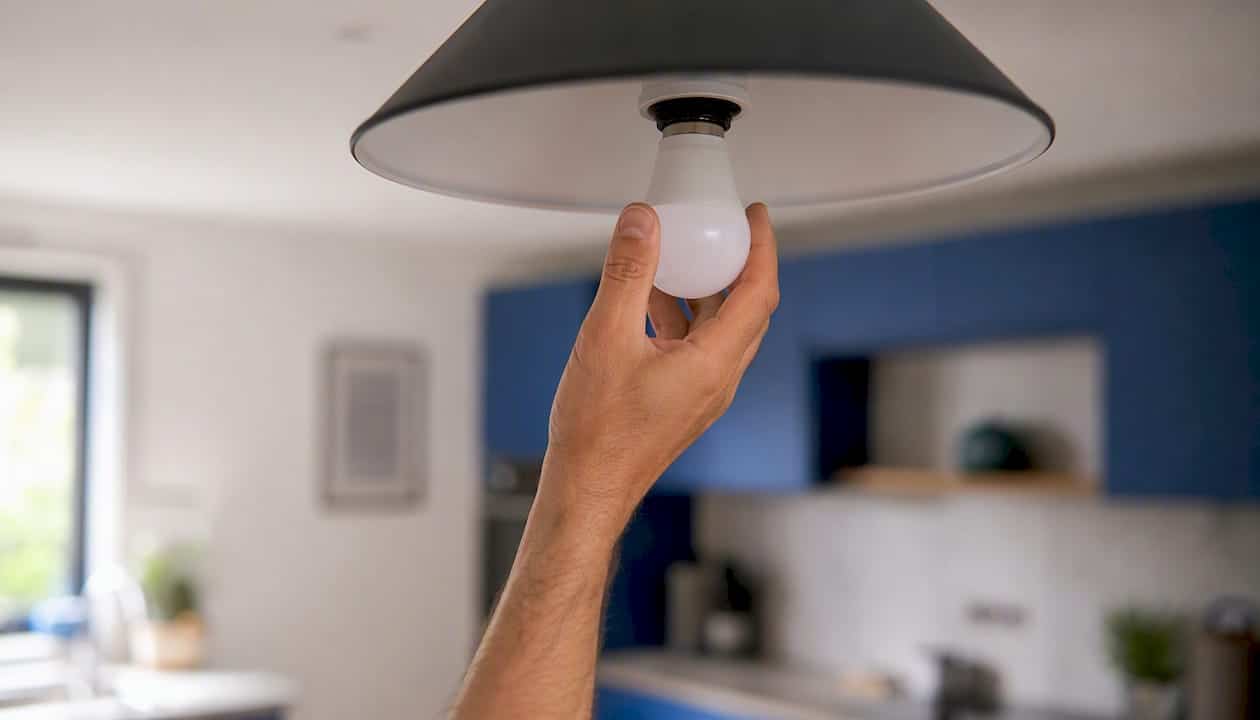
LEDs outperform halogen and incandescent bulbs on every practical measure. They use roughly 75–80% less energy for the same light output and last significantly longer, meaning fewer replacements and lower running costs. The DECC lighting factsheet confirms per-fitting savings of around £30 per year when replacing a halogen downlighter with an LED equivalent, and LED payback periods can be quite short, often within months.
Reading the label: lumens, watts, and kelvin
The Energy Saving Trust recommends checking lumens and colour temperature rather than wattage when choosing a replacement bulb. Watts measure power consumption; lumens measure brightness. A 60W incandescent produces around 800 lumens. An LED delivering the same 800 lumens typically draws only 8–10W.
Colour temperature, measured in kelvin (K), determines how warm or cool the light feels. Around 2700K produces a warm, amber-toned light suited to living rooms and bedrooms. 3000K is a neutral warm white, good for kitchens. 4000K and above gives a cooler, bluer light preferred for task areas, home offices, and bathrooms.
Wattage-to-lumen conversion table
| Old bulb type | Typical wattage | Lumen target | LED replacement wattage |
|---|---|---|---|
| Incandescent | 40W | — | 5–6W |
| Incandescent | 60W | ~800 lm | 8–10W |
| Halogen spotlight | 50W | — | 6–8W |
| Halogen spotlight | 35W | — | 4–5W |
| CFL (compact fluorescent) | 11W | — | 6–8W |
A note on dimmers: not all LED bulbs are dimmer-compatible. Check the packaging for a dimmer symbol or the phrase “dimmable.” Fitting a non-dimmable LED on a dimmer circuit can cause flickering or buzzing. Test one bulb before buying in bulk, and if your dimmer is older, consider replacing it with a leading-edge LED-compatible model.
Government proposals to raise minimum efficacy standards for lighting products, described in the GOV.UK lighting efficiency announcement and the associated ecodesign impact assessment, mean that the range of high-quality, affordable LEDs available in the UK will only improve over time.
How do controls cut your lighting bills further?
Bulb choice sets the floor; controls determine how much of that efficiency you actually capture. A well-placed PIR sensor in a hallway means the light is on only when someone is present, which in a busy household can cut that fitting’s running hours by more than half.
Dimmers reduce the wattage drawn by a compatible LED in proportion to the dimming level. A bulb dimmed to 50% brightness draws noticeably less power than at full output. The saving is real, though smaller than the saving from switching to LEDs in the first place. Dimmers work best in living rooms and dining areas where you genuinely vary light levels.
PIR (motion) sensors suit hallways, landings, stairwells, bathrooms, and outdoor security lights. Set the hold time to 1–2 minutes for indoor use; longer hold times reduce the benefit. Position the sensor to cover the full area without pointing directly at a heat source such as a radiator, which can cause false triggers.
Timers work well for external lights and for any indoor fitting that follows a predictable schedule, such as a porch light. A simple plug-in timer costs a few pounds and pays back quickly.
- Fit PIR sensors in hallways, landings, and bathrooms first.
- Use dimmers in living rooms and dining areas where you vary brightness.
- Set timers for external lights rather than leaving them on all night.
- For outdoor security lights, combine PIR with a daylight sensor so the light only activates after dark.
Pro Tip: For a purely energy-first setup, a mechanical switch combined with a PIR sensor often beats a networked smart bulb. Smart bulbs draw a small standby load continuously because their wireless receiver stays active. Over a year across multiple fittings, that phantom load adds up. Use smart bulbs where scheduling and remote control genuinely add value; use PIR or timers everywhere else.
The Independent’s lighting guide supports layering ambient, task, and accent lighting as a practical way to reduce over-illumination without sacrificing comfort.
How much can lighting changes actually save you?
Lighting is not the biggest lever on a UK energy bill. Heating and hot water account for the largest share of household energy spend, and switching payment method to Direct Debit or adjusting a thermostat by 1°C typically delivers a larger annual saving than lighting changes alone. That context matters: lighting is best framed as a fast, low-cost win rather than the sole solution.
Within lighting, the BEIS domestic lighting report projects that households converting around 80% of their lights to low-energy bulbs could save around 230 kWh per year. At a typical unit rate, that represents a meaningful annual reduction in electricity spend.
Estimated annual savings by action
| Action | Typical annual saving |
|---|---|
| Replace all halogen spotlights with LEDs | ~£45 (Energy Saving Trust) |
| Replace one halogen downlighter with LED | ~£30 (DECC estimate) |
| Turn off lights habitually (all rooms) | Several £ per year |
| Fit PIR sensors in hallways and landings | Variable; reduces running hours significantly |
| Install dimmers in living areas | Modest; depends on dimming behaviour |
For broader energy-saving home tips that go beyond lighting, heating controls and insulation upgrades deliver the largest bill reductions.
Worked example 1: small flat, 10 bulbs
A one-bedroom flat has 10 halogen spotlights at 50W each. Replacing all with 7W LEDs:
- Saving per bulb: 50W minus 7W = 43W = 0.043 kW
- Daily hours: 3 hours average
- Annual kWh saved per bulb: 0.043 × 3 × 365 = 47.1 kWh
- Total for 10 bulbs: 471 kWh per year
- At 24p per kWh (a broadly representative unit rate based on Ofgem’s price cap guidance): A substantial sum per year saved
Worked example 2: family house, 25 bulbs
A three-bedroom house has 25 halogen spotlights at 50W each, running an average of 3 hours per day:
- Annual kWh saved: 0.043 × 3 × 365 × 25 = 1,177 kWh
- At a typical unit rate: a substantial sum per year saved
A few caveats: your actual unit rate will differ depending on your tariff. Standing charges do not change with lighting use, so they do not affect this calculation. If you fit PIR sensors or timers, reduce the daily hours figure accordingly to reflect actual use rather than potential use. For a personalised calculation, the energy savings calculator on Homeenergymodel’s website applies your specific property data.
What are the most common lighting myths?
Several widely repeated beliefs stop homeowners from saving money. Here is what the evidence actually shows.
- “Switching a light on uses a surge of energy that costs more than leaving it on.” This is false for LEDs and modern CFLs. The DECC factsheet confirms there is no meaningful energy penalty from switching modern LED lights on and off frequently. Turn them off whenever the room is unoccupied.
- “Frequent switching shortens LED life significantly.” LEDs are not sensitive to switching cycles in the way older fluorescent tubes were. Turning an LED off and on many times per day does not materially reduce its rated lifespan.
- “Smart bulbs always save energy.” Not automatically. Smart bulbs draw a continuous standby load because their wireless receiver stays active. Without disciplined scheduling, a smart bulb left in “standby on” mode can consume more energy than a standard LED on a manual switch.
- “Brighter means better.” Over-illumination is a common and costly habit. The Energy Saving Trust’s guidance recommends choosing bulbs by lumens for the task, not defaulting to the highest wattage available.
One genuine caveat: very old compact fluorescent lamps (CFLs) do have a warm-up period and are slightly more sensitive to frequent switching than LEDs. If your home still has original CFLs from the early 2000s, replacing them with LEDs removes this concern entirely.
Key takeaways
Replacing halogen spotlights with LEDs, zoning your lighting, and fitting PIR sensors in high-traffic areas are the fastest ways to cut electricity costs from lighting in a UK home.
| Point | Details |
|---|---|
| Switch to LEDs first | Replacing halogen spotlights with LEDs saves a meaningful amount per year per household, per Energy Saving Trust. |
| Zone and task-light | Using task lights instead of full ceiling arrays reduces running hours and kWh without compromising comfort. |
| Fit PIR sensors | Motion sensors in hallways and landings cut running hours significantly at low upfront cost. |
| Calculate your own savings | Use the four-step formula: wattage saved ÷ 1000 × daily hours × 365 × unit rate = annual £ saving. |
| Homeenergymodel assessment | Homeenergymodel provides EPC-aligned modelling that quantifies lighting and fabric savings for your specific property. |
Why lighting-first is the right starting point
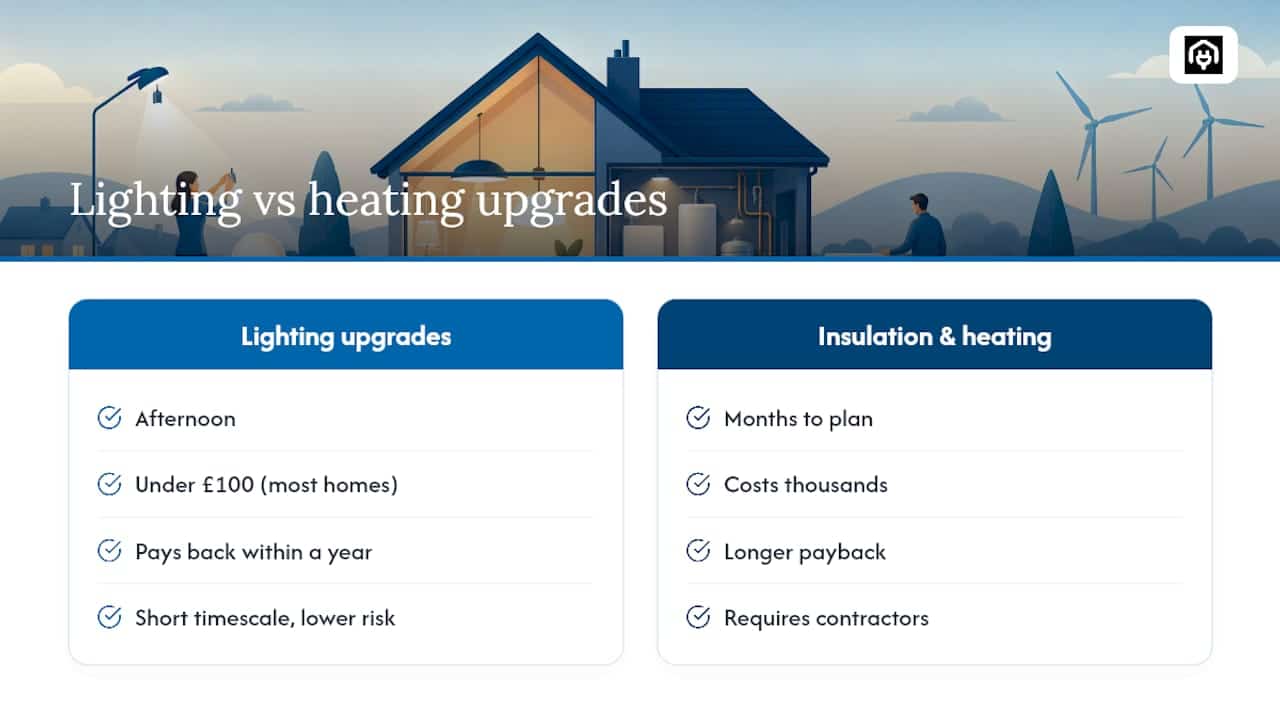
Lighting upgrades attract a lot of scepticism from homeowners who have been told, correctly, that heating is the dominant cost. The logic runs: “If heating is 60% of my bill, why spend time on lighting?” The answer is that the two are not in competition. Lighting improvements take an afternoon, cost under £100 for most homes, and pay back within a year. Insulation and heating upgrades take months to plan, cost thousands, and require contractors. Both matter; they just operate on entirely different timescales and risk profiles.
What gets underestimated is the behavioural compounding effect. A homeowner who fits LEDs, installs a PIR sensor, and starts zoning their lighting does not just save on lighting. They become more attentive to energy use across the board. That shift in awareness tends to carry into thermostat habits, appliance choices, and eventually larger investments like energy-efficient home upgrades such as insulation or heat pump readiness.
The other underrated point: lighting improvements show up directly on an EPC. An assessor modelling a property with LED lighting throughout and appropriate controls will record a meaningfully better energy performance score than one with halogens. For homeowners thinking about selling or letting, that distinction has financial consequences beyond the bill saving itself.
How Homeenergymodel can give you a personalised savings picture
Worked calculations like the ones above give a solid estimate, but every property is different. Ceiling heights, the number of fittings, existing tariff rates, and the interaction between lighting and heating all affect the final figure. Homeenergymodel’s energy performance assessment service applies EPC-aligned modelling to your specific property, producing a savings calculation that accounts for your actual fittings, usage patterns, and building fabric rather than national averages.
The assessment covers lighting as part of a full energy performance picture, so the output is directly relevant to EPC ratings, compliance with upcoming standards, and any planned upgrades. For landlords and homeowners considering a broader programme of improvements, this gives a clear, evidence-based starting point. DIY calculations remain valid and free; a modelled assessment adds the precision needed when the numbers need to stand up to scrutiny.
Request an assessment at homeenergymodel.co.uk/energy-performance-explained-uk to see what your property’s lighting and energy profile looks like in full.
Further reading and UK sources
- Energy saving light bulbs and lighting — Energy Saving Trust
- Leading the world in lighting efficiency lightens the load on energy bills — GOV.UK
- Quick tips to save energy — Energy Saving Trust
- Tips on how to use less lights at home and save money on energy bills | The Independent
- Save money on your energy bill — Ofgem