
TL;DR:
- Accurately estimating home energy costs requires analyzing 12 months of historical bills and considering occupant behaviour, building characteristics, and tariffs.
- Using multiple methods, such as bill analysis, online calculators, and professional assessments, yields the most reliable forecasts for budgeting and investment decisions.
- Regularly updating and cross-checking estimates helps property owners manage fluctuations and avoid surprises in energy expenses.
Energy bills are one of the most unpredictable expenses a property owner faces, yet most homeowners never attempt to forecast them with any precision. Knowing how to estimate home energy costs accurately helps with budgeting, informs purchasing decisions, and identifies where efficiency improvements will have the greatest impact. Whether you own a single home or a portfolio of rental properties, a structured approach to energy cost estimation puts you in control rather than leaving you at the mercy of quarterly surprises.
Table of Contents
- Key takeaways
- How to estimate home energy costs: gathering your data first
- Estimating from historical bills: a step-by-step method
- Estimation without historical data
- Professional energy assessments
- Verifying estimates and managing costs over time
- My take on where most homeowners go wrong
- Get a precise energy assessment for your property
- FAQ
Key takeaways
| Point | Details |
|---|---|
| Historical bills are most reliable | Analysing 12 months of actual utility data gives 85–95% accuracy for cost forecasting. |
| Behaviour shifts costs significantly | Occupant habits can move actual consumption 10–30% from any modelled baseline. |
| Standing charges matter | Fixed daily charges disproportionately affect low-usage households and must be factored into estimates. |
| Online calculators have limits | Utility provider tools offer 10–15% accuracy but require local tariff data to be meaningful. |
| Professional assessments add certainty | EPCs and energy audits identify both accurate cost estimates and realistic savings opportunities. |
How to estimate home energy costs: gathering your data first
Before running any calculations, assembling the right information makes the difference between a useful estimate and a misleading one. The most reliable starting point is 12 months of actual utility bills for the property. A full year captures seasonal variation across heating, cooling, and lighting cycles and reflects the property’s real consumption profile rather than a theoretical one.
When historical bills are unavailable, as is common when purchasing a new property or evaluating an investment, there are workable alternatives. The key data points to collect include:
- Property size in square metres. Floor area is the single strongest predictor of baseline energy demand.
- Building age and construction type. A 1970s cavity-wall semi-detached behaves very differently from a 2010 new-build with insulated floors.
- Appliance inventory. Older boilers, electric storage heaters, and unrated white goods all add substantially to running costs.
- Current energy tariffs. The UK price cap for Q2 2026 sets maximum unit rates and standing charges affecting average household bills of around £875 per year, so knowing the applicable tariff structure is non-negotiable.
- Occupant count and lifestyle. A family of four in a three-bedroom house uses noticeably more energy than a single occupant in the same property.
Understanding the structure of your bills is equally important. Fixed daily standing charges can disproportionately affect low-usage households, meaning a lower unit rate does not always translate into a lower annual bill. This is a frequently overlooked detail that skews estimates if ignored.
Pro Tip: Gather meter readings at the start and end of each month for three consecutive months before making any estimate. This simple baseline habit reveals usage trends that bills alone may obscure.
Estimating from historical bills: a step-by-step method
For properties with an existing billing history, a systematic review of past bills is the most direct route to a reliable forecast. Analysing 12 months of utility bills typically achieves 85–95% accuracy, making this the preferred method for homeowners and investors alike.
Follow these steps to build a solid cost estimate:
- Collect all bills for electricity and gas over 12 months. Separate them by fuel type and note the billing period, units consumed (kWh), and total cost including VAT and standing charges.
- Identify seasonal patterns. Gas consumption will spike in winter months; electricity usage often rises in summer due to lighting changes and certain appliances. Recognising these peaks prevents under-budgeting for high-cost months.
- Calculate average monthly spend. Add the total annual cost for each fuel type and divide by 12. This gives a working monthly average that can be adjusted for known future changes such as a tariff switch or a planned boiler replacement.
- Calculate cost per kWh. Divide total spend by total kWh consumed for each fuel. Comparing this figure against the published price cap rates confirms whether the property is on a competitive tariff.
- Adjust for personal circumstances. If the property was occupied by fewer or more people than it will be going forward, apply a proportional correction. Occupant behaviour influences actual consumption by 10–30% compared to modelled or historical figures, so this adjustment carries real weight.
- Build a 12-month projection. Use a simple spreadsheet to lay out projected monthly costs, incorporating known tariff changes and seasonal factors. Refer to UK energy usage patterns for guidance on how consumption typically varies through the year.
A common pitfall is treating the annual average as representative of every month. Annual averages can obscure significant seasonal variations that matter considerably when setting monthly budgets or evaluating a property’s running costs.
Pro Tip: When assessing a property for purchase, request bills from the current owner covering at least two winters. A single year can be unrepresentative if the previous winter was unusually mild or the property was vacant.
Estimation without historical data
Not every homeowner or investor has access to 12 months of prior bills. New builds, recently converted properties, and acquisitions from non-cooperative sellers all present this challenge. Several practical alternatives exist.

Using floor area as a baseline
A widely used proxy is cost per square metre of floor area. While rough, this approach provides a defensible starting figure when no other data is available. Regional adjustments are necessary because energy costs, heating degree days, and building stock all vary across the UK.
| Method | Typical accuracy | Best suited for | Key limitation |
|---|---|---|---|
| Floor area proxy | ±25–35% | Quick investment appraisals | Ignores fabric quality and occupant behaviour |
| Utility provider calculator | ±10–15% | Homeowners with local tariff data | Relies on average assumptions |
| EPC-based modelling | ±10–20% | Compliance and retrofit planning | Based on standard occupancy, not actual use |
| Professional energy audit | 85–95% | Major purchases or retrofit decisions | Requires upfront assessment cost |
Using online calculators
Utility company calculators offer estimates within 10–15% accuracy when local rates and historical usage patterns are applied. Provider-specific tools are generally more accurate than third-party platforms because they incorporate current tariff data for the region.
The inputs these tools typically require include property type, number of bedrooms, approximate floor area, heating fuel type, and insulation level. The output is a projected annual cost, which can then be broken into monthly figures.
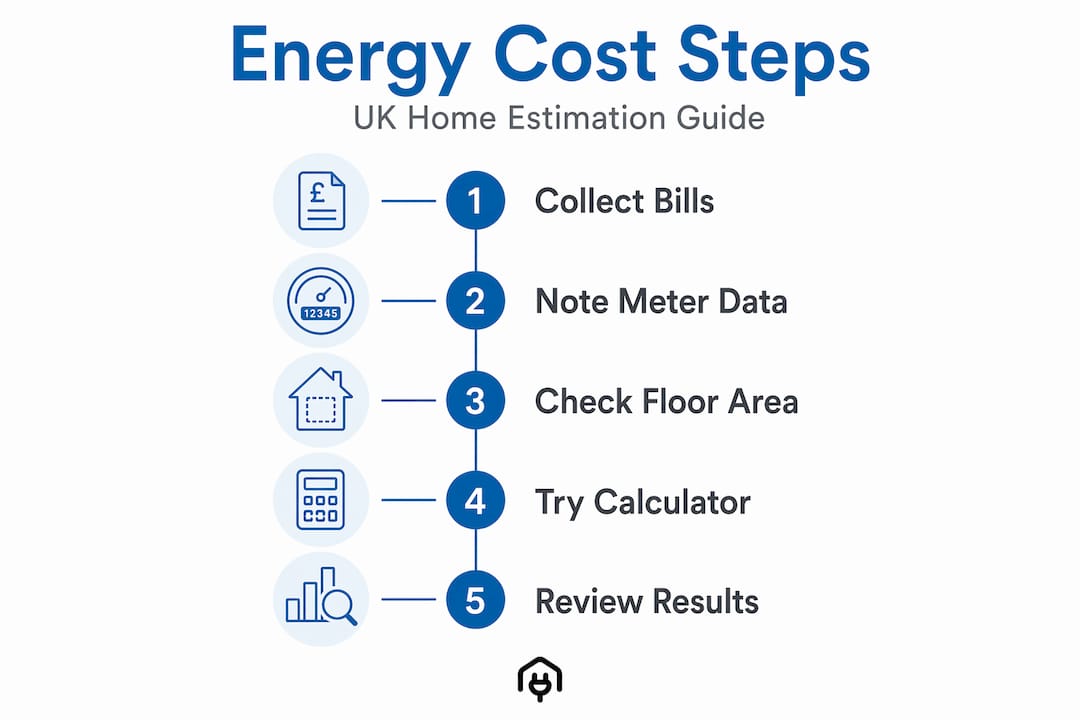
Bear in mind that all online calculators make assumptions about occupancy and behaviour. They work best as a cross-check against other methods rather than as a standalone figure. For an explanation of what the line items on a UK bill actually mean, the energy bills guide on Homeenergymodel provides a useful reference.
Professional energy assessments
For high-value decisions, such as acquiring a rental property, planning a major retrofit, or assessing compliance with upcoming regulations, professional assessments provide the most accurate and defensible estimates.
Professional energy audits deliver 85–95% accuracy and identify practical efficiency upgrades that can materially affect future costs. The key assessment options available to UK property owners are:
- Energy Performance Certificates (EPCs). An EPC rates a property from A to G based on its modelled energy performance using SAP calculations. The rating reflects predicted costs under standard occupancy, which is a useful baseline even if actual costs differ. EPCs are legally required for sales and lettings in the UK.
- Full energy audits. A qualified assessor inspects insulation levels, heating systems, glazing, air tightness, and controls. The resulting report quantifies likely annual running costs and prioritises upgrade measures by return on investment.
- SAP and HEM modelling. The Standard Assessment Procedure (SAP) and its successor, the Home Energy Model (HEM), provide detailed energy calculations that feed directly into EPC ratings and planning compliance. These models account for building fabric, services, and location in far greater detail than any generic calculator.
The financial case for professional assessment strengthens as energy prices rise. Energy-efficient homes deliver growing cost advantages over less efficient stock, making accurate estimation a genuinely useful tool for investment appraisal rather than a compliance exercise.
When evaluating a property for purchase, a professional assessment also creates a clear picture of potential improvement. Air conditioning, space heating, and water heating account for 43.5% of total home energy consumption, and these are precisely the systems that audit findings address in most detail.
Verifying estimates and managing costs over time
An estimate is only as useful as the process that follows it. Regular tracking against actual bills converts a one-off calculation into a living budgeting tool.
- Record monthly meter readings. Compare actual consumption against projected figures each month. Consistent over-runs in winter suggest the heating estimate was too conservative; summer spikes point to cooling or hot water system inefficiency.
- Review tariffs annually. UK energy tariffs change quarterly with the price cap. A tariff that represented good value six months ago may no longer do so.
- Use smart meter data. Smart meters provide half-hourly consumption data through their in-home displays and supplier apps. This granularity makes it straightforward to see which appliances or behaviours are driving costs above forecast.
- Set seasonal budget allocations. Rather than spreading annual costs evenly, allocate a larger monthly budget to November through February for gas and a smaller one for the warmer months. A seasonal energy checklist helps structure this planning.
- Reassess after any significant change. A new boiler, loft insulation, or change in household size all shift the baseline. Rebuild the estimate rather than simply adjusting the old one.
Pro Tip: Set a calendar reminder each April to review your energy budget alongside the new price cap quarter. This single habit prevents bill shock and keeps your forecasting current.
My take on where most homeowners go wrong
I have seen a consistent pattern across homeowners and investors who approach energy cost estimation for the first time. They rely on a single data source, whether that is an annual billing average or a quick online calculator, and treat the output as settled fact. It rarely is.
In my experience, the most reliable estimates come from combining at least two methods and then stress-testing the result against occupant behaviour. A property that bills at £900 per year under standard occupancy assumptions can easily reach £1,400 under a family working from home. That gap is not an edge case. It is the norm.
What I find genuinely useful is treating the EPC rating as a floor, not a forecast. The modelled cost on an EPC certificate tells you what the property could cost under ideal assumptions. Actual costs depend on the people living there. Pairing the EPC figure with 12 months of real billing data, where available, gives the most grounded picture.
The other area that consistently catches property investors off guard is standing charges. Focusing purely on unit rates misses the fact that standing charges can represent 20–30% of a low-usage property’s total annual bill. For investors assessing yield on smaller flats or studios, this detail changes the numbers materially.
Energy cost estimation is not a one-time task. Prices shift, occupants change, and buildings age. The homeowners who manage their energy budgets most effectively are those who revisit their estimates at least once a year and treat them as a dynamic tool rather than a fixed figure.
— Danny
Get a precise energy assessment for your property
Understanding how to calculate home energy expenses is one step. Acting on that knowledge is the next. For UK homeowners and property investors, an up-to-date EPC provides a legally recognised, professionally modelled estimate of your property’s energy performance and likely running costs. Homeenergymodel offers detailed guidance on energy performance certificates for London properties, covering what the ratings mean, when assessments are required, and how to arrange one. For those managing multiple properties or planning significant efficiency upgrades, the home energy models guide explains the different modelling approaches available and which suits each property type.
FAQ
How accurate is estimating costs from past bills?
Analysing 12 months of bills from the specific property typically achieves 85–95% accuracy. This method outperforms all other approaches when billing history is available.
What is the UK energy price cap in 2026?
The Q2 2026 price cap sets maximum unit rates and standing charges, with average household bills running to approximately £875 per year. Actual costs vary based on consumption and tariff structure.
Can online calculators replace historical bills for estimating costs?
Online utility calculators provide estimates within 10–15% accuracy but rely on average assumptions. They work best as a secondary check rather than a primary source, particularly when tariff data is applied correctly.
When should a homeowner commission a professional energy audit?
A professional audit is most worthwhile before a major purchase, ahead of a significant retrofit, or when actual bills consistently exceed estimates. Audits achieve the same 85–95% accuracy as historical bill analysis while also identifying specific efficiency improvements.
How does occupant behaviour affect energy cost estimates?
Occupant behaviour can shift actual consumption by 10–30% compared to any modelled or historical baseline. Household size, temperature preferences, and working patterns are the primary variables to account for when calibrating an estimate.