
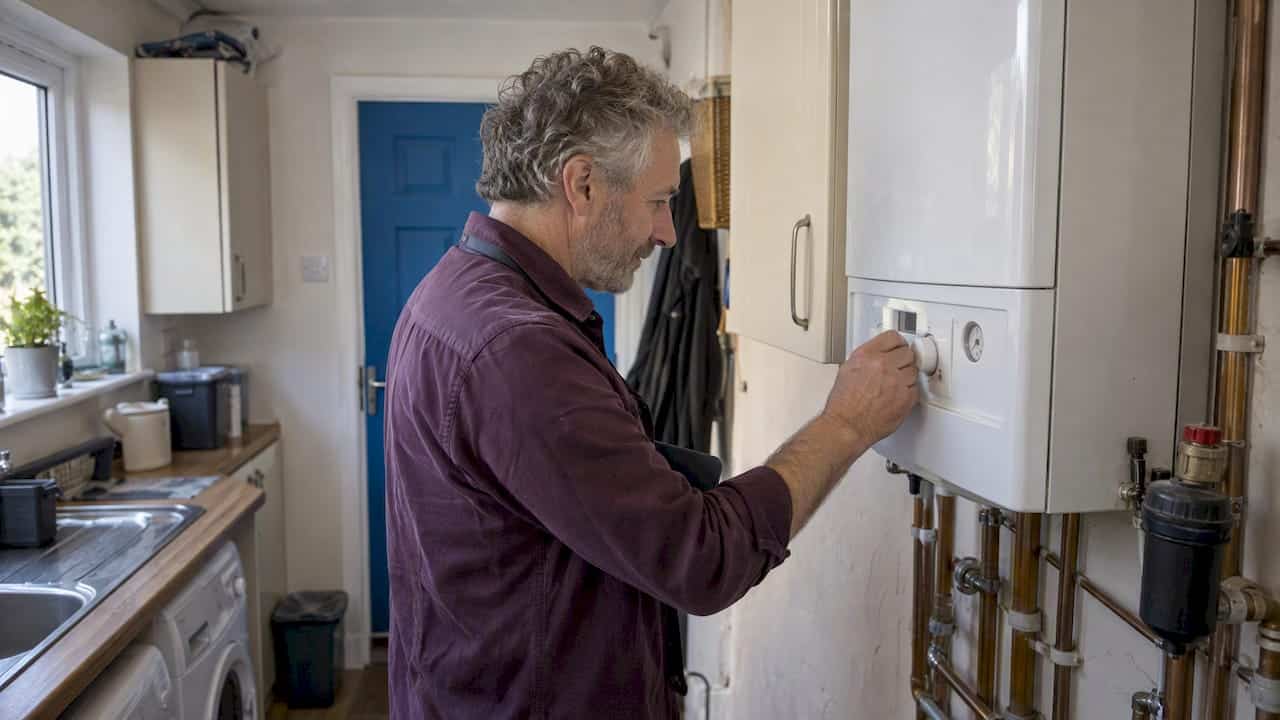
Energy efficiency is calculated by dividing the useful energy a device or system delivers by the total energy put into it, then multiplying by 100 to give a percentage. For a building, the answer is usually expressed differently: as energy use per square metre of floor area, or as an official rating such as an Energy Performance Certificate (EPC). This guide covers both routes, with worked examples and the mistakes that most often produce wrong answers.
TL;DR
- Efficiency (%) = useful energy output ÷ total energy input × 100. The result cannot exceed 100% for a simple energy conversion.
- Input and output must use the same units and cover the same period. Convert first, divide second.
- A building is measured differently: annual energy use divided by floor area gives energy use intensity (kWh per m² per year).
- A UK EPC rating is not a simple input and output ratio. It comes from a government methodology, currently SAP, which models running costs.
- Compare like with like: weather, occupancy and fuel type can all distort a comparison.
Table of Contents
- The basic energy efficiency formula
- How to calculate energy efficiency step by step
- Mistakes that give the wrong answer
- How to find the energy input and output figures
- Calculating a building’s energy efficiency
- How an EPC rating is calculated in the UK
- Which calculation suits which situation
- Getting the calculation done professionally
- Perspective: why the formula is only the start
- Practical ways to raise efficiency once you have the numbers
- FAQ
- Sources
The basic energy efficiency formula
Energy efficiency is the ratio of useful energy output to total energy input, often expressed as a percentage. Written out:
Efficiency (%) = (useful energy output ÷ total energy input) × 100
The formula appears in school physics and in engineering for the same reason: it tells you what fraction of the energy you pay for does the job you wanted.
What counts as useful output and total input
Useful output is the energy that performs the intended task. By-products, losses and energy dissipated to the surroundings are not useful output.
Total input is everything supplied to the device. Because energy can neither be created nor destroyed, total input equals useful output plus wasted energy. That gives a handy check: if two of the three figures are known, the third follows.
Some examples of the pairing:
| Device | Total input | Useful output | Typical waste |
|---|---|---|---|
| Gas boiler | Energy in the gas burned | Heat delivered to the water | Heat lost in flue gases |
| LED lamp | Electrical energy used | Light emitted | Heat |
| Electric motor | Electrical energy used | Mechanical work | Heat and friction |
| Immersion heater | Electrical energy used | Heat in the water | Heat lost from the tank |
How to calculate energy efficiency step by step
The method is the same whatever the device. Six steps cover it.
- Define the task. Decide what counts as the useful result: hot water, light, movement, space heating.
- Measure or find the total input. Use a meter reading, a bill, or the rated power multiplied by running time.
- Measure or find the useful output. This may be a manufacturer’s figure, a calculated value, or a measured one.
- Convert to the same units. Use the same unit for both figures. If they differ, convert them first, for example kWh to Btus, where 1 kWh equals 3412 Btus.
- Divide output by input. This gives a decimal, normally between 0 and 1.
- Multiply by 100. The decimal becomes a percentage.
The result is a dimensionless number, which is why the units cancel and only the ratio matters.
Worked example 1: a gas boiler
A boiler burns gas containing 10,000 kWh of energy over a year. It delivers 8,800 kWh of heat to the heating system and hot water.
- Efficiency = 8,800 ÷ 10,000 × 100
- Efficiency = 88%
The remaining 1,200 kWh was lost, mostly through the flue. Check: 8,800 + 1,200 = 10,000, which matches the input.
Worked example 2: a small appliance with a unit mismatch
A heater uses 2 kWh of electricity. The test report gives the heat output as 6,824 Btu.
- Convert the input: 2 kWh × 3,412 = 6,824 Btu.
- Divide: 6,824 ÷ 6,824 = 1.
- Multiply by 100: 100%.
A plain electric resistance heater turns essentially all its electricity into heat inside the room, so a figure near 100% is plausible. Had the two numbers been divided without converting, the answer would have been meaningless.
Rearranging the formula
Often one figure is missing. The same relationship gives:
- Useful output = efficiency × total input ÷ 100
- Total input = useful output ÷ efficiency × 100
Example: a boiler is rated at 90% efficient and must deliver 12,000 kWh of heat a year. Total input = 12,000 ÷ 90 × 100 = 13,333 kWh of gas energy, rounded to the nearest kWh. That is the figure to use when estimating fuel use.
Mistakes that give the wrong answer
Most errors come from the set-up, not the arithmetic.
- Mixed units. Dividing kWh by joules or Btus gives nonsense. Convert first.
- Different time periods. Comparing input and output measured over different intervals is a common slip, as is dividing energy by power. Energy is power multiplied by time, so the two are not interchangeable.
- A reversed ratio. Efficiency is a fraction of total input, so it lies between 0% and 100%. An answer above 100% may mean the ratio was flipped or the time periods differ.
- Expecting 100%. Thermodynamic laws mean losses are unavoidable in real systems, so a perfect score is not physically achievable in practice.
- Counting waste as output. Heat from a light bulb is not useful if the aim is light.
Heat pumps look like an exception because they are rated by a coefficient of performance that can be above 1, since they move heat rather than create it. The simple 0 to 100% ratio applies to straightforward conversion devices such as boilers, motors and lamps.
How to find the energy input and output figures
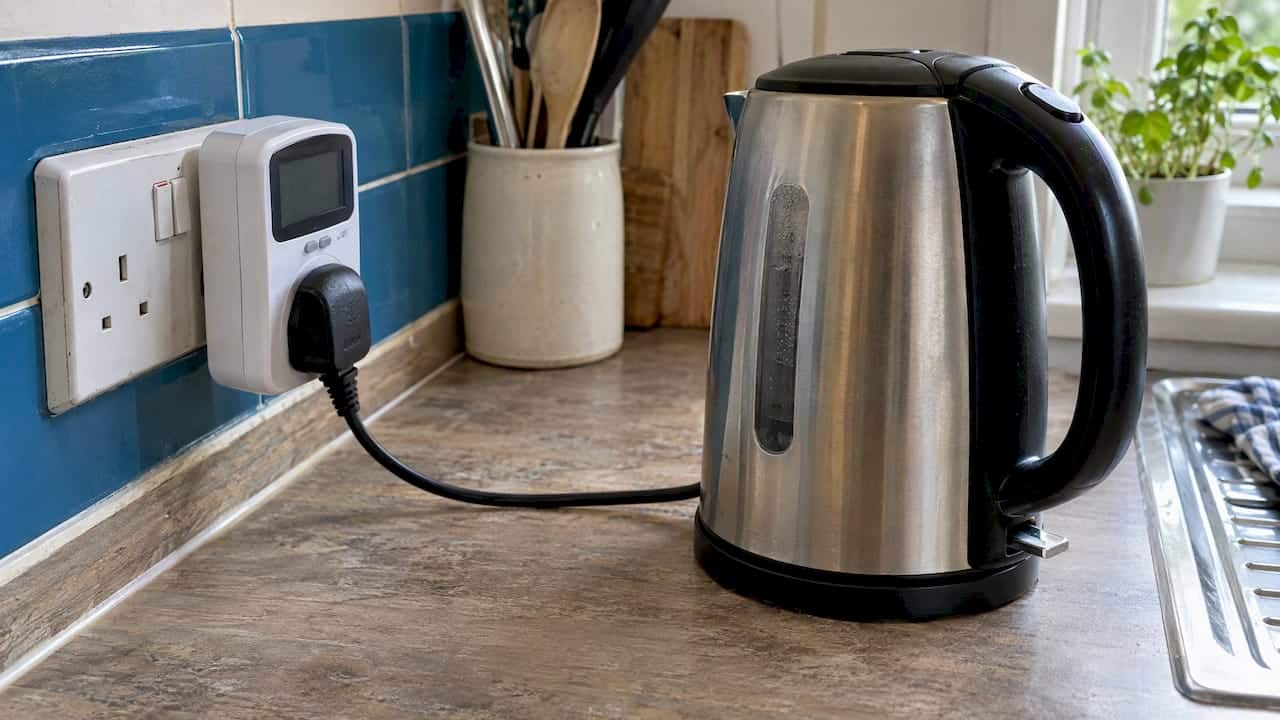
For a single appliance, the rated power on the label multiplied by hours of use gives kWh of input. A plug-in energy monitor gives a measured figure.
For a whole building, meter data is the starting point. Interval meter data, such as hourly or 15-minute readings, can help identify building energy-use patterns and operational waste. Sensible practice is to combine that data with information about the building’s systems, so performance gaps can be identified and quantified.
For homes with a smart meter, half-hourly consumption can usually be viewed through the supplier. For commercial premises, sub-metering on lighting, cooling and process loads gives a clearer split than a single bill.
Calculating a building’s energy efficiency
A building has no single “useful output” in the way a boiler does. Its job is to provide comfort, light and function. So building efficiency is normally expressed as a benchmark.
Energy use intensity (EUI)
The common measure is energy use intensity:
EUI = total annual energy consumption (kWh) ÷ floor area (m²)
Example: a 90 m² house uses 12,600 kWh of gas and electricity in a year.
- EUI = 12,600 ÷ 90 = 140 kWh/m² per year
A lower figure means less energy is needed per square metre. Dividing by floor area lets a small flat be compared with a large detached house.
EUI is not the same thing as efficiency in the physics sense. EUI describes how much energy a building consumes for its size. Efficiency describes how well a device converts input to output. A building can have a very efficient boiler and still have a high EUI if the walls and roof leak heat.
Site energy and source energy
Two versions of the figure exist. Site energy is what is consumed at the building, as shown on utility bills. Source energy includes the raw fuel needed, with generation, transmission and delivery losses. Always say which one is being used before comparing numbers.
Why comparisons can mislead
Two buildings, or two years of the same building, can look different for reasons unrelated to efficiency.
- Weather. Comparing load data from different periods can mislead if the data is not weather-normalised. A cold winter raises heating use even in an unchanged building.
- Standard versus actual use. A modelled score assumes standard operation and normal weather. The US Department of Energy’s asset scoring approach states that its estimate cannot be directly compared with utility bills for this reason.
- Occupancy. A home with someone in all day uses more heating than the same home empty.
The modelled approach has a benefit: standard weather, occupancy and use values allow direct comparison between buildings, because the building itself is being rated rather than the habits of its occupants.
Used well, measured data lets you compare a building with its own past performance or with similar buildings, and the quantified savings can support the case for further improvements.
How an EPC rating is calculated in the UK
Many UK readers searching this topic want to know how their property’s EPC rating is worked out, or whether they can calculate it themselves.
An EPC is not calculated with the input and output formula above. SAP is currently the government methodology for estimating the energy performance of homes and generating EPCs. An accredited assessor records the property’s characteristics: floor area, wall, roof and floor construction, glazing, heating system, controls, hot water and lighting. Software then models the home’s energy needs under standard assumptions and produces a rating.
The practical consequences are these:
- The rating describes the property, not how its current occupants live in it.
- Two identical homes get the same rating even if one household uses far more energy.
- Changing the heating system, insulation or glazing changes the modelled result, which is why recommendations on a certificate focus on those measures.
- Because a certificate needs an assessor’s survey and approved software, a free online estimate can show direction but cannot replace one.
For a fuller explanation of ratings and bands, see our guides to energy performance certificate ratings and the energy efficiency rating for UK property owners. The method behind the number is covered in what a SAP rating means for landlords.
The government’s methodology is changing. The Home Energy Model is the new methodology being introduced alongside the Future Homes Standard, and it is intended to replace SAP for new homes. Our page on energy models in homes tracks how it affects UK standards.
Which calculation suits which situation
| Situation | Right measure | What you need |
|---|---|---|
| Checking a single appliance or boiler | Efficiency % (output ÷ input × 100) | Input and output in the same units |
| Comparing your home’s usage year on year | EUI, weather-adjusted | Annual meter readings and floor area |
| Selling or letting a home | EPC rating | A domestic energy assessor |
| New-build home compliance | SAP calculation | Design drawings and specifications |
| New commercial building | SBEM or dynamic simulation | Building design data |
| Air conditioning over a set size | TM44 inspection | Access to the system |
Getting the calculation done professionally
Simple efficiency sums can be done at a kitchen table. Regulatory calculations cannot. They need an accredited assessor and approved software.
Homeenergymodel.co.uk helps property owners, landlords and developers request quotes for the assessments that follow from these calculations. Our domestic EPC and commercial EPC pages explain the process for existing buildings, and SAP calculations cover new dwellings. Commercial projects may need SBEM calculations, and larger or more complex designs may call for dynamic simulation modelling. Prices are agreed through the quote form, as no fixed fees are published on those pages.
Perspective: why the formula is only the start
We see the same pattern repeatedly with property owners. The basic efficiency formula is understood quickly. The confusion starts when the word “efficiency” is used for three different things: how well a device converts energy, how much energy a building uses per square metre, and the letter on an EPC.
Our advice is to decide first which question is being asked. A landlord asking whether a property can be let needs the EPC route and a qualified assessor. A homeowner asking whether the boiler is worth replacing needs the device formula and a year of gas readings. A developer asking whether a design complies needs a modelled calculation, not a utility bill.
The second point is that modelled and measured numbers answer different questions. Modelled ratings let two buildings be compared fairly. Bills show what a particular household actually did. Neither is wrong, but mixing them causes disappointment, such as expecting an energy bill to fall by exactly the amount a rating suggests.
The third point is timing. Methodologies are changing as the Home Energy Model arrives, so anyone planning work on a new build should check which method applies to their project before commissioning calculations.
— Danny
Practical ways to raise efficiency once you have the numbers
Calculation is useful because it shows where the loss is.
- Start with the biggest loss. If the boiler efficiency is low, replacement may matter. If the EUI is high but the boiler is good, look at insulation and draughts.
- Re-measure after any change. Compare a full year against the previous full year, adjusting for weather.
- Use the certificate recommendations. An EPC lists improvement measures for the property, which gives a prioritised starting point.
- Check the rules that apply. Landlords and commercial owners have obligations tied to ratings. Our guide to improving a house energy rating sets out practical measures, and the EPC exemption page covers when exemptions apply.
- Do not forget air conditioning. Larger systems in commercial buildings are subject to TM44 inspections.
FAQ
What is the formula for energy efficiency?
Efficiency equals useful energy output divided by total energy input, multiplied by 100 to give a percentage. Both figures must be in the same units and cover the same period. The result for a simple conversion device lies between 0% and 100%.
How can I calculate the energy efficiency of a building?
Divide the building’s total annual energy use in kWh by its floor area in square metres to get energy use intensity. Adjust for weather if comparing different years. For an official rating, an accredited assessor produces an EPC using the government methodology.
Can I calculate my own EPC rating?
You can get an indication from free online tools, but an official EPC must be produced by an accredited assessor using approved software. The assessor records the property’s construction and heating details, which the software uses to model the result. A self-made estimate cannot be lodged as a certificate.
How is the EPC calculated?
It is produced using the government’s SAP methodology, which estimates the energy performance of the home from its fabric, heating, hot water and lighting. The result reflects the property under standard assumptions, not the occupants’ actual bills. Our guide to SAP calculations explained for London homeowners walks through the inputs.
Why is my efficiency result over 100%?
The ratio is probably the wrong way round, or input and output cover different time periods or units. Recheck that output is on top and input underneath. Heat pumps are rated differently, using a coefficient of performance.
Sources
- Technical brief on energy efficiency, EEP Africa
- Energy Efficiency Basics, Penn State (EME 812)
- Efficiency of Energy Conversion Devices, Penn State (EGEE 102)
- Efficiency: useful output and total input, MiniPhysics
- Energy conversion efficiency, Wikipedia
- Energy Information Handbook, Lawrence Berkeley National Laboratory
- Quantifying the Energy-Related Costs and Benefits, Lawrence Berkeley National Laboratory
- Asset Score report guide, US Department of Energy
- Building Energy Modeling 101, US Department of Energy
- Standard Assessment Procedure, GOV.UK