
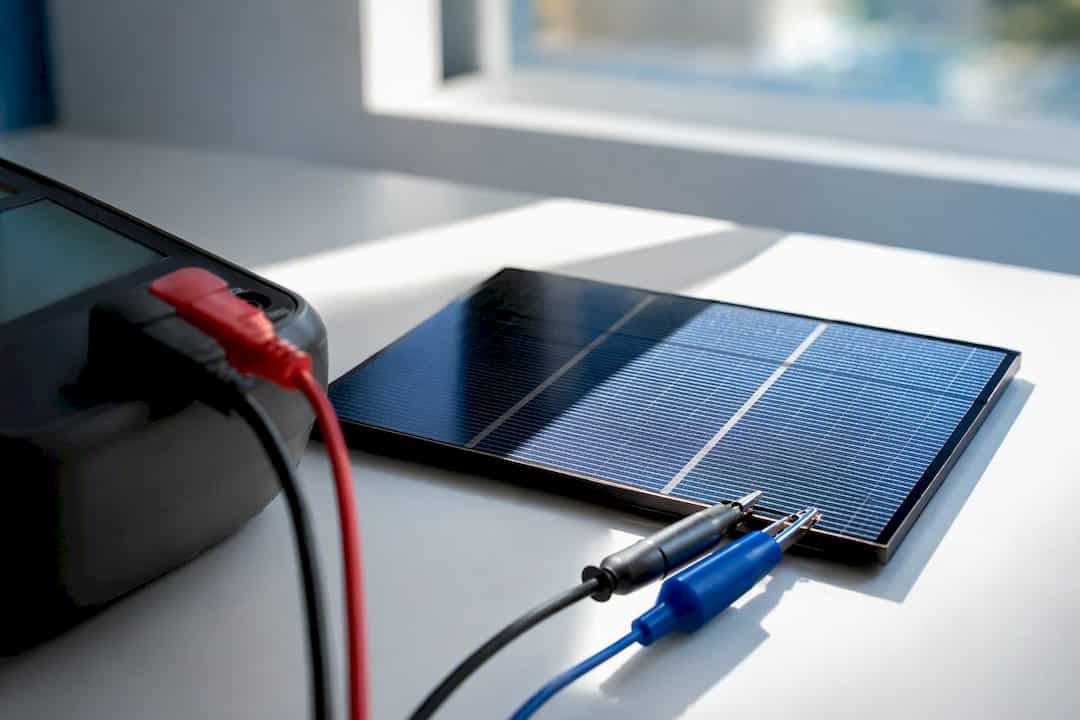
A photovoltaic cell converts sunlight into electricity through the photovoltaic effect: photons striking a silicon semiconductor knock electrons loose, and a built-in electric field pushes them into a directed flow, producing direct current (DC). An inverter then converts that DC into the 240V alternating current (AC) that UK homes actually run on.
TL;DR:
- Panel efficiency ratings under laboratory conditions do not predict actual annual energy output, which varies based on site-specific factors like shading, orientation, and temperature.
- Shading, soiling, and mismatch losses can significantly reduce energy yields, with shaded cells impacting entire strings and lowering overall performance.
- The output of a PV system depends heavily on irradiance and temperature, with heat reducing performance even under strong sunlight, especially in poorly ventilated setups.
- Proper wiring of cells into modules and arrays in series and parallel is essential to build up voltage and current for household use, with inverters converting DC to usable AC power.
- Understanding the physics and site conditions helps property owners make smarter decisions about panel placement, expected output, and the value of storage or export schemes.
Table of Contents
- How a PV cell works step by step
- What’s inside a solar cell: materials and construction
- From single cell to a working home system
- What actually determines how much electricity you get
- What efficiency figures actually mean
- Where PV cells show up in everyday life
- Common questions about how solar cells behave
- What this means for EPCs, HEM assessments, and property decisions
- Why understanding the physics changes property decisions
- Sources
- FAQ
How a PV cell works step by step
Every photovoltaic cell runs the same basic sequence, whether it’s a calculator strip or a 400-watt rooftop panel. What varies is scale, not mechanism. Understanding the sequence matters because it explains why panels behave the way they do: why cloud cover cuts output rather than killing it, why heat hurts performance, and why a single shaded cell can drag down an entire string.
The process starts the instant sunlight hits the cell’s surface and ends with usable direct current flowing out through metal contacts.
- Photons strike the semiconductor. Sunlight arrives as packets of energy called photons. When one hits the silicon layer with enough energy, it transfers that energy to an electron bound within the crystal structure.
- The electron breaks free. That energy is enough to knock the electron out of its normal position, leaving behind a “hole” where it used to sit. This paired gap and freed electron is known as an electron-hole pair, and it’s the fundamental unit of photovoltaic generation.
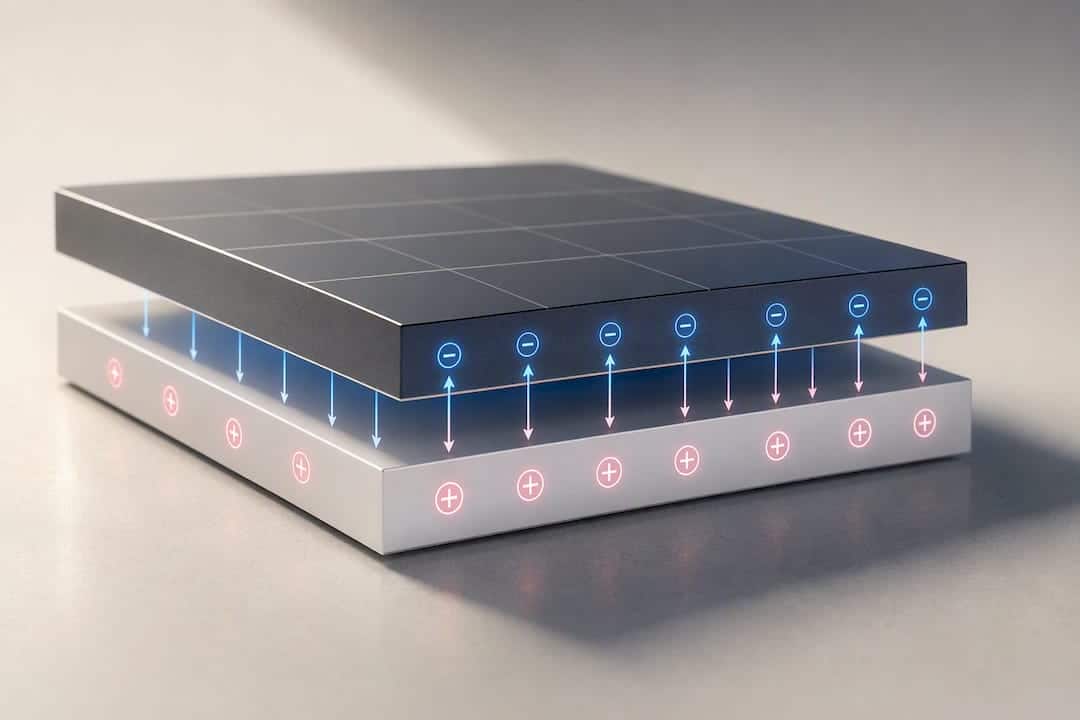
- The p-n junction separates the charges. Left alone, the electron would simply fall back into a hole and release its energy as heat, generating nothing useful. The p-n junction prevents that by creating a built-in electric field that sweeps electrons one way and holes the other.
- Electrons flow through an external circuit. Separated and unable to recombine locally, electrons travel through the silicon towards metal contacts on the cell’s surface, out through wiring, through whatever load is connected, and back round to the other side of the cell.
- Direct current is generated. This one-way electron flow is direct current, or DC, the raw output of every photovoltaic cell. It’s the same electrical form you get from a battery, just generated continuously as long as light keeps hitting the cell.
The contacts matter more than most explanations admit. A cell’s front surface carries a grid of thin metal fingers connected to thicker busbars, visible as the fine lines across a solar panel. These collect current from across the cell’s surface without blocking too much incoming light, a genuine trade-off engineers manage in every design: more metal collects current more efficiently but shades more of the active surface.
Statistic callout: The photovoltaic effect was first observed in 1839, but commercially viable silicon PV cells didn’t appear until the 1950s. It took over a century to turn an observed physical phenomenon into a manufacturable product, which says something about how demanding the materials science behind a “simple” solar cell actually is.
One frequently missed detail: a single cell only produces a small voltage, generally less than one volt, regardless of its size. That’s why practical systems always wire multiple cells together rather than relying on one large cell. Increasing surface area increases current, not voltage, so voltage has to be built up through wiring configuration instead, which is exactly what happens when cells are assembled into modules.
Pro Tip: If you want to see the photovoltaic effect for yourself, a basic multimeter and a small PV cell from a hobby kit will show voltage climbing the moment you move it from shade into direct sunlight. It’s a genuinely satisfying five-minute experiment.
What’s inside a solar cell: materials and construction
The silicon inside a PV cell isn’t just silicon. It’s silicon deliberately contaminated, in a process called doping, to create the electrical asymmetry that makes the whole thing work. Understanding what’s layered into a cell explains why some panels cost more, last longer, or perform better in particular conditions.
Doping and the p-n junction
Pure silicon is a poor conductor on its own. Manufacturers add tiny quantities of other elements to change that. Phosphorus, added to one layer, contributes extra electrons and creates “n-type” silicon (n for negative charge carriers). Boron, added to the adjacent layer, creates “p-type” silicon with a surplus of holes rather than electrons. Where these two layers meet is the p-n junction, and it’s the single most important structural feature in the entire cell. The junction generates a permanent electric field that does the work of separating charge carriers described in the previous section, without which sunlight would just heat the silicon rather than generate current.
Cell types and how they differ
Not every PV cell is built from the same silicon structure. The main types on the market today are:
- Monocrystalline silicon: grown from a single, continuous crystal structure, giving the highest efficiencies of mainstream silicon technology and a distinctive uniform dark appearance.
- Polycrystalline silicon: made from multiple silicon fragments melted together, cheaper to produce but slightly less efficient due to the boundaries between crystal grains.
- Thin-film cells: deposited as a thin layer onto glass, plastic, or metal, using materials such as cadmium telluride or amorphous silicon; lighter and more flexible but generally lower efficiency, useful for curved surfaces or lightweight applications rather than typical rooftops.
- Emerging technologies: perovskite and other next-generation materials are under active research for higher theoretical efficiencies and lower manufacturing costs, though long-term durability outside the laboratory is still being proven.
Beyond the silicon: the layers that protect and enhance
A finished solar cell inside a panel is far more than exposed silicon. An anti-reflective coating reduces the amount of sunlight bounced away before it can be absorbed. Tempered glass on the front protects against weather and impact while letting light through. An encapsulant, usually a polymer layer, bonds the cells to the glass and protects against moisture ingress. A backsheet seals the rear of the panel, and an aluminium frame gives the whole assembly structural rigidity for mounting.
| Cell/panel type | Typical efficiency range | Common use |
|---|---|---|
| Monocrystalline silicon | Higher end of mainstream commercial range | Rooftop domestic and commercial arrays |
| Polycrystalline silicon | Slightly below monocrystalline | Budget-conscious rooftop installations |
| Thin-film (cadmium telluride, amorphous silicon) | Lower than crystalline silicon | Lightweight, flexible, or curved-surface applications |
NREL’s photovoltaics research tracks these efficiency figures closely, and champion laboratory cells regularly outperform anything sold commercially, since research prototypes aren’t built to survive twenty years on a roof. Understanding this gap matters when you see efficiency percentages quoted in marketing material: a lab record and a warrantied product are two very different things.
From single cell to a working home system
A single cell producing half a volt is useless on its own. Turning that into something that runs a household requires wiring cells together and then converting the electrical form entirely.
Building up voltage and current
Cells are wired in series, meaning positive to negative in a chain, to add their voltages together. Sixty or so cells wired in series typically produce a module voltage in the tens of volts, enough to be practical. Wiring modules in parallel, rather than series, increases current instead of voltage. Most domestic arrays use a mix of both, arranged in “strings,” to balance the voltage and current a given inverter is designed to handle.
The naming hierarchy runs: cell (the basic unit) → module (multiple cells wired and encapsulated together, what most people call a “solar panel”) → array (multiple modules connected together across a roof or field). A domestic rooftop installation is technically an array of modules, each module built from a few dozen cells.
The inverter: where DC becomes usable AC
Every cell in every module still only produces DC. UK homes and the national grid run on AC, so an inverter sits between the array and the property’s consumer unit, converting DC into 240V AC that matches what mains electricity supplies. Without an inverter, a rooftop array can’t power a single household appliance. Choosing the right inverter, whether a single string inverter for the whole array or microinverters fitted to individual panels, has a real effect on how much a shaded or partially obstructed roof still produces. Homeenergymodel’s inverter guide covers that selection in more depth.
A simple worked example
Picture a household using electricity for lighting, a kettle, and a fridge freezer during a sunny afternoon. The array generates DC, the inverter converts it to AC, and that AC feeds the consumer unit directly. Electricity is used in the house first; only genuine surplus, generation exceeding what’s being consumed at that moment, either charges a battery or exports to the grid.
- Any unused surplus can be stored in a home battery for use after sunset.
- Exported surplus can earn payments through schemes such as the Smart Export Guarantee.
- On a heavily overcast day, generation drops but rarely reaches zero, since diffuse daylight still carries usable photon energy.
Pro Tip: If you’re assessing whether battery storage makes financial sense for a property, look at when the household actually uses electricity, not just how much it uses overall. A home empty all day and occupied only in the evening gets far more value from storage than one where most consumption happens during daylight anyway.
What actually determines how much electricity you get
Two identical panels on two different roofs can produce noticeably different output over a year. The physics inside the cell is fixed; everything else about performance is determined by the conditions around it.
Irradiance, orientation, and tilt
Irradiance, the intensity of sunlight hitting the panel surface, is the single biggest variable. Panel angle and compass orientation determine how much of the available irradiance actually reaches the cell surface rather than glancing off at a shallow angle. In the UK, a roughly south-facing roof pitched at a moderate angle tends to capture the most annual sunlight, though east and west orientations still generate meaningfully, just with a different daily output curve.
Temperature: the counterintuitive factor
Heat reduces PV output, which surprises people who assume more sun automatically means more electricity. Every solar cell has a temperature coefficient describing how much power drops for every degree above standard test conditions, and NREL’s ongoing research into module behaviour under real operating temperatures is part of why manufacturers now design for better ventilation behind panels rather than just chasing raw efficiency numbers. A panel baking on a black roof in July can produce less than the same panel on a cooler, breezier day with slightly weaker sunlight.
Shading, soiling, and mismatch
- A single shaded cell in a string can disproportionately reduce the output of the entire string, not just its own contribution.
- Partial shading can create localised “hot spots,” a genuine risk that modern panels manage with bypass diodes routing current around the shaded cell.
- Dust, pollen, and grime (soiling) gradually reduce output and are usually cleared by rainfall in most UK climates without intervention.
- Mismatch losses occur when cells or modules in the same string perform slightly differently, meaning the weakest link limits the whole string’s output.
Clouds, seasons, and latitude
Cloud cover reduces but doesn’t eliminate generation, because diffuse light scattered through cloud still carries usable energy. National Grid’s explainer on UK solar deployment notes that panels keep contributing useful output across the year despite genuinely variable weather, though seasonal swings are substantial: a UK array typically produces far more in June than in December, purely from day length and sun angle rather than any change in the equipment itself.
What efficiency figures actually mean
Manufacturer efficiency percentages get quoted constantly, and misunderstood almost as often. A panel rated at a given efficiency is not promising that percentage of its rated capacity, all the time, everywhere.
The theoretical ceiling
Physics itself caps how efficient a single-junction silicon cell can ever be. This ceiling, known as the Shockley-Queisser limit, exists because a silicon cell can only usefully absorb photons within a certain energy range; anything above or below that range is either wasted as heat or passes straight through. Commercial cells sit meaningfully below this theoretical ceiling once manufacturing tolerances, material imperfections, and practical design trade-offs are factored in.
Where the losses actually happen
The gap between a cell’s laboratory-rated efficiency and a panel’s real annual output comes from several compounding losses:
- Reflection off the glass and cell surface, partially offset by anti-reflective coatings but never eliminated entirely.
- Resistive losses in the internal wiring and connections between cells.
- Inverter conversion losses, since even efficient modern inverters aren’t perfectly lossless when converting DC to AC.
- Temperature losses on hot days, following the temperature coefficient described earlier.
- Mismatch and shading losses across strings, particularly on complex or partially obstructed roofs.
Reading a manufacturer’s claim correctly
A panel’s rated efficiency is measured under Standard Test Conditions, a fixed laboratory irradiance and temperature that rarely matches a real UK roof on a given afternoon. That rating is genuinely useful for comparing one panel against another, but it’s not a forecast of annual output. Actual yearly yield depends on the site-specific factors covered above, which is precisely why installers use modelled irradiance data for a specific postcode and roof angle rather than simply multiplying a panel’s rated wattage by daylight hours.
Where PV cells show up in everyday life
Photovoltaic technology scales from tiny to vast, and the underlying cell physics stays identical at every size.
- Small electronics. Calculators, garden lights, and some outdoor sensors run directly off small PV cells with little or no storage, generating just enough current for low-power devices.
- Domestic rooftop arrays. A typical UK home installs somewhere in the region of a 3 to 4 kWp array, generating enough over a year to cover a meaningful share of household electricity use, with the Centre for Sustainable Energy noting that actual annual output depends heavily on roof orientation, shading, and local irradiance rather than capacity alone.
- Commercial and industrial installations. Larger arrays on warehouse roofs or dedicated solar farms scale up the same cell technology into hundreds of kilowatts or several megawatts, feeding directly into commercial electricity supplies or the grid.
- Off-grid and specialised applications. Remote telecoms equipment, marine navigation buoys, and satellites all rely on PV cells precisely because there’s no practical alternative power source available where they operate.
For a typical domestic system, the practical takeaway is that capacity in kWp is a starting point for estimating output, not a guarantee. Two 4kWp arrays on different roofs can produce genuinely different annual totals, and that’s a large part of why proper site assessment matters more than headline panel specifications.
Common questions about how solar cells behave
Why do panels stop producing at night? The photovoltaic effect requires photons hitting the semiconductor; without incoming light, there’s no energy to free electrons, so generation drops to zero. Battery storage or grid export during the day is what covers overnight electricity use, not the panels themselves working after dark.
Why do panels still work on cloudy days? Cloud cover scatters sunlight into diffuse light rather than blocking it entirely, and diffuse photons still carry enough energy to generate current, just at a reduced rate compared with direct, unobstructed sunshine.
- The “20% rule” is not a single fixed standard. Depending on context, it can refer to a panel efficiency benchmark, a rule-of-thumb output estimate, or a specific inverter sizing ratio, so the term should always be checked against its specific source rather than assumed to mean one universal thing.
- PV cells can genuinely power a house, but almost never in isolation. A correctly sized array, paired with an inverter and often battery storage or grid export, can cover a substantial share of a typical household’s annual electricity use, though full independence from the grid usually requires oversizing the system well beyond typical domestic capacity.
What this means for EPCs, HEM assessments, and property decisions
Photovoltaic generation and the household consumption it offsets matter enormously to energy assessments, and Homeenergymodel spends most of its time helping property owners and assessors get that relationship right rather than treating solar panels as an automatic tick-box improvement.
Inverter choice affects more than efficiency
Whether a property uses a string inverter or microinverters influences resilience to shading and how generation data feeds into performance modelling. Homeenergymodel’s inverter explainer is worth reading before specifying equipment on a retrofit.
PV doesn’t automatically improve an EPC rating
Adding solar panels doesn’t guarantee a jump in Energy Performance Certificate banding. What matters for EPC and HEM assessments is how generation is modelled against the property’s actual demand, insulation standard, and heating system, not simply the presence of panels on the roof.
What an assessor actually checks
- Panel orientation, tilt, and any obstructions affecting expected generation.
- Inverter type and specification, since this determines how generation is recorded in the assessment methodology.
- Whether battery storage or export arrangements are in place, both of which affect how self-consumption is modelled.
- Existing insulation and heating system performance, since PV benefit is always assessed relative to overall building demand, not in isolation.
Property owners considering panels ahead of a sale, letting, or planning application get more value from an assessment that models the whole building than from adding capacity and assuming the rating improves.
Why understanding the physics changes property decisions
The cell physics isn’t academic trivia. It explains why a poorly oriented, heavily shaded array can underperform a smaller, well-sited one, and why that gap shows up directly in what an EPC assessment can credit a property with.
Property owners who understand irradiance, temperature effects, and shading make sharper decisions about where panels go and what output to expect, rather than relying on a headline wattage figure from a sales brochure. That same literacy helps when weighing storage against export tariffs, since the right answer depends on when a household actually uses electricity, not on generic advice.
None of this replaces a proper site-specific assessment. Balancing performance, cost, and compliance on a real property means accounting for roof geometry, existing insulation, and the specific methodology an EPC or HEM assessment applies, which is exactly where a qualified assessor adds value a general explainer cannot.
— Danny
Sources
National Grid’s explainer covers the photovoltaic effect’s discovery and UK deployment context. The Centre for Sustainable Energy offers detailed guidance on inverters, storage, and export schemes. Historic England explains PV system components clearly, including the distinction from solar thermal. NREL provides ongoing technical research into module efficiency and material science.
Property owners considering an EPC assessment after a PV installation can request one through Homeenergymodel’s domestic EPC service, while landlords and developers managing larger portfolios may need a commercial EPC or a full SAP calculation to confirm compliance ahead of sale or letting. Installers marketing their own services locally may also find value in SEO support tailored to trade businesses.
FAQ
How does a solar cell work step by step?
Photons hit the silicon semiconductor and transfer energy to electrons, knocking them loose and creating electron-hole pairs. The p-n junction’s built-in electric field separates these charges and drives electrons through metal contacts and external wiring, producing direct current.
Why can’t solar cells work at night?
The photovoltaic effect depends entirely on incoming photons providing the energy to free electrons within the semiconductor. Without daylight, there’s no energy source to drive the process, so generation falls to zero until a battery or grid export covers overnight demand.
What is the 20% rule for solar panels?
There’s no single fixed definition. The phrase gets applied to different things, including panel efficiency benchmarks, output estimation rules of thumb, and inverter sizing ratios, so it’s worth checking the specific context before assuming which one applies.
Can PV cells power a house?
A correctly sized array with an inverter, and often battery storage, can supply a substantial share of a typical home’s electricity across the year. Full independence from the grid usually needs a much larger system than most rooftops carry, and site-specific factors like shading and orientation determine how close any given property gets.