

TL;DR:
- Renewable resources replenish naturally and are vital for the UK’s energy transition. Solar, wind, water, geothermal, and biomass provide sustainable energy sources with environmental and economic benefits. Supporting policies like MCS certification and planning guidance help ensure successful installation and compliance.
A renewable resource is defined as a natural asset that replenishes at a rate equal to or faster than it is consumed, making it available for sustained, long-term use. Sunlight, wind, water, geothermal heat, and biomass are the five core categories recognised by the UK government under its clean energy framework. These sources are also referred to as green, clean, or sustainable energy, with policy emphasis on reducing carbon emissions and strengthening energy security. Public backing is strong: 81% of UK adults supported renewable energy use in spring 2026, with opposition standing at just 4%. That level of consensus is rare in energy policy and signals a genuine shift in public expectation.
What are the main types and examples of renewable resources?
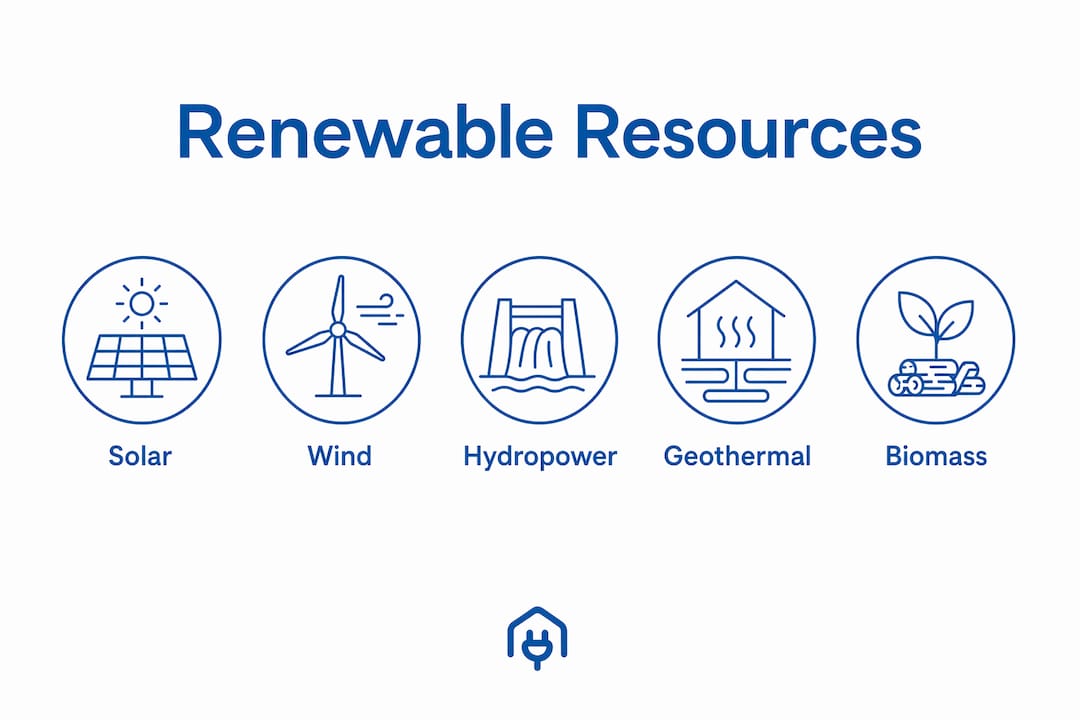
Renewable resources divide into five well-established categories, each with distinct characteristics, replenishment cycles, and practical applications in the UK.
Solar energy comes from sunlight captured by photovoltaic panels or solar thermal collectors. It replenishes continuously and produces no direct emissions during generation. Residential solar panel installations across the UK have grown steadily, with home solar benefits including reduced electricity bills and eligibility for the Smart Export Guarantee.
Wind energy is generated by turbines that convert kinetic energy from moving air into electricity. The UK operates some of the largest offshore wind farms in the world, including Hornsea One and Hornsea Two off the Yorkshire coast. Wind is a flow-limited resource, meaning generation depends on weather conditions rather than a finite stock.
Hydropower uses the movement of water through rivers, tidal flows, or reservoirs to drive turbines. It is one of the most reliable renewable sources because water cycles naturally through precipitation and evaporation. Small-scale run-of-river schemes are common in Scotland and Wales.

Geothermal energy draws heat from the earth’s interior. Ground source heat pumps, widely used in UK homes, extract low-grade geothermal heat and upgrade it for space heating and hot water. The Warm Homes Plan specifically supports heat pump adoption as a priority technology.
Biomass includes organic materials such as wood pellets, agricultural residues, and energy crops. Unlike solar or wind, biomass is a stock resource: forests and crops must be managed carefully to remain genuinely renewable. Biomass boilers and combined heat and power units are common in both residential and commercial settings.
| Resource type | How it replenishes | Primary UK use |
|---|---|---|
| Solar | Continuous sunlight | Electricity, hot water |
| Wind | Atmospheric circulation | Electricity generation |
| Hydropower | Precipitation and water cycle | Electricity generation |
| Geothermal | Earth’s internal heat | Space heating, hot water |
| Biomass | Managed crop and forest growth | Heating, electricity, fuel |
Pro Tip: When assessing which renewable resource suits a property, consider the site’s solar irradiance, wind exposure, and access to district heating networks before committing to a technology.
What are the environmental and economic benefits of renewable resources?
Renewable resources deliver measurable gains across three areas: environmental quality, public health, and economic performance.
Environmental benefits
Renewable generation produces no direct carbon dioxide emissions during operation. The UK’s clean energy transition aims to reduce fossil fuel reliance from 75% to 15% of the energy mix by 2050. Achieving that target would avoid £445 billion in fossil fuel spending over the same period. Cleaner air from reduced combustion also supports biodiversity by lowering acid deposition on soils and waterways.
Economic and health benefits
The economic case is equally strong. Renewables reduce exposure to volatile fossil fuel markets, which have historically triggered economic recessions when prices spike. The UK government projects that the clean energy transition will deliver 8,000 fewer hospital admissions annually as air quality improves. That figure represents a direct reduction in NHS costs and lost working days.
70% of UK adults agree that renewable industries provide economic benefits, a figure that has held broadly stable since 2022. Public confidence in the economic case matters because it sustains political support for the long-term investment renewables require.
Renewables also create jobs in manufacturing, installation, and maintenance. Offshore wind alone supports tens of thousands of roles across the UK supply chain. Price stability is a further advantage: once infrastructure is built, the fuel is free, which insulates households and businesses from the commodity price swings that affect gas and oil.
Energy security
Renewable energy security reduces the UK’s dependence on imported fossil fuels. Domestically generated electricity from wind and solar cannot be subject to geopolitical supply disruptions. That independence is a structural advantage that no amount of gas storage capacity can fully replicate.
How do renewable resources work and how are they supported in the UK?
Understanding how renewable technologies function, and how the UK policy framework supports them, is essential for anyone making investment or compliance decisions.
How generation technologies work
Solar panels use photovoltaic cells to convert photons from sunlight into direct current electricity, which an inverter converts to alternating current for household use. Wind turbines rotate blades using wind pressure, driving a generator through a gearbox. Heat pumps extract ambient heat from the ground or air and concentrate it using a refrigerant cycle, delivering efficient home heating at efficiencies more than three times greater than a conventional gas boiler.
Renewable energy vs microgeneration
A critical distinction affects grant eligibility and export tariff access. Microgeneration differs from renewable energy in two key ways: microgeneration is capacity-limited (50 kW electrical or 45 kW thermal maximum) and can include fossil fuel sources such as gas micro-CHP boilers. Renewable energy is defined solely by its source and carries no size limit. A large offshore wind farm is renewable but not microgeneration. A gas micro-CHP unit is microgeneration but not renewable.
This distinction matters practically. The Microgeneration Certification Scheme (MCS) certificate is mandatory for small-scale systems under 50 kW to qualify for the Smart Export Guarantee, which pays households for surplus electricity exported to the grid.
UK financial support mechanisms
- Renewables Obligation (RO): Requires licensed electricity suppliers to source a proportion of their electricity from eligible renewable sources. Generators receive tradeable Renewables Obligation Certificates as proof of compliance.
- Contract for Difference (CfD): Offers renewable generators a fixed strike price for electricity, removing revenue volatility and encouraging large-scale investment. The CfD mechanism has been central to the growth of offshore wind in the UK.
- Smart Export Guarantee (SEG): Requires licensed energy suppliers to pay small-scale generators for exported electricity, provided the system holds MCS certification.
- Warm Homes Plan: Provides consumer loans and combined system incentives to reduce the upfront cost of heat pumps and other efficient renewable heating technologies.
Pro Tip: MCS certification is not optional for homeowners seeking SEG payments. Always confirm installer accreditation before signing a contract.
What are the practical applications and future outlook for renewable resources?
Renewable resources are no longer a niche consideration. Renewables accounted for 51.7% of UK electricity generation by major producers in the most recent statistics, with a 23% year-on-year increase in renewable output. That figure means renewables now generate the majority of UK electricity, a structural shift that was considered ambitious just a decade ago.
Residential and commercial applications
- Solar photovoltaic panels reduce electricity bills and generate export income via the Smart Export Guarantee. Payback periods vary by roof orientation, shading, and local irradiance.
- Ground source and air source heat pumps replace gas boilers for space heating and hot water. The Warm Homes Plan supports installation with loans and grants, reducing the barrier of high upfront costs.
- Biomass boilers suit rural properties without access to the gas grid. They require fuel storage space and a reliable wood pellet supply chain.
- Solar thermal collectors heat water directly and are often paired with a conventional cylinder, reducing the energy demand on a primary heating system.
- Battery storage systems paired with solar panels allow households to store surplus generation for evening use, reducing grid dependence further.
Home energy modelling and renewables
Renewable technologies affect a property’s Energy Performance Certificate (EPC) rating directly. The Home Energy Model (HEM), which is set to replace SAP as the UK’s standard assessment methodology, accounts for renewable generation in its calculations. Properties with solar panels or heat pumps typically achieve higher EPC ratings, which matters for landlords facing minimum energy efficiency standards. Landlords can explore renewable energy incentives to understand which technologies deliver the greatest rating improvements.
Future outlook and challenges
The UK government’s Clean Power by 2030 target requires a significant acceleration in renewable deployment. Upfront installation costs remain the primary barrier for many households, though the Warm Homes Plan and other policy instruments are designed to address this. Historic England notes that renewable infrastructure design must balance energy benefits with the preservation of heritage sites, using reversible and replaceable technologies where possible. That constraint applies to a significant proportion of the UK’s older housing stock.
Pro Tip: Before installing any renewable technology on a listed building or in a conservation area, obtain written guidance from the local planning authority. Permitted development rights do not always apply.
Key takeaways
Renewable resources are the foundation of the UK’s energy transition, already supplying the majority of electricity and backed by strong public support and government policy.
| Point | Details |
|---|---|
| Core definition | A renewable resource replenishes naturally at or faster than its rate of consumption. |
| Five main types | Solar, wind, hydropower, geothermal, and biomass each serve distinct UK applications. |
| Economic and health gains | The clean energy transition could avoid £445bn in fossil fuel costs and 8,000 hospital admissions annually. |
| Microgeneration distinction | Systems under 50 kW need MCS certification to access the Smart Export Guarantee. |
| Current UK share | Renewables provided 51.7% of UK electricity generation in the most recent statistics. |
Why the microgeneration distinction matters more than most guides admit
Most articles on renewable resources treat the topic as a straightforward catalogue of green technologies. The detail that consistently trips up property owners and landlords is the microgeneration boundary. I have seen cases where a homeowner installs a solar system without MCS-certified installers, then discovers they cannot access SEG payments. The financial loss over a 10-year period is substantial.
The other area where I think conventional guidance falls short is heritage properties. The UK has a large stock of listed buildings and conservation area homes where standard permitted development rules do not apply. Renewable installations on these properties require planning permission, and the design must satisfy Historic England’s guidance on reversibility. Ignoring this step leads to enforcement notices and costly removal.
The broader point is that understanding what a renewable resource is, at a definitional level, is only the starting point. The practical value comes from knowing how UK policy frameworks, certification requirements, and property-specific constraints interact. Public support for renewables is at 81%, and the technology is mature. The gap between intention and successful installation is almost always a policy or compliance issue, not a technical one.
— Danny
How Homeenergymodel supports your renewable energy decisions
Homeenergymodel provides detailed guidance on how energy modelling frameworks, including the Home Energy Model, assess renewable technologies within UK properties. For landlords and property owners looking to understand how solar panels, heat pumps, or biomass systems affect EPC ratings and compliance obligations, the site offers clear, regulation-aligned resources. The types of home energy models for landlords page explains which assessment methodologies apply to different property types and how renewable installations are factored into energy performance scores. Understanding this connection is the practical next step after grasping the fundamentals of renewable resources.
FAQ
What is the renewable resource definition used in the UK?
A renewable resource is a natural source of energy or material that replenishes at a rate equal to or faster than its consumption. The UK government recognises sunlight, wind, water, geothermal heat, and biomass as the primary renewable sources.
How do renewable resources differ from nonrenewable resources?
Renewable resources replenish naturally within a human timescale, while nonrenewable resources such as coal, oil, and natural gas form over millions of years and are depleted permanently once used.
What percentage of UK electricity comes from renewable sources?
Renewables accounted for 51.7% of UK electricity generation by major producers in the most recent statistics, representing a 23% year-on-year increase.
Do all renewable energy systems qualify for government support schemes?
No. Small-scale systems under 50 kW must hold Microgeneration Certification Scheme (MCS) certification to qualify for the Smart Export Guarantee. Systems installed by non-MCS-accredited contractors are ineligible regardless of the technology used.
Why are renewable resources important for sustainable development?
Renewable resources reduce carbon emissions, improve air quality, and provide energy price stability. The UK government projects that the clean energy transition will avoid £445 billion in fossil fuel spending by 2050, alongside significant public health improvements.