

TL;DR:
- An EPC rating of D indicates average energy efficiency in UK homes, with a SAP score between 55 and 68. Landlords must upgrade to band C before October 2030 to avoid fines, typically with costs under £1,300 by adding simple improvements. Buyers should verify current EPC validity and future upgrade costs, as exemptions do not transfer upon sale.
An energy performance certificate rating of D is defined as a SAP score between 55 and 68, placing a property in the average efficiency band on the UK’s A-to-G scale. This is the most common rating in the UK, covering 35–40% of homes. Understanding the EPC rating D meaning matters now more than ever. Landlords face a hard deadline of 1 october 2030 to reach band C, and buyers risk inheriting compliance obligations that previous owners could not pass on. This guide covers costs, legal duties, and the most cost-effective upgrade path.
What does EPC rating D mean for your property?
An EPC rating D indicates average energy efficiency under the Standard Assessment Procedure, or SAP, which is the government-approved method for measuring a home’s energy performance. The SAP score range of 55–68 sits in the middle of the scale, above the poorly rated E, F, and G bands but below the more efficient A, B, and C categories. That middle position is where most UK housing stock sits, which is why D is the single most prevalent band nationally.

The energy performance certificate itself is a legal document valid for 10 years. It rates a property on energy use, carbon dioxide emissions, and typical fuel costs. A D rating does not mean a property is failing. It means the property is performing at an average level and has identifiable room for improvement without necessarily requiring major structural work.
For homeowners not planning to let their property, a D rating carries no immediate legal penalty. For landlords and buyers with rental intentions, the picture is more pressing, as the 2030 deadline creates a clear planning horizon.
How does a D rating affect running costs and property value?
The financial consequences of an EPC D rating are concrete and measurable. D-rated homes typically cost £1,000–£1,400 per year in energy bills and produce 3–5 tonnes of CO2 annually. That places them noticeably above C-rated equivalents, which typically cost £200–£400 less per year to run.
The gap in running costs is one reason D-rated properties attract a market discount. Savills analysis shows D-rated homes trade at a 3–5% discount relative to C-rated equivalents. That discount is expected to widen as the 2030 EPC C deadline approaches and buyer awareness increases.
This effect is sometimes called the “energy discount” in property valuation. A property worth £300,000 at band C could realistically be valued at £285,000–£291,000 at band D, purely on the basis of its energy rating. Buyers and investors are increasingly pricing in the cost of future upgrades when making offers.
Practical steps to reduce running costs in a D-rated home include:
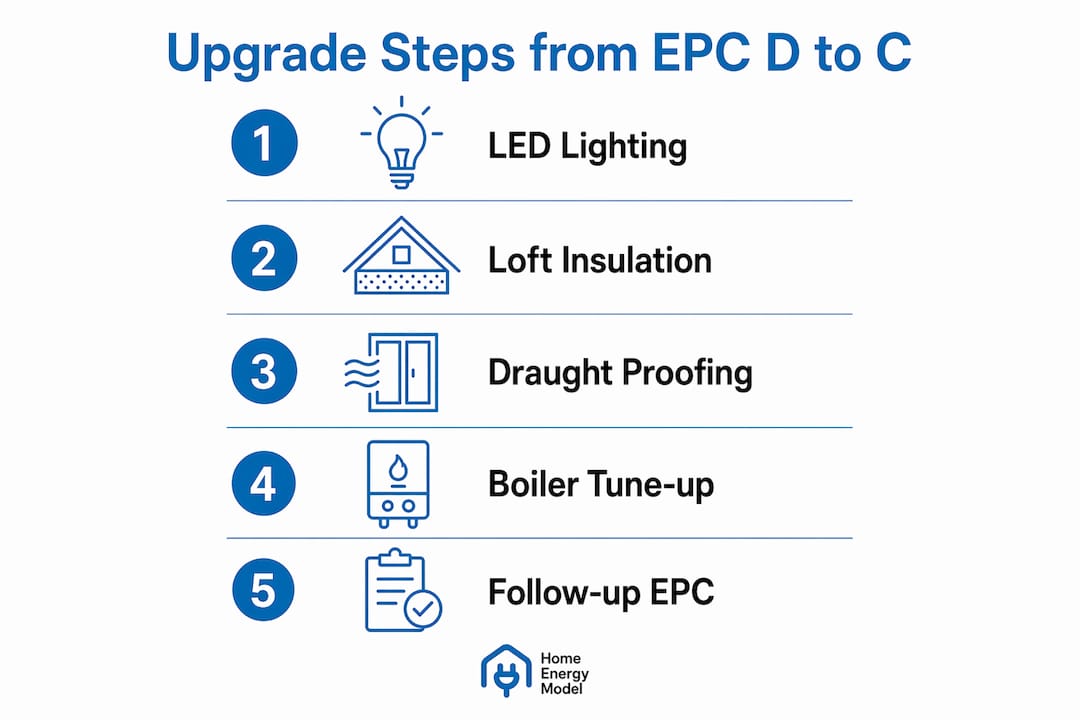
- Switching to LED lighting throughout the property
- Adding draught-proofing to doors, windows, and letterboxes
- Topping up loft insulation to the recommended 270mm depth
- Installing a smart thermostat or programmable heating controls
- Fitting thermostatic radiator valves to manage room temperatures
For broader guidance on cutting household energy costs, the utility bill reduction strategies published by Savings Grove offer practical, low-cost approaches applicable to D-rated properties.
What are the legal requirements for EPC D landlords?
The current Minimum Energy Efficiency Standards, known as MEES, require all privately rented properties in England and Wales to hold a minimum EPC band E. A D rating is fully compliant in 2026. However, compliance requirements are changing significantly.
From 1 october 2030, all private rental properties must achieve a minimum of band C. Landlords who fail to meet this standard face fines of up to £30,000 per property. That is not a per-tenancy fine. It applies per property, making non-compliance extremely costly for portfolio landlords.
The key legal obligations for landlords with D-rated properties are:
- Hold a valid EPC, current within the last 10 years, before letting the property.
- Provide the EPC to prospective tenants at the point of marketing.
- Plan and budget for upgrades to reach band C before october 2030.
- Register any exemptions on the PRS Exemptions Register if improvements are not technically feasible or cost-effective.
- Ensure exemptions are re-evaluated when the property changes tenancy or ownership.
Exemptions registered by a current landlord do not transfer automatically. When a property changes hands or a new tenancy begins, the new landlord must assess compliance obligations from scratch. This is a point many landlords overlook until it is too late.
Pro Tip: Commission an EPC assessment now, even if your current certificate is still valid. A fresh assessment will reflect any improvements already made and give a clearer picture of what is needed to reach band C before 2030.
For a full breakdown of landlord obligations under current and forthcoming rules, Homeenergymodel’s guide on EPC compliance for landlords covers the legislative timeline in detail.
Which upgrades move a D-rated home to band C?
The average gap between band D and band C is approximately 6 SAP points. That is a modest target, and most D-rated homes can reach it without expensive or disruptive works. The two highest-impact measures are loft insulation and smart heating controls, which together can close most or all of that gap.
Most D-rated homes can upgrade to band C for under £1,300, focusing on LED lighting, loft insulation top-ups, and draught-proofing. These three measures collectively add 10–23 SAP points, which is well above the average 6-point gap required. That means many properties will reach band C before all three measures are even completed.
The table below shows the most cost-effective upgrades ranked by typical SAP point gain:
| Measure | Estimated cost | Typical SAP points gained |
|---|---|---|
| Loft insulation top-up to 270mm | £300–£500 | 5–10 |
| Smart heating controls | £150–£300 | 3–8 |
| Draught-proofing | £100–£200 | 1–3 |
| LED lighting throughout | £50–£150 | 1–3 |
| Cavity wall insulation | £400–£700 | 4–8 |
Solid wall insulation is frequently listed on EPC recommendation reports, but the average D to C upgrade does not require it. Solid wall insulation costs £8,000–£20,000 and is disruptive. Landlords and owners should exhaust lower-cost options first.
Pro Tip: After completing initial improvements, commission a follow-up EPC assessment before carrying out further works. An interim assessment confirms whether band C has already been reached, preventing unnecessary spending on additional measures.
For a wider view of technologies that can improve a home’s energy performance, Homeenergymodel’s energy saving technologies guide covers both low-cost and higher-investment options with clear explanations.
What should buyers know before purchasing a D-rated property?
Buyers often underestimate the cost of upgrading EPC ratings after purchase. Due diligence on energy ratings is as important as a structural survey, particularly for anyone buying with rental intentions. A D-rated property is a legal purchase, but it carries a clear compliance obligation if it will be let after 2030.
The most important points for buyers to check before exchanging contracts are:
- Whether the current EPC is still valid or has expired.
- Whether any exemptions are registered on the PRS Exemptions Register, and whether those exemptions will transfer.
- What the EPC recommendation report lists as the most cost-effective improvements.
- Whether the property’s construction type (for example, solid stone walls or a listed building) limits which upgrades are feasible.
- What the estimated cost of reaching band C would be, factored into the purchase price.
MEES compliance obligations reset on change of ownership. A buyer cannot rely on exemptions registered by the previous owner. This applies even if the exemption was legitimately granted and is still within its five-year validity period. The new owner must register their own exemption or carry out the required improvements.
Pro Tip: Commission an independent EPC assessment before completing a purchase, not after. An independent assessment gives an unbiased view of the property’s current rating and the realistic cost of reaching band C, which can inform price negotiations.
For buyers seeking a broader understanding of how energy ratings affect property value and compliance, the EPC rating meaning guide on Homeenergymodel provides a thorough overview of the current regulatory context.
Key takeaways
A D-rated property sits at the average point of the UK’s energy efficiency scale, is legally lettable in 2026, but requires a plan to reach band C before the 1 october 2030 MEES deadline to avoid fines of up to £30,000 per property.
| Point | Details |
|---|---|
| EPC D definition | A SAP score of 55–68, the most common band in UK housing stock. |
| Running cost impact | Annual energy bills of £1,000–£1,400, with a 3–5% property value discount vs band C. |
| Legal deadline | All private rentals must reach band C by 1 october 2030 or face fines up to £30,000. |
| Upgrade cost | Most D-rated homes reach band C for under £1,300 using loft insulation, draught-proofing, and LED lighting. |
| Buyer caution | EPC exemptions do not transfer on sale; buyers must assess compliance obligations independently. |
Why incremental upgrades beat waiting for a perfect plan
From my experience working with property owners navigating EPC compliance, the biggest mistake is waiting. Landlords assume they need a full retrofit to reach band C, so they delay. In reality, the average SAP gap between D and C is just 6 points, and loft insulation alone often closes most of it.
The second most common mistake is completing all recommended works in one go without an interim assessment. EPC recommendation reports are generated at a point in time. Once two or three measures are done, the property may already be at band C. Spending £5,000 on additional works to reach a rating already achieved is a genuine risk, and one that a mid-point EPC assessment would prevent.
Buyers are equally prone to misjudgement. Many assume that because a property currently has a valid EPC, their obligations are covered. They are not. The moment a new tenancy begins, compliance resets. A property with a registered exemption under the previous owner is not a protected purchase. It is a liability waiting to surface.
My practical advice is straightforward. Get a current EPC assessment. Identify the two or three cheapest measures. Carry them out. Then get a second assessment before spending any more. That sequence costs far less than a reactive approach driven by a looming fine.
— Danny
How Homeenergymodel supports EPC compliance planning
Homeenergymodel provides detailed guidance for landlords and property owners working through EPC compliance requirements. The types of home energy models for landlords guide explains the different assessment methodologies available, including how the forthcoming Home Energy Model will replace SAP from 2025 onwards and what that means for EPC calculations. For owners seeking a clear picture of their property’s energy performance and the most cost-effective path to band C, Homeenergymodel’s resources on understanding EPCs cover the full compliance picture, from certificate validity to upgrade sequencing. Practical, regulation-aligned guidance is available across the site for both residential and commercial properties.
FAQ
What SAP score is an EPC rating D?
An EPC rating D corresponds to a SAP score of 55–68 under the Standard Assessment Procedure. This places the property in the average efficiency band on the UK’s A-to-G scale.
Can a D-rated property be rented out in 2026?
Yes. A D rating is fully compliant with current MEES regulations in 2026, which require a minimum of band E. Landlords must, however, plan to reach band C before 1 october 2030.
How much does it cost to improve from EPC D to C?
Most D-rated homes can reach band C for under £1,300, focusing on loft insulation, LED lighting, and draught-proofing. These measures typically add 10–23 SAP points, well above the average 6-point gap required.
Do EPC exemptions transfer when a property is sold?
No. EPC exemptions registered by a previous owner do not transfer to a new buyer. The new owner must assess their own compliance obligations and register a fresh exemption if required.
What is the fine for not meeting the 2030 EPC C deadline?
Landlords who fail to bring rental properties to band C by 1 october 2030 face fines of up to £30,000 per property under the updated MEES regulations.