

TL;DR:
- Planning energy-efficient upgrades requires understanding that Energy Star labels alone do not guarantee tax credits or compliance. UK regulations, like the 2030 EPC C deadline, necessitate carefully sequenced improvements starting with fabric insulation before system upgrades. Accurate assessments, proper documentation, and verifying specific standards are essential for successful planning and regulatory adherence.
Planning an energy star home upgrade is a decision many UK homeowners and property investors are getting wrong before they even begin. The Energy Star programme is a US certification scheme, yet its principles of measurable efficiency gains translate directly into the kind of improvements that matter for UK regulations. The critical misconception is that any Energy Star label automatically secures tax credits or regulatory compliance. It does not. This guide explains what qualifies, how UK rules like the upcoming MEES EPC C standard affect your decisions, and how to plan upgrades that deliver both savings and compliance.
Key takeaways
| Point | Details |
|---|---|
| Energy Star labels alone are insufficient | Products must meet specific IRS efficiency thresholds or UK EPC standards to count for credits or compliance. |
| UK landlords face a 2030 deadline | MEES regulations require privately rented homes to reach EPC C by 1 October 2030, with a £10,000 cost cap. |
| Sequencing upgrades matters | Starting with fabric improvements before heating controls reduces costs and regulatory risk significantly. |
| Funding is available now | The Warm Homes: Local Grant scheme runs from April 2025 to March 2028 for eligible low-income households. |
| Documentation protects you | Keeping invoices, specifications, and certification records is non-negotiable for both tax credit claims and exemption applications. |
What an energy star home upgrade actually includes
The term “energy star home upgrade” is widely used but frequently misunderstood. In formal industry terms, these are classified as qualified energy efficiency improvements or energy efficient home improvements under both the US Internal Revenue Code and UK building performance frameworks. The Energy Star label is a useful quality signal, but it is not the sole qualification test.
A typical upgrade package covers several interconnected components:
- Insulation and air sealing: Loft, cavity wall, and floor insulation reduce heat loss and are foundational to any retrofit.
- Windows and external doors: Upgraded glazing and well-sealed doors reduce thermal bridging and draught infiltration.
- Heat pumps: Air source and ground source heat pumps are increasingly central to both US and UK energy efficiency strategies.
- Smart thermostats and controls: These complement fabric and heating upgrades by ensuring the system operates efficiently in practice.
- Solar photovoltaic panels: Increasingly common in funded UK retrofit packages alongside insulation.
These components work together as a system. Replacing a heat pump in a poorly insulated home, for example, delivers a fraction of the potential savings compared to addressing the building envelope first. This is not just good practice. Under UK regulations, it is the approach that keeps upgrade costs within the MEES cost cap rules.
Energy Star certification in the US context requires products to meet or exceed specific energy performance thresholds set in reference to the International Energy Conservation Code (IECC). A window carrying an Energy Star sticker may still fail to meet the supplementary IRS efficiency requirements needed to qualify for a federal tax credit. The label is a starting point, not a finish line.
Pro Tip: When selecting products for an upgrade, always request the manufacturer’s certification statement confirming the item meets the specific IRS or UK standards relevant to your project. An Energy Star sticker alone will not satisfy an auditor or tax inspector.
US energy efficiency tax credits explained
For readers with US-situated properties or those familiar with the American incentive framework, the federal Energy Efficient Home Improvement Credit under IRS §25C is the primary financial lever. The credit covers 30% of qualified costs for improvements installed from 1 January 2023 through 31 December 2025, up to an annual maximum of $3,200.
The key word in that sentence is installed, not purchased. Claims must be made for the tax year in which installation actually occurs. Ordering a heat pump in December and having it fitted in January of the following year means the credit falls to the next year’s return.
Sub-limits apply to specific categories:
- Exterior doors: $250 per door, up to $500 total across both qualifying doors.
- Windows and skylights: Capped at $600 in total.
- Home energy audits: Up to $150 towards the cost of a qualifying assessment.
- Heat pumps and biomass stoves: Up to $2,000 as a separate sub-limit outside the main $1,200 cap.
- Insulation and air sealing materials: Included within the general $1,200 annual cap.
Documentation requirements are strict. Every eligible improvement needs a product specification confirming it meets the relevant efficiency standard, and the claim is filed using IRS Form 5695 for the tax year of installation.
A product carrying an Energy Star label does not automatically meet IRS efficiency requirements. Home improvements must meet relevant codes and certifications beyond branding alone. Always verify the specific IRS qualification criteria before purchasing.
A common mistake is assuming a product meeting the general Energy Star standard automatically meets the IRS threshold for a particular credit category. The IRS has set its own efficiency floors, which in some categories are more demanding than the base Energy Star specification. Checking the IRS-specific certification before purchase avoids discovering the gap after installation when it is too late to remedy.
UK regulations and the 2030 EPC C deadline
For UK landlords and property investors, the pressing compliance driver is not a tax credit but a legal requirement. Proposed MEES regulations would require all privately rented properties to achieve an Energy Performance Certificate (EPC) rating of C or above by 1 October 2030.
The regulation carries a cost cap structure that demands careful planning. The threshold currently sits at £10,000, and this figure does not rise with inflation. Landlords must spend up to that amount implementing the most cost-effective measures before applying for an exemption on grounds of cost. Crucially, the requirement is not simply to spend £10,000. It is to implement the cheapest recommended interventions first, progressing through the EPC report’s recommendations in order of cost-effectiveness.
| Scenario | EPC rating before works | Likely upgrade path | Estimated position |
|---|---|---|---|
| Older terraced house | F | Full insulation package, new heating controls | High cost, possible exemption claim |
| 1990s semi-detached | D | Cavity wall insulation, smart thermostat | Within cost cap |
| Modern flat | D/E | Draught proofing, upgraded controls | Likely achievable below cap |
The Warm Homes: Local Grant scheme provides a meaningful funding route for eligible households. With nearly £0.5 billion allocated, the programme runs from April 2025 to March 2028 and targets low-income households in homes rated EPC D to G. Landlords of properties occupied by qualifying tenants may be able to access this funding to offset upgrade costs.
Pro Tip: Register your property on the EPC exemption register only after exhausting all cost-effective measures. Applying prematurely, before completing cheaper fabric improvements, risks rejection and wasted administrative effort. Review the EPC exemption register guidance before proceeding.
Planning and sequencing your upgrades
An uncoordinated approach to energy improvements often produces disappointing results. Home energy assessments provide the foundation for a logical upgrade sequence, identifying where heat loss is greatest, which measures deliver the best return, and in what order interventions should be made.

The recommended sequencing principle is fabric first. Reduce heat loss through the building envelope before investing in heating upgrades or smart controls. There are two practical reasons for this approach.
First, oversizing a heat pump for a poorly insulated home wastes capital and delivers lower seasonal performance. Second, under UK cost cap rules, fabric improvements must be completed before an exemption application carries weight. Mid-project changes to the upgrade sequence are costly and administratively complicated.
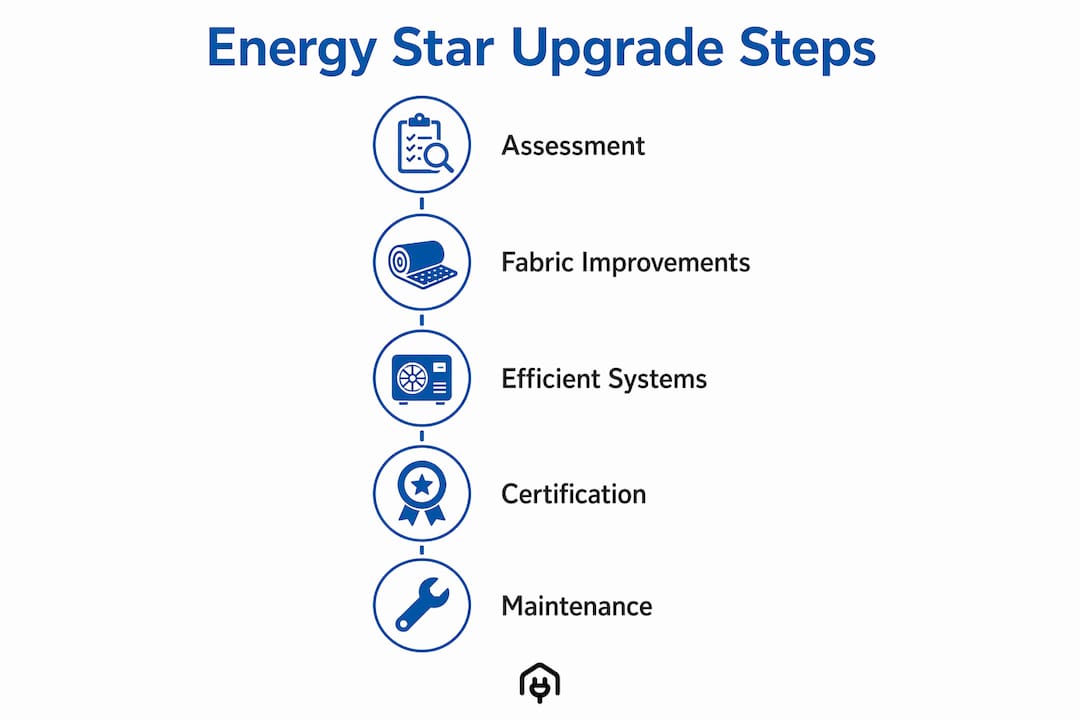
A practical upgrade plan for a UK landlord or homeowner typically follows this structure:
- Commission an energy assessment or review the current EPC recommendations report.
- Address loft and cavity wall insulation as the first intervention.
- Upgrade or seal windows and doors where draught infiltration is measurable.
- Install or upgrade heating controls and thermostats.
- Consider a heat pump replacement where the fabric improvements justify the sizing.
- Assess solar PV as a final stage once the base load has been reduced.
Pro Tip: Always use a qualified, accredited retrofit assessor rather than relying solely on a standard EPC report. The EPC gives a compliance rating; a proper home energy retrofit guide assessment gives you the sequenced plan you need to avoid expensive mistakes.
For both US and UK contexts, maintaining a clear file of invoices, product specifications, and installation records protects against challenges from HMRC, IRS, or a local authority reviewing an exemption claim.
Comparing upgrade options and expected savings
Choosing between upgrade paths requires an honest look at cost, carbon impact, and the regulatory outcome each measure delivers.
Under the Warm Homes: Local Grant data, solar PV accounts for 40% of measures installed, insulation for 23%, and low carbon heat for 17%. This breakdown reflects what government-funded programmes prioritise when a property is eligible, though measure combinations vary significantly depending on each property’s starting EPC band and construction type.
| Upgrade measure | Typical UK cost | Expected EPC impact | Carbon reduction |
|---|---|---|---|
| Loft insulation | £300–£600 | +5 to +15 points | Moderate |
| Cavity wall insulation | £500–£1,500 | +5 to +20 points | Moderate to high |
| Air source heat pump | £8,000–£15,000 | +10 to +30 points | High |
| Solar PV (3kWp) | £5,000–£7,000 | +10 to +20 points | High |
| Smart thermostat | £150–£300 | +2 to +5 points | Low to moderate |
Fabric-only improvements deliver reliable, low-risk gains. Integrated packages combining insulation with a heat pump and smart controls produce the largest EPC rating uplift but require careful sequencing and professional sizing calculations. Properties relying on fabric improvements alone may reach EPC C without a heat pump where the starting rating is D. Properties at E or below almost always require a combination approach.
Emerging technologies relevant for 2026 include heat pump hot water cylinders, battery storage paired with solar PV, and demand-side response controls that adjust energy use in response to grid pricing signals. None of these are yet mainstream in standard retrofit packages, but they are appearing in higher-specification projects and will become more common as the 2030 deadline approaches.
My perspective: what the label does not tell you
I’ve seen a consistent pattern across energy upgrade projects: property owners invest in Energy Star labelled products, confident they have done everything right, only to discover during a credit claim or compliance check that they have missed a critical certification requirement. The label creates a false sense of security.
What I’ve found actually works is starting every project with an independent assessment rather than a product catalogue. The assessment tells you what the building needs. The product selection follows from that, not the other way around. Choosing a product because it carries an efficiency label and then hoping it fits the plan is a backwards approach that costs more money and delivers worse outcomes.
The 2030 UK deadline feels distant. It is not. Landlords with portfolios of EPC D and E properties who are not yet planning their upgrade sequences are already running out of affordable options. Fabric improvement costs are rising, installer capacity is constrained, and energy model standards are evolving. The owners who act now, with a sequenced plan and proper documentation in place, will be the ones who meet the deadline without the stress of a rushed, over-budget project in 2029.
Stay informed about how assessment methodologies are changing. The Home Energy Model is replacing SAP as the basis for EPC calculations, and that transition will affect how upgrade measures are scored and how compliance is measured. Understanding that shift now is a genuine advantage.
— Danny
Plan your upgrades with Homeenergymodel
Homeenergymodel provides practical resources to help UK landlords and property investors plan energy improvements with confidence. Understanding which energy model types apply to your property is the starting point for effective upgrade planning, whether you are targeting EPC C compliance or assessing the financial return on a retrofit investment. The site covers the full range of compliance tools, from EPC assessment guidance to energy simulation methods that support upgrade compliance calculations. If the 2030 MEES deadline affects your portfolio, the resources at Homeenergymodel offer a clear path from current rating to compliant property.
FAQ
What counts as an energy star home upgrade for tax purposes?
For US federal tax purposes, the improvement must meet specific IRS efficiency thresholds for its category, not simply carry an Energy Star label. The claim is filed via IRS Form 5695 for the year of installation.
When must UK landlords reach EPC C?
Proposed MEES regulations set a target of EPC C for all privately rented homes by 1 October 2030, subject to a £10,000 cost cap before exemption is permitted.
Does the Energy Star programme apply in the UK?
Energy Star is a US Environmental Protection Agency scheme and has no direct regulatory standing in the UK. However, eco-friendly home upgrades that align with Energy Star principles, such as insulation and heat pumps, directly support UK EPC rating improvements.
What is the Warm Homes: Local Grant?
The Warm Homes: Local Grant is a UK government scheme running from April 2025 to March 2028, allocating nearly £0.5 billion to fund energy efficiency and low-carbon heating improvements for eligible low-income households in EPC D to G rated properties.
How do I start planning energy efficient home improvements?
Commission an accredited home energy assessment to identify the most cost-effective measures in sequence. Address fabric improvements first, then heating controls, before considering heat pumps or solar PV.