

For most UK homes, the cheapest way to use a portable heater is to choose the right type for the job and pair it with an accurate thermostat and timer. At the current Ofgem price cap rate of approximately 26.11p/kWh, a 2.0kW heater running at full power costs around 52p per hour. A well-calibrated thermostat cycling at 50% duty cuts that to roughly 26p. The technology matters less than the controls.
Top picks for UK buyers:
- Best overall value: Dreamland Pure Air Fan Heater — quiet, fast warm-up, strong thermostat for the price
- Best budget: Russell Hobbs 13-inch space heater — very low upfront cost, usable thermostat for cycling
- Best smart control: Mill WiFi Max Portable Heater 1500W — PID thermostat, app scheduling, quiet operation
- Best overnight/bedroom: Devola 2.5kW oil-filled radiator — sustained quiet heat, good retention after switch-off
- Best personal/desk: Swan 700W plug-in mini fan heater — 700W draw, instant warmth for one person
—-
Table of Contents
- What types of portable heaters are there, and when should you use each?
- How much does a portable heater cost to run in the UK?
- How to choose an energy-efficient portable heater: sizing, controls and red flags
- Recommended energy-efficient portable heaters in the UK
- How the shortlist was put together
- What do upcoming UK ecodesign changes mean for portable heaters?
- Key takeaways
- The case for prioritising controls over marketing claims
- Homeenergymodel and whole-property energy performance
What types of portable heaters are there, and when should you use each?
Every electric portable heater converts electricity to heat with close to 100% efficiency at the point of use, as the Energy Saving Trust confirms. The meaningful differences lie in how heat reaches the room and how quickly, not in some hidden efficiency advantage one technology holds over another.
Fan heaters push air across a heated element and deliver warmth within seconds. The Dyson Hot+Cool HF1 / HP1, the Dreamland Pure Air Fan Heater, and the Russell Hobbs oscillating ceramic 2kW heater all work on this principle. Fan heaters suit short bursts in small rooms where rapid warm-up matters. The trade-off is noise and the fact that heat disperses quickly once the unit switches off.
Convector and panel heaters heat air by natural convection rather than a fan, making them quieter and better suited to gradual whole-room warming. The Mill WiFi Max Portable Heater 1500W and the Devola wifi-enabled smart glass panel electric heater fall into this category. They take longer to warm a room but maintain a steadier temperature once up to heat.
Oil-filled radiators store heat in thermal oil, which means the element cycles less frequently to maintain temperature and the unit stays warm for some time after switching off. The Devola 2.5kW oil-filled radiator and the VonHaus small oil-filled radiator 1,500W are the most cost-effective choices for all-evening or overnight use in a bedroom. They are heavier and slower to warm up initially, but their heat retention reduces average wattage draw.
Ceramic PTC heaters use a positive temperature coefficient element that self-regulates as it heats up, reducing the risk of overheating. The Princess Smart 360 Ceramic Heater, Dreo PTC fan heater Solaris 718, Beldray 2,000W smart ceramic core radiator, and De’Longhi Capsule Fan Heater Cream 1.8KW all use ceramic elements. They are a reliable middle ground: faster than oil-filled, quieter than basic fan heaters.
Radiant and infrared heaters warm surfaces and people directly rather than heating the air. The Everhot electric heater and halogen-element models work this way. They are efficient for personal spot heating in draughty spaces where warming the air would be wasteful, but they do not heat a whole room comfortably. The Centre for Sustainable Energy notes that halogen and infrared heaters suit targeted use rather than background warmth.

Gas portable heaters (butane or propane) produce carbon monoxide and water vapour as combustion by-products. They must only be used in well-ventilated spaces and should never be left unattended or used in bedrooms. For most UK households, a mains-electric option is safer and more practical.
—-
How much does a portable heater cost to run in the UK?
The calculation is straightforward: multiply the heater’s wattage in kilowatts by the unit rate in pence per kilowatt-hour. At the Ofgem price cap rate of approximately 26.11p/kWh, the figures below show full-power costs and realistic thermostat-adjusted estimates.
| Wattage | Full-power cost per hour | At reduced duty cycle cost per hour |
|—-|—-|—-|
| 700W | About 18p | About 11p with thermostat cycling at 60% duty |
| 1.5kW | About 39p | About 23p with thermostat cycling at 60% duty |
| 2.0kW | About 52p | About 31p with thermostat cycling at 60% duty |
| 2.5kW | About 65p | About 39p with thermostat cycling at 60% duty |
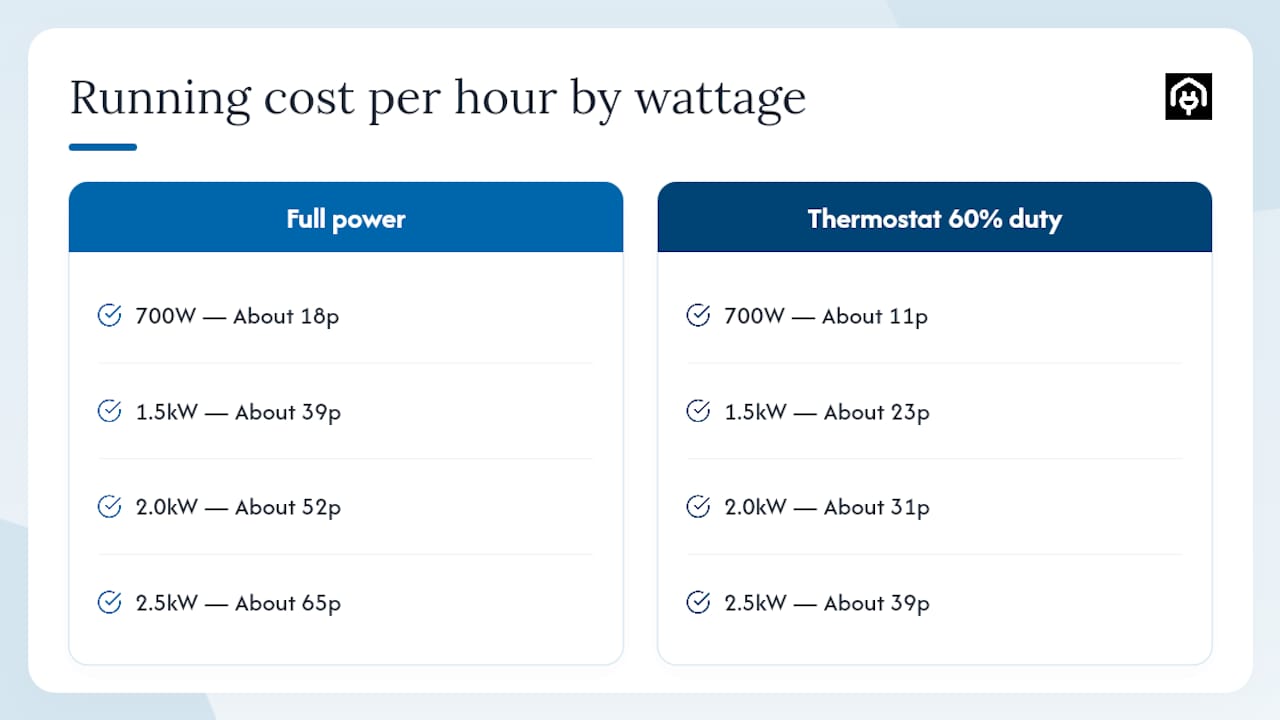
Duty cycle refers to the proportion of time the heating element is actually running. A heater set to maintain 20°C in a well-insulated room may only run its element 50–60% of the time, which is where the real savings appear. A heater without a thermostat runs continuously at full power, making it the most expensive option regardless of its wattage. As HomeHeatingHQ explains, at identical wattage all electric heaters cost the same per hour; the differences in real-world bills come from lower average draw through better controls or heat retention.
Pro Tip: Set the thermostat to the lowest comfortable temperature rather than maximum heat. Dropping the set point by 1°C typically reduces the duty cycle noticeably, cutting running time without a perceptible drop in comfort.
For context, running a 2.0kW heater for three hours each evening at full power adds roughly £1.56 to a daily electricity bill. Over a 90-day winter period, that is approximately £140. A thermostat cycling at 50% halves that figure to around £70 for the same period.
Electric plug-in heaters cost more per hour than gas central heating. They work best as zone heaters for a single room over a short period, not as a whole-house solution. Pairing a portable heater with low-cost energy-saving measures such as draught-proofing and curtain use reduces the run time needed to reach comfort temperature.
—-
How to choose an energy-efficient portable heater: sizing, controls and red flags
Sizing the heater to the room
A widely used rule of thumb is 1.0kW per 10m² for a well-insulated room with average ceiling height. A poorly insulated room or one with high ceilings may need 1.5–2.0kW for the same floor area. Oversizing wastes money on purchase price; undersizing means the heater runs continuously at full power with no cycling, which is the most expensive outcome.
Quick sizing guide:
- Measure the room in square metres (length × width).
- Multiply by 0.1 to get the minimum kW needed for a well-insulated room.
- Add 25–50% for poor insulation, draughts, or high ceilings.
- Choose the nearest standard wattage (1.0kW, 1.5kW, 2.0kW, 2.5kW).
Red flags to avoid
- No thermostat at all — the heater will run at full power continuously
- Exaggerated coverage claims (e.g. “heats a 40m² room” for a 1.0kW unit)
- High standby power with no off-mode
- Vague “energy-saving” badges without specifying the control mechanism
The CMA consumer guide on green heating products recommends verifying claims carefully and not relying on marketing labels alone. Check the product specification sheet for thermostat type, standby wattage, and safety certifications before purchasing.
—-
Recommended energy-efficient portable heaters in the UK
The shortlist below draws on UK test observations, thermostat accuracy, noise levels, smart-control quality, and value for money. Running-cost estimates use the Ofgem rate of 26.11p/kWh at 60% duty cycle as a realistic operating assumption.
| Model | Best for | Power | Est. cost (p/hr at 60% duty) | Controls | Price tier | Noise | Safety |
|—-|—-|—-|—-|—-|—-|—-|—-|
| Dreamland Pure Air Fan Heater | Overall value, living rooms | 2.0kW | 26p | Thermostat, timer | Mid | Low | Tip-over, overheat cut-off |
| Dyson Hot+Cool HF1 / HP1 | Premium multi-function, year-round | 2.0kW | 26p | App, thermostat, timer | Premium | Very low | Tip-over, overheat cut-off |
| Russell Hobbs 13-inch space heater | Budget, small rooms | 2.0kW | 26p | Basic thermostat | Budget | Moderate | Tip-over, overheat cut-off |
| Mill WiFi Max Portable Heater 1500W | Smart scheduling, bedrooms | 1.5kW | — | App, PID thermostat, timer | Low | Low | Overheat cut-off |
| De’Longhi Capsule Fan Heater Cream 1.8KW | Personal/desk, small bedrooms | 1.8kW | 26p | Thermostat | Mid | Low | Tip-over, overheat cut-off |
| Devola 2.5kW oil-filled radiator | All-evening, overnight | 2.5kW | 39p | Thermostat, timer | Silent | Overheat cut-off |
| VonHaus space heater | Short bursts, occasional use | 2.0kW | 26p | Basic thermostat | Budget | Moderate | Tip-over, overheat cut-off |
| Princess Smart 360 Ceramic Heater | Smart control, mid budget | 1.5kW | — | App, timer, oscillation | Mid | Low | Tip-over, overheat cut-off |
| Duux Threesixty 2 Smart Fan Heater | Living rooms, child safety | 1.5kW | — | App, timer | Mid-premium | Low | Bladeless, tip-over |
| Dimplex DXBC22 ThermaIQ Smart Baseboard Heater | Wall-mounted, regular use | 2.0kW | 26p | App, adaptive control | Mid-premium | Silent | Overheat cut-off |
| Beldray 2,000W smart ceramic core radiator | Budget smart option | 2.0kW | 26p | Thermostat, basic smart | Budget | Low | Tip-over, overheat cut-off |
| Dreo PTC fan heater Solaris 718 | Bedrooms, home offices | 1.5kW | — | Thermostat, remote | Mid | Very low | Tip-over, overheat cut-off |
| Everhot electric heater | Long-duration, residual heat | 2.0kW | 26p | Thermostat | Mid-premium | Silent | Overheat cut-off |
| Swan 700W plug-in mini fan heater | Personal desk use | 700W | 11p | Basic | Budget | Moderate | Overheat cut-off |
| VonHaus small oil-filled radiator 1,500W | Bedrooms, steady heat | 1.5kW | — | Thermostat | Budget | Silent | Overheat cut-off |
| Shark TurboBlade Cool + Heat | Multi-season, living rooms | 1.5kW | — | App, thermostat, timer | Mid-premium | Low | Tip-over, overheat cut-off |
| Devola wifi-enabled smart glass panel electric heater | Smart panel, regular rooms | 2.0kW | 26p | App, timer, thermostat | Mid | Silent | Overheat cut-off |
| Russell Hobbs oscillating ceramic 2kW heater | Whole-room spread, budget | 2.0kW | 26p | Thermostat, oscillation | Budget | Moderate | Tip-over, overheat cut-off |
A note on the Dyson Hot+Cool HF1: the premium price reflects its air-purifier function and year-round cooling mode, not a meaningful efficiency advantage over cheaper fan heaters at the same wattage. For pure heating value, the Dreamland Pure Air Fan Heater consistently performs well in UK tests at a fraction of the cost.
The Shark TurboBlade Cool + Heat occupies a similar multi-season niche to the Dyson at a lower price point and is worth considering for living rooms where year-round use justifies the outlay.
For the smallest personal spaces, the Swan 700W plug-in mini fan heater draws less than half the power of a standard 1.5kW unit, making it the lowest-cost option per hour at approximately 11p at 60% duty.
—-
How the shortlist was put together
Selection drew on published UK test observations from sources including The Independent’s portable heater guide and Danbury & Lovejoy’s 2026 electric heater review, cross-referenced against product specifications for thermostat type, standby power, safety certifications, and noise ratings.
Running costs were calculated using the Ofgem price cap rate of 26.11p/kWh. Duty cycle estimates of 50–60% reflect a reasonably insulated UK room maintained at 20°C; actual duty cycles vary with room size, insulation quality, and ambient temperature. Full-power figures are included for comparison.
Limitations to note:
- Prices fluctuate; always verify current retail pricing before purchasing
- Lab test conditions differ from in-home performance, particularly for thermostat accuracy in draughty rooms
- Smart-feature quality depends on app stability, which can change with software updates
- Availability varies by retailer and season
The Telegraph’s best electric heater guide provided additional context on heater types and use cases, particularly for matching radiant heaters to personal use and convectors to whole-room heating.
—-
What do upcoming UK ecodesign changes mean for portable heaters?
The UK government’s consultation on updating minimum energy performance standards for local space heaters proposes raising the Seasonal Space Heating Energy Efficiency (SSHEE) thresholds for several heater categories. Under the proposals, electric portable local space heaters would face a threshold of 44.7%, and electric visibly glowing radiant portable heaters 39.5%. The consultation also proposes stricter standby and off-mode power limits and new requirements for specified control functions on many categories.
In practice, this means heaters without accurate thermostats or timers are likely to be phased out or redesigned. Products already meeting these control requirements, such as the Mill WiFi Max, Dimplex ThermaIQ, and Devola smart glass panel heater, are well-positioned for the post-MEPS market. Budget models with bimetallic strip thermostats and no timer may not meet the new thresholds without redesign.
For buyers in 2026, the practical implication is straightforward: choose a model with an electronic thermostat and programmable timer now, and the purchase will remain compliant and cost-effective as standards tighten. Waiting for the next generation of MEPS-compliant products is unlikely to be necessary if the current model already meets the control requirements the proposals specify.
Understanding how these regulatory changes interact with a property’s overall energy performance is covered in more depth in Homeenergymodel’s guide to the Home Energy Model and its impact on UK properties.
—-
Key takeaways
The single most important decision when buying a portable heater is not the technology type but whether it has an accurate electronic thermostat and a programmable timer — those two controls determine real running costs more than any other factor.
| Point | Details |
|—-|—-|
| Controls over technology | An electronic thermostat and timer reduce real running costs more than heater type alone. |
| Running-cost calculation | At 26.11p/kWh, a 1.5kW heater at full power costs 39p/hr; at 60% duty cycle, approximately —/hr. |
| Size the heater correctly | Use 1.0kW per 10m² as a baseline; add 25–50% for poor insulation or high ceilings. |
| MEPS changes ahead | New SSHEE thresholds (e.g. 44.7% for electric portable heaters) will require better controls on future products. |
| Homeenergymodel guidance | Homeenergymodel provides UK energy performance resources, including EPC guidance and efficiency tools for property owners. |
—-
The case for prioritising controls over marketing claims
The portable heater market is full of products marketed with efficiency language that does not reflect how running costs actually work. At the same wattage, a ceramic PTC heater and a basic fan heater cost exactly the same per hour while their elements are running. The ceramic element does not save money by existing; it saves money only if it allows the thermostat to cycle more accurately or the unit to run at lower average wattage.
The models that consistently perform well in UK tests share one characteristic: reliable thermostat accuracy. The Mill WiFi Max’s PID control and the Dimplex ThermaIQ’s adaptive algorithm both reduce temperature overshoot, which means the element switches off sooner and stays off longer. That is where the bill saving comes from, not from the material the element is made of.
For most UK households, the Dreamland Pure Air Fan Heater represents the most sensible balance of price, performance, and controls. The Dyson Hot+Cool HF1 is a genuinely good product, but its premium is justified only if the purifier and cooling functions are actually used year-round. A household that wants heating and nothing else is paying a significant premium for features it will not use.
The one scenario where the technology choice does matter is overnight bedroom use. Oil-filled radiators, including the Devola 2.5kW and the VonHaus small oil-filled radiator 1,500W, retain heat after the element switches off, which reduces cycling frequency and average draw. For a room that needs to stay warm for six or more hours, that heat retention has a measurable effect on the bill.
—-
Useful sources and further reading
The following sources were used in preparing this article and are recommended for further reading:
- Ofgem
- Updating minimum energy performance standard for local space heaters: options assessment (accessible)
- Best electric heaters
- Room heaters — Centre for Sustainable Energy
- The best portable heater guide — The Independent
- Cheapest electric heaters to run UK (2026 cost guide) | HomeHeatingHQ
- Buying green heating and insulation products: a consumer guide — GOV.UK
For personalised running-cost estimates, use the Ofgem unit rate for the current quarter alongside the actual wattage and estimated daily run time for the chosen model. Homeenergymodel’s appliance energy guide for UK homeowners provides a step-by-step method for calculating costs across multiple devices.
—-
Homeenergymodel and whole-property energy performance
Portable heaters solve an immediate comfort problem, but they are a supplement to a property’s main heating system, not a replacement. The real question for many UK property owners and landlords is whether the building itself is performing efficiently enough that supplemental heating is rarely needed.
Homeenergymodel provides UK energy performance resources covering EPC assessments and ratings, guidance on the Home Energy Model replacing SAP, and practical tools for understanding a property’s energy efficiency rating. For landlords and property investors, understanding a building’s EPC rating and the measures that improve it is the most direct route to reducing the need for portable heating altogether. To explore how a property’s energy performance is assessed and what changes make the most difference, visit Homeenergymodel’s energy performance guide.