

TL;DR:
- Many UK property owners underestimate the importance of their Energy Performance Certificate as a legal and financial tool rather than a formality. With MEES regulations tightening and a 2030 EPC C requirement, understanding how ratings impact compliance and value is crucial for owners and landlords. Early assessment and targeted retrofits focusing on insulation, heating, and glazing can ensure compliance and maximize property value and tenant appeal.
Many UK property owners misread their Energy Performance Certificate as a formality rather than a financial and legal instrument. That misreading is becoming expensive. With MEES regulations tightening and the requirement for a minimum EPC C rating by 2030, having a clear understanding of how an energy efficiency rating explained translates into compliance obligations is no longer optional. This article breaks down how ratings work, what the A to G scale actually means, and what property owners need to do now to stay on the right side of the law.
Table of Contents
- Key takeaways
- What the energy efficiency rating explained actually means
- Current MEES regulations and what changes in 2030
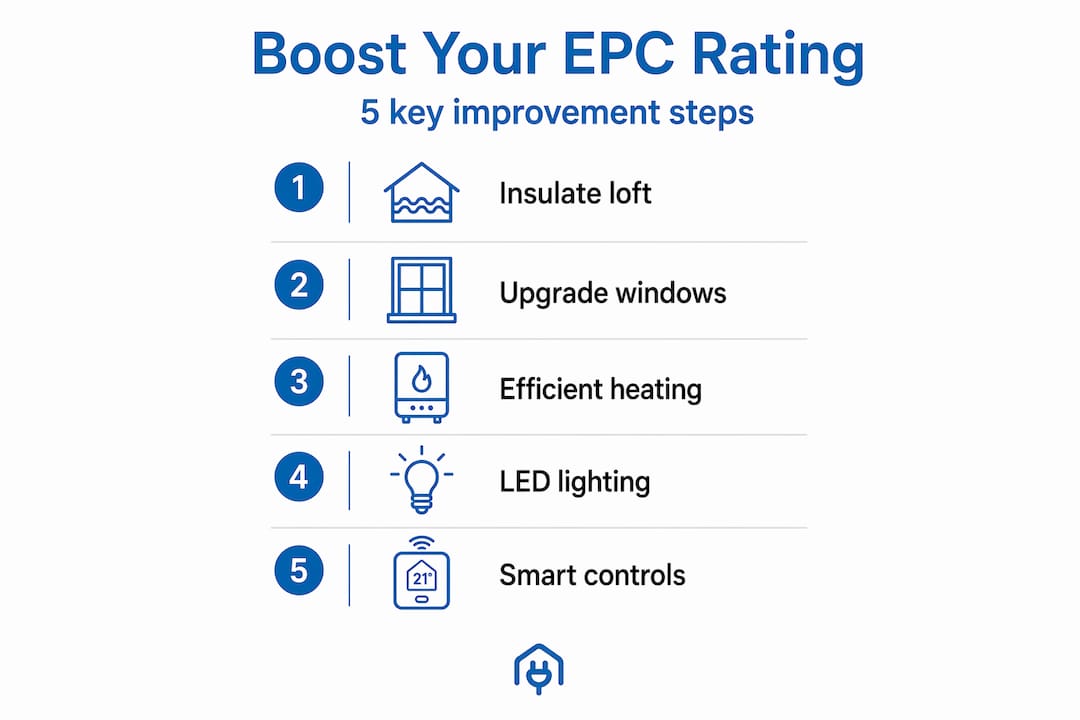
- Practical steps to improve your energy rating
- SAP vs EPC: understanding both
- How to read your EPC report
- My perspective: why waiting is the costlier option
- How Homeenergymodel can help
- FAQ
Key takeaways
| Point | Details |
|---|---|
| EPC ratings run A to G | Most UK homes currently sit at band D, with A being the most energy efficient and G the least. |
| SAP feeds into the EPC | A numerical SAP score underpins every EPC letter rating, and both carry regulatory weight. |
| F and G ratings are illegal to let | Letting an F or G rated property in England and Wales already breaches current MEES law. |
| EPC C required by 2030 | Private rented sector properties must reach EPC C by October 2030 or face significant fines. |
| Early planning reduces cost | Commissioning an energy assessment now helps prioritise retrofits before demand and costs rise. |
What the energy efficiency rating explained actually means
An Energy Performance Certificate (EPC) is the document that records a property’s energy efficiency rating. EPC ratings run from A to G, where A covers scores of 92 to 100 or above and G covers scores of just 1 to 20. Most properties in the UK fall into band D, which spans scores of 55 to 68. Understanding the energy label explained in this way matters because the letter banding is what regulators, tenants, and lenders actually reference.
The numerical score behind each letter comes from the Standard Assessment Procedure (SAP). This calculation considers a range of factors across the property.
- Insulation levels: Wall, floor, and loft insulation all contribute significantly to heat retention and therefore to score.
- Heating system type and efficiency: A modern condensing boiler or heat pump scores far better than an older oil or electric storage system.
- Glazing: Double or triple glazing reduces heat loss and improves the overall assessment.
- Renewable energy: Solar panels or solar thermal installations can push scores into higher bands.
- Lighting and ventilation: LED lighting and appropriate ventilation also factor into the calculation.
The following table shows how the rating bands break down numerically and what they indicate about a property’s typical energy performance.
| EPC band | Numerical score | Typical description |
|---|---|---|
| A | 92 to 100+ | Highly efficient, very low energy costs |
| B | 81 to 91 | Good efficiency, low running costs |
| C | 69 to 80 | Above average, meeting 2030 targets |
| D | 55 to 68 | Average, common in UK housing stock |
| E | 39 to 54 | Below average, borderline legal for letting |
| F | 21 to 38 | Poor, currently illegal to let |
| G | 1 to 20 | Very poor, currently illegal to let |
Understanding energy efficiency at this level helps property managers identify exactly how far their asset sits from both the legal minimum and the 2030 target.
Current MEES regulations and what changes in 2030
The Minimum Energy Efficiency Standards (MEES) are the legal framework that ties energy ratings to landlord obligations. The rules have already made it illegal to let F or G rated properties in England and Wales, with fines reaching up to £30,000 per property for non-compliance. That is the current baseline. The more significant shift is on the horizon.

From October 2030, private rented sector properties will be required to hold a minimum EPC C rating. A large proportion of the UK’s rental stock currently sits at D or E, meaning the volume of properties requiring retrofitting before that deadline is substantial. Non-compliance penalties vary by property type: residential landlords can face fines up to £5,000, while commercial property owners face penalties up to £150,000 for larger buildings.
The regulatory changes are not limited to the 2030 deadline. From 2026, the 28-day EPC grace period has been removed, meaning a valid EPC must be in place before a property is marketed for sale or letting. EPC certificates remain valid for 10 years, so properties assessed before the rule change may still hold compliant documents, but any lapsed certificate creates an immediate legal exposure.
Key compliance checkpoints for property owners and managers:
- Confirm the current EPC band for every property in the portfolio.
- Identify all F and G rated properties and act immediately.
- Flag all D and E rated properties as requiring upgrade before 2030.
- Check EPC expiry dates across the portfolio and renew ahead of any marketing activity.
- Document improvement measures undertaken, as these support exemption applications where applicable.
“Landlords should view the 2030 EPC C deadline as an operational risk requiring urgent strategic retrofit planning, not a distant event.” Langham Estate MEES insights
The government’s net zero commitments are the driver behind these tightening standards. The 2025 UK housing energy standards signal that the direction of travel will not reverse, and forward planning now avoids the cost and disruption of rushed retrofits as the deadline approaches.
Practical steps to improve your energy rating
Many properties currently rated D or E will require a targeted package of improvements to reach band C. The good news is that retrofit upgrades are well understood, and early planning allows owners to sequence them cost-effectively rather than completing everything at once under deadline pressure.
The following steps provide a structured approach to raising an EPC rating.
- Commission an up-to-date EPC assessment. Before any works are planned, a current certificate establishes the baseline score and highlights the specific measures that would deliver the greatest uplift.
- Address the highest-impact insulation gaps first. Loft insulation, cavity wall insulation, and solid wall insulation are typically the most cost-effective interventions for moving from D or E into the C band.
- Upgrade the heating system. Replacing an ageing gas boiler with a high-efficiency condensing model or an air source heat pump can add significant points to a SAP score. Heat pump installations carry additional weight under newer assessment methodologies.
- Improve glazing. Moving from single to double glazing, or double to triple, reduces heat loss and contributes measurable points to the rating.
- Install smart controls and low-energy lighting. Programmable thermostats, zone controls, and LED lighting are lower-cost interventions that together contribute to a higher score.
- Consider solar photovoltaic panels. For properties where roof orientation and condition permit, solar PV can push scores from mid-C into B territory and beyond.
- Use energy modelling to plan before spending. Energy simulation tools allow property owners to model the impact of different measures before committing capital, identifying the most cost-effective route to compliance.
Pro Tip: Commission an energy assessment that models multiple retrofit scenarios before instructing any contractor. Spending money on the wrong measures first, such as replacing windows before addressing wall insulation, frequently results in a lower-than-expected score improvement.
The importance of energy ratings is that they directly affect lettability, financing, and sale value. Lenders are increasingly using EPC bands in mortgage affordability calculations, and tenants actively compare running costs when choosing between properties.
SAP vs EPC: understanding both
The SAP (Standard Assessment Procedure) and the EPC are related but serve different purposes. SAP produces a numerical score from 1 to 100 or above, reflecting a property’s overall energy efficiency based on construction, services, and energy use. A score above 70 indicates good performance, and a score above 90 is considered excellent. A score exceeding 100 means the property is net zero or energy positive, typically achieved only with significant renewable generation.
The EPC takes the SAP score and converts it into the A to G letter banding that appears on the certificate. This distinction matters for property owners.
- SAP is the technical foundation. Assessors and energy modellers work with SAP calculations to identify how specific improvements shift the score.
- EPC is the regulatory currency. MEES regulations, tenancy law, and marketing requirements all reference the EPC letter, not the raw SAP figure.
- Both are relevant for planning. Understanding your SAP score allows precise targeting of improvements. A property at SAP 65 needs a smaller intervention to reach band C (69 minimum) than one sitting at SAP 50.
The Home Energy Model (HEM) is the government’s planned replacement for SAP, expected to reshape how EPCs are calculated from 2025 onwards. Property owners should be aware that assessments under HEM may produce different results from current SAP calculations, which could affect portfolio planning.
| Tool | Output | Primary use |
|---|---|---|
| SAP calculation | Numerical score (1 to 100+) | Technical assessment and improvement modelling |
| EPC | A to G letter band | Regulatory compliance, marketing, and tenancy law |
| Home Energy Model | Updated numerical score | Future EPC assessments under 2025+ methodology |
How to read your EPC report
An EPC report is more than a letter grade. Understanding how to read energy ratings within the full document gives property owners the information needed to plan upgrades effectively.
The report contains several sections worth examining carefully.
- Current energy efficiency rating: The letter band and numerical score your property holds today.
- Potential energy efficiency rating: The band the property could reach if all recommended measures were implemented. This figure is often two or three bands above the current rating, which highlights how much headroom exists.
- Environmental impact rating: The CO2 emissions rating, given as an A to G grade separately from the energy efficiency score.
- Estimated energy costs: Annual estimates for heating, hot water, and lighting based on the current specification. These figures help quantify savings from proposed improvements.
- Recommendations table: A list of suggested measures ranked by typical cost and typical saving, along with the indicative impact each measure would have on the EPC band.
EPC reports include recommendations covering insulation, glazing, heating efficiency, and smart technology adoption, and they forecast the energy cost savings each measure delivers. The recommendations section is the most practical part of the document for budgeting purposes. A property owner can use it to create a phased improvement plan, prioritising measures that deliver the highest score uplift at the lowest cost, while deferring larger capital items to later years.
For a full reference on reading EPC certificates and what the metrics mean in practice, Homeenergymodel provides detailed guidance aligned with current UK assessment standards.
My perspective: why waiting is the costlier option
I have worked with enough landlords navigating EPC compliance to say with confidence that the ones who treat the 2030 deadline as tomorrow’s problem are the ones who will face the highest bills. The retrofit supply chain in the UK is already under pressure. Insulation contractors, heat pump installers, and assessors are booking further ahead than they were three years ago. Waiting until 2028 or 2029 to act means competing for limited capacity at peak demand prices.
The other pattern I see consistently is landlords who invest in visible improvements first. New kitchens, redecoration, new bathrooms. None of that moves an EPC band. When the EPC assessment comes back unchanged at D or E, the frustration is real, but it is entirely avoidable. The improvements that shift ratings are largely invisible: insulation in walls and ceilings, efficient boilers, heat pumps, and glazing upgrades.
There is also a financial case being underweighted. Properties rated C and above command stronger rental yields and valuations in most UK markets. Tenants are paying utility bills, and a property with predictable low running costs is a tangible selling point. The cost of retrofitting is real, but so is the return. My view is that the owners who plan this upgrade as an investment rather than a compliance cost will see better outcomes on both fronts.
— Danny
How Homeenergymodel can help
Understanding energy efficiency ratings is the first step. Knowing exactly what to do about them requires the right tools and guidance. Homeenergymodel provides practical resources covering everything from types of home energy models through to detailed EPC consultancy for residential and commercial properties across the UK. Whether the priority is understanding where a portfolio stands today or modelling the most cost-effective route to EPC C by 2030, the platform offers evidence-based guidance aligned with current MEES obligations and the incoming Home Energy Model methodology. Property owners can also access guidance on EPC compliance for London properties, where regulatory scrutiny and market expectations are particularly high. Acting now, with the right information, is the most cost-effective position any property owner can take.
FAQ
What is an energy efficiency rating on an EPC?
An energy efficiency rating is a letter grade from A to G assigned to a property based on its SAP score, reflecting how much energy it uses to heat, light, and run. Band A is the most efficient and band G the least.
What EPC rating is required to legally let a property?
In England and Wales, landlords must hold a minimum EPC rating of E to legally let a property under current MEES rules, with F and G rated properties already illegal to let. This minimum will rise to C by October 2030.
How is an EPC rating calculated?
EPC ratings are calculated using the Standard Assessment Procedure (SAP), which assesses insulation, heating systems, glazing, and renewable energy installations to produce a numerical score that maps to the A to G band.
How long does an EPC certificate last?
An EPC certificate is valid for 10 years. From 2026, a valid EPC must be in place before a property is marketed for sale or letting, as the previous 28-day grace period no longer applies.
What is the difference between SAP and an EPC rating?
SAP produces a numerical score from 1 to 100 or above based on a detailed technical assessment, while the EPC converts that score into the A to G letter banding used for regulatory and marketing purposes. Both are relevant for compliance planning.