

TL;DR:
- Renewable energy sources, such as solar and wind, are essential for the UK’s net zero strategy due to their sustainability. Installing solar PV offers the highest financial return, with optimal results when combined with insulation and heat pumps. Grid connection delays pose a significant challenge for scaling renewable projects and require early planning.
Renewable energy is defined as energy generated from natural sources that replenish faster than they are consumed, making it the foundation of the UK’s net zero strategy. The different types of renewable energy include solar, wind, hydropower, tidal, geothermal, and biomass, each with distinct characteristics, costs, and suitability for UK properties. Renewable energy supplies over 30% of global electricity, with projections pointing to 50% by 2030. The UK’s offshore wind capacity already exceeds 14 GW, and the Future Homes Standard from 2025 mandates low-carbon heating in all new residential builds. Understanding which renewable energy sources suit a given property or organisation is the first practical step towards compliance and cost reduction.
What are the different types of renewable energy?
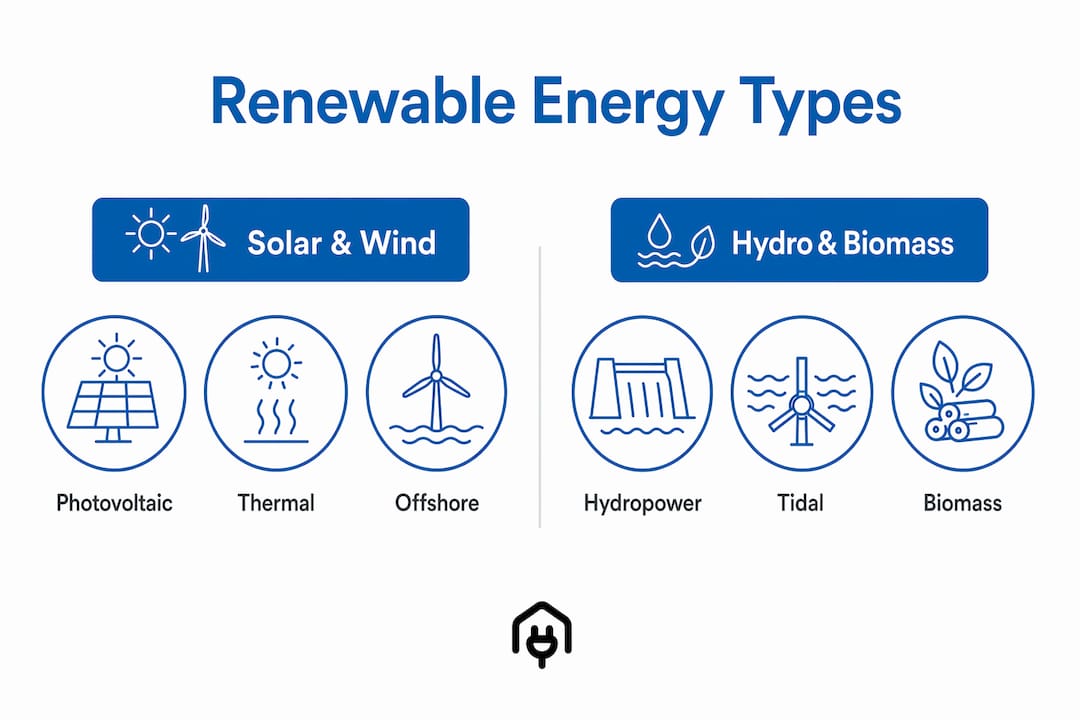
Solar and wind are the two most widely deployed renewable energy sources in the UK, and for good reason. Both technologies have fallen sharply in cost over the past decade, and both benefit from active government support.
Solar energy: photovoltaic and thermal
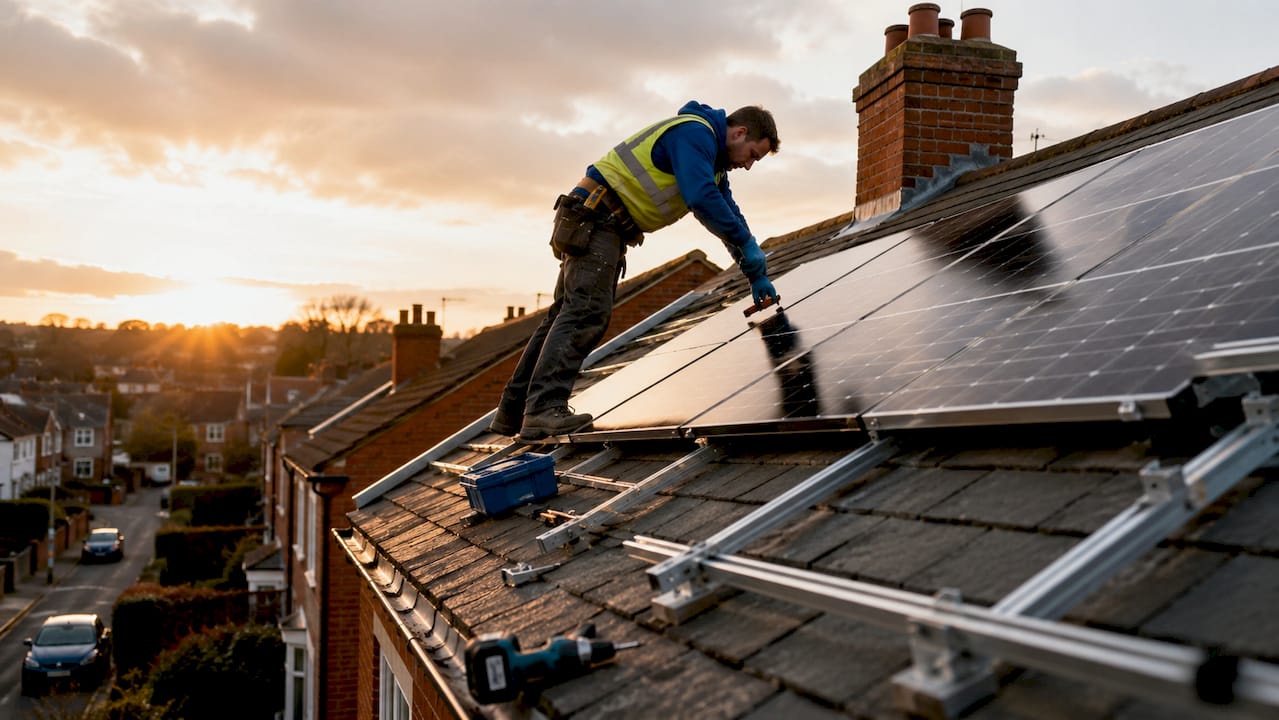
Solar photovoltaic (PV) panels convert sunlight directly into electricity. Solar thermal systems use sunlight to heat water, reducing demand on a boiler. Domestic solar PV costs in the UK typically range from £5,400 to £9,200, depending on system size and region. Installer rates vary by £3,000 to £5,000 across different parts of the country, so obtaining multiple quotes is worthwhile.
Bifacial solar modules, which capture light from both sides of the panel, are an emerging innovation that improves yield on reflective surfaces such as flat commercial roofs. Solar PV offers the highest financial return among residential renewables in the UK. That makes it the most logical starting point for homeowners and landlords assessing their options.
- Best suited to: south-facing roofs with minimal shading
- Government support: Smart Export Guarantee pays for excess electricity exported to the grid
- Typical payback period: 8–12 years for domestic systems
- Emissions benefit: eliminates the carbon cost of grid electricity for self-consumed power
Pro Tip: Install solar PV before battery storage. The battery only adds value once the solar system is generating surplus power, so sequencing matters.
Wind energy: onshore and offshore
Onshore wind is the cheapest new electricity generation form in the UK, but planning restrictions in England have pushed most new projects to Scotland and Wales. Offshore wind faces fewer planning barriers and benefits from stronger, more consistent wind speeds. The UK’s offshore fleet already exceeds 14 GW and continues to grow, with floating offshore wind technology opening up deeper water sites previously inaccessible to fixed foundations.
Grid bottlenecks remain a real constraint. Curtailment payments reached £1.4 billion in Scotland in 2024, meaning wind farms were paid to switch off because the grid could not absorb their output. That figure illustrates the infrastructure gap that must close alongside generation growth. For organisations considering hybrid solar and wind systems, combining both sources reduces reliance on either single technology and improves year-round generation.
Micro wind turbines are generally not recommended for urban or suburban UK settings. Return on investment is poor in low-wind environments, and planning permission is rarely straightforward.
How do hydro, tidal, and geothermal sources work?
These three alternative energy types are less visible in everyday property decisions but play a significant role in the UK’s clean power mix. Each operates on a different physical principle and suits different scales of deployment.
| Source | How it works | UK deployment | Typical scale |
|---|---|---|---|
| Hydropower | Flowing water drives turbines | Established, mainly Scotland and Wales | Small run-of-river to large reservoirs |
| Tidal | Tidal flow or wave motion drives turbines | Emerging, significant coastal potential | Pilot projects to multi-MW arrays |
| Geothermal | Heat from the earth’s crust generates electricity or direct heat | Very limited, mainly Cornwall pilot | Small-scale, localised |
Hydropower provides stable, predictable output because river flow is far more consistent than sunshine or wind. That reliability makes it a valuable balancing resource within the grid. The UK has significant installed hydro capacity, concentrated in Scotland and Wales where topography supports it.
Tidal energy is emerging as a credible option for the UK’s extensive coastline. Tidal leasing has awarded capacity linked to floating offshore wind projects where fixed foundations are not feasible. The predictability of tidal cycles is a genuine advantage over wind and solar, since tides follow a known schedule regardless of weather.
Geothermal energy extracts heat stored in the earth’s crust. The UK’s geology limits large-scale deployment, but deep geothermal projects in Cornwall are demonstrating that district heating applications are viable. Geothermal is unlikely to become a mainstream residential option in the near term, but it holds long-term potential for urban heat networks.
What is biomass energy and what are its environmental trade-offs?
Biomass energy is defined as energy produced by burning or processing organic material, including wood pellets, agricultural waste, and energy crops. It is classified as a renewable energy source because the carbon released during combustion is theoretically reabsorbed by new plant growth. That carbon cycle argument holds only when feedstocks are responsibly sourced and managed.
Biomass boilers are most suitable for rural properties off the gas grid, where they replace oil or LPG heating. Biomass boilers reduce emissions compared to fossil fuels, with typical savings of 2–3.5 tCO2e per year. Payback periods range from 12–20 years, which is longer than solar PV, so the financial case depends heavily on fuel costs and usage patterns.
The environmental impact of biomass depends entirely on the supply chain. Wood pellets sourced from sustainably managed forests carry a low lifecycle carbon footprint. Pellets from old-growth forests or long-distance shipping routes can produce higher lifecycle emissions than the gas they replace.
- Confirm certification: Only use pellets certified under schemes such as the Sustainable Biomass Program (SBP) or ENplus.
- Assess heat demand first: Biomass boilers suit high heat demand properties. Low-demand homes rarely recover installation costs.
- Consider air quality: Biomass combustion produces particulate emissions. Urban areas face stricter controls under the Clean Air Strategy.
- Pair with solar thermal: Combining biomass with solar thermal reduces fuel consumption in summer months and extends boiler life.
Pro Tip: Before installing a biomass boiler, check whether the property qualifies for the Boiler Upgrade Scheme. The scheme currently focuses on heat pumps, but eligibility criteria evolve with each policy review.
How do renewables integrate with home and organisational energy systems?
Practical integration of renewable energy technologies requires a sequenced approach. Standard industry advice for UK domestic systems is to install heat pumps first, then solar PV, then battery storage. Each step builds on the last to maximise carbon savings and cost reduction.
Insulation improvements are fundamental before installing any renewable heating system. A heat pump in a poorly insulated property will run inefficiently and deliver poor returns. Addressing fabric first, through loft insulation, wall insulation, and double glazing, is the prerequisite step that most property owners skip. Homeenergymodel provides guidance on assessing a property’s energy performance before committing to any technology installation.
The Future Homes Standard from 2025 mandates low-carbon heating and on-site generation in all new homes, making heat pumps and solar PV the default specification for new builds. Landlords with existing stock face a different challenge: retrofitting these technologies into older properties with varying fabric quality.
| Technology | Typical installed cost | Annual saving estimate | Carbon reduction |
|---|---|---|---|
| Air-source heat pump | £7,000–£13,000 (grant up to £7,500) | £300–£700 | 1–3 tCO2e/year |
| Solar PV (3–4 kWp) | £5,400–£9,200 | £400–£800 | 0.8–1.5 tCO2e/year |
| Battery storage (5–10 kWh) | £2,500–£5,000 | £150–£400 | Marginal additional |
Battery storage optimises self-consumption by storing surplus solar generation for use in the evening. It also allows tariff arbitrage, charging from the grid during cheap overnight periods and discharging during peak-price hours. The financial case for batteries strengthens as time-of-use tariffs become more widely available.
Grid connection delays represent the largest bottleneck for larger-scale renewable projects. The National Grid ESO connection queue exceeds 700 GW, with wait times of 10–15 years for new connections as of 2025. Organisations planning on-site generation above domestic scale must factor connection timelines into project planning from the outset.
- Heat pumps qualify for the Boiler Upgrade Scheme grant of up to £7,500
- Solar PV export earnings come through the Smart Export Guarantee
- Renewable energy grants for UK homeowners cover a range of technologies and income levels
- Battery storage does not currently attract a standalone government grant but benefits from reduced VAT
Key takeaways
The most effective approach to renewable energy adoption in the UK is to address building fabric first, then install heat pumps, solar PV, and battery storage in that sequence to maximise both carbon savings and financial returns.
| Point | Details |
|---|---|
| Fabric before technology | Insulate the property before installing heat pumps or solar PV to avoid poor system performance. |
| Sequenced installation | Install heat pumps first, then solar PV, then battery storage for optimal cost and carbon outcomes. |
| Solar PV leads on returns | Solar PV delivers the highest financial return among residential renewables in the UK. |
| Grid delays affect larger projects | Connection queues exceed 700 GW; organisations must plan grid access years in advance. |
| Biomass suits rural, off-grid properties | Biomass boilers work best where gas is unavailable and heat demand is high, with certified fuel sources. |
Why energy efficiency must come before renewable technology
The conversation about types of green energy often skips the most important step: reducing demand before adding supply. I have seen property owners invest in solar PV and heat pumps on buildings that lose heat through uninsulated walls and single-glazed windows. The technology works, but it works far harder than it should, and the returns disappoint.
The sequencing principle matters more than the technology choice. A well-insulated home with a heat pump and modest solar array will outperform a poorly insulated home with a larger, more expensive system every time. The low carbon home essentials framework makes this clear: fabric efficiency is the foundation, not an optional extra.
I am also cautious about the pace of grid reform. The 700 GW connection queue is not a minor administrative backlog. It is a structural constraint that will limit how quickly the UK can deploy distributed generation at scale. Organisations planning renewable projects in 2026 should treat grid connection as a critical path item, not an afterthought.
Hydrogen and carbon capture will eventually complement renewables in sectors where direct electrification is not practical, such as heavy industry and aviation. But for property owners and landlords making decisions now, the practical toolkit is solar PV, heat pumps, and battery storage, applied in the right order, on a well-prepared building.
— Danny
How Homeenergymodel supports renewable energy planning for UK properties
Homeenergymodel helps property owners and landlords understand how their buildings perform before committing to renewable technology. The platform provides detailed guidance on energy assessment, performance modelling, and compliance with the Future Homes Standard and EPC requirements. Choosing the right renewable technology starts with knowing a property’s current energy baseline. Homeenergymodel’s energy models for landlords cover the full range of assessment approaches, from basic EPC ratings to detailed simulation. For those calculating potential savings before installation, the energy savings calculator guide provides a structured methodology suited to both residential and commercial properties.
FAQ
What is renewable energy?
Renewable energy is energy generated from natural sources that replenish continuously, including solar, wind, hydro, tidal, geothermal, and biomass. These sources contrast with fossil fuels, which are finite and release stored carbon when burned.
Which renewable energy type is best for UK homes?
Solar PV delivers the highest financial return among residential renewables in the UK, but heat pumps should be installed first to address heating demand before generation is added.
Are there government grants for renewable energy in the UK?
The Boiler Upgrade Scheme offers grants of up to £7,500 for air-source heat pumps, and the Smart Export Guarantee pays homeowners for surplus solar electricity exported to the grid.
What are the benefits of renewable energy for landlords?
Renewable energy reduces energy bills, improves EPC ratings, and supports compliance with upcoming regulations including the Future Homes Standard, which mandates low-carbon heating in new builds from 2025.
Why are grid connection delays a problem for renewable energy projects?
The National Grid ESO connection queue exceeds 700 GW, with wait times of 10–15 years for new connections as of 2025, meaning larger-scale renewable projects must plan grid access well in advance of installation.