
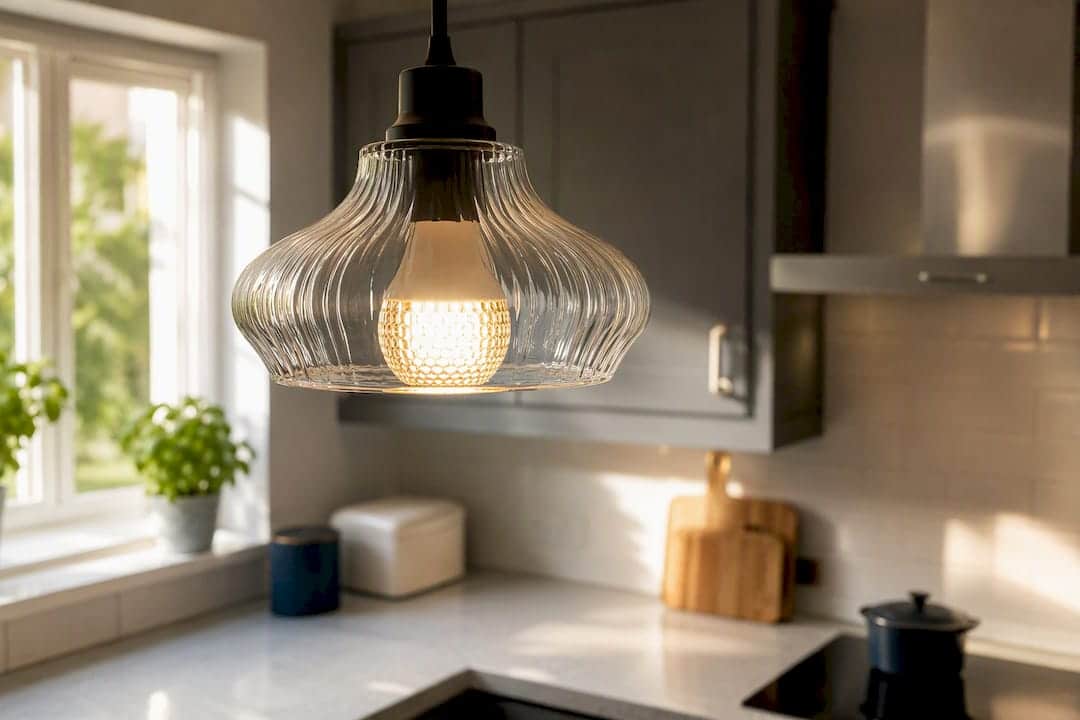
LED lighting cuts electricity use by roughly 80–90% compared with incandescent or halogen bulbs, lasts many times longer, and produces less carbon per hour of light. For a typical UK home, replacing all halogen bulbs with LEDs can save £180–£400 a year. The rule for buying LEDs is simple: check lumens and CRI, not watts, since wattage no longer tells you how bright a bulb is.
- Uses 80–90% less electricity for the same brightness
- Lasts significantly longer, cutting replacement and maintenance costs
- Pays back quickly in most homes and businesses
- Choose by lumens (brightness) and CRI (colour accuracy), not watts
Table of Contents
- Benefits of LED lighting for energy efficiency
- How much can LED lighting save on cost and payback?
- How long do LED bulbs actually last?
- What do lumens, colour temperature and CRI actually mean?
- What is the UK policy driving LED adoption?
- Does LED lighting affect health or sleep?
- Getting the most from retrofit and smart controls
- How to choose the right LED bulb: a purchase checklist
- Why trust this guidance on LED lighting benefits?
- Ready to see how lighting fits your property’s energy performance?
- What’s an editorial take on LED lighting’s real payoff?
- Key takeaways from switching to LED lighting
- Sources
Benefits of LED lighting for energy efficiency
Luminous efficacy, measured in lumens per watt (lm/W), is what separates LEDs from older technology. A halogen bulb might produce 15–20 lm/W. A good-quality LED delivers 90–120 lm/W or more, so it needs a fraction of the electricity to produce the same brightness. That’s the mechanical reason LEDs use up to 80–90% less energy than incandescent or halogen lamps for equivalent light output.
The numbers: a full household halogen-to-LED switch typically saves £180–£400 per year, and swapping a single halogen downlighter for an LED equivalent can save around £30 annually per fitting.
Real-world savings depend heavily on how the space is used:
- A kitchen with downlighters running four hours a day sees savings compound fast because the fittings are used daily
- An office running lights for eight to ten hours across dozens of fixtures magnifies the per-bulb saving into a meaningful line item on the energy bill
- A warehouse with high-bay fittings often left on for entire shifts sees some of the largest absolute savings, since LED high-bays draw a fraction of the wattage of legacy metal halide or fluorescent alternatives
How much can LED lighting save on cost and payback?
Working out payback is straightforward: divide the capital cost of the LED upgrade by the annual saving it generates. That gives you the number of years before the investment pays for itself.
- Small home retrofit: Ten halogen downlighters replaced with LEDs might cost around £80–£120 in bulbs. At roughly £30 saved per fitting per year across similar households, the whole retrofit can pay for itself well within the first year.
- Business lighting upgrade: Commercial fittings cost more upfront, but government leaflets show many lighting upgrades achieving payback around one year, with strong lifetime returns after that point.
Businesses investing in efficient lighting should also check whether Annual Investment Allowance provisions or Energy Technology List-listed products apply to their purchase, since these can shorten payback further. For household-specific calculations, Homeenergymodel’s guide on how to reduce your light bill walks through worked examples in detail.
How long do LED bulbs actually last?
An incandescent bulb typically lasts around 1,000 hours. A CFL might reach 8,000–10,000 hours. A good LED is rated for 15,000 to 50,000 hours, and premium fittings can exceed that. Lumen maintenance matters too. LEDs dim gradually rather than failing outright, and manufacturers usually rate lifespan to the point where output drops to 70% of original brightness (known as L70).
For businesses and landlords, that longevity translates directly into avoided labour:
- Fewer replacement cycles across a building means less time spent on ladders or scaffold hire
- Street lighting programmes converting to LED have reported energy reductions of 61–70% alongside sharply reduced maintenance visits
- Warranties of five years or more are now common on quality LED products, giving buyers a clear benchmark to check before purchase
What do lumens, colour temperature and CRI actually mean?
Watts measured heat output on old bulbs, not light. LEDs made that measurement meaningless, which is why Energy Saving Trust guidance tells buyers to check lumens instead. A 60W-equivalent LED typically produces around 800 lumens, but always check the packaging rather than assuming.
Colour temperature, measured in Kelvin (K), tells you how warm or cool the light appears:
- 2,700K–3,000K (warm white): living rooms, bedrooms, hospitality spaces
- 3,500K–4,000K (cool white): kitchens, bathrooms, offices
- 5,000K–6,500K (daylight): workshops, garages, task-heavy commercial areas
CRI (Colour Rendering Index) measures how accurately a light source reveals true colours, on a scale to 100. Retail displays, art studios and clinical settings generally need CRI 90+; everyday living spaces can perform well at CRI 80.
Pro Tip: Match the fitting to a lux target for the task, not just a lumen figure for the room. A kitchen worktop needs far higher task lighting than the ambient glow of a hallway.
What is the UK policy driving LED adoption?
UK ecodesign and energy-labelling rules exist specifically to push the poorest-performing lamps off the market, raising the baseline quality of everything sold as an LED replacement.
Government’s own impact assessment on the draft ecodesign and energy-labelling regulations projects multi-terawatt-hour energy savings and substantial carbon reductions over the life of the policy, alongside stronger consumer protections on product labelling and performance claims.
That matters for buyers because it means the minimum standard for an LED bulb on UK shelves keeps rising, and the government’s own response document confirms the policy also tightens energy labelling so comparisons between products become more reliable, not less.
Does LED lighting affect health or sleep?
Major reviews of LED lighting in normal domestic and commercial use find no additional health risk, and municipal street lighting schemes report neutral or mildly positive health outcomes when glare and colour temperature are managed sensibly at the design stage.
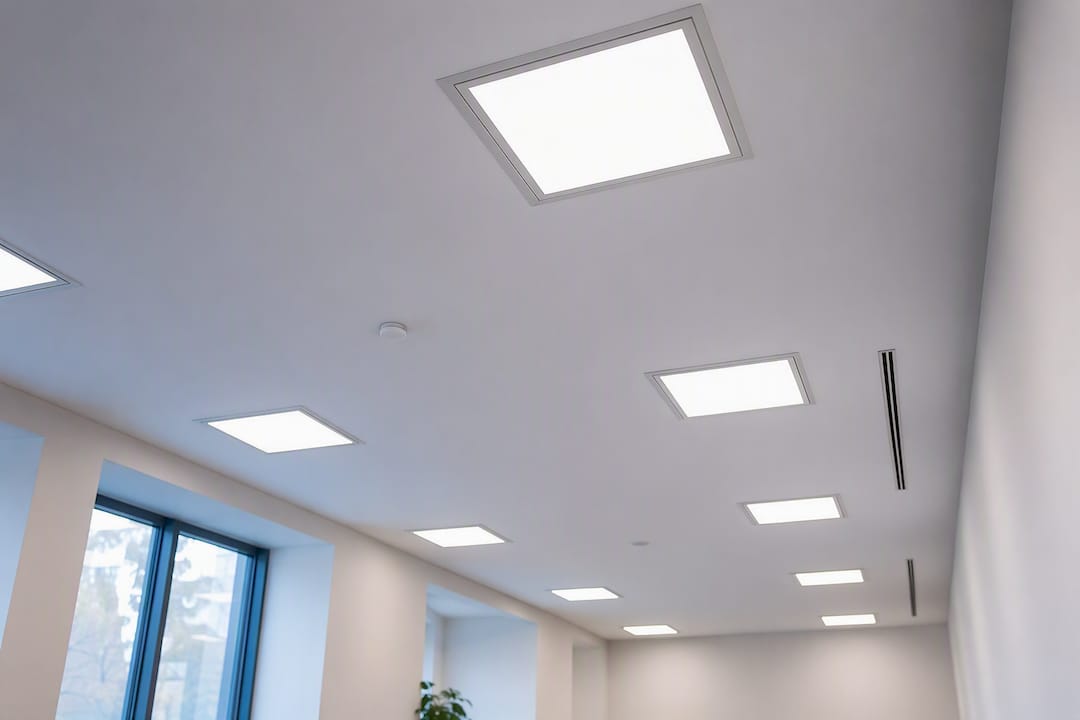
There is more nuance in specialised settings. A 2026 study in Scientific Reports found that the narrow spectral range of some LEDs, compared with broader daylight, can reduce certain measures of visual performance unless supplemented with wider-spectrum light, particularly relevant in clinical or precision work environments.
Practical mitigations for everyday households:
- Choose warmer CCTs (2,700K–3,000K) for evening and bedroom lighting
- Fit dimmers where possible to reduce blue-rich exposure late at night
- Avoid overbright, cool-white fittings in bedrooms
- Seek specialist lighting advice for clinical, laboratory or colour-critical work environments
Getting the most from retrofit and smart controls
Before buying, check the fitting’s base type, whether existing dimmers are LED-compatible, and whether any transformers need replacing. Not all LED drivers work with legacy dimming circuits, and mismatched components cause flickering or premature failure.
- Confirm base and socket compatibility before purchase
- Check dimmer and driver compatibility if the circuit already has dimming installed
- Add occupancy sensors or daylight harvesting where rooms are used intermittently. Government guidance notes these controls can deliver 30–70% additional savings depending on the space
- Bring in a qualified electrician for any circuit or transformer changes beyond a simple bulb swap
How to choose the right LED bulb: a purchase checklist
Buying decisions get easier once you know which figures on the packaging actually matter.
- Lumens: the brightness figure, not watts
- Lm/W: higher means more efficient for the same brightness
- CCT (Kelvin): matched to the room’s purpose
- CRI: 80+ for general use, 90+ for colour-critical spaces
- Dimmer compatibility: confirmed if the circuit already has a dimmer
- IP rating: essential for bathrooms, outdoor fittings and damp areas
- Warranty: five years or more is a reasonable expectation from quality manufacturers
- Energy label: prefer products with strong efficiency ratings, since ecodesign rules have tightened what qualifies
Pro Tip: For commercial tenders, ask suppliers for the L70 lumen-maintenance curve alongside the warranty. It tells you how the fitting will actually perform in year eight, not just year one.
Homeenergymodel’s guide to the real benefits of LED bulbs covers how these specifications interact with EPC assessments for anyone weighing lighting upgrades against a wider retrofit plan.
Why trust this guidance on LED lighting benefits?
Homeenergymodel focuses specifically on UK energy policy, EPCs and property-level energy modelling, which places lighting upgrades in the context of real compliance requirements, not just generic advice.
- Explore the key advantages of LED lights for UK properties
- Read guidance for landlords on lighting and energy incentives
- This article is informational; property owners assessing wider upgrades can book a professional home energy assessment
Ready to see how lighting fits your property’s energy performance?
Lighting is one lever in a much bigger energy performance picture, and it interacts directly with how a property scores under the incoming Home Energy Model. Landlords weighing an LED retrofit alongside other upgrades can review the types of Home Energy Model reports available to understand how lighting choices feed into compliance under the Future Homes Standard, or read how the Home Energy Model methodology will assess properties once it replaces SAP.
What’s an editorial take on LED lighting’s real payoff?
That figure is accurate, but it flatters the case without telling anyone what to do next. The more useful truth buried in the government’s own leaflets is that controls, not just bulbs, often deliver the second wave of savings, sometimes matching or exceeding the swap itself in commercial settings.
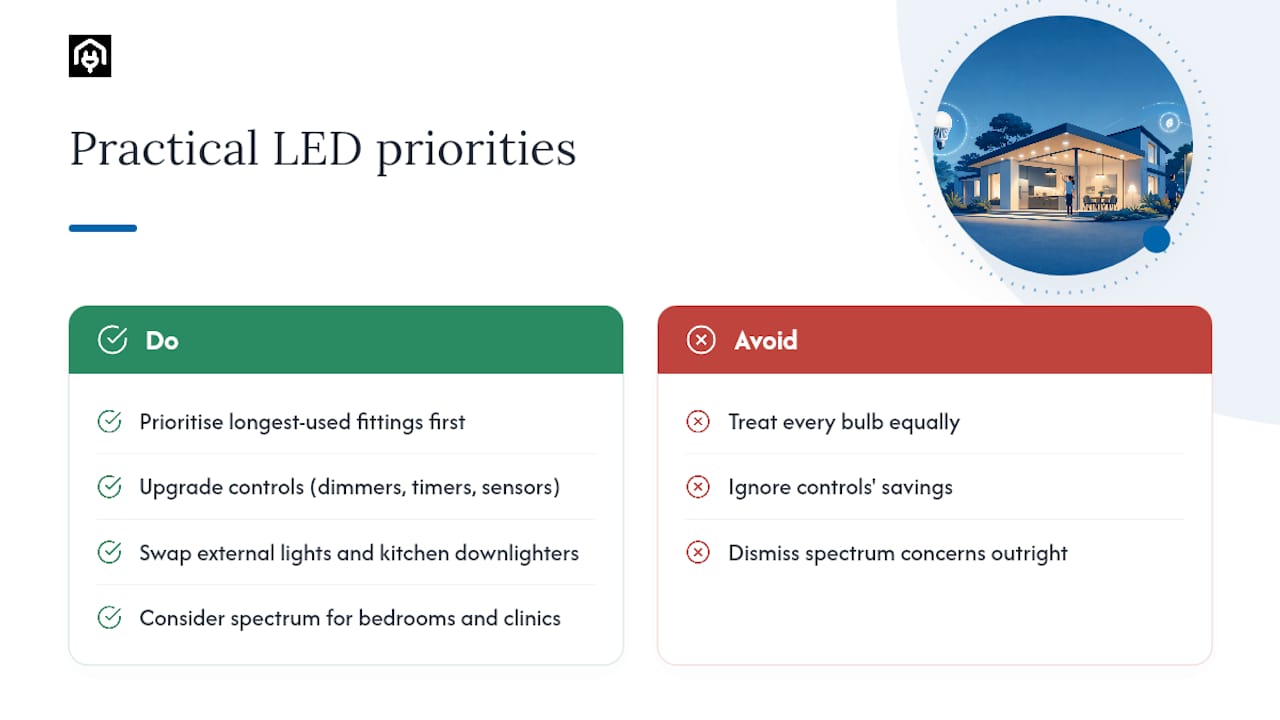
Where I think households get it wrong is treating every bulb in the house as equal priority. It isn’t. The Energy Saving Trust’s own guidance points toward targeted swaps first: the fittings used longest each day, external lights left on overnight, downlighters in kitchens. A rarely used cupboard bulb can wait.
The health angle deserves more nuance than either side gives it. LEDs are not dangerous in ordinary use, but the emerging spectrum research is a genuine reason to think harder about bedroom and clinical lighting specifically, rather than dismissing the concern outright.
— Danny
Key takeaways from switching to LED lighting
LED lighting delivers energy savings, longer lifespan and lower carbon output simultaneously, and the fastest way to capture all three is to buy by lumens and CRI while prioritising high-use fittings first.
| Point | Details |
|---|---|
| Energy savings are substantial | LEDs cut electricity use by 80–90% versus incandescent or halogen for equivalent brightness. |
| Payback is often under a year | Domestic downlighter swaps and many commercial upgrades pay back within roughly a year. |
| Buy by lumens, not watts | Check lumens, lm/W and CRI on packaging; wattage no longer indicates brightness. |
| Controls multiply savings | Occupancy sensors and daylight harvesting can add 30–70% further savings depending on the space. |
| Warmer light suits bedrooms | Use 2,700K–3,000K CCT and dimming in the evening to reduce blue-rich exposure. |
Sources
- Lighting technology information leaflet (ETL) — April 2020
- Scientific Reports — LED lighting (350–650 nm) undermines visual performance unless supplemented by wider spectra