

LED lighting uses far less electricity than the bulbs it replaces, lasts many times longer, gives off very little heat and is available in a wide range of colours and brightness levels. For UK homeowners, landlords and businesses, that means lower running costs, fewer replacements and a more comfortable, safer building. The sections below set out each benefit with figures from official sources, then show how to get the most from an upgrade.
TL;DR
- LEDs are the most energy efficient bulb type. The Energy Saving Trust says they use 80% less electricity than halogen lights for the same light output.
- Replacing the remaining halogen spotlights in a home could save £45 a year in Great Britain.
- LEDs last far longer, which cuts replacement effort and maintenance, especially in high ceilings and commercial buildings.
- They run cool, switch on instantly at full brightness and work well with dimmers, sensors and controls.
- Savings depend on how many hours the lights run, the fixtures and how the project is planned, so a room-by-room approach works best.
Table of Contents
- What makes LED lighting different
- Lower electricity use and lower bills
- A much longer lifespan
- Cooler running and better safety
- Light quality, colour and control
- Environmental benefits
- Benefits for landlords and investors
- Benefits for businesses and commercial buildings
- Perspective
- How to get the most from an LED upgrade
- Planning a bigger energy upgrade?
- FAQ
- Sources
What makes LED lighting different
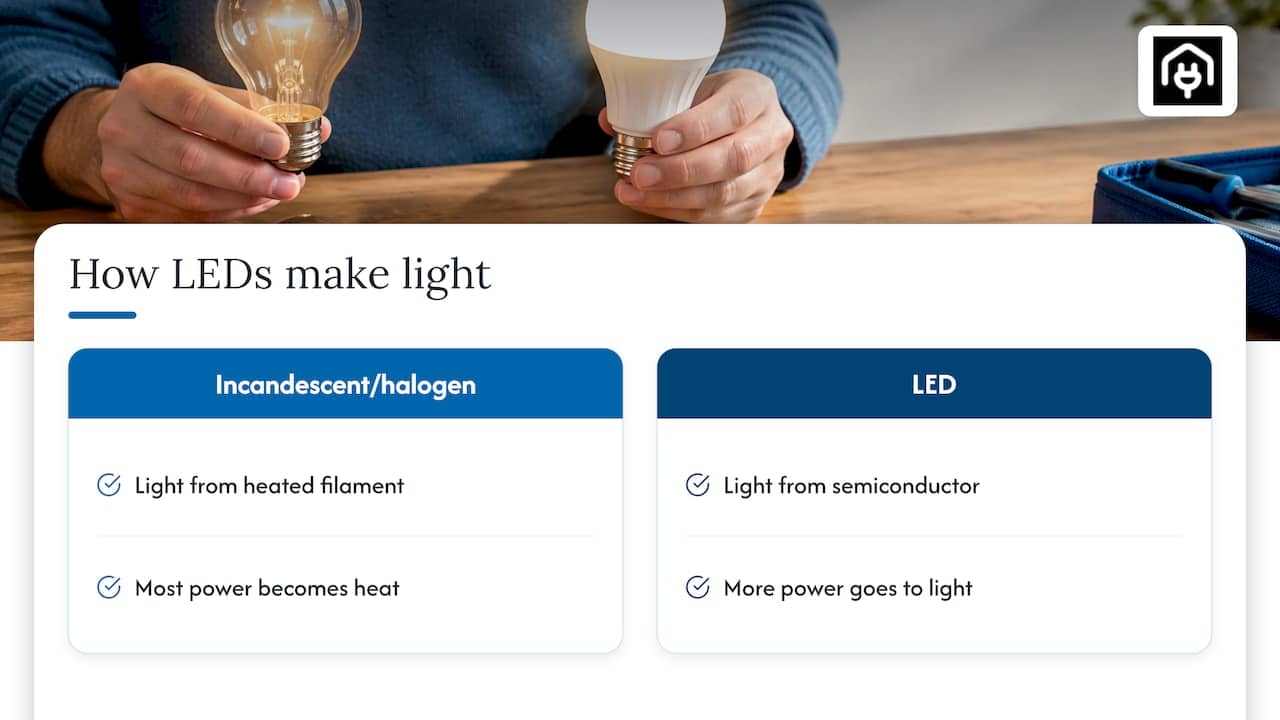
A traditional incandescent or halogen bulb makes light by heating a filament. Most of the electricity becomes heat, not light. An LED (light emitting diode) produces light in a semiconductor, so much more of the power goes into illumination.
The US Department of Energy describes LEDs as having compact size, long life, resistance to breakage and vibration, good performance in cold temperatures and instant-on performance. It also notes that LED technology now offers the highest luminous efficacy of any light source technology. Luminous efficacy is simply the amount of light produced for each watt of electricity.
The Energy Saving Trust adds that LEDs are the most common type of light bulb on sale and fit pretty much any light fitting in the home. In the UK, that availability is partly a result of regulation: the halogen bulb ban took effect on 1 September 2021, and sales of most fluorescent tubes were restricted in 2023. For most properties the question is no longer whether to use LEDs but how to use them well.
Lower electricity use and lower bills
Energy efficiency is the benefit most readers search for, and the evidence is consistent.
- Against halogen: the Energy Saving Trust puts the saving at 80% less electricity for the same light.
- Against incandescent: the US Department of Energy says LEDs use at least 75 percent less energy than incandescent bulbs. A later DOE article states that top-performing LEDs consume 80% less energy than traditional incandescent bulbs.
- Against fluorescent: the US General Services Administration says conversions to LED typically save 50% of electricity over a fluorescent baseline. Straight tube LED replacements alone save 25% to 40% compared with fluorescent lamps.
What this means in pounds
Lighting is a small part of the average UK household bill, so the saving per home is modest but certain. The Energy Saving Trust’s figure of £45 a year applies to replacing the remaining halogen spotlights. It also lists a carbon saving of 35kg a year in Great Britain for that change. The homes that gain most are those with many downlights, since a single kitchen with eight halogen spots uses far more power than one pendant.
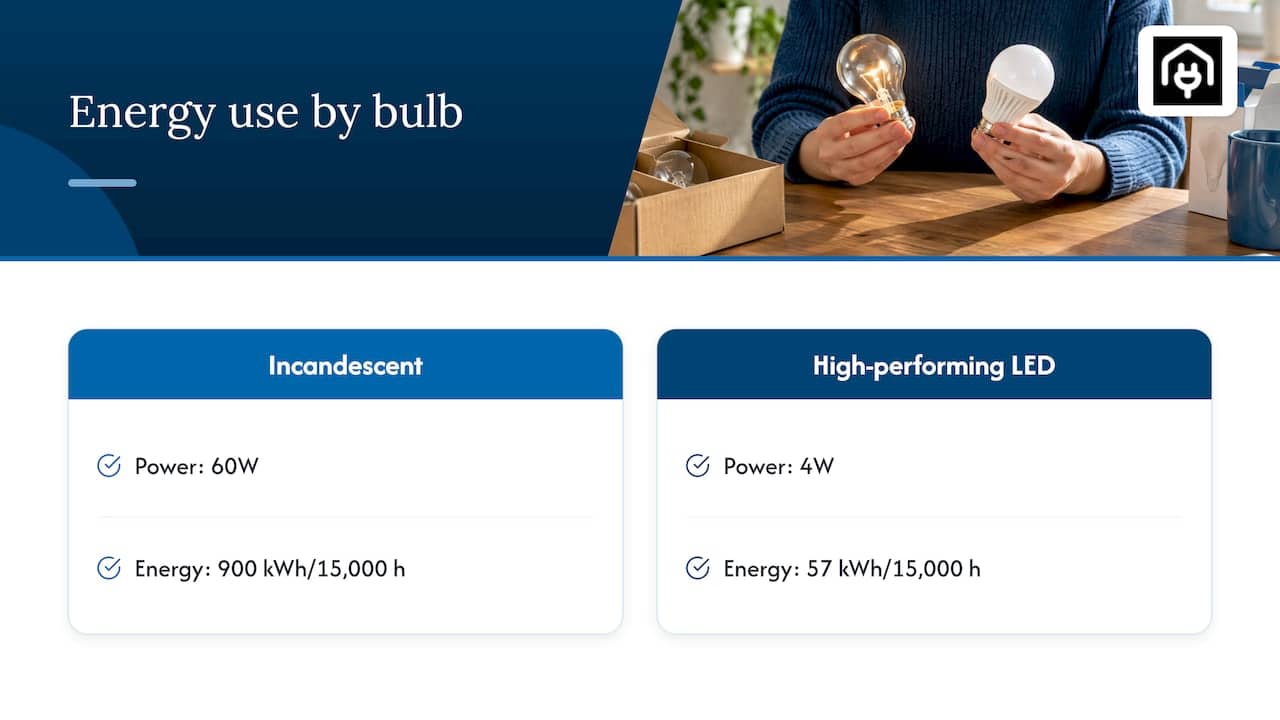
For a worked comparison from an official source, Australia’s energy rating programme shows a 60W incandescent globe using 900 kWh over 15,000 hours, against 57 kWh for a 4W high-performing LED. The prices there are in Australian dollars, but the energy gap is the point: roughly sixteen times less electricity over the same hours.
The benefit scales with use. The US Department of Energy advises replacing bulbs that are lit three or more hours a day first, because those return the saving fastest. Hallways, kitchens, living rooms, shared stairwells and external lights are the usual starting points.
For a fuller look at household figures, see our guide to the real energy, cost and health benefits of LED lighting and our walkthrough on how to reduce your lighting bill.
A much longer lifespan
Longevity is the second major benefit. The US Department of Energy says LEDs last 25 times longer than incandescent bulbs and up to four times longer than CFLs. The Energy Saving Trust says LEDs can last up to 20 times longer than halogen bulbs in many cases, so replacement may not be needed for many years.
Lifespan figures vary by product, so read the rated hours on the packaging. As a commercial benchmark, the GSA notes that tube LEDs are typically rated at 50,000 hours, while fluorescent lamps are rated at 25,000 to 40,000 hours.
How LEDs reach the end of their life
LEDs rarely fail suddenly. A report from the American Medical Association’s Council on Science and Public Health says LED lighting does not tend to burn out abruptly but dims slowly over many years, with replacement generally needed once output has fallen by 30%. In practice, a room simply becomes a little dimmer, which gives time to plan a replacement.
Less maintenance
Fewer replacements matter most where access is awkward or labour is paid for. High ceilings, stairwells, car parks and plant rooms are obvious examples. The same GSA guidance reports that 25% of the cost savings from converting fluorescent lighting to LED came from reduced maintenance over a 15-year period. For a landlord with several units, fewer call-outs for failed bulbs is a practical gain that never shows on an energy bill.
Cooler running and better safety
Because an LED turns most of its power into light, it produces very little heat. The University of Florida’s extension service notes that LEDs produce very little heat and emit no infrared or ultraviolet light. That has several consequences for a property:
- Fittings, shades and nearby materials are under less thermal stress.
- Bulbs are safer to handle and to replace.
- In larger buildings, the GSA points out that lights generating less heat can allow reductions in air-conditioning energy.
The last point links lighting to cooling load. Offices and shops with air conditioning can gain twice: less power for lighting and less for removing the heat the old lamps produced. Where a building has air conditioning above a certain size, a TM44 inspection is the route to reviewing how that system is performing.
LEDs also cope with knocks. The DOE lists resistance to breakage and vibration among their characteristics, which suits garages, workshops, rental properties and outdoor fittings. There is no mercury in LEDs, as the Florida publication confirms, which makes disposal simpler than for fluorescent tubes.
Light quality, colour and control
A common worry is that LED light looks harsh. Modern products cover a wide range, and the choice comes down to two figures on the box.
- Colour temperature (CCT, in kelvins): lower numbers give warm light, higher numbers give cool, bluish light.
- Colour rendering index (CRI): how accurately colours appear under the light, on a scale up to 100.
The North Carolina State Construction Office recommends a CRI of 80 or higher for indoor lighting, with CCT of 3000K to 3500K for residential spaces, 3500K to 4000K for offices and classrooms, and 4000K or higher for parking areas and other outdoor uses. These are US public-sector guidelines, but they match what lighting designers commonly specify.
| Space | Suggested colour temperature | Why |
|---|---|---|
| Living rooms, bedrooms | 3000K to 3500K | Warm, relaxed light |
| Offices, classrooms, kitchens | 3500K to 4000K | Clearer light for tasks |
| Car parks, external areas | 4000K or higher | Visibility and security |
Dimming, sensors and controls
LEDs are inherently dimmable and respond instantly. The DOE notes that this lets them be integrated with sensor and control systems, enabling further savings through occupancy sensing, daylight harvesting and local control of light levels. Ireland’s SEAI makes the same point for businesses: controls ensure lights are only on when and where they are needed.
If you are planning timers, presence detection or app-controlled scenes, a specialist in home automation and smart controls can show how lighting fits into a wider energy management setup. Our own overview of what works in smart buildings covers the same ground for UK properties.
Environmental benefits
Lower electricity use means lower emissions at the power station. The Energy Saving Trust attributes a 35kg CO2 reduction a year in Great Britain to swapping the remaining halogen spotlights in a home. Multiplied across millions of homes and businesses, the effect is large.
At global scale, CLASP reports that the full transition to LEDs by 2027 would avoid 2.7 gigatonnes of CO2 emissions and eliminate 158 tonnes of mercury pollution, following the agreement to phase out fluorescent lighting worldwide. These are projections tied to a full global transition, not a promise for any single building, but they show why policy keeps moving the market toward LEDs.
Benefits for landlords and investors
For rented property, LED lighting is one of the cheapest efficiency measures available. It is quick to install, needs no building work and reduces tenants’ bills. Fewer failed bulbs also means fewer maintenance requests.
Lighting is also taken into account when a property is assessed. A domestic Energy Performance Certificate records the proportion of low-energy lighting in a home, so a full switch to LEDs is a straightforward way to support the rating. For background on how ratings work, read our explanation of the EPC rating. Landlords planning several measures at once will find more in our lighting energy saving guide for UK landlords and the list of smart energy efficient home upgrades.
Benefits for businesses and commercial buildings
Lighting is a large load in commercial premises. SEAI states that lighting can be responsible for up to 40% of a building’s electricity use, and describes an LED upgrade as an opportunity for significant savings, often at relatively low cost with quick payback. The GSA reports that lighting consumes between 10% and 25% of electricity in its buildings, which shows how much the share varies by building type.
For offices, retail units and warehouses, the gains stack up: lower energy use, less maintenance, less cooling load and better light for staff. A commercial Energy Performance Certificate reflects the building’s lighting and services, and our 25 practical energy saving measures for business puts lighting alongside heating, controls and metering.
Perspective
In our experience, lighting is the upgrade that property owners can act on first. It needs no planning permission, no building work and very little disruption, and the benefits show up on the next bill.
The mistake we see is treating it as a one-for-one bulb swap. The best results come from looking at how each space is used: which lights are on for long hours, where dimming or sensors make sense, and what colour temperature suits the room. Savings and long-term success depend on planning, specification and ongoing management, as SEAI says in its guidance.
We also see lighting as one input into a wider energy picture. Once the easy measures are done, the next question is how the whole building performs. That is where an EPC, a SAP or SBEM calculation, or a TM44 inspection gives owners a clear, evidence-based view of what to do next, and where the Home Energy Model will shape how performance is assessed in future.
Danny
How to get the most from an LED upgrade
The Energy Saving Trust, the DOE and the GSA all point the same way: results depend on the project, not just the bulb. The GSA notes that site conditions, design, maintenance and lighting usage all influence life-cycle cost effectiveness, and that each project yields a different return.
- List your lights by hours of use. Start with the fittings on longest. The DOE suggests prioritising bulbs lit three or more hours a day.
- Match the bulb to the fitting. Check the base type, whether the lamp is dimmable and whether your dimmer switch is compatible. Older dimmers designed for halogen can cause flicker with some LEDs.
- Choose the right colour. Use the table above as a starting point, and check the CRI on the packaging.
- Add controls where they pay. Sensors suit corridors, stores and shared areas. Timers and daylight sensors suit external lights.
- Phase the rest. The DOE advises phasing out other bulbs as they burn out, so nothing perfectly good is thrown away.
- Record what you did. Keep invoices and product details for EPC assessments and tenant or investor reporting.
Our wider energy saving tips guide shows where lighting sits among other home measures, and our article on the advantages of LED lamps for UK homes and landlords goes further into the household numbers.
Planning a bigger energy upgrade?
Lighting is a first step. If you own, let or develop property and need a formal view of its performance, we connect you with assessors for domestic EPCs, commercial EPCs, SAP calculations, SBEM calculations and TM44 inspections. Request a quote through the relevant service page, or start from the Home Energy Model homepage.
FAQ
Is it better to use LED lights or regular lights?
For almost every use, LEDs are the better choice. They use around 80% less electricity than halogen bulbs for the same light, according to the Energy Saving Trust, and last far longer. Halogen bulbs are no longer sold new in the UK in most cases, so LEDs are also the practical option.
How much can I save by switching to LED bulbs?
The Energy Saving Trust estimates £45 a year in Great Britain if you replace the remaining halogen spotlights in a home. The actual figure depends on how many bulbs you replace, how long they are on and your electricity tariff. Homes with many downlights tend to save the most.
How long do LED lights last?
The US Department of Energy says LEDs last 25 times longer than incandescent bulbs and up to four times longer than CFLs. Rated life varies by product, so check the hours on the packaging. LEDs usually dim gradually rather than failing suddenly.
What colour LED light is best for a home?
Warm white, around 3000K to 3500K, suits living rooms and bedrooms. Kitchens and home offices often work better at 3500K to 4000K. Look for a CRI of 80 or higher so colours look natural.
Do LED lights help an EPC rating?
LED lighting is a low-cost measure that improves the lighting element recorded in a domestic EPC. It sits alongside heating, insulation and glazing in the overall rating. Our EPC rating guide explains how those elements combine.
Sources
- Energy saving light bulbs and lighting, Energy Saving Trust
- A guide to the halogen bulb ban, The Eco Experts
- Guide to Energy Efficient Lighting, US Department of Energy
- LED Basics, US Department of Energy
- Saving American Families and Businesses Money through Lighting Efficiency, US Department of Energy
- LED Lighting and Controls Guidance for Federal Buildings, US GSA
- Switch and save, Energy Rating (Australia)
- Council on Science and Public Health report, American Medical Association
- Energy Efficient Homes: Introduction to LED Lighting, University of Florida IFAS
- Global Leaders Agree to Full Phase-Out of Fluorescent Lighting, CLASP
- Energy Efficient Lighting Guidance Document, North Carolina State Construction Office
- Energy Efficient LED Lighting Guide, SEAI
- Home automation and smart controls