
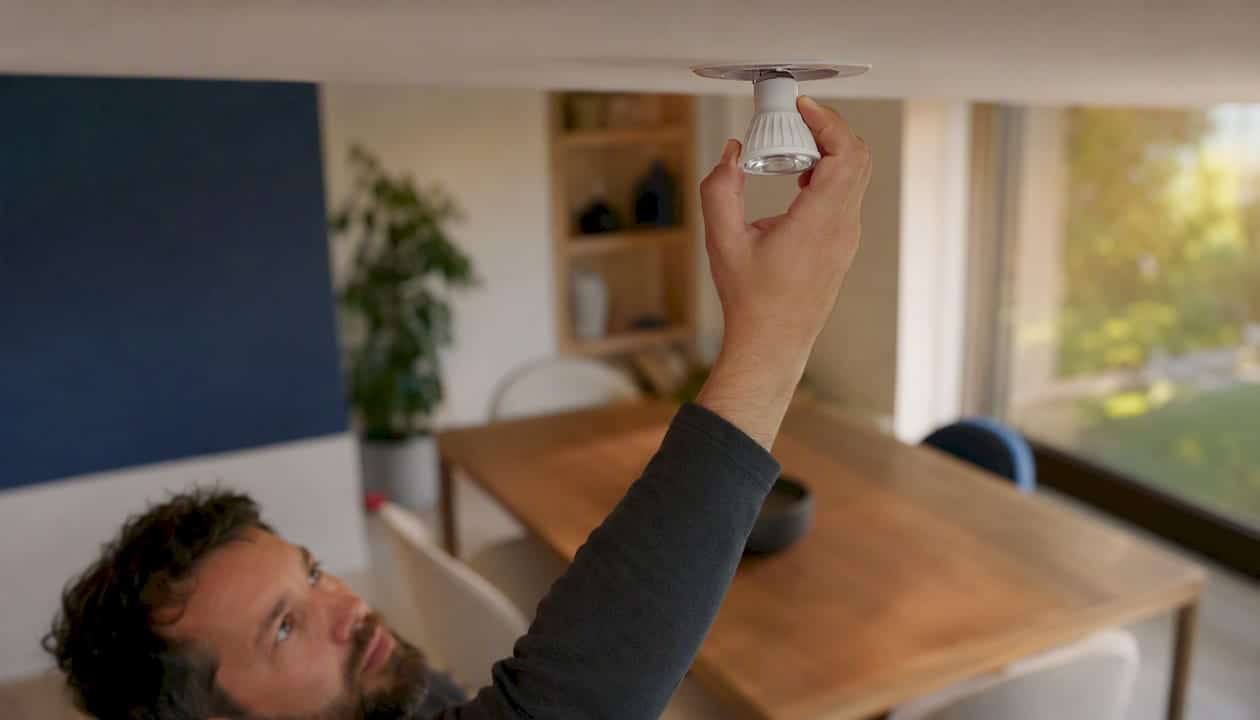
LED bulbs cut running costs, last far longer than legacy lamps, and reduce carbon — making them the best practical lighting choice for most UK homes, rented properties, and business premises. The Energy Saving Trust confirms LEDs are the most energy-efficient common bulb type, using around 80% less electricity than equivalent halogen lamps. For landlords, homeowners, and business owners, the advantages of LED lighting extend well beyond the electricity meter.
Key benefit categories at a glance:
- Energy efficiency: far fewer watts for the same lumens output
- Lower running costs: reduced bills and fast payback periods
- Longer lifespan: up to 25,000–50,000 hours versus 1,000–2,000 for halogens
- Better light quality: controllable colour temperature, high CRI options, instant-on
- Environmental gains: lower kWh consumption and CO2 emissions, backed by UK Ecodesign / MEPS policy
- Compatibility: direct swap for most fittings; smart and dimmable options available
Key takeaways
LED bulbs deliver the fastest payback of any common energy efficiency upgrade for UK properties, with quality GU10 replacements typically recovering their cost in weeks at current electricity tariffs.
| Point | Details |
|---|---|
| Replace halogens first | Halogen downlights offer the largest wattage saving and fastest payback of any bulb swap. |
| Read lumens, not watts | Lumens measure brightness; a 6W LED GU10 matches a 50W halogen at around 400 lumens. |
| Lifespan advantage | Quality LEDs are rated at around 25,000 hours versus 1,000–2,000 hours for halogen lamps. |
| EPC and SAP gains | A full LED upgrade costs £100–£300 and can add 1–2 SAP points to a property’s EPC rating. |
| Add controls for extra savings | Occupancy sensors can cut lighting energy use by up to about a third in suitable areas. |
Table of Contents
- What are the main benefits of LED bulbs for UK properties?
- How LEDs cut energy bills and what the payback looks like
- How long do LED bulbs last, and why that matters for landlords
- What to check for brightness, colour, and dimming performance
- Fitting types, transformers, and when to call an electrician
- How UK policy and Ecodesign regulations are driving LED adoption
- When LED bulbs may not be the right choice
- How to choose the right LED bulb: a practical checklist
- A worked UK payback example using BEIS and Energy Saving Trust data
- An editorial perspective on LED upgrades and UK property
- Sources
What are the main benefits of LED bulbs for UK properties?
The core advantages of LED lighting cover five areas that matter directly to property owners and landlords.
- Energy savings: LEDs deliver the same brightness at a fraction of the wattage of a halogen. The Energy Saving Trust advises comparing lumens, not watts, because watts measure power consumed, not light produced.
- Lower bills: Gov estimates that replacing halogens with LEDs can deliver lifetime household savings of several thousand pounds, depending on property size.
- Longer life: Quality LEDs are rated at around 25,000 hours, compared with roughly 1,000–2,000 hours for halogen lamps. Fewer replacements mean lower maintenance costs and less disruption.
- Light quality: Modern LEDs offer a wide range of colour temperatures and high colour rendering index (CRI) values, making them suitable for every room type.
- Environmental impact: Lower energy consumption translates directly into reduced CO2 emissions. UK Ecodesign / MEPS regulations now set minimum energy performance standards that effectively make efficient LEDs the market default.
| Point | Details |
|---|---|
| Energy use reduction | LEDs use around 80% less electricity than equivalent halogen lamps. |
| Lifetime household savings | BEIS modelling estimates £2,000–£3,000 in lifetime bill savings per typical home. |
| Lifespan advantage | Quality LEDs are rated at around 25,000 hours versus 1,000–2,000 hours for halogens. |
| Policy driver | UK Ecodesign / MEPS standards now make efficient LEDs the market default. |
| EPC impact | LED upgrades can add 1–2 SAP points and improve a property’s EPC rating. |
How LEDs cut energy bills and what the payback looks like
Lumens versus watts
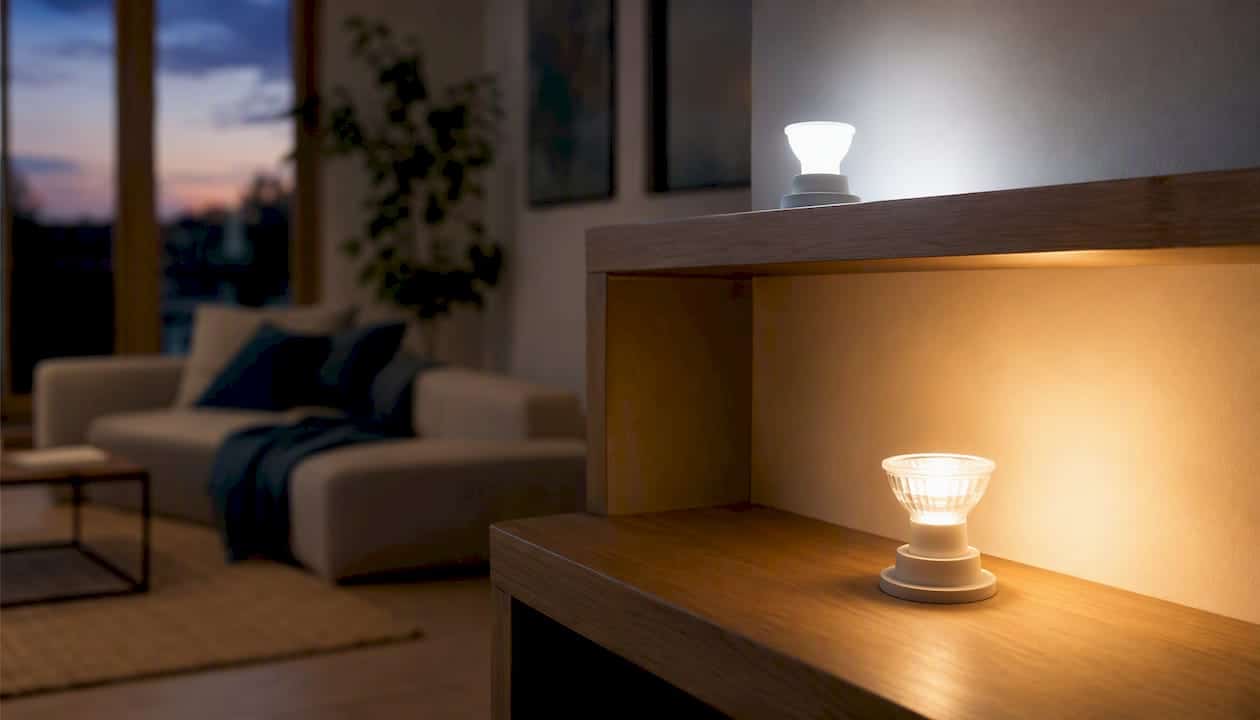
Watts measure how much electricity a bulb consumes, not how much light it produces. Lumens measure brightness. A 50W halogen GU10 downlight produces around 400 lumens; a quality LED GU10 delivers the same 400 lumens at roughly 5–7W. That is the efficiency gap the Energy Saving Trust highlights when advising buyers to read lumen figures on packaging rather than relying on wattage comparisons.
A worked payback calculation
The steps below use a representative UK unit rate to illustrate the saving per bulb per year. Always check your current tariff from your supplier or Ofgem for an accurate figure.
- Identify the wattage difference. A 50W halogen replaced by a 6W LED saves 44W per hour of use.
- Estimate annual hours. A kitchen downlight used 4 hours per day runs for roughly 1,460 hours per year.
- Calculate kWh saved. 44W × 1,460 hours ÷ 1,000 = approximately 64 kWh saved per bulb per year.
- Apply the unit rate. At a typical UK rate of around 24p per kWh, that is roughly £15 saved per bulb annually.
- Divide bulb cost by annual saving. A quality LED GU10 costing around £3–£5 pays back in weeks at that rate.
Selectra’s per-bulb worked examples confirm that the arithmetic is similarly compelling across a range of UK tariff scenarios. For a kitchen with eight downlights, the annual saving approaches £120 from that single room alone.
Total cost of ownership
Purchase price is only one part of the equation. LED bulbs also generate less heat than halogens, which slightly reduces air-conditioning loads in commercial settings. The BEIS technical guidance on business retrofits shows that when maintenance labour, lamp replacement frequency, and cooling effects are factored in, total operating cost savings exceed the simple electricity calculation.
Pro Tip: Replace halogen downlights in kitchens and living rooms first. These are typically the highest-wattage, highest-usage fittings in a home, so they deliver the fastest payback and the biggest visible impact on the electricity bill.
How long do LED bulbs last, and why that matters for landlords
Rated life and the L70 metric
A quality LED bulb is typically rated at around 25,000 hours, with some commercial-grade products reaching up to 50,000 hours. Below L70, most occupants notice the dimming. Reputable manufacturers publish their L70 figure; if a product omits it, treat that as a quality warning.
Lifespan in context: At 25,000 rated hours, an LED used for 3 hours per day would last roughly 23 years before reaching L70. A halogen in the same fitting, rated at 2,000 hours, would need replacing approximately every 18 months.
Maintenance savings for landlords and businesses
Fewer replacements mean fewer maintenance visits, less scaffolding or ladder work in hard-to-reach fittings, and less disruption to tenants or customers. For a landlord managing multiple properties, or a business with high-bay warehouse lighting, the labour cost avoided over a decade can rival the electricity saving itself.
- Halogen lamps in recessed ceiling fittings often require a tradesperson to replace safely.
- Commercial premises with fittings above 3 metres typically incur access equipment costs per lamp change.
- NEF’s sustainable lighting guidance notes that quality LEDs are rated at around 25,000 hours and offer very large percentage efficiency gains over legacy bulbs.
One caution: cheaper LED bulbs can underperform significantly in enclosed fittings where heat cannot dissipate. Heat shortens LED driver life, causing early failure that erodes the lifespan advantage. Specify LEDs rated for enclosed or fire-rated fittings where applicable.
What to check for brightness, colour, and dimming performance
Choosing the right LED goes beyond picking the lowest wattage. Three specifications on the packaging determine whether the light actually suits the space.
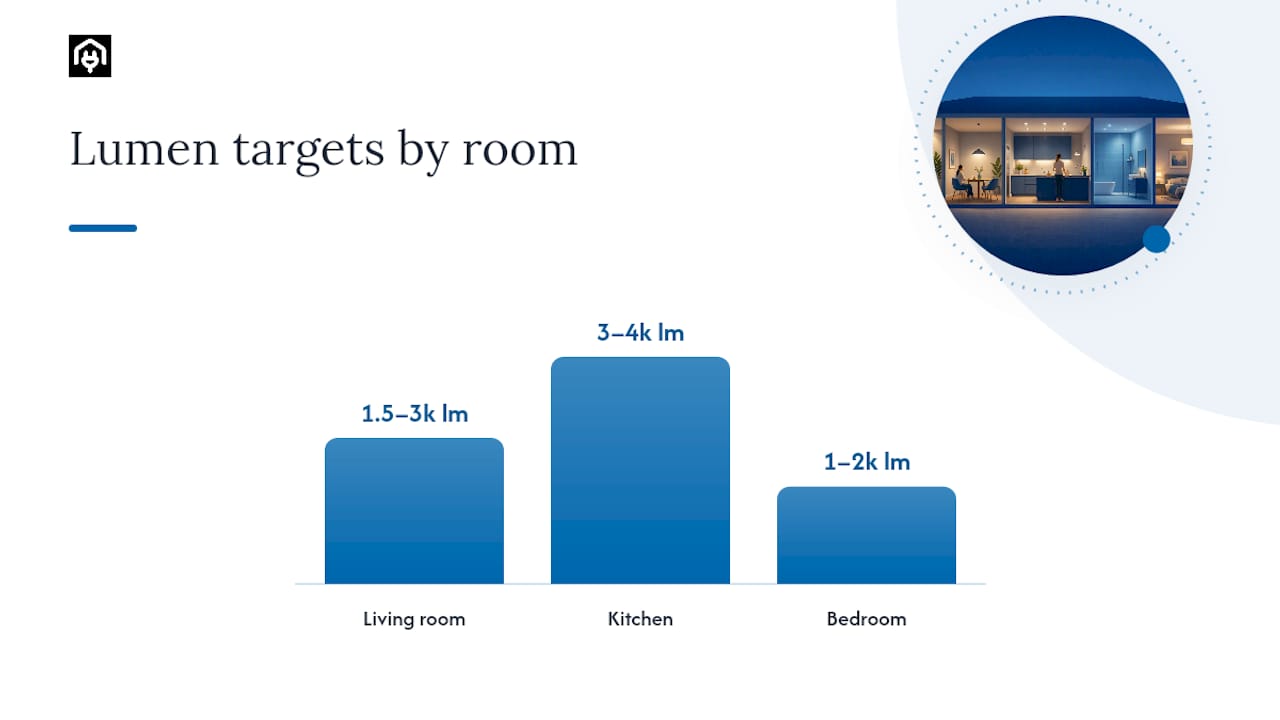
- Lumens (brightness): A living room typically needs 1,500–3,000 lumens total; a kitchen 3,000–4,000 lumens; a bedroom 1,000–2,000 lumens. Individual bulb lumen output varies, so count the number of fittings and divide the room target accordingly.
- Colour rendering index (CRI): CRI measures how accurately colours appear under the light, on a scale of 0–100. A CRI of 80 or above suits most domestic rooms. Kitchens, bathrooms, and retail displays benefit from CRI 90+, where food and merchandise colours read accurately.
- Colour temperature: Measured in Kelvin (K). Warm white (2,700–3,000K) suits living rooms and bedrooms. Cool white (4,000K) works well in kitchens and offices. Daylight (5,000–6,500K) suits task lighting and some retail environments.
Dimming is where many LED installations run into problems. Not all LED bulbs are dimmable, and those that are may flicker or buzz on older leading-edge dimmer switches designed for incandescent or halogen loads. Check the manufacturer’s dimmer compatibility list before purchasing, and consider replacing legacy dimmers with LED-compatible trailing-edge models.
Pro Tip: Look for the lumen output, CRI, colour temperature, and dimmer compatibility information on the packaging or the manufacturer’s data sheet before buying. If any of those four figures are absent, choose a different product.
Business Wales guidance also highlights that good-quality lighting improves workplace productivity and wellbeing, making CRI and colour temperature choices commercially relevant beyond simple energy savings.
Fitting types, transformers, and when to call an electrician
Most LED bulbs are direct replacements for existing fittings. The common UK cap types are:
- B22 (bayonet cap): the standard UK two-pin twist fitting for pendant and table lamps.
- E27 (Edison screw): common in decorative and statement fittings.
- GU10: the push-and-twist fitting used in most recessed halogen downlights. LED GU10s run on mains voltage (240V) and replace halogen GU10s directly.
- MR16 / GU5.3: low-voltage halogen downlights running on 12V via a transformer. These require more care.
MR16 halogen downlights use either a magnetic or electronic transformer. Many electronic transformers have a minimum load requirement that a low-wattage LED will not meet, causing flickering or failure to illuminate. The solution is either to replace the transformer with an LED-compatible driver or to switch to mains-voltage GU10 fittings. This work typically crosses into Part P of the Building Regulations, which covers electrical installations in dwellings. Any work that involves replacing a transformer or modifying the wiring circuit should be carried out by a qualified electrician registered with a competent person scheme such as NICEIC or NAPIT.
Safety note: Swapping a bulb in an existing, unmodified fitting is DIY-safe. Changing transformers, drivers, or wiring is notifiable work under Part P and requires a registered electrician.
Controls add further savings. Occupancy sensors and daylight-harvesting controls can reduce lighting energy use by up to about a third in some areas, according to Business Wales guidance. For offices, corridors, and external security lighting, these controls pay back quickly alongside the LED upgrade itself.
How UK policy and Ecodesign regulations are driving LED adoption
The UK government’s Ecodesign / MEPS framework has progressively raised the minimum energy performance standards for lighting sold in Great Britain. The practical effect is that most halogen and inefficient fluorescent lamps can no longer be placed on the market, making efficient LEDs the default choice for consumers and businesses.
The ecodesign impact assessment published by the government modelled the projected energy and bill savings from raising these standards, confirming that replacing older lamps with LEDs can recover upfront capital quickly in most scenarios and contributes meaningfully to the UK’s carbon budgets.
Ofgem’s carbon savings calculations provide sectoral CO2 reduction data for LED replacements, used by businesses and policy planners to quantify the environmental impact of lamp-swap programmes at scale. For individual properties, the kWh reduction from switching all lighting to LED translates into a measurable fall in annual CO2 emissions, contributing to both corporate sustainability targets and household carbon footprints.
The BEIS technical guidance on business retrofits includes retail and signage case studies where payback periods of under one year were modelled, underlining that the commercial case for LED upgrades is strong even before carbon pricing or policy obligations are considered.
When LED bulbs may not be the right choice
LEDs are the right choice for the vast majority of applications, but a balanced assessment requires acknowledging the situations where they are not.
- Still-working CFLs: Replacing a compact fluorescent lamp that has years of life remaining may not be cost-effective immediately. The energy saving over a CFL is smaller than over a halogen, and the upfront cost may not recover before the CFL fails naturally.
- Variable product quality: The LED market includes a wide range of quality. Cheap imports with no published lumen or CRI data frequently underperform their packaging claims and fail early, particularly in enclosed fittings.
- Recycling and disposal: Integrated LED fittings (where the LED array cannot be separated from the luminaire) create electronic waste when they fail. Unlike a replaceable bulb, the entire fitting goes to landfill unless taken to a WEEE recycling point. Specify fittings with replaceable LED modules where longevity matters.
- Colour-critical professional tasks: Some photographic, print-proofing, or colour-matching applications require very high CRI values (95+) or specific spectral characteristics that standard consumer LEDs do not always meet. Specialist high-CRI LEDs exist for these uses but carry a significant price premium.
Quality check: If a product listing omits lumen output, CRI, and L70 data, the manufacturer is unlikely to stand behind those figures. Spend slightly more on a reputable brand with published specifications.
How to choose the right LED bulb: a practical checklist
Step-by-step selection
- Determine the required lumens for the room or task, based on room size and use.
- Choose the colour temperature suited to the space: 2,700–3,000K for warm domestic rooms; 4,000K for kitchens and offices; 5,000K+ for task or display lighting.
- Set a CRI target: 80+ for general domestic use; 90+ for kitchens, bathrooms, and retail.
- Confirm the fitting type (B22, E27, GU10, MR16) and check whether the existing transformer is LED-compatible if replacing MR16 halogens.
- Check dimmer compatibility if the circuit has a dimmer switch; verify against the manufacturer’s compatibility list.
- Check the IP rating for bathrooms, external fittings, or any wet area (minimum IP44 for bathroom zones; IP65 for external use).
- Review the warranty: reputable LED products carry a minimum two-year warranty; three years or more is a positive indicator of quality.
Red flags to avoid
- No lumen output stated on the packaging or listing
- No CRI figure published
- Warranty shorter than two years
- No dimmer compatibility information for a product sold as dimmable
- No L70 or rated-life figure for commercial or high-use applications
Quick spec guide by room
- Living room: 2,700–3,000K, CRI 80+, dimmable preferred
- Kitchen: 4,000K, CRI 90+, IP44 for over-sink areas
- Bathroom: 3,000K, CRI 80+, IP44 minimum in zones 1 and 2
- Home office: 4,000K, CRI 80+, non-dimmable acceptable
- External / security: 4,000–5,000K, IP65, PIR sensor compatible
A worked UK payback example using BEIS and Energy Saving Trust data
Scenario: a three-bedroom semi-detached home
A typical three-bedroom semi-detached property in the UK might have 20 halogen downlights across the kitchen, living room, and hallways, plus a mix of pendant and bathroom fittings.
- Baseline: 20 × 50W halogen GU10s = 1,000W total installed load for downlights.
- LED replacement: 20 × 6W LED GU10s equal a substantially reduced total installed load.
- Wattage saved: 880W per hour of simultaneous use.
- Annual hours (estimated): 4 hours per day average across all fittings = 1,460 hours.
- Annual kWh saved: 880W × 1,460 hours ÷ 1,000 = approximately 1,285 kWh per year.
- Annual bill saving: At approximately 24p per kWh, that is roughly £308 per year from downlights alone.
- Upfront cost: 20 quality LED GU10s at approximately £4 each = £80.
- Simple payback: £80 ÷ £308 = under four months.
The BEIS modelling supports the scale of these savings at a national level, estimating lifetime household savings of around £2,000–£3,000 when all lighting is converted. The Energy Saving Trust calculator allows property owners to run their own estimates based on actual fixture counts and usage patterns.
EPC and SAP implications for landlords
LED upgrades affect a property’s Standard Assessment Procedure (SAP) score, which underpins the Energy Performance Certificate (EPC) rating. According to EPCFix, a full LED upgrade typically costs £100–£300 for a property and can add 1–2 SAP points, making it one of the cheapest EPC improvements available. For landlords subject to Minimum Energy Efficiency Standards (MEES), this can be a meaningful step towards compliance.
Landlords seeking to understand how LED upgrades interact with their EPC obligations can find detailed guidance through Homeenergymodel’s Home Energy Model explained resource, which covers how the new Home Energy Model methodology will assess lighting and other efficiency measures from 2025 onwards.
For a full picture of how lighting upgrades fit within a broader retrofit plan, Homeenergymodel’s energy-efficient home upgrades guide sets out prioritisation advice for UK property owners.
An editorial perspective on LED upgrades and UK property
The case for LED bulbs is, by now, well established in the data. What the data does not always convey is how consistently property owners underestimate the speed of payback. A sub-four-month payback on a kitchen downlight retrofit is not a best-case scenario; it is routine at current UK electricity tariffs. The hesitation usually comes from upfront cost perception, yet twenty quality LED GU10s cost less than a single call-out fee for an electrician to replace failed halogens.
The more interesting question for landlords and business owners is not whether to switch, but where to start and how to use the upgrade to maximum effect on an EPC or a sustainability report. The MEES obligations are tightening, and the Home Energy Model methodology replacing SAP from 2025 will assess lighting efficiency with greater granularity. An LED upgrade completed now locks in both the bill saving and the compliance benefit before the assessment methodology changes.
Controls are the underused lever. Occupancy sensors in corridors, stairwells, and meeting rooms add a further layer of saving that most retrofit plans ignore. Combined with a full LED upgrade, they can push total lighting energy reduction well beyond what the bulb swap alone achieves.
The guidance from the Energy Saving Trust, BEIS, and the ecodesign impact assessment all point in the same direction. The technology is mature, the economics are clear, and the regulatory direction is fixed. For landlords managing properties under MEES regulations, LED lighting is one of the few upgrades that pays back before the next EPC assessment is even due.
Sources
- Energy saving light bulbs and lighting – Energy Saving Trust
- Gov
- Lighting technology information leaflet April 2020 – GOV.UK
- Guide to Sustainable Lighting – NEF
- LED light bulbs UK 2026: Are they really worth the switch? – Selectra
- LED lighting guidance – Business Wales
This article is general information, not a substitute for advice from a qualified financial advisor. Consult a qualified financial professional about your own circumstances before acting on anything here.