
Most UK households can lower their electricity bill by doing three things in order: check what they are paying per unit, find out what is using the power, and then fix the biggest items first. Tariff choice, heating, hot water and standby loads usually matter more than switching off the odd light. Longer-term work, such as draught-proofing and insulation, lowers the bill every year after.
This guide sets out where the money goes, which changes are worth the effort, and how an Energy Performance Certificate (EPC) helps decide what to do next. Savings figures come from named UK sources and are averages. Actual results depend on the size of the home, the number of occupants and the fuel used.
TL;DR
- Check the unit rate and standing charge on the current tariff. Both appear on the bill, and both can be compared with other deals.
- A smart meter only helps if the readings are used. Note which appliances and times of day push usage up.
- Heating, hot water, standby devices and old lighting are the usual sources of avoidable cost.
- Draught-proofing, loft insulation and a better boiler or heat source lower the bill permanently. The EPC recommendations list them in a sensible order.
- Start with free changes this week, then book paid improvements in order of payback.
Table of Contents
- Understand what the bill is made of
- Check the tariff first
- Use the smart meter properly
- Cut heating and hot water costs
- Stop paying for power nobody uses
- Run appliances more efficiently
- Stop heat escaping
- Use the EPC to decide what comes next
- Savings at a glance
- Our perspective
- Get a current EPC for your property
- A sensible order of action
- FAQ
- Sources
Understand what the bill is made of
An electricity bill has two parts: a unit rate (pence per kilowatt hour, kWh) and a daily standing charge. Reducing the bill means lowering the number of units used, lowering the unit rate, or both. The standing charge is paid whatever the usage.
For reference, Ofgem’s price cap from 1 October to 31 December 2026 is 26.32 pence per kWh with a 54.83 pence daily standing charge for Direct Debit customers in England, Scotland and Wales. The cap is reviewed every quarter, so the current figures are on Ofgem’s page. The cap limits the rate per unit. It does not limit the total bill, because usage still decides that.
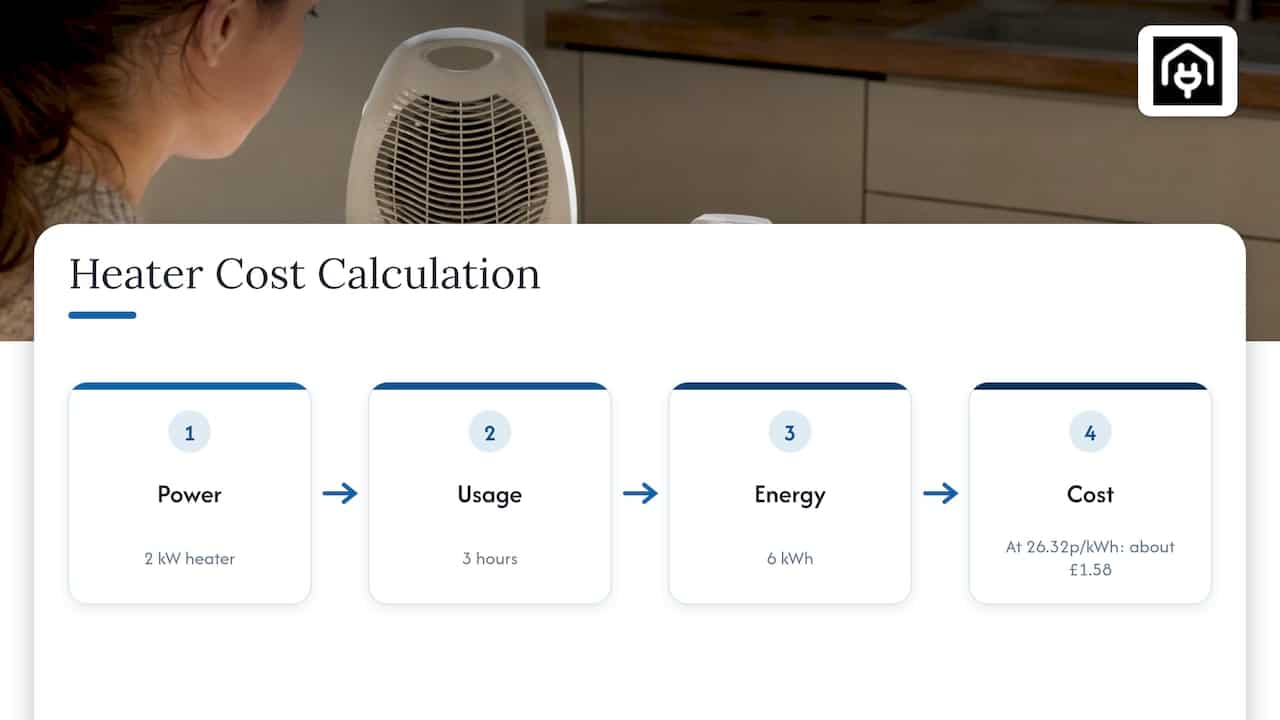
A quick way to see what an appliance costs: multiply its power in kilowatts by the hours used, then by the unit rate. A 2 kW heater running for three hours uses 6 kWh. At 26.32p per kWh that is about £1.58. Doing this sum for a few devices shows quickly where the money goes.
Read the meter before changing anything
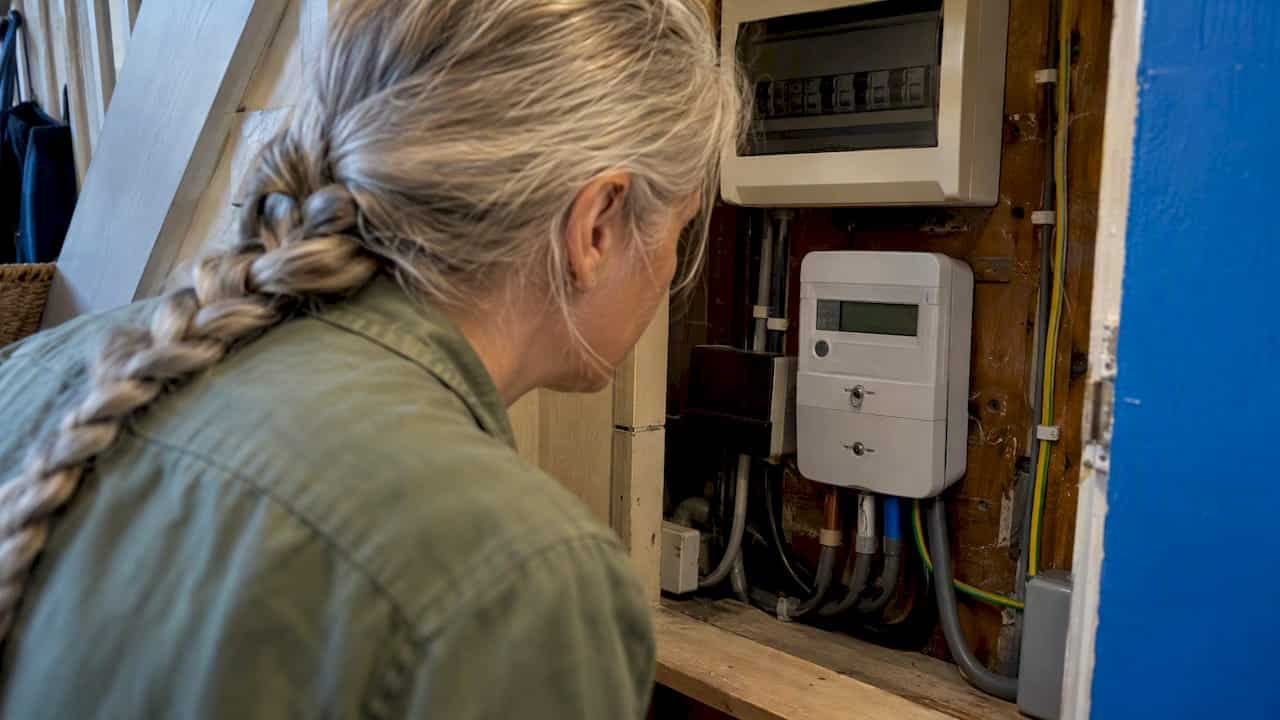
Take a meter reading at the same time each day for a week. This gives a baseline in kWh. After each change, repeat the check. Without a baseline, it is hard to tell whether a change worked or whether the weather did the work.
Check the tariff first
Paying a poor rate is the one cost that needs no change of habit to fix. Citizens Advice explains how to switch energy supplier or tariff, including how to compare deals. It also says that tenants who pay their landlord for energy should ask the landlord to switch tariffs, because the tenant cannot do it directly.
Points to check when comparing:
- Unit rate and standing charge together. A low unit rate with a high standing charge can cost more for a low-use flat.
- Fixed or variable. A fixed deal gives certainty for the term. Look at exit fees before signing.
- Time-of-use options. Citizens Advice notes that a tariff such as Economy 7 may suit households that use energy overnight, for example with storage heaters. The meter and supplier must support it.
- Payment method. Ofgem’s cap figures apply to Direct Debit. Other payment methods can cost more.
A time-of-use tariff is worth modelling before committing. If most usage falls in the cheaper hours, the saving can be real. If most usage falls in the peak, the bill can rise. Check the off-peak window and the peak rate on the tariff sheet, then compare them with the meter readings gathered above.
Use the smart meter properly
A smart meter shows usage and cost nearly live. It does not lower the bill alone. Citizens Advice makes this clear: a smart meter is a monitoring tool, and savings come when the household uses the in-home display to change how it uses energy.
A simple routine that works:
- Switch off everything non-essential at night and look at the live reading. What remains is the “base load”: fridge-freezer, router, standby devices.
- Turn on one appliance at a time (kettle, oven, dryer) and note the jump in the reading.
- Check which hours of the day use most. Move flexible tasks, such as the dishwasher, if a time-of-use tariff makes some hours cheaper.
Our guide on how to use your EPC and smart meter to save shows how the two sets of information fit together.
Cut heating and hot water costs
Heating and hot water are the largest energy costs in most UK homes. Where the heating runs on gas, it shows up on the gas bill. Where it runs on electricity (electric radiators, storage heaters, a heat pump or an immersion heater), it is the main electricity cost. Either way, the habits below apply.
Turn the thermostat down a degree
The Energy Saving Trust states that turning the thermostat down from 22°C to 21°C can save about £120 a year in Great Britain and £80 in Northern Ireland. One degree is rarely noticeable, and it is the quickest change on this page.
Use the timer or a programmable thermostat so the heating is not running in an empty home. Set it to come on shortly before getting up and to switch off before leaving.
Reduce shower time and fit a water-efficient head
Hot water costs money twice: once to heat it and once, with a water meter, to buy it. The Energy Saving Trust gives these figures in its top ten energy saving tips:
- One minute less in the shower each day can save up to £7 a year per person on energy, and a further £12 on water and sewerage with a meter.
- A water-efficient shower head could save a four-person household up to £75 a year on gas for water heating, and a further £120 on water bills with a meter.
Insulate the hot water cylinder
For homes with a tank, the Energy Saving Trust says topping up a loose 25mm jacket with an 80mm British Standard jacket can save £45 a year in Great Britain and £35 in Northern Ireland. It is a cheap job, and it pays back quickly.
Lower the immersion heater thermostat
If an immersion heater supplies the hot water, set the cylinder thermostat no higher than needed for comfortable use. Ask a heating engineer for the right setting for the system, particularly where there is a risk of bacteria growth in stored water. Do not turn it down without checking, as a store that is too cool is a health risk.
Stop paying for power nobody uses
Standby and lighting are small per item, but they run all year. The Energy Saving Trust puts the figures at:
- About £30 a year for turning off appliances left on standby.
- About £35 a year for replacing every bulb in an average home with LEDs.
The practical approach is to target the worst devices instead of unplugging everything. A plug-in watt meter shows what a device draws when it is “off”. Games consoles, set-top boxes and old audio equipment are typical culprits. A smart plug or a switched extension lead makes it easy to cut the power to a whole TV area with one switch.
Our guide to reducing a light bill covers lighting choices room by room, including where it makes sense to change bulbs first (the rooms lit longest).
Run appliances more efficiently
The following habits cost nothing:
- Washing machine: wash full loads at 30°C where the clothes allow. Most of the energy goes on heating the water.
- Tumble dryer: dry clothes on a rack or line when possible. If a dryer is used, clean the filter after each load and keep loads spaced out.
- Kettle: boil only the water needed.
- Fridge-freezer: keep it away from the cooker, defrost on schedule if it is not frost-free, and do not leave the door open.
- Oven: use the microwave, air fryer or a lidded pan for small meals where practical. They heat less space and run for less time.
When an appliance wears out, compare running costs on the energy label before buying. A cheaper machine with poor efficiency can cost more over its life.
Stop heat escaping
Whatever the heating system, a home that leaks heat costs more to run. The usual priorities are:
- Draught-proofing doors, windows, loft hatches and gaps around pipes. The Energy Saving Trust has a page on draught-proofing costs and savings.
- Loft insulation where it is thin or missing.
- Wall insulation (cavity or solid), depending on the house type.
- Glazing and curtains. Close curtains at dusk to keep heat in.
Insulation and air sealing should come before an expensive new heating system. A better-sealed home needs a smaller, cheaper system and uses less energy. The same logic is used in US federal guidance on air sealing and insulating first, and it applies in UK homes too.
Heating upgrades
Once the fabric is improved, a more efficient boiler, heat pump or electric heating with good controls may be worth the cost. The right choice depends on the house, the fuel and the budget. Get a qualified installer or an energy assessor to size the system, because an oversized or undersized unit loses the savings.
Use the EPC to decide what comes next
An EPC rates a home from A to G and lists recommended improvements with estimated costs and savings. It is the nearest thing to a prioritised shopping list for the property. Our guide to EPC energy saving tips explains how to read the recommendations.
How to use it:
- Sort the listed measures by cost. Do the cheap ones first.
- Compare the estimated saving against the cost to find the payback.
- Check the certificate’s date. If major work has been done since, the rating may be out of date.
- Landlords should also check the property against the current rental requirements, because a poor rating can limit lettings. The EPC exemption guide covers the main rules.
A home without a current certificate, or with one that predates upgrades, needs a new assessment. A domestic EPC assessment from a qualified domestic energy assessor produces an up-to-date rating and a recommendations list for the home as it is now.
Savings at a glance
| Action | Typical annual saving | Effort | Source |
|---|---|---|---|
| Thermostat down from 22°C to 21°C | About £120 (GB) | Free | Energy Saving Trust |
| Turn off standby devices | About £30 | Low | Energy Saving Trust |
| Replace all bulbs with LEDs | About £35 | Low to moderate | Energy Saving Trust |
| One minute less in the shower | Up to £7 per person | Free | Energy Saving Trust |
| Cylinder jacket top-up to 80mm | About £45 (GB) | Low | Energy Saving Trust |
The figures are not cumulative in a simple way. Heating savings overlap with insulation savings, for instance. Treat each as an estimate for an average home.
Our perspective
We see the same pattern in the questions that reach us. Households look for a single trick, then find that the bill hardly moves. The ones who lower their bills tend to do two things: they measure first, and they deal with the building as well as the habits.
The building matters more than most guides admit. A home that loses heat through the loft, floors and gaps will always cost more to run, however carefully the occupants behave. That is why we point readers to the EPC. It turns a vague wish to “save energy” into a ranked list for one specific property. For landlords and investors it also shows where a rating problem is likely to arise before it blocks a letting.
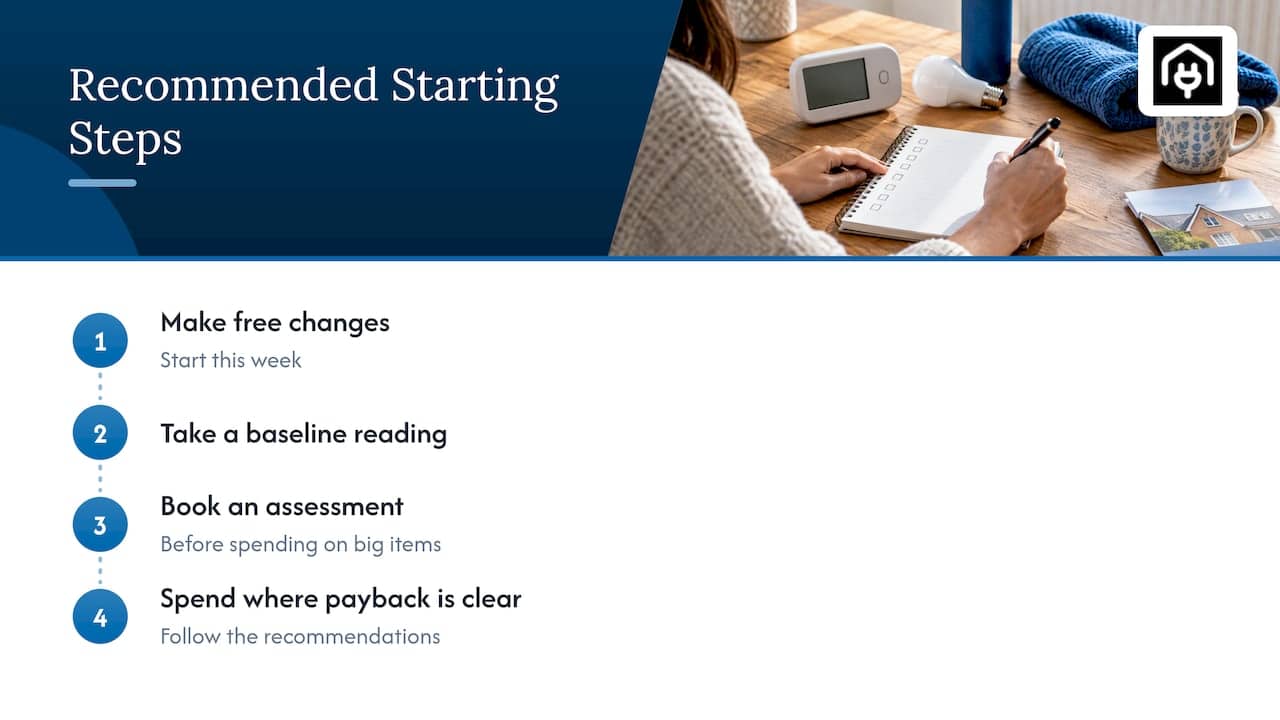
Our advice is to start with the free changes this week, take a baseline reading, and book the assessment before spending on big items. Spend money only where the recommendations show a clear payback. For more detail on cutting costs across fuels, see our guide to saving money on gas and electricity bills.
— Danny
Get a current EPC for your property
Homeowners, landlords and developers who want a reliable starting point can request a quote through Home Energy Model’s domestic EPC service. Commercial premises can use the commercial EPC service. The online form passes the request to a qualified assessor. Prices are not published on the site, so the quote sets out the cost for the specific property.
A sensible order of action
- This week: read the meter daily, find the standby loads, turn the thermostat down a degree, and shorten showers.
- This month: compare tariffs, using the unit rate and standing charge from the bill. Tenants who pay a landlord should ask for a switch.
- This quarter: draught-proof, fit LEDs in the most used rooms, and add a cylinder jacket if needed.
- This year: get an up-to-date EPC, then price the larger measures it lists, starting with loft and wall insulation.
- Next: consider a new heating system only after the fabric is improved.
For a wider overview, the guide on how to reduce home energy use goes into more detail on each step.
FAQ
What uses the most electricity in a home?
In homes with electric heating or an immersion heater, heating and hot water use the most. In homes with gas heating, the biggest electricity users are usually the fridge-freezer, the cooker, the washing machine and dryer, lighting, and standby devices. A smart meter display or a plug-in watt meter shows which ones dominate in a particular home.
Does turning off lights and standby devices really save money?
Yes, though the amounts are modest. The Energy Saving Trust estimates about £30 a year from turning off standby and about £35 from switching all bulbs to LEDs. Concentrate on the devices that draw the most, rather than unplugging everything.
Will a smart meter lower my bill?
Not by itself. Citizens Advice says a smart meter is a monitoring tool. It lowers bills only when the household uses the display to spot waste and change habits. It also gives accurate readings, so bills are not based on estimates.
Can renters reduce their electricity bill?
Yes. Renters can change habits, use LEDs, cut standby use and ask the landlord for improvements. If the landlord supplies the energy and passes on the cost, Citizens Advice advises asking them to switch tariffs. Renters who hold the account can switch supplier or tariff themselves. Check the tenancy agreement first.
How do I know which improvements are worth paying for?
Start with the EPC recommendations, which list the cost and expected saving for each measure. Do the cheapest, fastest-payback items first, such as draught-proofing and loft insulation. An assessor can update the certificate after the work is done so the new rating is on record.
Sources
- Ofgem: Energy price cap unit rates and standing charges
- Citizens Advice: Switch energy supplier or tariff
- Citizens Advice: Getting a smart meter installed
- Energy Saving Trust: Draught proofing
- Energy Saving Trust: Top ten energy saving tips
- Energy Saving Trust: Quick tips to save energy at home