
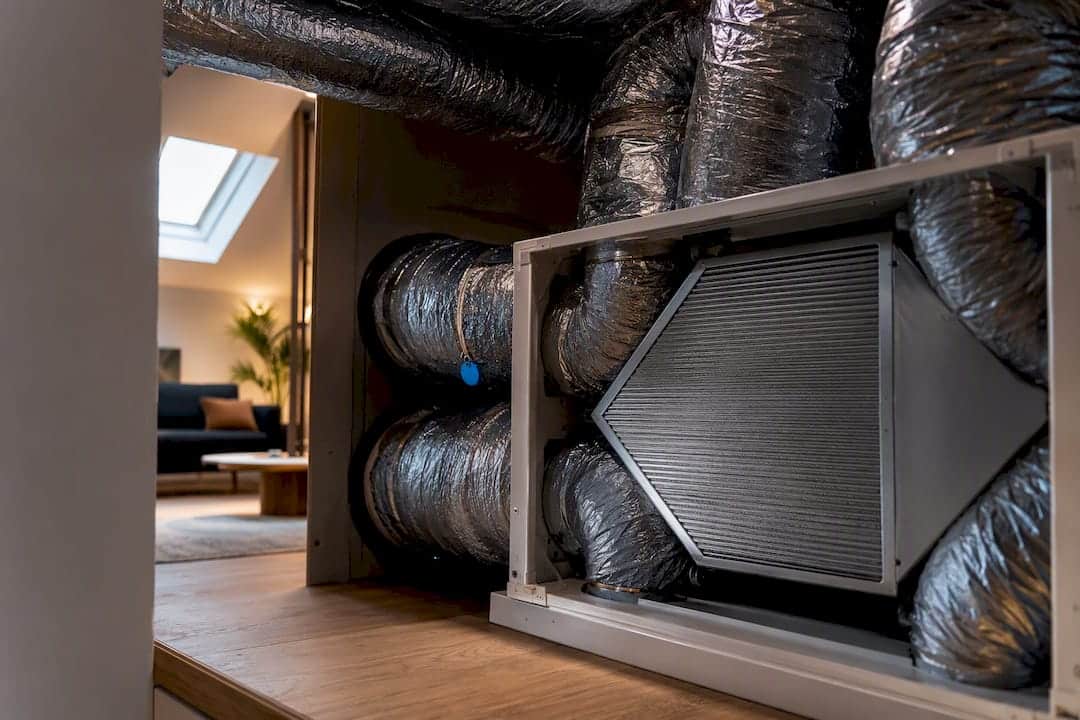
A heat recovery ventilator recovers heat from stale air leaving a property and uses it to pre-warm incoming fresh air, so the two never mix. A heat exchanger sits at the core of the system, typically recovering 80–90% of that heat in a well-commissioned installation. The result is continuous, filtered ventilation with far less of the heat loss that comes from opening windows or relying on extractor fans alone.
TL;DR:
- Proper installation and commissioning are crucial, as misbalanced airflow or incomplete setup can significantly reduce actual system efficiency below tested values.
- Duct leaks and uninsulated ducts are common issues that impair heat recovery performance and can introduce health risks by allowing unfiltered air and humidity to escape.
- In airtight homes, heat recovery ventilation typically recovers 80–90% of heat from stale air, but real-world inefficiencies often lower this figure.
- Selecting between HRV and ERV depends on humidity control needs; ERVs transfer moisture along with heat, offering better comfort in different seasons.
- Initial costs and ongoing maintenance, including filter changes and system checks, are essential considerations, especially when retrofitting into existing buildings.
Table of Contents
- How does a heat recovery ventilator work?
- What components make up a whole-house MVHR system?
- HRV or ERV: which type of exchanger fits your home?
- How efficient is a heat recovery ventilator really?
- What are the benefits and downsides of heat recovery ventilation?
- Why does commissioning make or break system performance?
- How do you operate an MVHR system through the seasons?
- What maintenance and running costs should you budget for?
- Should you install MVHR, or is an alternative more suitable?
- A publisher’s view on getting heat recovery right
- Where to read more on heat recovery ventilation
- Sources
- FAQ
How does a heat recovery ventilator work?
The system runs two separate air paths through the same box without letting them touch. Stale, moist air is pulled from wet rooms, typically kitchens, bathrooms, and utility rooms, and routed through a network of ducts back to a central unit. Fresh air is drawn in from outside at the same time. Both streams pass through a heat exchanger core, where warmth from the outgoing air transfers into the incoming air through thin separating walls, before the two are ducted off in opposite directions. The stale air, now cooled, is exhausted outside. The fresh air, now pre-warmed, is supplied to living rooms and bedrooms.
That separation is the entire point. Extract air often carries cooking odours, moisture, and pollutants, so it can never be allowed to blend with the supply air heading into bedrooms. A well-designed core keeps leakage between the two airstreams to a minimum, which is one of the technical benchmarks installers check during commissioning.
Most residential systems only recover sensible heat, meaning temperature alone. Warmer stale air raises the temperature of the cooler fresh air as it passes through the exchanger, but any moisture in the outgoing air is exhausted rather than transferred. Some exchangers go further and recover latent heat too, transferring a portion of the moisture content along with the temperature. That distinction becomes important later when weighing up HRV against ERV.
The physical exchanger core comes in a handful of common designs, and the type fitted affects both efficiency and how the unit handles condensation:
- Plate heat exchangers use stacked layers of thin material, usually plastic or aluminium, with air streams flowing past each other in a cross or counterflow pattern. These are the most common type in UK residential MVHR units.
- Thermal wheels rotate a heat storage matrix between the two airstreams, picking up warmth on one side and releasing it on the other. These recover some moisture as well as heat but need mechanical rotation, so they see more use in commercial installations.
- Heat pipe exchangers use a sealed refrigerant that evaporates and condenses to shuttle heat between the streams, with no moving parts in the core itself.
- Run-around coils connect two separate coils with a pumped fluid loop, useful where the extract and supply points are physically far apart and ducting them to a single core isn’t practical.
Decentralised, single-room units work differently again. Rather than a central exchanger, a small ceramic or metal core sits in a wall-mounted unit and alternates between extracting and supplying air in short cycles, storing heat during the extract phase and releasing it during supply. That design avoids the ductwork a whole-house system needs, but it also means each room’s unit works independently rather than as part of one balanced system, a trade-off worth understanding before choosing between the two. The core operating principle applies to both formats, though the practical experience of running each differs considerably.
What components make up a whole-house MVHR system?
The air handling unit itself is the visible box most homeowners associate with MVHR, but it’s really a small collection of parts working together rather than a single device. Inside, you’ll typically find the heat exchanger core, two fans (one drawing extract air in, one pushing supply air out), filters on both the incoming and outgoing airstreams, a control board, and a condensate drain to carry away the moisture that naturally forms when warm, humid air cools inside the exchanger.
That condensate path matters more than most people expect. Every core produces some condensation as extract air cools, and the unit needs a properly sloped drain running to a suitable outlet. A blocked or badly installed condensate line is a common, avoidable fault that can lead to water pooling inside the unit or dripping through ceilings below.
Where the unit sits vary by property type and is usually driven by practical space constraints:
- Loft installations are common in houses with accessible roof space, keeping the unit out of living areas but making routine filter changes a climb up a ladder.
- Utility rooms and airing cupboards suit properties without loft access, and they keep the unit within easy reach for maintenance.
- Dedicated plant rooms appear in larger new-build and Passivhaus-standard homes, often grouped with other services like a hot water cylinder.
Ductwork radiates out from the unit to ceiling or wall-mounted terminals in each room, insulated where it passes through unheated spaces to prevent heat loss and condensation forming on the duct itself. Terminal grilles are fitted with their own coarse filters in some designs, supplementing the main unit’s filtration and catching larger debris before it reaches the core. Access matters as much as design here. A unit tucked into an unreachable loft corner, with no boarded walkway and no clear light, tends to get neglected long before it fails outright.
HRV or ERV: which type of exchanger fits your home?
HRV (heat recovery ventilation) and ERV (energy or enthalpy recovery ventilation) both use a central exchanger, but they recover different things. An HRV system transfers sensible heat only: temperature moves from the outgoing air to the incoming air, while moisture is simply exhausted outside. An ERV system transfers both sensible heat and a portion of the moisture content, sometimes called total or enthalpy exchange, using a membrane core rather than a solid plate.
That moisture transfer changes how a home feels in different seasons. In winter, an ERV core returns some humidity to the incoming air rather than expelling it entirely, which can help prevent the uncomfortably dry indoor air that plain HRV systems sometimes produce in very airtight homes. In humid climates or during muggy summer spells, the same mechanism works in reverse, tempering how much outdoor moisture enters the building. CIBSE describes these total energy exchangers as a genuine alternative to sensible-only cores where moisture control is a specific design priority.
Neither approach is universally superior. HRV cores are simpler, cheaper, and easier to maintain, since there’s no membrane to degrade over time, but they do nothing to manage humidity. ERV cores add moisture control at the cost of a more complex, typically pricier core, and the membrane needs proper specification to avoid cross-contamination between airstreams.
Centralised whole-house systems and decentralised single-room units present a similar trade-off:
- Whole-house MVHR ducts every room from one central unit, giving balanced, coordinated airflow across the property but requiring full ductwork installation.
- Decentralised units install more cheaply since they skip ductwork entirely, making them a realistic retrofit option, but each device operates in isolation, which can complicate whole-house balance and sometimes introduces more noticeable noise per room.
How efficient is a heat recovery ventilator really?
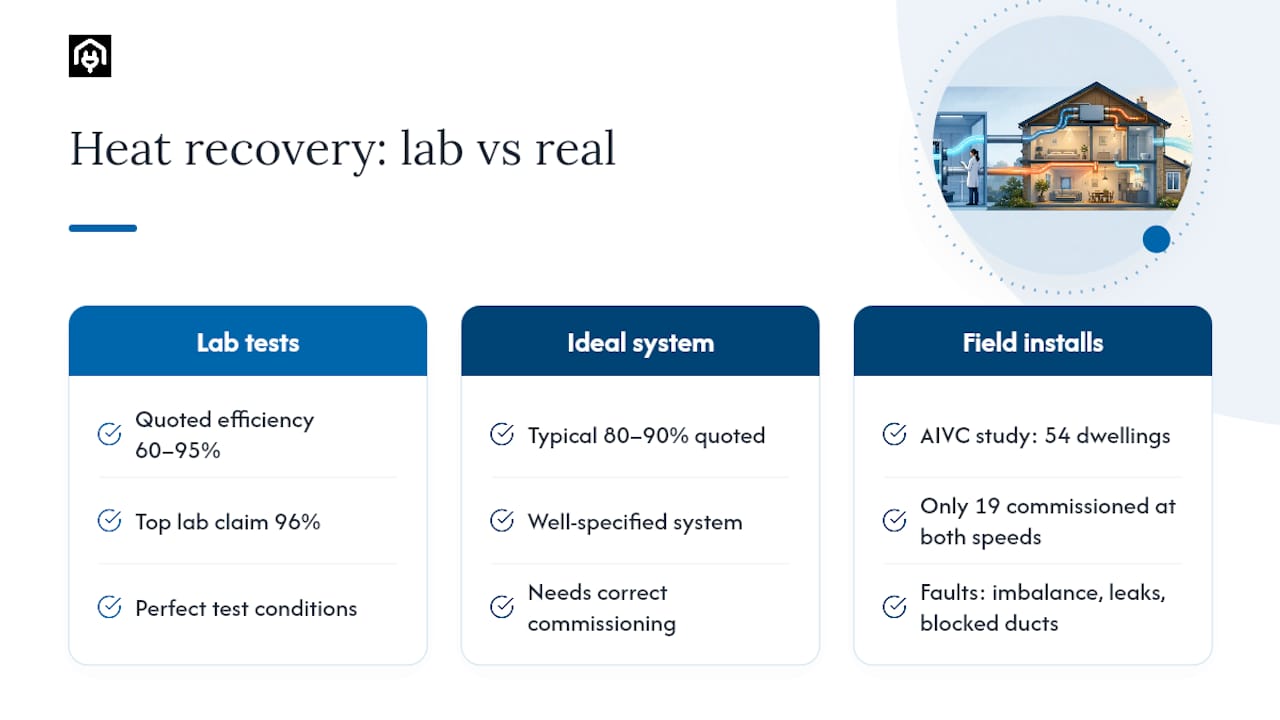
Manufacturers quote heat recovery efficiency figures ranging from 60% to 95%, with 80–90% typical for a well-specified system in ideal conditions. Some units tested under controlled lab conditions claim sensible recovery as high as 96%. Those figures describe the proportion of heat energy in the extract airstream that successfully transfers to the supply airstream inside the exchanger, not the overall reduction in a household’s heating bill.
The efficiency gap between lab tests and real homes is the single most important number most buyers never see. Manufacturer figures come from controlled test rigs with perfectly balanced flows, sealed ductwork, and no installation shortcuts. Real installations rarely match that standard.
Field research tells a less flattering story. An AIVC review of MVHR installations found that of 54 dwellings studied, only 19 systems had been commissioned properly at both normal and boost fan speeds. Imbalanced airflows, blocked ducts, and uninsulated ductwork were common faults across the sample. Every one of those problems drags the in-use efficiency below the number printed on the box, sometimes drastically.
Duct leaks compound the issue further — an overlooked problem that highlights why dirty ducts affect your health as well as system performance. Air escaping through poorly sealed joints before it reaches the exchanger core never gets the chance to exchange heat at all, regardless of how good the core itself is. An uninsulated duct running through a cold loft loses heat to the surroundings before that warmed air ever reaches a bedroom.
None of this means MVHR doesn’t deliver real savings in the right property. In an airtight, well-insulated home where the system is correctly commissioned, reduced ventilation heat loss is a genuine and measurable benefit rather than a marketing claim. The fans themselves draw a modest amount of electricity to run continuously, and that running cost needs weighing against the heating energy saved, but in a properly balanced system the heat recovered comfortably outweighs the electricity spent moving the air.
What are the benefits and downsides of heat recovery ventilation?
The case for MVHR in an airtight home rests on a simple mechanical fact: sealing a building against draughts also seals it against natural ventilation, and something has to replace the fresh air that used to leak in through gaps and cracks. Continuous, controlled ventilation is that replacement, and it brings several benefits beyond simply moving air:
- Consistent indoor air quality through continuous, filtered fresh air rather than the sporadic ventilation that trickle vents and open windows provide.
- Lower condensation and mould risk, since stale, moist air is constantly extracted rather than allowed to build up in bathrooms and kitchens.
- Reduced ventilation heat loss compared with extractor fans that simply vent warmed indoor air outside with nothing to replace it.
- Filtered supply air, which can meaningfully reduce pollen and outdoor pollutants reaching living spaces, particularly valuable for allergy sufferers.
The downsides are just as real and deserve equal weight. Upfront cost is significant, covering the unit itself, ductwork, and professional installation, and retrofitting ducts into an existing home is genuinely disruptive work involving ceiling access and sometimes structural alterations. Poorly specified or badly installed fans can introduce noticeable background noise, particularly at boost speed. Filters need regular attention, and a system left uncommissioned or unmaintained can underperform badly enough to negate most of its intended benefit, as the AIVC field data makes clear.
Mitigating these risks comes down to three practical steps: insist on proper commissioning with measured flow rates, choose a unit location that’s genuinely accessible for filter changes rather than the most convenient spot for the installer, and make sure whoever lives in the property receives a clear handover explaining what the system does and how to look after it. None of that costs much extra at the design stage, but it’s routinely skipped.
Why does commissioning make or break system performance?
Balanced airflow is the single technical requirement that separates a well-performing system from an underperforming one. If the extract fan pulls more air out than the supply fan pushes in, or vice versa, the building’s overall air pressure shifts, which can drive moist air into wall cavities or draw in unfiltered air through gaps rather than through the ventilation system itself. Passivhaus and wider industry guidance generally treat an imbalance of around 10% between supply and extract flows as the acceptable ceiling, and some designers deliberately bias extract slightly higher than supply, by around 5 to 10%, to maintain mild negative pressure and reduce the risk of moisture being pushed into the building fabric.
Field evidence shows how often that standard gets missed. The same AIVC review that found only 19 of 54 systems properly commissioned also documented recurring installation failings: partial commissioning that checked only one fan speed, ducts left uninsulated where they crossed cold spaces, physical blockages from debris or crushed flexible ducting, and fan speeds set incorrectly at handover and never revisited.
A practical commissioning checklist for installers should cover:
- Measure and record supply and extract flow rates at both normal and boost speeds.
- Confirm the imbalance between the two streams sits within the accepted tolerance.
- Inspect duct runs for insulation, physical damage, and secure joints.
- Check the condensate drain slopes correctly and runs to a suitable outlet.
- Test the summer bypass function operates and closes correctly.
- Provide a written handover document covering filter type, replacement interval, and basic controls.
Pro Tip: Ask your installer for the actual measured flow figures in writing, not just a verbal confirmation that “it’s been balanced”. A one-page commissioning sheet with numbers on it is the difference between a system that performs as advertised and one nobody can later prove was ever set up correctly.
Occupants benefit from their own short checklist too: know where the filters are, how often they need changing, what the boost switch in the kitchen or bathroom actually does, and who to call if the unit starts making an unfamiliar noise.
How do you operate an MVHR system through the seasons?
A correctly specified system runs continuously at a low background speed, drawing in filtered fresh air and extracting stale air around the clock rather than switching on and off. That continuous operation is what delivers consistent indoor air quality, and turning the unit off to save electricity defeats much of its purpose.
Boost mode exists for exactly the moments continuous background ventilation can’t handle: cooking, showering, or any burst of moisture and odour that needs clearing quickly. Most systems trigger boost automatically via a humidity sensor, or manually through a wall switch in the kitchen or bathroom, and it typically runs for a set period before dropping back to normal speed.
Summer bypass is where the system adapts to warmer weather. When outdoor temperatures rise above indoor temperatures, the bypass mechanically routes air around the heat exchanger core rather than through it, so the unit stops pre-warming incoming air that’s already warmer than the house needs. This is a ventilation adjustment, not a cooling system. It stops the unit making a warm day worse, but it won’t cool a house down the way air conditioning does, and treating it as a substitute for shading or night-time ventilation is a common misunderstanding.
Day-to-day operation and maintenance decisions worth knowing:
- Humidity sensors trigger automatic boost when bathroom or kitchen moisture spikes, reducing reliance on occupants remembering to switch modes manually.
- CO2 sensors, more common in higher-specification systems, adjust ventilation rates based on occupancy and air quality rather than a fixed schedule.
- Noise complaints usually trace back to fan speed set too high for the ducting, or a unit mounted without adequate acoustic isolation from structural elements.
- Filters need checking on a schedule rather than waiting for a visible problem, since reduced airflow from a clogged filter isn’t always obvious to occupants.
A correctly specified bypass and demand control setup noticeably improves comfort and reduces the temptation for occupants to simply switch the whole system off, which is exactly the outcome good design should avoid.
What maintenance and running costs should you budget for?
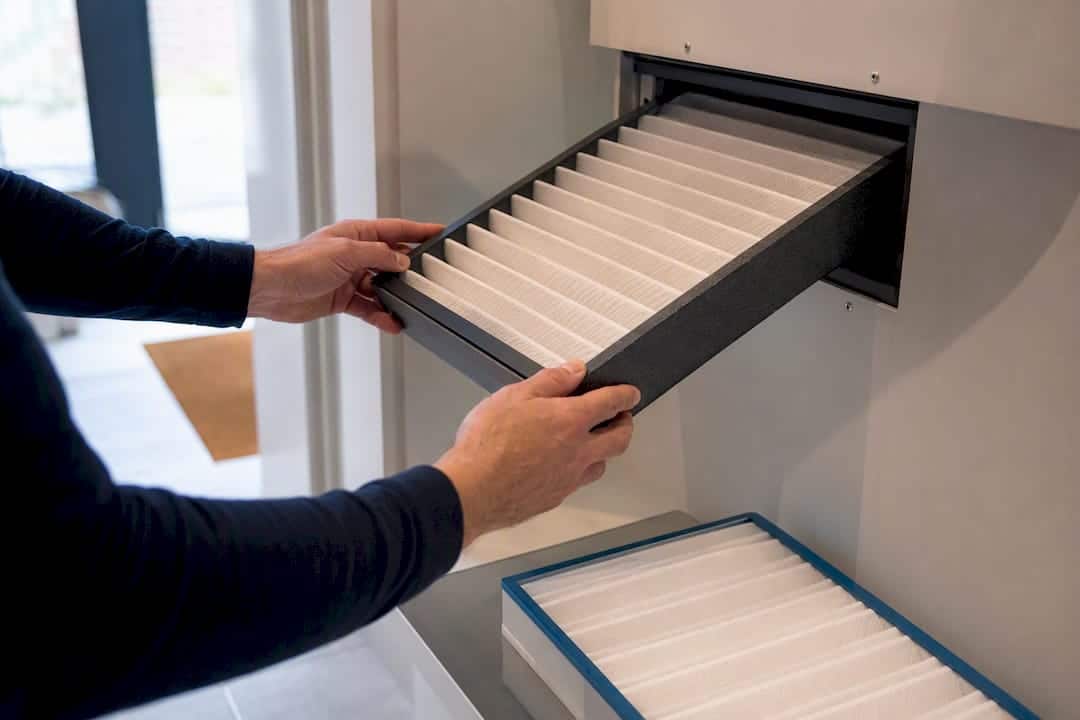
Routine maintenance for MVHR is modest compared with most mechanical building services, but skipping it undermines performance faster than most owners expect. Filters typically need replacing every three to six months, though the exact interval depends on the unit and local air quality, with a full service and duct inspection recommended annually. The heat exchanger core itself benefits from occasional cleaning, generally every few years, and ducts should be checked periodically for blockages or damage, particularly after any building work nearby.
Fan electricity draw is small on a per-hour basis, but the unit runs continuously, so it adds up over a year. In a properly commissioned, well-insulated home, the heating energy saved through recovered heat generally outweighs the electricity the fans consume, though the exact balance depends on climate, building airtightness, and how well the system was installed in the first place.
Ongoing responsibilities to plan for:
- Filter replacement every three to six months, depending on the unit and local air conditions.
- Annual servicing to check fan performance, condensate drainage, and duct integrity.
- Core cleaning every few years to remove dust build-up that gradually reduces exchange efficiency.
- Clear documentation at handover, particularly in rented properties, so tenants and landlords both know who is responsible for filter changes and servicing.
That last point matters more than it might seem. Occupant handover and an accessible maintenance plan are essential, since MVHR is not a fit-and-forget system, and landlords who fail to clarify maintenance responsibility often end up with a unit nobody has serviced in years.
Should you install MVHR, or is an alternative more suitable?
MVHR earns its keep in airtight new-build and deep-retrofit properties, where the building envelope is sealed tightly enough that natural infiltration can no longer provide adequate fresh air on its own. In that context, a whole-house system with a well-commissioned exchanger genuinely reduces ventilation heat loss while maintaining good indoor air quality throughout the year.
Older, leakier housing stock tells a different story. Retrofitting MVHR into a draughty Victorian terrace before dealing with the building’s fabric often delivers a poor return, since background air leakage undermines the balanced ventilation the system depends on, and the ducting itself can be difficult to route through solid walls and shallow ceiling voids.
Alternative approaches suit different situations:
- Positive Input Ventilation (PIV) supplies filtered air from a loft-mounted unit into the hallway, gently pressurising the home to push out stale air through existing gaps, a simpler retrofit for leakier properties.
- Decentralised mechanical extract ventilation (dMEV) replaces individual bathroom and kitchen extractor fans with continuously running low-speed units, a modest upgrade over intermittent fans.
- Trickle vents paired with extractor fans remain the baseline approach in many existing homes, relying on background infiltration that airtight new builds are specifically designed to eliminate.
The sequencing matters as much as the choice itself. Fabric-first improvements, insulation, draught-proofing, and airtightness detailing, should generally come before considering MVHR in an existing home. Installing a heat recovery system into a building that still leaks air freely through the fabric means paying for ductwork and a heat exchanger that never gets the chance to do its job properly. Comparing whole-house ventilation strategies against your property’s actual airtightness is worth doing before committing to any single approach.
A publisher’s view on getting heat recovery right
The technical explanations above matter less than one practical truth: design and commissioning decide whether a heat recovery ventilator delivers what the brochure promises. A system specified correctly but installed carelessly will still underperform, and the field evidence on commissioning failures bears that out repeatedly. Homeowners researching MVHR should note that a badly balanced or partially commissioned system can significantly reduce expected performance.
This platform exists to help property owners and professionals cut through the gap between specification and reality. If you’re weighing up ventilation strategy alongside a wider Home Energy Model assessment or an EPC review, our guide to Home Energy Model services sets out how tailored assessments work. Start with an initial suitability check against your property’s airtightness, insist on a documented commissioning checklist, and put a maintenance plan in writing before anyone moves in.
— Danny
Where to read more on heat recovery ventilation
Readers wanting the primary sources behind the figures and guidance in this article can go directly to the following:
- The Centre for Sustainable Energy’s guidance on MVHR gives consumer-facing advice on how systems work and typical efficiency ranges.
- The AIVC meta-study on in-use MVHR performance provides the field evidence behind commissioning failure rates cited throughout this piece.
- BEAMA’s GPG268 guidance sets out industry standards for heat exchange efficiency and airflow balance.
- CIBSE’s Module 141 covers summer bypass strategies and total energy exchange in technical depth.
- The U.S. Department of Energy’s ventilation overview offers additional background on ventilation’s role in energy-efficient buildings.
Sources
- Mechanical ventilation with heat recovery
- AIVC meta-study on in-use performance of MVHR systems
- GPG268 guidance on heat recovery units
- Module 141: MVHR for energy-efficient ventilation and summer cooling – CIBSE Journal
FAQ
How does heat recovery ventilation work?
A central heat exchanger transfers warmth from stale, extracted indoor air into cooler incoming fresh air, keeping the two airstreams physically separate throughout the process. The warmed fresh air is then supplied to living rooms and bedrooms while the cooled stale air is exhausted outside.
Does an HRV use a lot of electricity?
The fans run continuously, so they draw power around the clock, but the draw per hour is modest. In a properly commissioned, airtight home, the heating energy recovered typically outweighs the electricity the fans consume, though the exact balance depends on the building and installation quality.
Can you open windows with MVHR installed?
Yes, opening windows occasionally causes no harm, but doing so regularly undermines the point of the system by letting conditioned, filtered air escape and unfiltered outdoor air in. MVHR is designed to provide continuous ventilation without needing windows open at all.
What are the downsides of using a heat recovery system?
The main drawbacks are upfront installation cost, disruption during retrofit ductwork fitting, potential fan noise if poorly specified, and the real risk of underperformance if the system isn’t properly commissioned. Field studies found only 19 of 54 systems reviewed had been commissioned correctly at both normal and boost speeds.
What’s the difference between HRV and ERV?
HRV transfers sensible heat (temperature) only, while ERV also transfers a portion of moisture content through an enthalpy exchange membrane. ERV can help manage humidity in both winter and summer, but its core is generally more complex and costly than a standard HRV plate exchanger.