
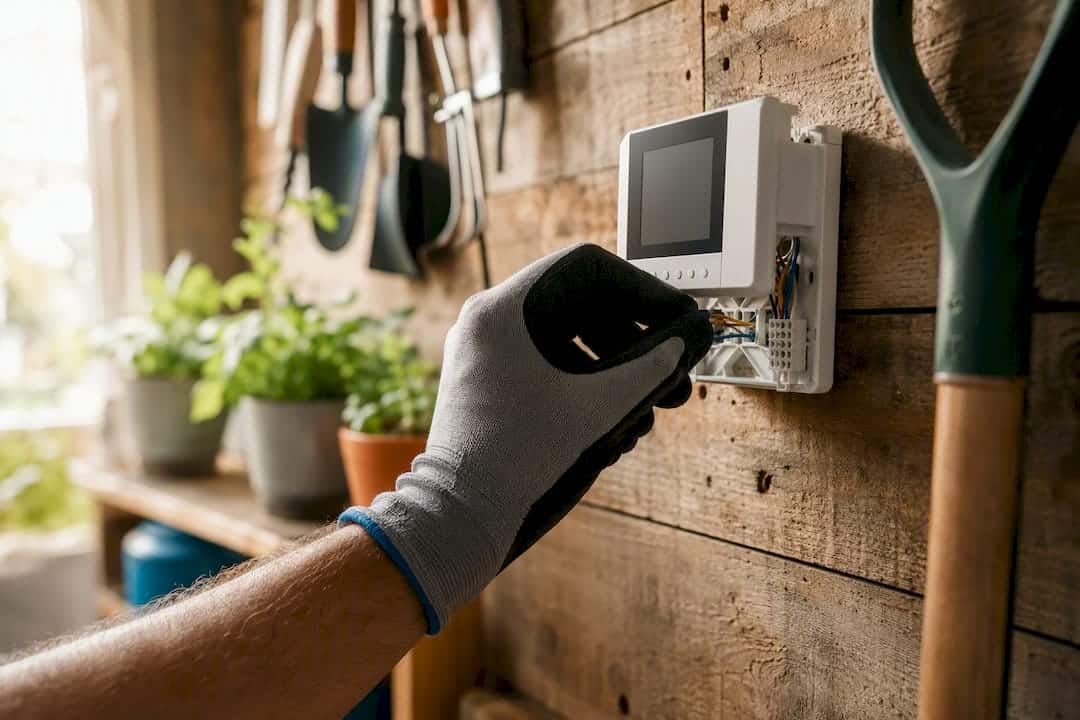
Installing a smart thermostat will not usually change a property’s headline EPC rating on its own. What it can do is generate the evidence an assessor needs to model controls accurately under the Home Energy Model (HEM), and it may eventually feed into a smart-readiness metric that sits alongside, rather than inside, the EPC band. The Ofgem Smart Systems and Flexibility Plan frames this as a capability question, not a guaranteed-savings one.
For anyone briefing an installer or an assessor this week, three things matter more than the thermostat’s brand or app:
- Record the device’s capabilities and any wiring or zoning evidence before the installer leaves site.
- Capture the actual schedule in use, plus any integration with solar PV, a battery, or an EV charger.
- Hand this evidence to the assessor rather than assuming the device will be recognised automatically.
Do that, and the installation stands a real chance of being credited properly under HEM, whatever an EPC assessment later decides about the headline band.
Key Takeaways
A smart thermostat rarely moves a headline EPC band on its own, but the schedule, wiring, and integration evidence collected during installation determines how well HEM can model its real value.
| Point | Details |
|---|---|
| EPC impact is usually minimal | A property with existing controls typically gets the same credit for a smart thermostat as for a standard wired one. |
| Evidence drives HEM accuracy | Schedules, advanced-start settings, and integration proof let assessors map devices to HEM control objects properly. |
| TRVs still matter | Keep TRVs functioning and documented even after a central smart thermostat is installed. |
| Smart-readiness is separate from EPC bands | Future metrics are expected to measure capability and integration, not guaranteed savings. |
| Homeenergymodel supports the evidence process | Homeenergymodel offers EPC assessments, HEM reports, and checklists to help landlords compile installation evidence properly. |
Table of Contents
- Ecobee installation guide basics: what an assessor actually needs
- How should assessors record and model a smart thermostat?
- Will a smart thermostat change my EPC rating?
- Installation practices that protect your evidence trail
- What does installation typically cost and take?
- What should landlords and assessors realistically expect?
- Getting your smart thermostat properly assessed
- Frequently asked questions
- Sources
Ecobee installation guide basics: what an assessor actually needs
Anyone searching for an ecobee installation guide from a compliance angle is really asking one question: what evidence turns a smart thermostat into something an assessor can use? The answer lies in how HEM structures its inputs, not in the device’s marketing sheet.
HEM models buildings in half-hourly steps rather than the monthly averages SAP used, which matters because smart controls behave differently hour to hour, not month to month. A thermostat that pre-heats a house at 6am on weekdays and stays off all weekend simply cannot be represented properly in a monthly model. HEM can represent it, provided someone records what it actually does.
The features that map cleanly onto HEM inputs include:
- Schedules and programmable setpoints — the core control object HEM references for every timestep.
- Advanced start or pre-heat — the system calculating when to switch on based on target time and outdoor conditions.
- Occupancy detection or learning behaviour — relevant where it changes setpoints, not just where it exists.
- Time-of-use or price response — how the device shifts load away from peak tariff periods.
- Integration with PV, battery storage, or an EV charger — HEM’s ChargeControl and SmartHotWaterTank objects support predictive and scheduled charging behaviour.
- TRV and zoning capability — whether the thermostat controls the whole system or sits alongside independent room-by-room controls.
The EPC wrapper being built around HEM will simplify much of this for existing dwellings, largely because most assessments will not have device logs to hand. Where evidence exists, though, HEM’s finer resolution gives it somewhere to go.
Pro Tip: If a property has both a central smart thermostat and TRVs on individual radiators, don’t let the assessor assume single-zone control. Photograph every TRV setting and note explicitly that zones are independently controlled, otherwise the model may default to treating the whole house as one thermostat zone.
How should assessors record and model a smart thermostat?
Evidence collection is where most smart thermostat installations lose their value on paper, even when the installation itself is faultless. An assessor working from a site visit alone, with no logs or export files, has little choice but to fall back on conservative defaults.
A practical evidence checklist for landlords, installers, or the assessor themselves:
- Photograph the thermostat, its wiring, and any wall-mounted sensors.
- Photograph every TRV location and its current setting.
- Request a schedule export or app screenshot showing the weekday and weekend programme.
- Note any advanced-start or predictive charging feature and whether it is switched on.
- Collect proof of PV, battery, or EV charger integration if the system is linked to one.
- Keep a simple wiring diagram, especially where the thermostat replaced an older wired programmer.
Converting a device schedule into HEM inputs is more straightforward than it sounds. A typical weekday schedule of 18°C from 6am to 8am, setback to 16°C during the day, then 20°C from 5pm to 10pm, translates into a series of numeric setpoints against half-hourly Control objects. Advanced-start behaviour, where the system brings the house to temperature before 6am based on outdoor conditions, needs a separate note, since it affects when heating demand actually begins rather than the setpoint itself.
Where detailed evidence is missing, the EPC wrapper is expected to fall back on simplified, conservative assumptions rather than crediting undocumented smart behaviour. Assessors are better served asking for device logs upfront than trying to reconstruct behaviour after the fact.
HEM’s heat-balance calculation method iterates through each timestep to work out unmet demand, so the setpoints and schedule entered genuinely do drive the outcome, unlike SAP’s cruder seasonal assumptions.
Will a smart thermostat change my EPC rating?
Expectations matter here, because most homeowners assume installing anything labelled “smart” moves the EPC needle. It rarely does, at least not on its own.
- Minimal change — if the property already has a programmer, room thermostat, and TRVs, a smart thermostat typically gets the same EPC credit as standard wired controls. The controls box was already ticked.
- Modest gain — if the property previously lacked a room thermostat or TRVs entirely, installing a smart thermostat that fills that gap can improve the SAP-style controls score, because it is replacing an absence, not upgrading an adequacy.
- Behavioural benefit without EPC gain — learning modes, eco setbacks, and occupancy-based adjustments can cut real energy bills without adding SAP points, because the EPC framework does not currently reward behavioural savings it cannot verify.
Each outcome follows directly from how the controls methodology scores presence rather than sophistication. A future smart-readiness metric is expected to measure capability, such as whether smart meters, PV, storage, and heating controls are present and communicating with each other, rather than promising specific savings. That metric sits separately from the headline EPC band.
Pro Tip: Never quote a client or tenant a specific carbon or cost saving from time-of-use shifting unless there’s demonstrable integration with a battery or a price-responsive tariff. HEM can model the capability; it cannot verify that a household actually uses it that way.
Installation practices that protect your evidence trail
The physical installation choices made on the day affect how credible the paperwork looks months later, when an assessor turns up.
Get these right during commissioning:
- Site the thermostat away from direct sunlight, draughts, and heat sources that would skew its readings.
- Decide wired versus wireless deliberately. A wired connection to the boiler or heat source is usually more reliable for HEM evidence than a wireless bridge with no clear commissioning log.
- Leave TRVs in place and functioning. A smart thermostat is not a substitute for zone control on individual radiators.
- Label wiring at the back of the unit and sketch a basic wiring diagram, particularly where an old programmer is being replaced. The A-z is a useful reference for anyone unfamiliar with retrofitting smart controls into older wiring runs.
- Confirm interoperability with any existing PV or battery system before calling the job finished.
Pro Tip: For landlords managing multiple tenancies, standardise the default schedule across properties and document it in the tenancy handover pack. It gives every new tenant a sensible starting point and gives the next assessor a clean baseline to work from, rather than whatever setpoints the previous tenant left behind.
Commissioning is not complete until advanced-start, occupancy detection, and any time-of-use response have been tested and screenshotted. An installer who hands over a working device without proof it was tested is leaving the landlord to gather evidence retroactively, which is far harder.
What does installation typically cost and take?
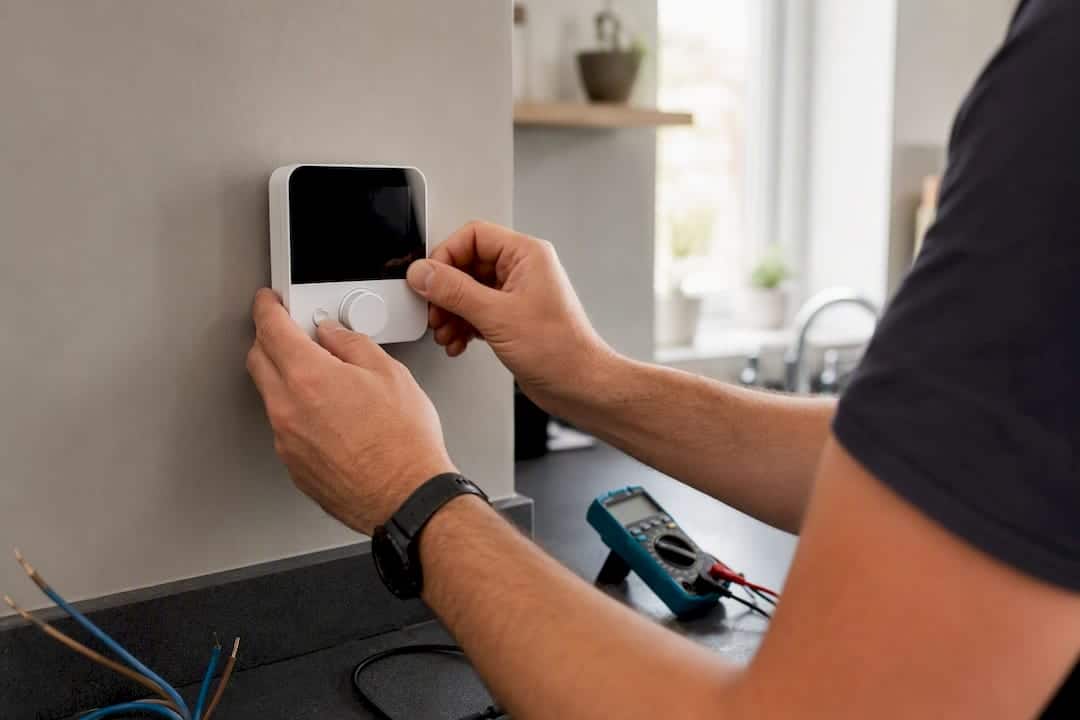
Installation time and cost vary with how much rewiring is needed, how many zones exist, and whether the thermostat needs to talk to PV or battery storage. Simple single-zone replacements usually take less time, while multi-zone properties or systems requiring integration with storage or an EV charger take longer.
Keep a single evidence pack, ideally as one dated PDF, containing:
- The installation invoice and product specification sheet.
- Photographs of the finished installation and any wiring changes.
- A schedule or logs export showing the programme in use.
- Proof of PV, battery, or EV charger integration where applicable.
- A note of any tenant-adjusted settings that might affect measured performance later.
This pack is what turns a good installation into evidence an assessor can actually use.
What should landlords and assessors realistically expect?
HEM improves how smart systems get modelled, but the EPC wrapper for existing homes will likely lean on simplified assumptions unless solid evidence is presented. Good documentation earns credit; marketing claims about “AI learning” or “smart savings” do not.
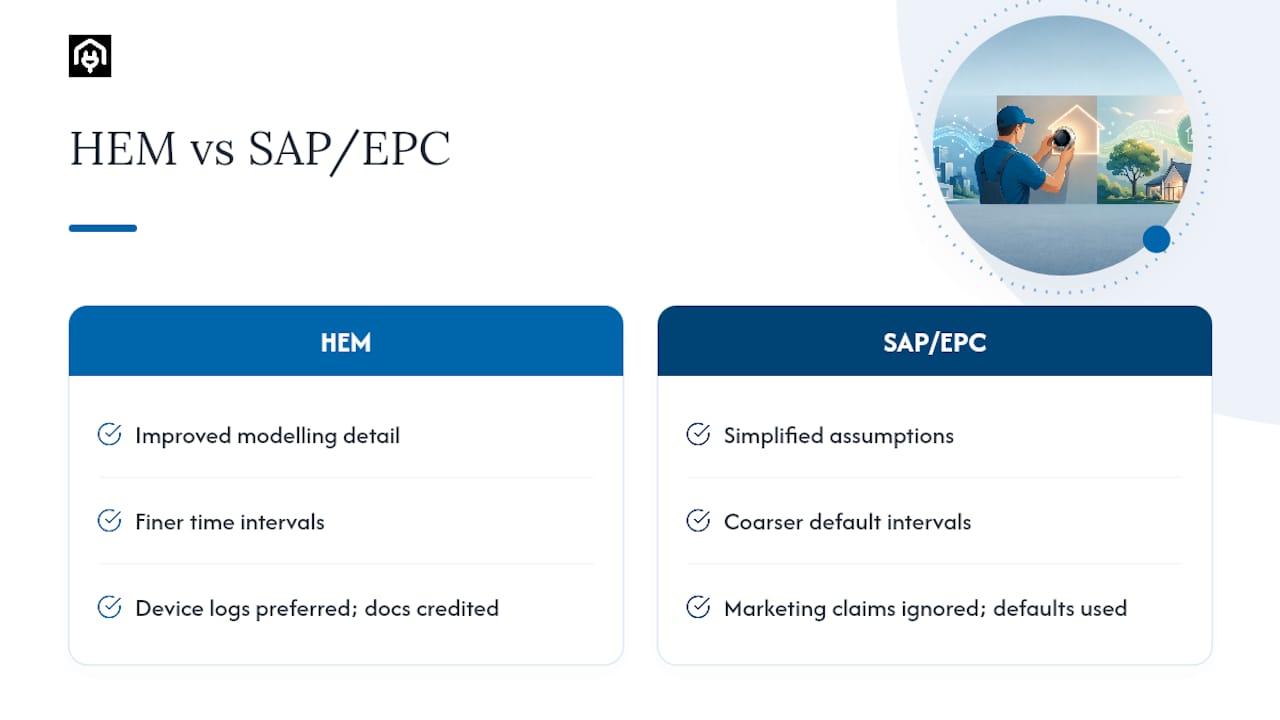
Assessors should ask for device logs first and only fall back to conservative defaults when logs genuinely do not exist.
Getting your smart thermostat properly assessed
A smart thermostat installation deserves a proper assessment, not a guess dressed up as an EPC. Homeenergymodel gives landlords and assessors a way to get that evidence turned into a defensible HEM or EPC report, rather than leaving controls credit to chance on assessment day. The site’s services cover domestic EPC assessments, HEM reports, and downloadable checklists built around exactly the evidence categories covered above, wiring, schedules, zoning, and integration proof.
Landlords preparing for a portfolio-wide assessment round can also read the full explanation of how HEM will affect UK properties before booking. If a smart thermostat installation is already done and the evidence pack is ready, the sensible next step is requesting a quote for an EPC or HEM assessment and handing the assessor everything gathered on-site.
Frequently asked questions
Does installing a smart thermostat automatically improve my EPC rating?
No. If a property already has a programmer, room thermostat, and TRVs, a smart thermostat usually receives the same EPC credit as those existing controls. Gains typically only appear where the smart device replaces a genuine gap in controls.
What evidence should I give my energy assessor after installation?
Provide photographs of the installation and TRVs, a schedule export or app screenshot, the product specification sheet, and proof of any integration with solar PV, a battery, or an EV charger.
Why does HEM matter more than SAP for smart thermostats?
HEM runs half-hourly simulations rather than SAP’s monthly averages, so it can represent schedules, advanced-start behaviour, and time-of-use responses far more accurately, provided the evidence exists to support the model.
Will a smart-readiness metric replace my EPC band?
No. It is expected to sit alongside the EPC as a separate measure of smart system capability and integration, not as a replacement for the headline rating.
Do I still need TRVs if I install a central smart thermostat?
Yes. TRVs provide room-by-room control that a single central thermostat cannot replicate, and assessors need evidence that both systems are working together rather than assuming one replaces the other.
Sources
Assessors new to HEM should start with the HEM technical documentation library, specifically HEM-TP-17 on controls, before reading the wider consultation on the EPC wrapper.
- Home Energy Model consultation (full PDF) – GOV.UK
- Heating controls upgrade: TRVs, thermostats & EPC points (EPCFix blog)