

Nearly 6 million british households receive vital help with energy costs thanks to the Warm Home Discount Scheme. For landlords, understanding this programme is more than a box-ticking exercise. Getting to grips with eligibility and supplier rules can make a direct difference for tenants during winter. This guide reveals how property owners can support residents financially while staying on top of energy efficiency obligations.
Table of Contents
- What Is The Warm Home Discount Scheme
- Eligibility Criteria For Landlords And Tenants
- How The Discount Works For Energy Bills
- Energy Supplier Obligations And Deadlines
- Impacts On Rental Property Compliance
Key Takeaways
| Point | Details |
|---|---|
| Support for Vulnerable Households | The Warm Home Discount Scheme provides a £150 discount on electricity bills for eligible low-income and vulnerable households in the UK. |
| Eligibility Focus | Eligibility primarily depends on the energy account holder’s circumstances, including benefits received and account registration by specified dates. |
| Energy Supplier Responsibilities | Energy suppliers must apply discounts by the end of March each year and notify eligible customers within a defined timeline. |
| Impact on Landlords | Landlords must ensure tenants understand their eligibility and assist them in navigating the application process to benefit from the scheme. |
What Is the Warm Home Discount Scheme
The Warm Home Discount Scheme represents a critical UK government initiative designed to support low-income and vulnerable households by providing financial relief on energy bills. Established to combat fuel poverty, this programme offers eligible households a one-off £150 discount on their electricity costs, effectively reducing winter energy expenditure for those most in need.
Operating under a structured framework, the scheme mandates energy suppliers with over 1,000 domestic customers to provide annual bill discounts, ensuring widespread support across the United Kingdom. The programme encompasses three primary elements: Core Group 1 targeting Pension Credit recipients, Core Group 2 supporting low-income customers with high energy expenses, and Industry Initiatives offering broader assistance.
For landlords managing residential properties, understanding the Warm Home Discount Scheme is crucial. The programme supports approximately 6 million households annually, with specific eligibility criteria determining who receives the discount. Importantly, the scheme does not apply in Northern Ireland, which operates a separate Affordable Warmth programme. Landlords should be aware that tenants receiving certain benefits or meeting specific income thresholds might qualify for this valuable energy bill reduction.
Here is a summary of the Warm Home Discount Scheme’s main groups and their characteristics:
| Group Name | Primary Recipients | Application Process | Key Benefit |
|---|---|---|---|
| Core Group 1 | Pension Credit Guarantee Credit | Automatic via supplier | £150 electricity discount |
| Core Group 2 | Low-income, high energy costs | May require application | £150 energy cost relief |
| Industry Initiatives | Vulnerable/at-risk groups | Varies by initiative | Broader energy support |
Pro tip: Proactively communicate with tenants about the Warm Home Discount Scheme to help them understand their potential eligibility and navigate the application process effectively.
Eligibility Criteria for Landlords and Tenants
The Warm Home Discount Scheme eligibility is nuanced, focusing primarily on the energy account holder’s circumstances rather than the landlord’s status. Domestic customers must meet specific qualifying criteria to receive the £150 energy bill discount, with key considerations determining potential participation.
Eligibility fundamentally depends on three primary factors: being a customer of a participating energy supplier, receiving specific means-tested benefits, and having the energy bill registered in the tenant’s name by critical qualifying dates. Tenants receiving Universal Credit, Pension Credit Guarantee Credit, or other qualifying benefits may be eligible. Crucially, landlords must ensure their tenants understand these requirements, as the discount is linked directly to the energy account holder, not the property ownership.
The scheme’s structure includes different groups with varying eligibility pathways. Core Group 1 typically covers Pension Credit Guarantee Credit recipients, while Core Group 2 supports low-income households meeting specific financial thresholds. Each energy supplier may have slightly different application processes, so landlords should encourage tenants to verify their precise eligibility with their specific energy provider.
Pro tip: Maintain open communication with tenants about their energy bill arrangements and potential Warm Home Discount eligibility to help them maximise financial support opportunities.
How the Discount Works for Energy Bills
The Warm Home Discount operates through a straightforward mechanism designed to directly reduce energy expenses for eligible households. Energy suppliers apply a £150 credit to electricity accounts during the winter period, typically between October and March, providing critical financial relief for low-income and vulnerable customers.

For households with different energy arrangements, the discount application varies. Customers on standard electricity accounts receive the credit directly applied to their bill, while those using prepayment meters receive vouchers or meter credits. Dual-fuel tariff customers might see the discount applied to their gas bill, offering additional flexibility in managing winter energy costs. Importantly, this discount does not count as income and does not impact other winter-related benefits such as the Winter Fuel Payment or Cold Weather Payment.
The following table outlines how different energy account setups affect the discount application:
| Account Type | How Discount is Applied | Landlord Consideration |
|---|---|---|
| Standard Electricity | Credit on electricity bill | Ensure tenant holds the account |
| Prepayment Meter | Vouchers or meter credit | Inform tenants about voucher use |
| Dual Fuel Tariff | May apply to gas or electric | Clarify discount allocation |
The application process differs between Core Group 1 (Pension Credit Guarantee Credit recipients) and Core Group 2 (low-income households). Eligible customers are typically contacted automatically by their energy supplier, with the discount applied without requiring a separate application. Energy bills reveal crucial details about how the discount is implemented, making it essential for landlords to encourage tenants to review their statements carefully.
Pro tip: Advise tenants to contact their energy supplier directly if they believe they qualify for the Warm Home Discount but have not received automatic communication.
Energy Supplier Obligations and Deadlines
Energy suppliers play a crucial role in implementing the Warm Home Discount Scheme, with specific legal responsibilities that directly impact landlords and tenants. UK energy suppliers with over 1,000 domestic customers are legally mandated to participate in the annual discount programme, ensuring widespread support for vulnerable households.
The timeline for the Warm Home Discount Scheme is strictly regulated, with key deadlines that both suppliers and customers must navigate. Suppliers are required to apply discounts by the end of March each year, typically notifying potential recipients between October and January. These notifications are critical, as they often include specific response deadlines, usually falling in late winter around 28 February. Different application processes exist for Core Group 1 (automatic eligibility) and Core Group 2 (requiring additional application), adding complexity to the scheme’s implementation.
Energy tariffs and supplier obligations create a structured approach to delivering the discount. Suppliers must verify customer eligibility, manage applications for those not automatically included, and ensure timely distribution of the £150 credit. This includes special provisions for customers with prepayment meters, who may receive vouchers or direct meter credits instead of bill reductions.
Pro tip: Create a tracking system to monitor your tenants’ Warm Home Discount communications and help them meet critical application deadlines.
Impacts on Rental Property Compliance
Rental property compliance intersects critically with the Warm Home Discount Scheme, creating nuanced challenges for landlords managing energy-related responsibilities. The scheme directly influences how landlords must structure billing arrangements and support tenant energy cost reductions, particularly in private rental sectors.
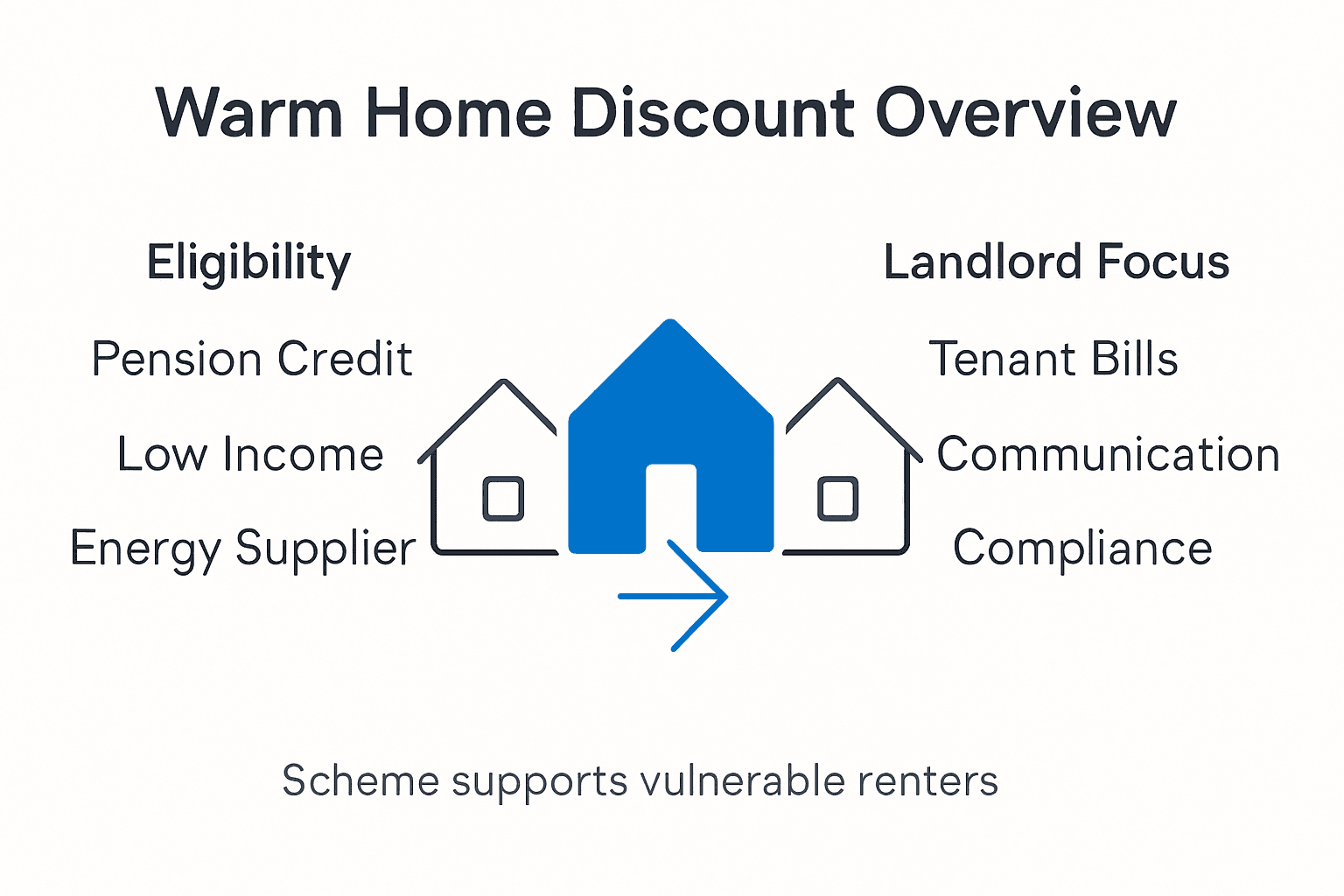
Landlords must carefully navigate the scheme’s implications for Energy Performance Certificates (EPCs) and tenant billing arrangements. The primary compliance requirement involves ensuring that energy accounts are correctly set up, with the billholder being an eligible tenant who can access the Warm Home Discount. This might necessitate adjusting rental agreements to facilitate clear communication about energy account responsibilities and potential discounts.
Energy conservation strategies become increasingly important as the Warm Home Discount indirectly supports broader regulatory frameworks addressing housing standards and fuel poverty. The scheme encourages landlords to consider energy efficiency improvements, as properties with better energy performance may help tenants more easily qualify for financial support and reduce overall energy costs.
Pro tip: Develop a proactive communication strategy with tenants that explains the Warm Home Discount eligibility requirements and helps them navigate the application process.
Support Your Tenants and Stay Compliant with Expert Energy Insights
Navigating the complexities of the Warm Home Discount Scheme can be a challenge for UK landlords aiming to support vulnerable tenants while ensuring rental property compliance. Key issues include managing energy account arrangements, understanding eligibility criteria like Pension Credit Guarantee Credit, and handling supplier deadlines—all crucial to maximising financial relief for tenants and meeting your obligations. With rising energy costs, landlords face pressure to improve property energy performance and communicate effectively with tenants about discounts that could save them hundreds of pounds.
At homeenergymodel.co.uk, we provide clear guidance on upcoming energy regulations and tools like the Home Energy Model (HEM) that will revolutionise how EPCs and building performance are assessed in 2025. Our insights help landlords align with the Future Homes Standard while supporting tenants through schemes like the Warm Home Discount. Discover practical advice on energy conservation, billing strategies, and the latest government initiatives designed to enhance property energy efficiency and reduce fuel poverty.
Don’t wait for rising energy bills to disrupt your rental business. Visit homeenergymodel.co.uk now to empower your property management approach. Learn more about the energy bills UK explained and the impact of energy tariffs UK landlords face so you can take informed steps today.
Frequently Asked Questions
What is the Warm Home Discount Scheme?
The Warm Home Discount Scheme is a UK government initiative that provides eligible low-income and vulnerable households with a one-off £150 discount on their electricity bills to alleviate fuel poverty, especially during winter.
Who is eligible for the Warm Home Discount discount?
Eligibility primarily depends on whether the energy account holder receives specific means-tested benefits, such as Pension Credit or Universal Credit, and whether they are a customer of a participating energy supplier. Tenants must have the energy bill registered in their name by critical qualifying dates.
How does the Warm Home Discount get applied to energy bills?
Eligible households receive a £150 credit on their electricity account during the winter months, typically between October and March. The application method varies; customers on standard electricity accounts get the discount applied directly, while prepayment meter customers may receive vouchers or meter credits.
What are the responsibilities of energy suppliers in the Warm Home Discount Scheme?
Energy suppliers with over 1,000 domestic customers are legally required to participate in the Warm Home Discount Scheme. They must apply the discount by the end of March, notify eligible recipients, and manage applications for those who need to apply separately.