

A mini split heat pump is a ductless, reversible air-source heat pump that transfers heat from outside air into a home, or in reverse, out of it, to warm or cool individual rooms without ductwork. Homeowners choose them for room-by-room control and because they move heat rather than generate it, which usually costs less to run than direct electric heating. Actual performance still depends on the equipment, the building and the weather.
TL;DR:
- Seasonal performance of mini split heat pumps varies with outdoor temperature and proper sizing, affecting their efficiency and running costs.
- Installing a system typically costs around £12,000 in the UK, with costs influenced by property size, indoor unit count, and existing building conditions.
- Correct system sizing, building insulation, and unobstructed outdoor airflow are key to maintaining high efficiency and maximizing savings.
- Performance drops in very cold weather, but the systems can still extract heat; defrost cycles may briefly reduce output but are normal.
- Homeowners should prefer system estimates based on detailed property assessments rather than rule-of-thumb sizing to ensure optimal operation.
Table of Contents
- How does a mini split heat pump work?
- What components and system types will you come across?
- What efficiency and performance can you realistically expect?
- What does installation involve, and what does it cost in the UK?
- What are the pros and cons of a mini split heat pump?
- Is a mini split heat pump right for your home?
- How does official testing and modelling shape realistic expectations?
- Common pitfalls to avoid before you commit
- How Home Energy Model supports your heat pump decision
- Sources
- FAQ
How does a mini split heat pump work?
The system works on a refrigeration cycle, the same principle behind a fridge, run in both directions. Outdoors, a fan draws air over a heat exchanger containing refrigerant. Even on a cold day, that refrigerant absorbs low-temperature heat from the air and evaporates into a gas.
A compressor then squeezes that gas, which raises its pressure and temperature substantially. This hot, high-pressure refrigerant travels indoors, where it passes through the indoor unit’s coil. A fan blows room air across the coil, the refrigerant condenses back into a liquid, and it releases the heat it is carrying into the room. The refrigerant then passes through an expansion valve, drops in pressure and temperature, and returns outside to start again.
Cooling works the same way in reverse. A reversing valve swaps the roles of the two coils, so the indoor unit becomes the evaporator, absorbing heat from the room, and the outdoor unit becomes the condenser, dumping that heat outside. It is the same hardware and the same cycle, just running backwards.
This transfer process explains why heat pumps can outperform electric heaters on running costs. The UK government notes that heat pumps can produce around 3 units of heat for every unit of electricity consumed, though this ratio, known as the coefficient of performance or COP, changes with the equipment, the weather and how the system is controlled. A COP of 3 means that for every kilowatt of electricity used to run the compressor and fans, the system delivers roughly three kilowatts of heat into the home. An electric panel heater, by contrast, delivers at best one kilowatt of heat for one kilowatt of electricity, because it can only convert energy rather than move it.
That COP figure is not fixed. It falls as the gap between outdoor and target indoor temperatures widens, because the compressor has to work harder to lift the refrigerant to a useful temperature. Testing standards such as EN 14825 and BS EN 15316, referenced in the Home Energy Model technical methodology, set out how manufacturers measure and report seasonal performance so that homeowners and assessors can compare products on a consistent basis rather than relying on a single best-case number.
What components and system types will you come across?
A mini split system has two main parts. The outdoor unit houses the fan, the outdoor heat exchanger and the compressor, the part that does most of the work and makes most of the noise. Refrigerant pipework, electrical wiring and a condensate drain connect it to one or more indoor units, which come as wall-mounted cassettes, ceiling units or floor-standing consoles depending on the room and the available wall space.
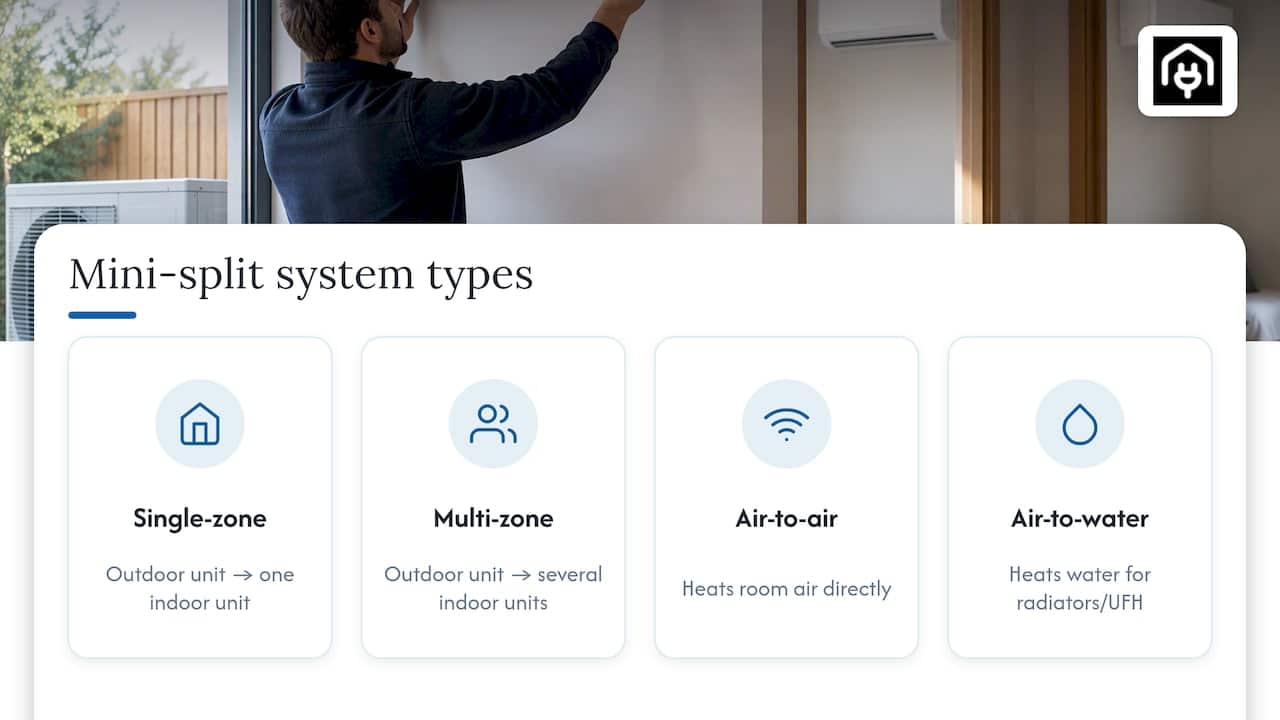
Carbon Trust guidance describes this typical air-to-air layout, where the outdoor unit connects to one or more indoor fan-coil units that deliver heat directly into room air, much as a small air-conditioning system does. A single-zone system serves one indoor unit and suits a single room, an extension or a self-contained annexe. A multi-zone, or multi-split, system connects several indoor units to one outdoor compressor, letting different rooms run at different temperatures at the same time, which suits whole-home retrofits where ductwork is impractical.
Two other distinctions matter when comparing quotes. Split systems separate the compressor outdoors from the fan coil indoors, connected by refrigerant pipework, while monobloc systems house the entire refrigeration circuit outdoors and only pipe water indoors, which simplifies installation but limits flexibility. Air-to-air units heat and cool room air directly, as described above, while air-to-water units heat water for radiators, underfloor heating or a hot water cylinder instead, making them a closer match for homes already fitted with wet central heating.
What efficiency and performance can you realistically expect?
Seasonal performance, rather than a single COP figure, is what actually determines running costs, because it accounts for a full year of varying outdoor temperatures rather than one test condition. Government and Carbon Trust framing both treat heat pumps as energy-transfer appliances: efficiency holds up well in mild weather and drops as the temperature gap between outside air and the target indoor temperature grows.
Flow temperature matters here too. Guidance from Warwick District Council notes that heat pumps typically deliver output at 30 to 55°C, notably lower than a gas boiler, which is why systems paired with underfloor heating or generously sized radiators tend to run more efficiently than those forcing high flow temperatures through undersized emitters.
Cold weather does not stop a mini split working, but it changes how it behaves. Energy Saving Trust material confirms that mini splits can still extract useful heat below freezing, though efficiency falls as the outdoor-to-indoor temperature difference increases. Frost can form on the outdoor coil in cold, humid conditions, and the system periodically reverses briefly to melt it off before returning to normal heating, a short defrost cycle that can feel like a brief dip in output rather than a fault.
Around 3 units of heat per unit of electricity is the government’s benchmark figure for well-functioning heat pumps, according to gov.uk guidance, though this depends heavily on design, controls and operating conditions.
Homeowners can protect that efficiency with a few sensible steps: getting the unit correctly sized for the space rather than oversized “just in case”, improving insulation before or alongside installation, using zone controls sensibly rather than constant high setpoints, and keeping the outdoor unit’s airflow unobstructed. Our guide to sizing a heat pump covers this in more detail.
What does installation involve, and what does it cost in the UK?
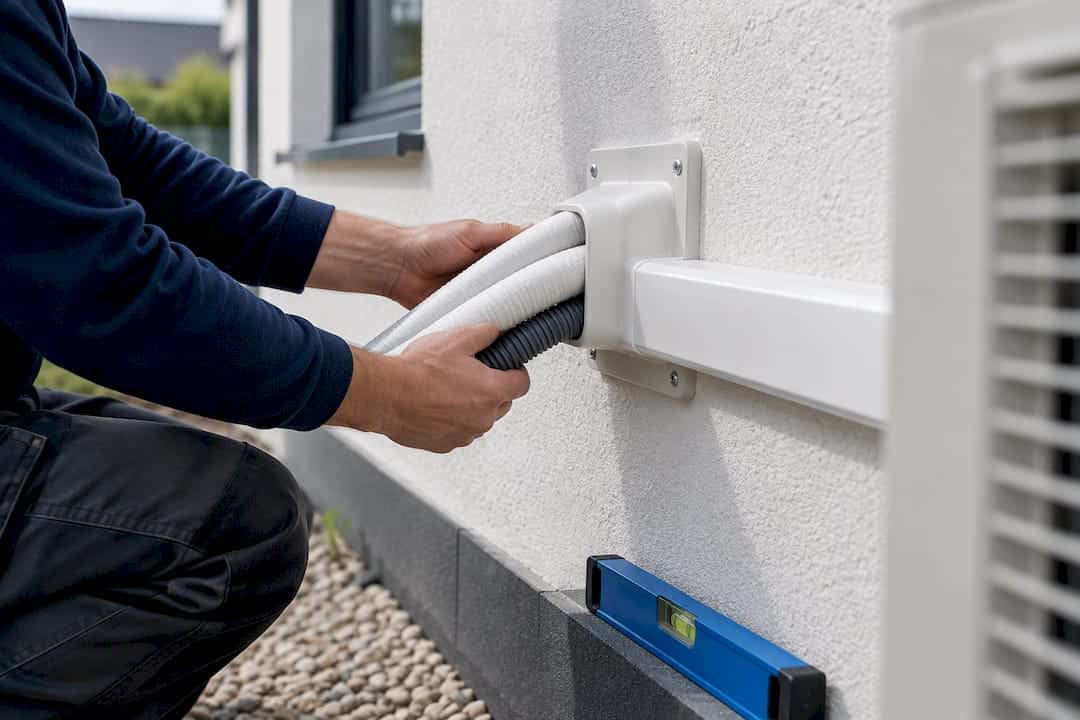
A typical installation starts with a site survey, where an installer assesses insulation levels, room sizes, existing heating distribution and where the outdoor unit can be sited. This feeds into sizing calculations, followed by the physical work: mounting the outdoor unit, running refrigerant pipework and electrical cabling to each indoor unit, then commissioning and handover, when the installer sets controls and explains operation.
Cost varies with the scope of the job. Energy Saving Trust gives a typical air-source heat pump installation cost of around £12,000, though this figure covers air-source heat pumps generally and varies with property size, the number of indoor units, any electrical upgrades needed and the condition of the building fabric. Retrofitting an older, poorly insulated home costs more than fitting a similar system into a new-build designed around it. Our piece on grants and EPC gains for air source heat pumps sets out how funding support and EPC outcomes interact with these costs.
Planning permission is often unnecessary for a domestic installation, but conditions apply. Gov.uk guidance flags listed buildings, conservation areas, and constraints on how close a unit can sit to a boundary or how high it can be mounted as common triggers for needing consent. Always check with the local planning authority before committing to a design.
When requesting quotes, a few questions separate a considered proposal from a rough guess:
- Ask how the installer calculated the size of the system, not just the brand or model they prefer.
- Ask for an estimated seasonal performance figure for your specific property, not a generic headline COP.
- Ask whether the electrical supply needs upgrading to run the new load.
- Ask what the warranty covers and whether an annual service is included or separate.
What are the pros and cons of a mini split heat pump?
The advantages centre on flexibility and running costs. A mini split gives room-by-room control, so unused rooms are not heated or cooled unnecessarily. It handles both heating and cooling from the same equipment, which suits homes that previously relied on separate systems or none at all for summer comfort. It needs no ductwork, which makes it practical for retrofits where installing ducts would mean major disruption. And because it transfers rather than generates heat, it can offer real savings over direct electric heating when sized and installed well.
The drawbacks are worth weighing honestly:
- The indoor units are visible on a wall, ceiling or floor, which not every homeowner wants in every room.
- The outdoor unit produces noise, generally modest but noticeable if sited close to a bedroom window or a neighbour’s boundary.
- Efficiency drops as outdoor temperatures fall, so a system might need a complementary heat source in an especially cold, poorly insulated home.
- Up-front cost is higher than a like-for-like electric heater, even if running costs are lower over time.
A common misconception is that heat pumps cannot work below freezing. They can, and continue to extract heat in cold conditions, but output and efficiency both fall as the temperature gap widens, which is a design and sizing issue rather than a fundamental limit.
Is a mini split heat pump right for your home?
Start with a short checklist before requesting quotes:
- Assess your insulation. A well-insulated home holds heat longer and lets a smaller, more efficient system do the job.
- Decide whether you need whole-house heating or targeted comfort in specific rooms, since this determines single-zone versus multi-zone.
- Check what heating distribution you already have. Homes with radiators sized for a boiler may need larger emitters or underfloor heating for best results.
- Set a realistic budget that accounts for potential electrical upgrades, not just the unit price.
- Confirm any planning constraints, particularly for listed buildings, conservation areas or shared boundaries.
When speaking to installers, ask how they calculated sizing, what seasonal performance they expect for your specific property, whether your electrical supply needs upgrading, what warranty and servicing are included, and how the system behaves during defrost cycles in winter.
Pro Tip: Get an EPC or HEM-informed assessment before you commission a system, so sizing and quotes are based on your building’s actual fabric rather than rough estimates.
Some homes are better served by improving the building fabric first, or by considering a hybrid system that pairs a heat pump with an existing boiler for the coldest days. Our guide to the most efficient way to heat a house looks at when fabric improvements should come before, not after, a new heating system.
How does official testing and modelling shape realistic expectations?
Manufacturers test heat pumps under standardised conditions, using standards such as EN 14825 and BS EN 15316, referenced directly in the Home Energy Model’s heat pump methodology. This test data feeds into the calculations used to estimate seasonal performance for energy modelling and compliance purposes, which is why headline COP figures on a spec sheet do not always match what a household experiences.
An EPC or HEM-informed assessment translates this generic test data into figures specific to a property, covering insulation, existing heating distribution and room-by-room needs. That matters for two practical reasons:
- It supports more accurate sizing, reducing the risk of an undersized or oversized system.
- It feeds directly into planning submissions and permitted development decisions where energy performance evidence is required.
Modelling services such as domestic EPC, SAP and HEM assessments help homeowners and landlords considering a heat pump retrofit, alongside guidance on how these assessments fit UK compliance requirements. See our ASHP EPC page for more detail.
Common pitfalls to avoid before you commit
The mistakes I see most often are undersizing a system to save money upfront, skipping fabric improvements because they seem separate from the heating decision, and treating controls and commissioning as an afterthought rather than part of the specification.
Get a proper site survey, request quotes informed by SAP or HEM modelling rather than rule-of-thumb sizing, and factor a service contract into your budget from the start. These three steps do more for long-term performance than any single piece of equipment.
— Danny
How Home Energy Model supports your heat pump decision
Choosing a mini split heat pump involves more uncertainty than choosing a boiler, because sizing depends on your building’s fabric, not just a manufacturer’s chart. Home Energy Model provides Domestic EPC assessments, SAP and HEM calculations, and energy statements for planning submissions, each of which gives your installer accurate, property-specific data to work from instead of generic assumptions.
These services reduce the guesswork in a heat pump quote and support the paperwork planning authorities and EPC assessments require. If your property also has air conditioning equipment that needs compliance checks, our TM44 inspection service covers that too. Request a quote through our Domestic EPC page to get started with an assessment tailored to your home.
Sources
- Gov
- Heat pumps key to London’s net zero ambition — Carbon Trust
- Modelling heat pumps within the Home Energy Model — HEM technical note
FAQ
Do mini splits use a lot of electricity?
A mini split uses less electricity than direct electric heating for the same amount of warmth, because it transfers heat rather than generating it. Gov.uk guidance notes heat pumps can produce around 3 units of heat per unit of electricity, though actual consumption depends on the system’s size, the home’s insulation and outdoor temperatures.
How much does it cost to run a mini-split for 8 hours?
Running cost depends on the unit’s power draw, your electricity tariff and outdoor temperature, so there is no single UK-wide figure. A well-sized, efficient system running in mild weather typically costs less to run than an equivalent electric heater, because of the multiplying effect described in the government’s heat pump guidance.
Do mini splits have to be vented outside?
Yes, a mini split needs an outdoor unit connected to the indoor unit or units by refrigerant pipework, since that outdoor unit is where the system exchanges heat with outside air. This is different from ducted ventilation and does not need internal ducts, but it does need an external wall or ground location for the outdoor component, subject to any relevant planning conditions.
How do I know if my mini-split is a heat pump?
Check whether the system has a reversing valve and can both heat and cool, since a heat pump moves heat in either direction while a standard air conditioner only removes it. Most mini split systems sold for both heating and cooling are reversible air-source heat pumps by design, so if your unit heats as well as cools, it is almost certainly a heat pump.