
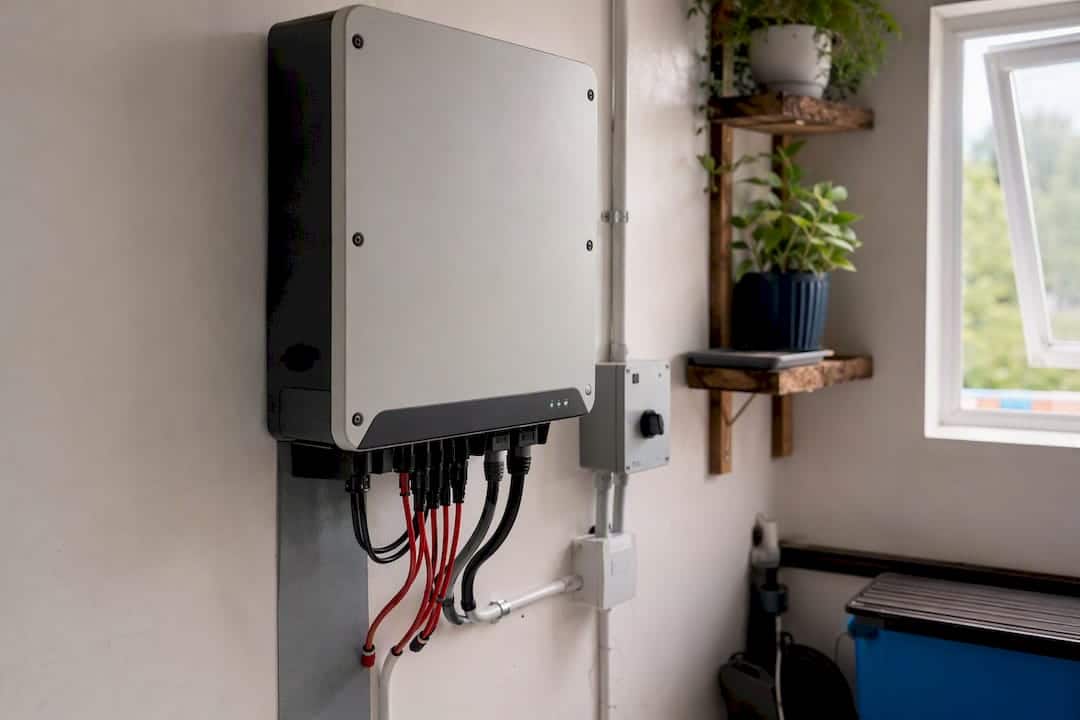
A solar power inverter converts the direct current (DC) electricity produced by rooftop panels into 230V alternating current (AC), the standard form used by UK household appliances and the national grid. Without this conversion, panels alone are useless to a home. Modern inverters go further than simple conversion, handling Maximum Power Point Tracking (MPPT), managing battery charge and discharge in hybrid setups, and monitoring the system for safety and performance.
Two schemes prove how central this role is:
- MCS certification covers the inverter as part of the whole solar system, not just the panels.
- The Smart Export Guarantee (SEG) pays homeowners for exported electricity, but only when that MCS-certified inverter and installation are in place.
Key Takeaways
A solar power inverter converts panel DC into 230V AC, tracks maximum power output via MPPT, and manages safety, battery and grid functions that determine how much a home actually benefits from its panels.
| Point | Details |
|---|---|
| Core function | The inverter converts DC from panels into 230V AC for household use and grid export. |
| Type shapes performance | String inverters suit simple roofs; microinverters or optimisers help shaded roofs by up to 25%. |
| Safety is automatic | Anti-islanding disconnects the inverter within milliseconds during a grid outage. |
| Certification matters financially | MCS certification is required for SEG payments, warranty claims and smooth conveyancing. |
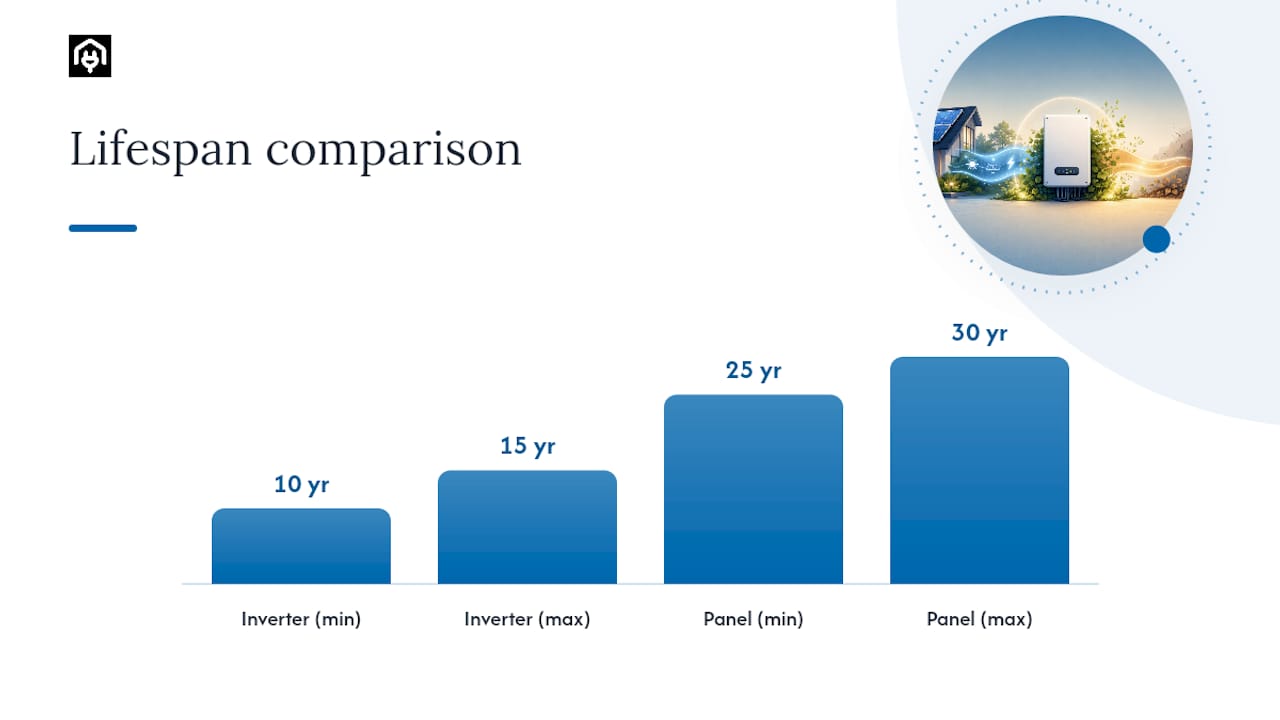
| Replacement is expected | Inverters typically last 10 to 15 years, well short of a panel’s 25 to 30-year lifespan. |
For homeowners weighing solar against other efficiency measures, Homeenergymodel’s guide to smart home energy efficiency sets out where an inverter fits into the wider picture of reducing household energy costs.
Table of Contents
- How does a solar inverter actually work?
- What are the main types of solar inverter?
- Where does a solar inverter lose energy?
- What safety rules apply to solar inverters?
- How do you size and choose the right inverter?
- How long do solar inverters last and what maintenance do they need?
- Does the inverter affect your EPC or Home Energy Model rating?
- An installer’s honest take on choosing an inverter
- Frequently asked questions
- Sources
How does a solar inverter actually work?
Panels generate DC electricity, but every socket in a UK home runs on AC at 230V and 50Hz. An inverter sits between the panels and the consumer unit and performs that conversion continuously, switching the current direction thousands of times per second to build a clean, stable AC waveform that matches the grid’s frequency and voltage exactly.
Getting that match right is trickier than it sounds, which is where Maximum Power Point Tracking comes in. Panel output shifts constantly as clouds pass, the sun moves, or a chimney casts a shadow across one corner of the array. MPPT continuously hunts for the voltage and current combination that pulls the most usable power out of the panels at that exact moment, adjusting many times a second rather than settling for a fixed setting.
Beyond conversion and tracking, the inverter also runs several control functions homeowners rarely think about:
- Synthesising a clean AC waveform synchronised precisely to the grid’s frequency and voltage.
- Detecting a power cut and disconnecting automatically, a safety behaviour called anti-islanding.
- Limiting how much power gets exported, when local network rules require it.
- Communicating system status to installers and homeowners via app or web portal.
The inverter also acts as the system’s “brain,” monitoring performance and routing energy between panels, any battery, and the grid.
Pro Tip: If generation looks lower than expected, check the inverter’s status light or app dashboard first. A steady green light and a live generation figure usually rule out a fault; a red or flashing light almost always means something needs an installer’s attention.
What are the main types of solar inverter?
Homeowners typically choose between four inverter types, and the right one depends on roof shape, shading, and whether a battery is on the cards now or later.
String inverters connect a whole row, or “string,” of panels to one central unit, usually mounted in a garage or utility space. They are the cheapest and simplest option, which explains why string inverters account for the majority of UK residential installations.
Microinverters fit behind each individual panel, converting DC to AC at the source. Because each panel operates independently, a shaded or underperforming panel does not drag down the whole string.
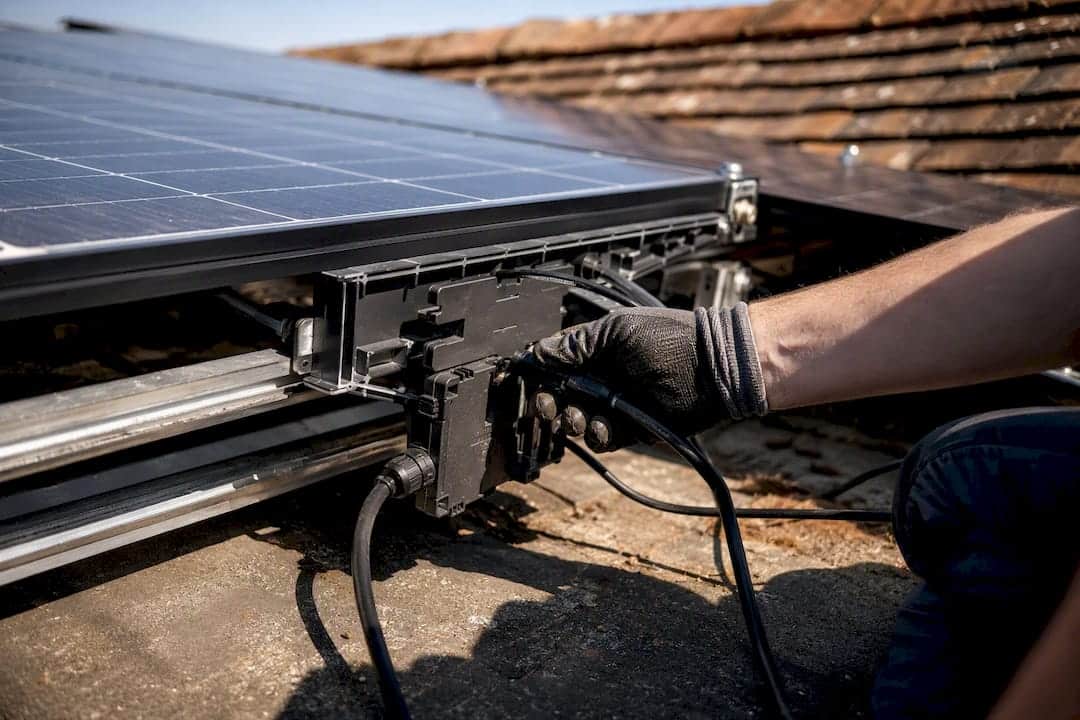
Power optimisers sit between string simplicity and microinverter independence. They condition each panel’s DC output before sending it to a central string inverter, catching much of the shading benefit at lower cost.
Hybrid inverters combine solar conversion with battery management in one unit, handling charge and discharge without a separate charge controller.
| Inverter type | Best for | Cost / complexity | Efficiency / harvest | Battery compatibility | Typical system size |
|---|---|---|---|---|---|
| String | Simple, unshaded roofs | Lowest cost, simplest install | Good on unshaded roofs; string-wide dip if one panel is shaded | Needs added hybrid unit or separate charger | Small to medium |
| Microinverter | Complex or shaded roofs | Higher upfront cost, more install points | Panel-level tracking limits shading losses | Usually needs a separate battery inverter | Small to large |
| Power optimiser | Moderate shading, mixed orientations | Mid-range cost | Close to microinverter gains at lower cost | Often works with hybrid or AC-coupled batteries | Small to large |
| Hybrid | Homes planning battery storage | Higher upfront cost, fewer components overall | Efficient DC-coupled battery charging | Built-in battery management | Small to large |
On shaded or complex roofs, microinverters or optimisers can improve generation on shaded or complex roofs by a significant margin compared with a basic string setup compared with a basic string setup. That gain has to be weighed against the higher installation cost, and against whether a battery is likely to join the system in the next few years.
Where does a solar inverter lose energy?
Every inverter loses a small amount of energy converting DC to AC, mostly as heat inside the switching components. In homeowner terms, efficiency describes how much of the DC power arriving from the panels actually reaches the home as usable AC.
Several everyday factors chip away at that figure beyond the inverter’s own rated efficiency:
- Heat: inverters run less efficiently on very hot days, when semiconductor losses rise.
- Partial shading: a shaded string inverter can lose output disproportionate to the shaded area.
- Cable runs: longer DC and AC cable lengths add resistive losses.
- Sizing mismatch: an inverter rated well below the array’s peak output clips excess generation.
On shaded roofs, panel-level optimisation can recover a meaningful share of that lost generation, as noted above. Over a 20 to 25-year system life, even a few percentage points of extra harvest compound into a noticeably larger return.
What safety rules apply to solar inverters?
Every grid-connected inverter must disconnect automatically the moment it detects a power cut, a safety feature called anti-islanding. It exists to protect network engineers working on what they assume is a dead line, and inverters are required to detect the anomaly and disconnect within milliseconds.
Beyond that, inverters often need to respect export limits set by the local electricity network, using firmware settings that cap how much power flows back to the grid at any one time. This keeps local infrastructure from being overloaded when many homes on the same street are exporting solar power simultaneously.
Homeowners should confirm a few things with any installer before work begins:
- Confirm the installer and the whole system, inverter included, carry MCS certification.
- Ask whether any export limit applies to the property and how it is configured.
- Check that grid compliance certificates are provided and kept safe.
A grid-connected inverter is not just converting power, it is constantly negotiating with the network: matching frequency, watching for faults, and stepping back the instant something goes wrong.
Requirements around export limits and grid communication vary between countries and even between local network operators, so it is worth asking an installer to confirm what applies to a specific property and postcode.
Monitoring, controls and smart features homeowners will use
Most inverters pair with an app or web dashboard showing real-time generation, historical graphs, and fault alerts. Hybrid units add controls for tariff-based charging schedules and export limiting, letting a household decide when the battery charges from the grid or from panels alone. A solar battery monitor can add finer detail on battery state for homes running storage alongside their inverter.
Pro Tip: Check the app weekly against a sunny-day baseline. A sudden, unexplained drop is often the first sign of a fault, long before anything looks obviously wrong on the roof.
How do you size and choose the right inverter?
Choosing an inverter starts with understanding the home’s demand profile, the array size, and whether a battery or EV charger is likely to join the system later. A roof with partial shading tips the decision towards microinverters or optimisers regardless of budget, since a string inverter would lose disproportionate output there.
Installers commonly size the inverter close to the array’s rated kW, though many deliberately undersize slightly, since panels rarely hit their full rated output simultaneously. Modest oversizing of the panel array relative to inverter capacity is also common practice, squeezing more real-world generation from the same inverter footprint.
Before signing off on a quote, work through this checklist:
- Confirm MCS certification for the installer and the full system.
- Compare warranty length across inverter brands, not just panel warranties.
- Check what monitoring features are included and whether they need a subscription.
- Ask directly about battery compatibility, even if storage is not planned yet.
- Get a second opinion if planning battery storage or a large EV charger alongside the array.
Anyone weighing solar against wider household efficiency upgrades may find it useful to read about home solar energy benefits for UK homeowners before comparing quotes.
How long do solar inverters last and what maintenance do they need?
Most inverters carry a working life of 10 to 15 years, noticeably shorter than the 25 to 30-year lifespan of the panels themselves, so budgeting for at least one replacement over a system’s lifetime is sensible from the outset.
Routine upkeep is light. A visual check for dust, unusual heat, or warning lights takes a few minutes, and firmware updates are usually pushed by the installer or automatically over Wi-Fi.
Common faults include the inverter tripping after a grid disturbance, a blank display, or a sudden output drop. The first steps are usually a power reset and a check of the isolation switch before calling the installer.
Pro Tip: Register the inverter’s warranty as soon as it is installed and keep the MCS certificate somewhere safe. Both documents matter if a fault claim arises, and both are frequently requested during property conveyancing.
Does the inverter affect your EPC or Home Energy Model rating?
A correctly installed, MCS-certified solar and inverter system feeds directly into EPC and Home Energy Model assessments, and the certification paperwork is what an assessor needs to record it properly. Without it, the system may not count towards the rating at all, even though it is generating power on the roof.
Practical steps worth taking:
- Keep MCS certificates and installation documentation together and accessible.
- Register SEG export details against the correct MCS reference number.
- Retain the installer’s contact details for any future conveyancing questions.
Missing certification is not just a paperwork gap. It can knock value off a sale and block the transfer of an existing SEG export account to a new owner, since absent MCS documentation can reduce a property’s sale value by a small percentage.
Anyone unsure how PV and inverter choices feed into a broader rating should read how solar PV interacts with UK energy ratings before finalising a quote.
An installer’s honest take on choosing an inverter
The most common mistake homeowners make is fixating on panel brand while treating the inverter as an afterthought, when it is the component most likely to fail first and the one doing all the ongoing decision-making. A trustworthy quote always states the inverter model and warranty length explicitly, not buried in small print.
If storage is even a distant possibility, ask about hybrid or battery-ready options now. Retrofitting later almost always costs more than building it in from the start.
Frequently asked questions
What does a solar power inverter do in simple terms?
It converts the DC electricity from solar panels into the 230V AC electricity that runs household appliances and can be exported to the grid.
Do I need a solar inverter if I already have panels?
Yes. Panels cannot power a home or export to the grid without an inverter converting their DC output into usable AC.
How does MPPT improve solar inverter efficiency?
MPPT constantly adjusts to changing light conditions, pulling the maximum available power from panels rather than settling for a fixed output level.
What is the difference between a string inverter and a microinverter?
A string inverter converts power for a whole row of panels centrally, while microinverters convert power at each individual panel, limiting losses from shading.
How long does a solar inverter typically last?
Most inverters last 10 to 15 years, shorter than the 25 to 30-year lifespan of solar panels, so a replacement should be budgeted for during system ownership.
Sources
- Solar Inverter Types Explained: String, Microinverter, Hybrid and Optimisers Compared (2026)
- Solar Inverters: How To Choose a Good One – Solar4Good