

TL;DR:
- EPC services refer either to large-scale construction delivery contracts or to energy efficiency assessments of buildings in the UK. The construction meaning involves a single contractor managing engineering, procurement, and construction phases, while the property certification meaning involves assessing and rating a building’s energy efficiency for legal compliance. Understanding the context is crucial to avoid confusion and ensure proper compliance and investment decisions in 2026.
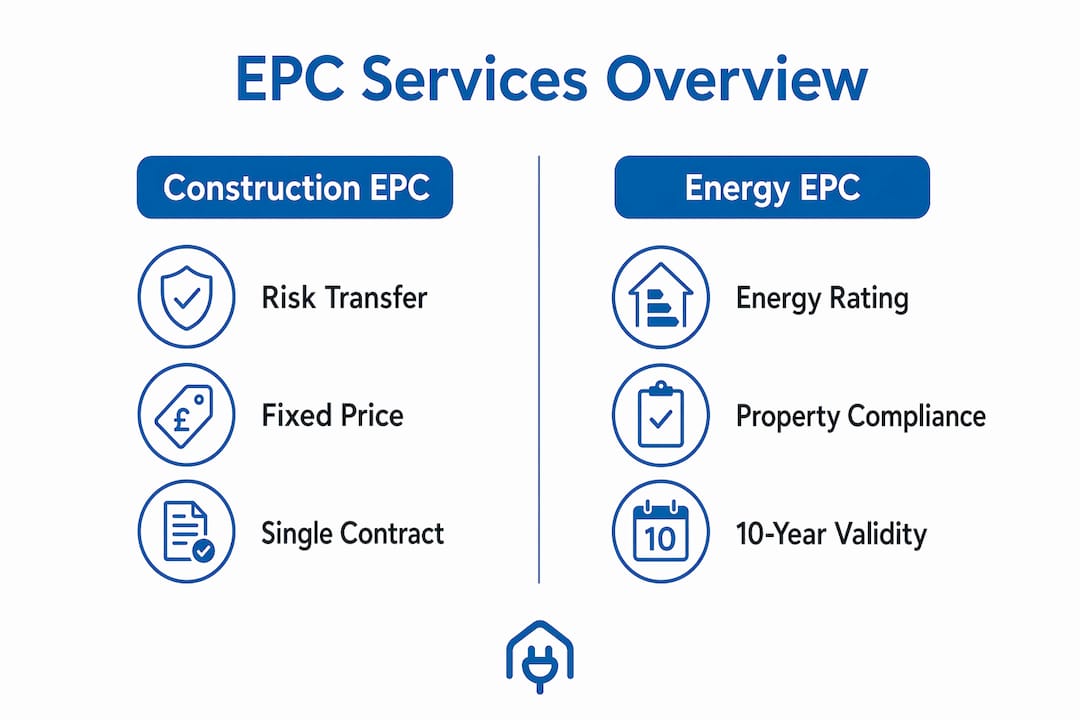
EPC services is a term with two distinct meanings: it refers either to Engineering, Procurement, and Construction contracts used in large-scale project delivery, or to Energy Performance Certificate services that assess and rate a building’s energy efficiency. Property owners, homeowners, and investors in the UK frequently encounter both meanings, often in the same conversation, which creates genuine confusion about obligations and costs. This guide separates the two definitions clearly, explains how each works in practice, and shows how both affect compliance, property value, and investment decisions in 2026.
What are EPC services in construction?
EPC services in the construction context refer to a single-contract project delivery model in which one contractor takes full responsibility for engineering, procurement, and construction phases, handing over a working facility at completion. This is often called a turnkey contract because the owner effectively receives a finished, operational asset. The model is common in industrial plants, power generation facilities, data centres, and large infrastructure projects.
The three phases work as follows:
- Engineering and design. The EPC contractor produces all technical drawings, specifications, and design documentation. The owner approves key milestones but does not manage the design process directly.
- Procurement. The contractor sources all equipment, materials, and specialist subcontractors. Critically, long-lead procurement overlaps with the engineering phase to prevent schedule delays on items such as transformers, bespoke steelwork, or specialist plant.
- Construction and commissioning. The contractor builds the facility, conducts acceptance testing, and hands over documented performance evidence to the owner.
The primary appeal of this model is risk transfer. EPC contracts give owners a fixed price and a fixed completion date, removing the financial exposure that comes with managing multiple separate contractors. Owners trade day-to-day control for certainty, which suits organisations with limited internal project management capacity.
How does EPC differ from EPCM?
EPCM stands for Engineering, Procurement, and Construction Management. The distinction matters significantly. Under an EPCM model, the management firm coordinates design and construction but does not hold the contracts with trades and suppliers. The owner contracts directly with each party, retaining both control and risk. Owners with strong internal teams and a preference for flexibility often choose EPCM, while those seeking risk transfer and schedule certainty choose EPC.
| Feature | EPC contract | EPCM contract |
|---|---|---|
| Single point of accountability | Yes | No |
| Fixed price certainty | Yes | Typically no |
| Owner risk exposure | Low | Higher |
| Owner control over design | Limited | Greater |
| Suitable for | Risk-averse owners, complex projects | Owners with internal capacity |
Pro Tip: Before signing any EPC construction contract, confirm that acceptance testing criteria, handover documentation requirements, and performance benchmarks are written explicitly into the agreement. Vague performance clauses are the most common source of post-completion disputes.
What are energy performance certificate (EPC) services for properties?
Energy Performance Certificate services, the second meaning of EPC services, involve the formal assessment and certification of a building’s energy efficiency. An EPC rates a property on a scale from A (most efficient) to G (least efficient), based on an assessment of the building fabric, heating systems, insulation, windows, and lighting. The certificate also includes a list of recommended improvements and their estimated impact on the rating.
In the UK, EPCs are a legal requirement in the following situations:
- When selling a residential or commercial property
- When letting a property to a new tenant
- When constructing a new building
- When making certain types of significant alterations to an existing building
The Minimum Energy Efficiency Standards (MEES) regulations set a legal floor for rental properties. Landlords in England and Wales are currently required to hold a minimum EPC rating of E before letting a property, with proposals under active discussion to raise this threshold to C for new tenancies. Non-compliance carries financial penalties, making EPC services directly relevant to rental income and legal standing.
The assessment process itself is conducted by an accredited Domestic Energy Assessor (DEA) for residential properties. The assessor visits the property, records details about construction, insulation, heating, and glazing, and enters the data into approved software. The resulting certificate is valid for 10 years but must be updated if significant energy-related changes are made, such as a full insulation upgrade or a new heating system installation.
A common misunderstanding is that carrying out improvement works automatically updates the EPC rating. It does not. Rating improvements require a formal reassessment by an accredited assessor, supported by correct documentation of the works completed. Property owners who skip this step may find their compliance record does not reflect the actual condition of the building.
Pro Tip: Gather all installation certificates, product specifications, and contractor invoices before booking a reassessment. Assessors rely on documentary evidence to credit improvements, and missing paperwork can result in a lower rating than the property deserves.
How to tell which EPC services apply to your situation
The term EPC services can appear in planning documents, letting agent correspondence, contractor proposals, and government guidance, often without clarification of which meaning is intended. Confusion around EPC acronyms can result in erroneous service engagements and compliance failures, so identifying the correct context early is not optional.
Several context clues help distinguish the two meanings:
- Scale and sector. EPC construction contracts apply to large commercial, industrial, or infrastructure projects. If the conversation involves a power plant, data centre, or major industrial facility, the construction meaning applies.
- Regulatory references. If the document references MEES, the Private Rented Sector (PRS) regulations, or the requirement to lodge a certificate on the national register, the energy certification meaning applies.
- Service provider type. EPC construction firms are engineering and project management organisations. EPC certificate providers are accredited energy assessors or surveying practices.
- Fee structure. EPC construction contracts run into millions of pounds and involve detailed commercial negotiations. EPC certificate assessments for residential properties typically cost between £60 and £150.
When engaging any service provider who uses the term EPC, ask them to confirm in writing which service they are providing and under what regulatory framework. This single step eliminates the majority of miscommunication risks.
How EPC services affect property owners and investors in 2026
Both types of EPC services carry direct financial and legal consequences for property owners and investors operating in the UK market today.
For energy certification, the stakes are rising. The UK government’s net zero commitments and the proposed tightening of MEES to a minimum C rating for rental properties mean that EPC ratings are increasingly factored into mortgage lending decisions, property valuations, and tenant demand. Properties rated D or below are already attracting lower offers in some markets, and lenders such as Halifax and NatWest have introduced green mortgage products with preferential rates for properties rated A or B.
For property development and major renovation projects, understanding EPC construction contracts is equally relevant. An owner undertaking a large-scale development who inadvertently engages an EPCM firm expecting EPC-style risk transfer will face unexpected cost exposure and coordination responsibilities. The choice of delivery model should be made deliberately, based on the owner’s internal capacity and risk appetite.
Practical steps for property owners and investors include:
- Obtain a current EPC certificate for every property in the portfolio and identify those rated D or below as priority assets for improvement.
- Consult an accredited DEA before undertaking improvement works to understand which upgrades will have the greatest impact on the rating.
- For development projects, engage a legal adviser with EPC contract experience to review delivery model options before procurement begins.
- Check the EPC exemption register if a property cannot practically meet the minimum standard, as exemptions are time-limited and must be actively maintained.
Pro Tip: For landlords planning upgrades, prioritise loft insulation and cavity wall insulation before replacing the heating system. Fabric improvements deliver the largest rating gains per pound spent and are assessed more reliably by DEAs than heating system upgrades.
EPC construction contracts versus EPC certificates: a practical comparison
The two types of EPC services differ substantially in cost, timeline, and responsibility allocation. The table below summarises the key dimensions for property owners and investors making decisions in 2026.
| Dimension | EPC construction contract | EPC certificate service |
|---|---|---|
| Typical cost | Millions of pounds, project-specific | £60 to £150 for residential |
| Timeline | Months to years | Days to two weeks |
| Who is responsible | EPC contractor holds full delivery risk | Property owner manages improvements |
| Legal driver | Project contract and specification | MEES, Housing Act, Building Regulations |
| Outcome | Completed, operational facility | Rated certificate lodged on national register |
| Renewal or update | Not applicable | Every 10 years or after significant works |
The contrast in scale is stark. An EPC construction contract for a data centre may run for 18 to 36 months and involve hundreds of subcontractors. An EPC certificate for a two-bedroom flat takes a single assessor approximately 45 minutes on site. Both carry legal and financial weight, but in entirely different contexts.
Pro Tip: Property investors acquiring portfolios should request EPC certificates as part of due diligence, not as an afterthought. A portfolio with several F or G-rated properties represents a measurable compliance liability that should be priced into any acquisition offer.
Key takeaways
EPC services cover two legally and operationally distinct areas: construction project delivery and property energy certification, and confusing the two carries real financial and compliance risk.
| Point | Details |
|---|---|
| Two distinct meanings | EPC refers to both construction contracts and energy performance certificates; context determines which applies. |
| Construction EPC transfers risk | A single EPC contractor delivers a fixed-price, turnkey facility, removing day-to-day management from the owner. |
| Energy EPC is a legal requirement | UK property owners must hold a valid EPC when selling or letting, with minimum E rating required under MEES. |
| Improvements need reassessment | Carrying out energy upgrades does not update an EPC rating automatically; a formal reassessment is required. |
| Context clues prevent confusion | Scale, regulatory references, and service provider type reliably identify which EPC service is being discussed. |
Why clarity on EPC services is worth more than most owners realise
Having worked across UK property compliance and energy assessment for a number of years, the single most costly mistake I see property owners make is assuming that EPC is a self-explanatory term. It is not. I have seen landlords commission what they believed was an energy assessment, only to receive a project management proposal for a construction delivery model. I have also seen developers sign EPCM agreements expecting the risk transfer of a full EPC contract, then face significant cost overruns when the distinction became apparent mid-project.
The energy certification side of EPC services is where most residential and buy-to-let investors need to focus right now. The regulatory direction is unambiguous: minimum standards are tightening, and properties that do not meet them will face letting restrictions and reduced valuations. The owners who act proactively, commissioning assessments before they are legally compelled to, consistently achieve better ratings because they have time to plan improvements strategically rather than rushing to meet a deadline.
The construction contract side matters most for those undertaking significant development or infrastructure work. Here, the choice between EPC and EPCM is a genuine strategic decision, not a formality. Owners who understand the difference protect themselves from unexpected liability. Those who do not often discover the distinction at the worst possible moment.
My consistent advice is to clarify the term in writing at the first point of contact with any service provider, and to treat EPC compliance as a portfolio-wide asset management issue rather than a property-by-property administrative task.
— Danny
How Homeenergymodel supports UK property owners with EPC services
Homeenergymodel is a dedicated resource for UK property owners, landlords, and investors navigating energy efficiency compliance and EPC certificate requirements. The site provides clear guidance on the Home Energy Model, the government’s replacement for SAP assessments, as well as practical support for obtaining EPC assessments and improving property ratings ahead of tightening MEES standards. Whether the priority is understanding current certificate requirements, planning fabric improvements, or preparing for the Future Homes Standard, Homeenergymodel offers up-to-date guidance tailored to the UK property market. Explore the energy performance guide to identify the most cost-effective upgrades for any property type.
FAQ
What does EPC stand for in property?
In the property context, EPC stands for Energy Performance Certificate. It is a legally required document that rates a building’s energy efficiency on a scale from A to G, and must be obtained when selling or letting a property in the UK.
What is an EPC contract in construction?
An EPC contract in construction stands for Engineering, Procurement, and Construction. It is a single-contract delivery model in which one contractor manages all phases of a project and hands over a completed, operational facility at a fixed price.
How long is an EPC certificate valid for?
An EPC certificate is valid for 10 years. It must be updated before the expiry date or following significant energy-related changes to the property, such as a major insulation or heating system upgrade.
What is the minimum EPC rating required to let a property in England?
Under current MEES regulations, landlords in England and Wales must hold a minimum EPC rating of E before letting a property. Proposals to raise this to a minimum of C for new tenancies are under active government consideration.
What is the difference between EPC and EPCM in construction?
Under an EPC contract, a single contractor holds full delivery responsibility and risk. Under an EPCM arrangement, the management firm coordinates the project but the owner contracts directly with trades and suppliers, retaining greater control and greater financial exposure.