

Did you know that properties in the UK with top energy ratings can command up to 14 percent higher sale prices? More homeowners and landlords are paying attention as stricter regulations make energy labelling a crucial part of selling, renting, or managing property. Understanding how the Energy Performance Certificate and new Home Energy Model shape the market can help you avoid costly fines and unlock big savings on future energy bills.
Table of Contents
- Defining UK Home Energy Labelling Standards
- Types of Labels: EPCs, SAP, and HEM
- How the Home Energy Model Works
- Legal Requirements and 2025 Regulations
- Practical Implications for Owners and Landlords
Key Takeaways
| Point | Details |
|---|---|
| EPC Importance | Energy Performance Certificates (EPCs) are mandatory for property sales and rentals, rating energy efficiency from A to G. |
| Regulatory Changes | By 2030, properties must achieve a minimum EPC rating of ‘C’, with potential fines for non-compliance reaching significant amounts. |
| Transition to HEM | The emerging Home Energy Model (HEM) offers dynamic assessments and will replace SAP by 2025, enhancing the understanding of energy efficiency. |
| Opportunities for Landlords | Proactive energy efficiency upgrades can enhance property value, attract tenants, and reduce long-term energy costs while ensuring compliance with regulations. |
Defining UK Home Energy Labelling Standards
Home energy labelling in the United Kingdom represents a critical framework for understanding and improving residential energy efficiency. Gov.uk mandates a standardised rating system that helps homeowners, landlords, and property investors comprehend their property’s energy performance through a clear, easy-to-understand classification method.
The Energy Performance Certificate (EPC) serves as the primary mechanism for home energy labelling, rating properties on a scale from A to G. According to IEA, this system originated from the UK Building Regulations 2000, which initially required new homes to display energy ratings. Properties are assessed based on several key factors:
- Overall energy efficiency
- Carbon dioxide emissions
- Potential energy cost savings
- Recommended energy-saving improvements
Understanding these ratings goes beyond mere compliance. A high-performing energy label can significantly impact property value, rental potential, and long-term operational costs. Landlords navigating MEES regulations will find these standards particularly crucial, as they directly influence rental eligibility and potential financial penalties for non-compliance.
The labelling process involves a comprehensive assessment by a qualified energy assessor who evaluates the property’s construction, insulation, heating systems, and potential for energy conservation. The resulting certificate provides not just a rating, but a roadmap for potential energy efficiency improvements, making it an invaluable tool for property owners looking to reduce their environmental impact and energy expenditure.
Types of Labels: EPCs, SAP, and HEM
The United Kingdom employs multiple energy assessment methodologies to evaluate residential property efficiency, with three primary systems playing critical roles: Energy Performance Certificates (EPCs), Standard Assessment Procedure (SAP), and the emerging Home Energy Model (HEM). Wikipedia notes that the Standard Assessment Procedure has historically formed the basis for Energy Performance Certificates, providing a standardised approach to understanding residential energy performance.
Energy Performance Certificates (EPCs) represent the most familiar label for most homeowners. These certificates provide a comprehensive overview of a property’s energy efficiency, rating buildings from A (most efficient) to G (least efficient). They offer crucial insights into:
- Current energy performance
- Potential energy savings
- Recommended improvements
- Estimated energy costs
The Standard Assessment Procedure (SAP) serves as the underlying calculation method for EPCs. AESSC highlights that the emerging Home Energy Model (HEM) is set to replace SAP, promising more nuanced and dynamic energy calculations aligned with the UK’s ambitious net-zero carbon objectives.
Exploring SAP calculations reveals a complex assessment process that considers multiple factors including building fabric, heating systems, ventilation, and potential renewable energy installations. The transition to HEM represents a significant evolution in how properties will be evaluated, offering more precise and contextually relevant energy performance measurements that better reflect modern building technologies and environmental considerations.
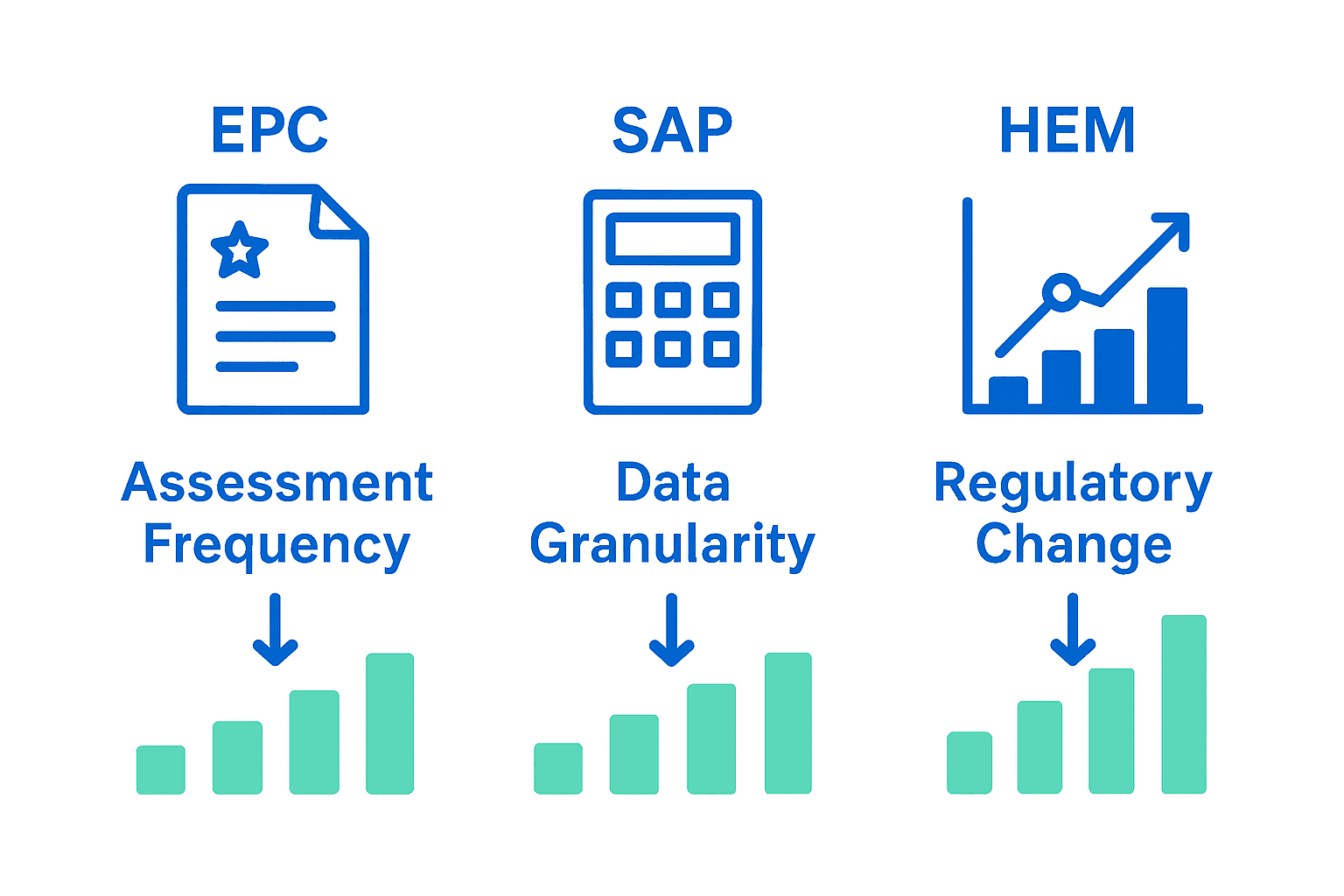
Here’s a comparison of the main residential energy labelling systems in the UK:
| Feature | Energy Performance Certificate (EPC) | Standard Assessment Procedure (SAP) | Home Energy Model (HEM) |
|---|---|---|---|
| Purpose | Property rating for buyers/tenants | Underlying EPC calculation method | Next-generation dynamic assessment |
| Assessment Method | Visual inspection by assessor | Software-based calculation | Advanced algorithm with frequent measurements |
| Data Frequency | Once per assessment | 12 monthly periods | 17,520 data points annually |
| Factors Considered | Insulation Heating CO₂ emissions |
Fabric Heating Renewables |
Generation Storage Consumption patterns |
| Regulatory Status | Mandatory for all sales/lets | Required for new builds & EPCs | Set to replace SAP from 2025 |
| Level of Detail | General overview | Detailed model, static data | Highly granular, dynamic data |
 |
|
How the Home Energy Model Works
The Home Energy Model (HEM) represents a quantum leap in residential energy assessment, introducing unprecedented precision and dynamic analysis of home energy performance. AESSC reveals that HEM dramatically improves upon previous methodologies by conducting incredibly granular calculations, running 30-minute iterations that generate an astounding 17,520 data points annually, compared to the traditional 12 monthly iterations used in Standard Assessment Procedure (SAP).
At its core, HEM provides a comprehensive approach to understanding energy consumption by considering multiple critical factors:
- Daily energy generation fluctuations
- Energy storage capabilities
- Precise consumption patterns
- Renewable energy integration
- Heating and cooling system efficiency
The model’s sophisticated algorithm captures real-world energy dynamics with remarkable detail. Unlike previous static assessment methods, HEM offers dynamic calculations that reflect the intricate ways modern homes consume and generate energy. Solar energy calculations become particularly nuanced, allowing homeowners and developers to understand precise energy performance across different scenarios and seasons.
By providing such granular insights, HEM supports the UK’s ambitious net-zero carbon objectives. The model enables property owners to make more informed decisions about energy efficiency improvements, potential renewable energy investments, and overall carbon footprint reduction. This approach transforms energy assessment from a static rating to a dynamic, actionable roadmap for sustainable living.
Legal Requirements and 2025 Regulations
The United Kingdom is implementing increasingly stringent energy efficiency regulations to drive sustainable property development and reduce carbon emissions. Gov.uk introduced a significant change in March 2021, re-scaling energy labels to a simplified A to G rating system, making energy performance more transparent and easier for consumers to understand.
Key regulatory milestones for property owners and investors include:
- Mandatory EPC rating of ‘C’ or above by 2030
- Potential significant financial penalties for non-compliance
- Increased focus on renewable energy integration
- Stricter building performance standards
Homebuilding highlights the substantial financial implications, with potential fines reaching £1.66 billion if the housing market fails to improve energy efficiency by 2030. Understanding Part L compliance becomes crucial for property professionals navigating these evolving regulatory landscapes.
The 2025 regulations represent a transformative approach to energy efficiency, pushing the property sector towards more sustainable practices. Landlords, homeowners, and developers must proactively assess and upgrade their properties, recognizing that these regulations are not just legal requirements but essential steps towards reducing carbon emissions and creating more environmentally responsible living spaces.
Practical Implications for Owners and Landlords
The upcoming energy efficiency regulations present significant challenges and opportunities for property owners and landlords across the United Kingdom. MoneyWeek emphasises that landlords are specifically required to upgrade rental properties to a minimum EPC rating of ‘C’ by 2030, which could necessitate substantial financial investment in property improvements.
Key practical considerations for property owners include:
- Comprehensive property energy assessments
- Targeted energy efficiency upgrades
- Potential renewable energy installations
- Budget planning for retrofit investments
- Understanding potential financial penalties
Homebuilding warns that homeowners could face fines up to £5,000 for properties failing to meet the required EPC rating. EPC Exemption Register becomes a critical resource for understanding potential exceptions and navigating these complex regulatory requirements.
Property owners must view these regulations not as a burden, but as an opportunity to enhance property value, reduce long-term energy costs, and contribute to broader environmental sustainability goals. Proactive investment in energy efficiency improvements will not only ensure regulatory compliance but potentially increase property marketability and attract environmentally conscious tenants or buyers.

Take Control of Your Property’s Energy Future Today
Meeting the evolving UK home energy labelling standards can feel overwhelming. With the new Home Energy Model (HEM) set to replace SAP in 2025, understanding dynamic energy assessments and preparing for stricter regulations like mandatory EPC ratings is more important than ever. If ensuring your property complies with these upcoming changes while enhancing energy efficiency is your goal, you need clear guidance and practical solutions.

Explore homeenergymodel.co.uk for expert insights into the HEM, detailed explanations on EPC calculations, and strategies to navigate legal requirements smoothly. Don’t wait until penalties loom or costly fines become a reality. Act now to secure your investment, reduce energy costs, and contribute positively to the UK’s net-zero ambitions. Visit Home Energy Model to start your journey toward smarter, compliant energy management today.
Frequently Asked Questions
What is the Energy Performance Certificate (EPC) and how does it work?
The Energy Performance Certificate (EPC) is a standardized rating system for residential properties in the UK, measuring energy efficiency on a scale from A (most efficient) to G (least efficient). It assesses various factors like overall energy efficiency, carbon dioxide emissions, and potential energy cost savings.
How often do I need to get an EPC for my property?
EPCs are required whenever a property is sold, rented, or built, with assessments conducted by qualified energy assessors. It’s advisable to ensure that your EPC is up to date to comply with legal requirements and to reflect any energy efficiency improvements made to the property.
What are the benefits of having a high EPC rating?
A high EPC rating can significantly enhance property value, improve rental potential, and lead to lower long-term operational costs. It also demonstrates a commitment to sustainability, which can be attractive to environmentally conscious buyers or tenants.
What are the new regulations regarding EPC ratings by 2030?
Starting from 2030, properties in the UK must achieve a minimum EPC rating of ‘C’ to be legally rented out. Failing to comply can result in substantial financial penalties, so property owners should proactively invest in energy efficiency improvements to avoid fines.