

TL;DR:
- SBEM is the government-approved calculation method for assessing energy performance in non-domestic buildings in England. It is essential for Part L compliance and requires complete building services data for accurate results. Early engagement with qualified assessors saves time, reduces costs, and prevents compliance failures during development.
SBEM calculations are the government-approved methodology for assessing the energy performance of non-domestic buildings in England. The Simplified Building Energy Model, known as SBEM, sits at the heart of Part L Building Regulations compliance for commercial properties, offices, retail units, and mixed-use developments. Property owners, landlords, and developers searching for SBEM calculations near me need to understand what the process involves, what it costs, and how to choose a qualified local assessor. This guide covers all of that, updated for the 2026 National Calculation Methodology.
What are the regulatory requirements for SBEM calculations?
SBEM is the standard calculation tool under the National Calculation Methodology (NCM) for non-dwellings in England. The 2026 GOV.UK Notice of Approval, dated 24 march 2026, supersedes the previous june 2025 version and confirms that SBEM or an approved Dynamic Simulation Model (DSM) must be used for EPC purposes on non-domestic buildings. That update matters because assessors using outdated software versions may produce non-compliant reports.
The key regulatory triggers are straightforward:
- Buildings over 50m² with heated or cooled environments require a full SBEM assessment.
- BRUKL reports (Building Regulations UK Part L) are the mandatory output, submitted to Building Control at design and completion stages.
- Two modelling stages apply: “As Designed” at planning or building notice stage, and “As Built” at practical completion.
- Part L compliance is demonstrated by comparing the building’s Target Emission Rate (TER) against its Building Emission Rate (BER).
- EPCs for non-domestic buildings must be lodged on the Non-Domestic Energy Performance Certificate Register upon completion.
The distinction between As Designed and As Built modelling catches many developers off guard. A building that passes at design stage can still fail if the final specification deviates from the modelled inputs. Keeping the assessor informed of any specification changes during construction avoids last-minute compliance failures.
Mixed-use developments add another layer. SAP and SBEM assessments apply to different parts of the same building. SAP covers domestic units; SBEM covers non-domestic areas. Clarifying this split at the outset prevents regulatory confusion and cost overruns later.

How much do SBEM calculations cost?
SBEM calculations cost varies with building size, complexity, and the scope of services included. Pricing is market-driven, not government-set, so fees differ between providers. The table below reflects typical 2026 pricing bands by building type.
| Building size | Typical fee range | Common building types |
|---|---|---|
| Small (up to 500m²) | £450–£750 | Small retail units, single offices |
| Medium (500–2,000m²) | £750–£1,500 | Medium offices, larger retail |
| Large (2,000m²+) | £1,500+ | Industrial, multi-storey commercial |
Several factors push fees toward the higher end of each band:
- Complex building services: underfloor heating, chilled beams, or bespoke ventilation systems require more detailed modelling inputs.
- Multiple zones: buildings with varied occupancy types (office plus warehouse, for example) need separate zone modelling.
- Iterative design support: if the assessor is engaged throughout design development rather than just at submission, fees reflect that additional work.
- Urgency: fast-turnaround requests typically attract a premium.
Pro Tip: Request a fixed-fee quote that specifies exactly how many design iterations are included. Open-ended hourly arrangements can escalate quickly on complex projects.
Comparing quotes from two or three local providers is sensible, but the cheapest option is not always the most cost-effective. An assessor who charges less but produces a report based on incomplete data may cost more in revision fees and Building Control delays.
What are common misunderstandings about SBEM and EPCs?
The most widespread misconception is that an EPC reflects a building’s actual energy consumption. Commercial EPCs based on SBEM use standardised assumptions about occupancy, operating hours, and equipment loads. They do not measure real-world energy use. A building rated B on its EPC may consume more energy in practice than a building rated C, depending on how it is operated.
This matters for landlords and investors who rely on EPC ratings to benchmark running costs. The rating reflects the building’s inherent fabric and services efficiency under standard conditions, not the tenant’s behaviour.
Incomplete building data creates a second problem. When an assessor lacks full details on heating systems, lighting specifications, or ventilation strategies, they must apply default assumptions. Those assumptions are typically conservative and can produce a worse rating than the building would achieve with accurate inputs. The practical consequence is that a developer who submits incomplete information may need to upgrade specifications unnecessarily.
Choosing a quality local provider requires checking several things:
- Approved software: confirm the assessor uses software compliant with the 2026 NCM methodology.
- Accreditation: assessors must be registered with an accreditation scheme such as Elmhurst Energy or CIBSE Certification.
- Transparency: a good assessor explains which inputs are based on actual data and which are assumptions, and why.
- Local experience: familiarity with local Building Control offices and their specific submission requirements reduces delays.
- References: ask for examples of similar building types they have assessed.
Pro Tip: Ask any prospective assessor to confirm in writing which version of the NCM their software uses. A reputable provider will answer immediately. Hesitation is a warning sign.
Understanding the difference between an EPC and real energy use helps property owners set realistic expectations and make better investment decisions.
What is the process for commissioning local SBEM assessments?
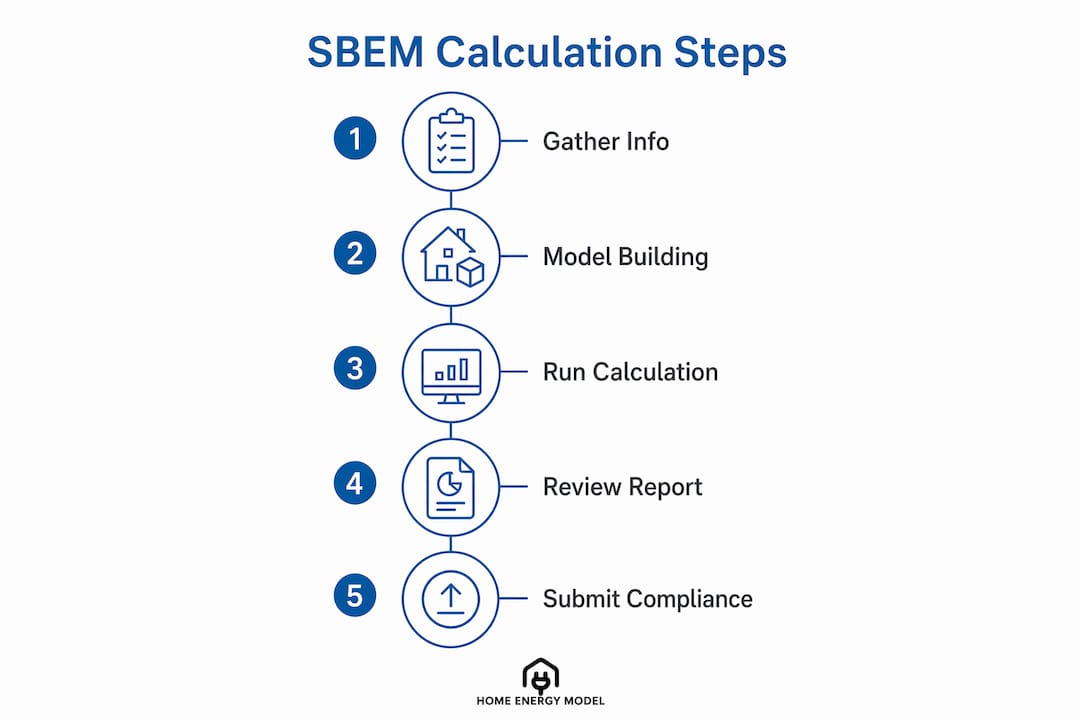
The SBEM compliance workflow follows four clear stages. Understanding each stage helps developers engage local services at the right time and avoid expensive rework.
-
Feasibility review: the assessor reviews the proposed building specification and identifies any Part L compliance risks before detailed design begins. This stage costs relatively little and can save significant fees later by flagging specification issues early.
-
Design development modelling: the assessor runs iterative SBEM models as the design evolves. Each iteration tests a different specification option, such as glazing ratios, insulation levels, or heating system types. Engaging early for iterative modelling integrates energy efficiency into the design rather than retrofitting compliance at the end.
-
Compliance assessment and BRUKL report: once the design is finalised, the assessor produces the formal BRUKL report demonstrating compliance. This document is submitted to Building Control alongside the planning or building notice application.
-
As Built assessment and EPC issuance: at practical completion, the assessor updates the model to reflect the actual specification. The final BRUKL report and non-domestic EPC are lodged with the relevant register.
The information developers must provide at each stage includes:
- Full heating and cooling system specifications, including plant sizes and efficiencies.
- Lighting design with lamp types, control strategies, and zone layouts.
- Ventilation system details, including heat recovery efficiency where applicable.
- Building fabric specifications: U-values for walls, roofs, floors, and glazing.
- Air permeability targets and any pressure test results.
Complete building services information directly improves SBEM output accuracy. Gaps in this data force the assessor to apply defaults, which typically produce a less favourable result.
Pro Tip: Prepare a single document compiling all building services specifications before approaching an assessor. Providing this upfront reduces back-and-forth, speeds up the process, and often reduces fees.
For mixed-use schemes, coordinate the SBEM assessor with the SAP assessor from the start. Early clarification of domestic versus non-domestic areas ensures both assessments use consistent boundary assumptions and avoids conflicting submissions to Building Control.
Timing matters for Building Control submissions. Most local authorities require the As Designed BRUKL report before they will issue a building notice or full plans approval. Leaving the SBEM assessment until after design sign-off creates a bottleneck. Engaging a local assessor during RIBA Stage 2 or 3 is the standard practice for projects that run to programme.
Key takeaways
SBEM calculations are the mandatory compliance tool for non-domestic buildings in England, governed by the 2026 NCM, and require complete building services data to produce accurate, approvable results.
| Point | Details |
|---|---|
| Regulatory trigger | Buildings over 50m² with heated or cooled spaces require SBEM and a BRUKL report. |
| 2026 methodology update | The march 2026 NCM notice supersedes 2025 guidance; confirm your assessor uses compliant software. |
| Cost by building size | Fees range from £450 for small units to £1,500 or more for large or complex buildings. |
| EPC versus real energy use | SBEM-based EPCs use standard assumptions, not measured consumption; ratings reflect design efficiency only. |
| Early engagement saves money | Commissioning SBEM at feasibility stage reduces rework, revision fees, and Building Control delays. |
Why early engagement is the decision most developers get wrong
I have worked with enough developers and landlords to spot the pattern immediately. The SBEM assessment gets treated as a box-ticking exercise, commissioned at the last possible moment before Building Control submission. The assessor receives incomplete information, applies conservative defaults, and the report comes back showing a compliance failure. Then begins the expensive cycle of specification changes, revised drawings, and resubmissions.
The developers who avoid this are the ones who bring the assessor in at feasibility stage. Not because regulations require it, but because iterative modelling during design is genuinely cheaper than retrofitting compliance. Testing three or four specification options during design costs a fraction of what a single failed compliance assessment and subsequent redesign costs.
Local knowledge also matters more than most clients realise. An assessor who regularly submits to a specific Building Control office understands that office’s preferences for report format, level of detail, and response times. That familiarity translates directly into faster approvals. When searching for SBEM services nearby, prioritise assessors with a track record in your local authority area, not just the lowest fee.
The other mistake I see consistently is treating the EPC as a proxy for actual energy costs. Landlords sometimes use the EPC rating to justify rental premiums or investment decisions, without understanding that the rating reflects standardised assumptions. A building with a strong EPC rating can still carry high energy bills if the tenant operates it outside standard hours or with high equipment loads. Understanding energy performance standards in their proper context leads to better property decisions.
— Danny
How Homeenergymodel supports SBEM compliance for UK developers
Homeenergymodel provides clear, practical guidance on SBEM assessments, Part L compliance, and energy performance certification for UK property developers and landlords. The site covers the full range of energy modelling approaches relevant to both domestic and non-domestic buildings, helping property professionals understand which assessment applies to their project and what to expect from the process. Guidance is aligned with the 2026 NCM update, so developers can approach Building Control submissions with confidence. For those managing mixed portfolios or planning new commercial developments, Homeenergymodel offers a practical starting point for understanding compliance requirements and connecting with qualified local assessors.
FAQ
What does SBEM stand for?
SBEM stands for Simplified Building Energy Model. It is the government-approved calculation methodology for assessing the energy performance of non-domestic buildings in England under the National Calculation Methodology.
Which buildings need an SBEM assessment?
Non-domestic buildings over 50m² with heated or cooled environments require an SBEM assessment. The assessment produces a BRUKL report needed for Part L Building Regulations compliance.
How much do SBEM calculations cost in 2026?
Fees typically range from £450–£750 for small units, £750–£1,500 for medium-sized buildings, and £1,500 or more for large or complex developments, depending on building size and services complexity.
What is a BRUKL report?
A BRUKL report is the formal output of an SBEM assessment, demonstrating that a building meets Part L Building Regulations. It is submitted to Building Control at both design and completion stages.
Do I need both SAP and SBEM for a mixed-use development?
Yes. SAP applies to domestic units and SBEM applies to non-domestic areas within the same development. Clarifying the boundary between domestic and non-domestic uses at the start of the project avoids regulatory delays.
Recommended
- SBEM Calculations | SBEM Assessment | SBEM Reports | SBEM EPC
- SAP Calculation Services in London: Ensuring Your New Build Meets Energy Standards – Home Energy Model
- Finding SAP Calculations Near Me: A Londoner’s Guide To Energy Efficiency – Home Energy Model
- Energy modelling best practices for UK properties in 2026