

Nearly every british landlord now feels the pressure as energy regulations shift toward stricter Home Energy Model targets across the United Kingdom. Staying ahead is more than a smart move—it protects property value and avoids costly penalties. Understanding retrofit assessments is crucial for anyone managing residential investments. This guide reveals how these assessments support compliance, maximise efficiency, and safeguard your portfolio as british property standards evolve.
Table of Contents
- Defining A Retrofit Assessment For UK Properties
- Types Of Retrofit Assessments And Key Differences
- How The Retrofit Assessment Process Works
- Legal Duties And Regulatory Compliance
- Costs, Common Pitfalls, And Financial Impact
Key Takeaways
| Point | Details |
|---|---|
| Importance of Retrofit Assessment | Retrofit assessments are essential for enhancing energy efficiency and achieving the UK’s net-zero carbon goals by 2050. They provide a structured methodology for property evaluations. |
| Types of Assessments | Different types of assessments address specific property characteristics, such as energy performance and structural integrity, ensuring tailored recommendations. |
| Compliance and Legal Requirements | Retrofit projects must adhere to legal regulations regarding safety and energy efficiency, and it is vital to engage certified professionals to navigate these complexities. |
| Financial Considerations | Understanding the costs associated with retrofit assessments is crucial, as improper implementations can lead to significant financial risks and hidden expenses. |
Defining a Retrofit Assessment for UK Properties
A retrofit assessment represents a comprehensive evaluation of a property’s current energy performance, identifying potential improvements to enhance efficiency and reduce carbon emissions. This systematic process has become increasingly critical as the United Kingdom advances towards its net-zero carbon objectives by 2050. The new code of practice for retrofit assessment provides a structured methodology for professionals to conduct thorough property energy reviews.
The assessment typically involves a multi-stage process that includes detailed desktop research and on-site investigations. Key elements include:
- Detailed property fabric analysis
- Energy consumption measurement
- Thermal performance evaluation
- Identification of potential retrofit interventions
- Cost-benefit analysis of proposed improvements
- Assessment of potential carbon reduction strategies
Under the British Standards Institution’s BS 40104 guidelines, retrofit assessments now require a more rigorous approach. Assessors must demonstrate advanced understanding of building pathology, energy efficiency principles, and potential heritage considerations. This comprehensive framework ensures that retrofitting recommendations are not just technically sound, but also tailored to the specific characteristics of individual properties.
Pro tip: When preparing for a retrofit assessment, gather all historical property documentation, including previous energy performance certificates, building plans, and maintenance records to provide a comprehensive baseline for the evaluation.
Types of Retrofit Assessments and Key Differences
Retrofit assessments are not a one-size-fits-all approach, but rather a nuanced set of evaluation methods designed to address specific property characteristics and energy performance challenges. The RICS Residential Retrofit Standard outlines several distinct assessment types that provide comprehensive insights into a property’s potential energy efficiency improvements.
The primary types of retrofit assessments include:
- Energy Performance Assessment: Focuses on measuring current energy consumption and identifying potential reduction strategies
- Condition Survey: Evaluates the overall structural integrity and potential risks associated with proposed retrofit interventions
- Ventilation Assessment: Examines current airflow, humidity levels, and potential improvements to ensure healthy indoor environments
- Heritage Significance Assessment: Specialised evaluation for properties with historical or architectural significance, ensuring retrofit measures preserve cultural value
Each assessment type serves a unique purpose within the broader retrofit framework. For instance, a condition survey goes beyond energy metrics to examine potential structural implications of proposed improvements, while a ventilation assessment ensures that energy efficiency modifications do not compromise indoor air quality. The British Standards Institution’s BS 40104 guidelines emphasise the importance of selecting the appropriate assessment type based on individual property characteristics, professional qualifications, and specific project goals.
Here is a summary comparing the focus and benefits of different retrofit assessment types:
| Assessment Type | Primary Focus | Unique Benefit |
|---|---|---|
| Energy Performance | Analysing energy use | Identifies ways to reduce consumption |
| Condition Survey | Structural integrity and risks | Ensures safe retrofit interventions |
| Ventilation Assessment | Air quality and humidity | Supports occupant health |
| Heritage Significance | Historical and architectural features | Preserves cultural property value |
Pro tip: When planning a retrofit assessment, consult multiple professional assessors to ensure you receive a comprehensive evaluation that covers energy performance, structural integrity, and potential heritage considerations.
How the Retrofit Assessment Process Works
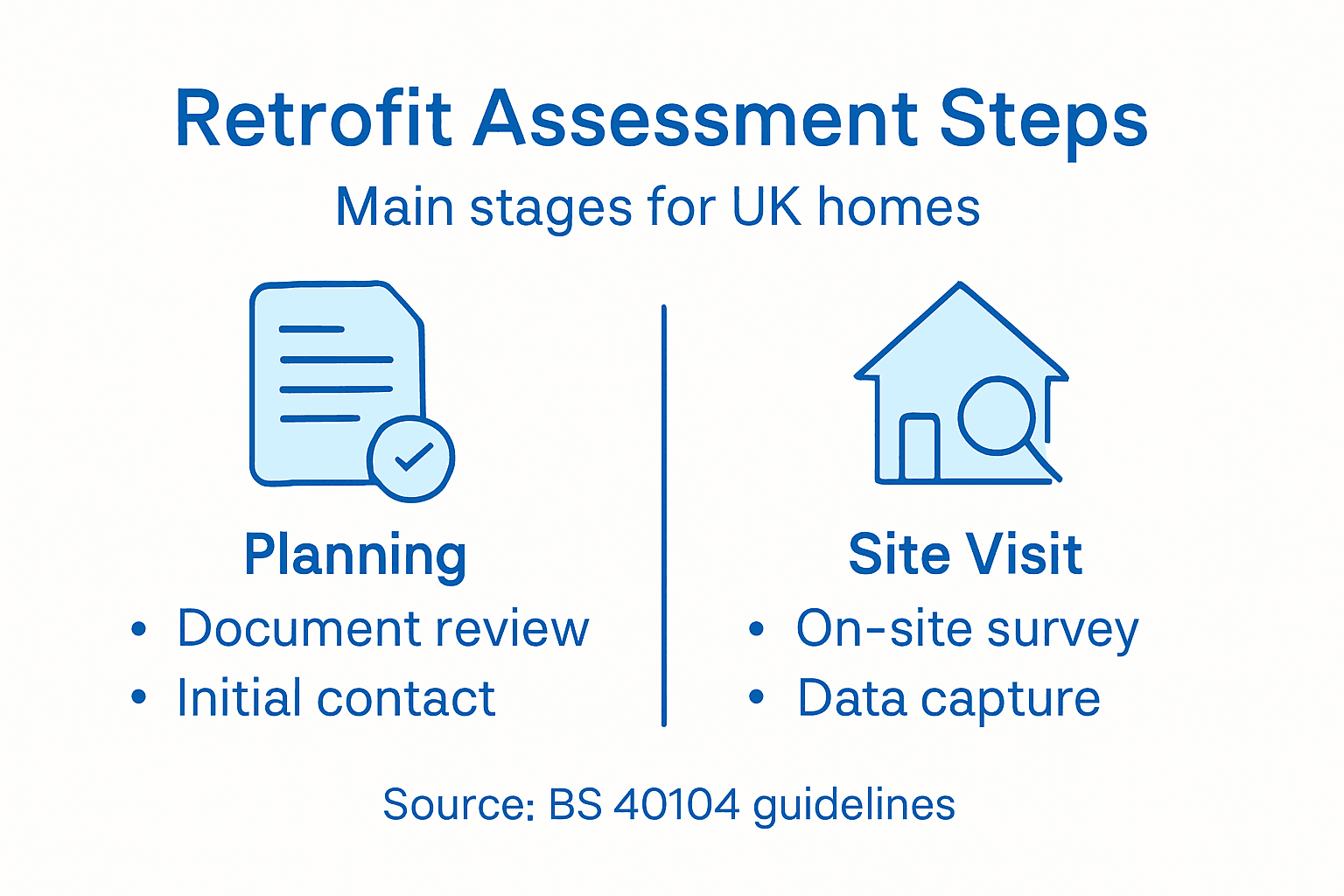
The retrofit assessment process represents a structured approach to evaluating a property’s energy performance and potential improvements. BS 40104 establishes a comprehensive seven-stage methodology that guides professionals through a systematic evaluation of residential properties.
The standard retrofit assessment process typically involves the following key stages:
- Desktop Research: Gathering initial property documentation, historical energy performance records, and architectural plans
- On-Site Survey: Comprehensive physical inspection of the property’s current condition
- Building Fabric Analysis: Detailed examination of walls, roof, windows, and insulation characteristics
- Energy Performance Evaluation: Measuring current energy consumption and identifying potential efficiency improvements
- Ventilation and Indoor Environment Assessment: Reviewing air quality, humidity levels, and potential system upgrades
- Occupancy Pattern Analysis: Understanding how residents use the property to inform targeted improvements
- Recommendation Report: Producing a detailed document outlining proposed retrofit interventions
Qualification is crucial in this process. Assessors must hold specific certifications, including Domestic Energy Assessor (DEA) credentials and Level 3 Retrofit Assessor qualifications. This ensures that the assessment meets rigorous professional standards and provides property owners with accurate, actionable insights into potential energy efficiency upgrades.
Pro tip: Request a sample retrofit assessment report from potential assessors to understand the depth and quality of analysis you can expect during the evaluation process.
Legal Duties and Regulatory Compliance
Retrofit projects in the United Kingdom are subject to a complex framework of legal requirements designed to ensure safety, energy efficiency, and environmental sustainability. Building Regulations 2010 establish critical standards that govern all significant building modifications, including energy retrofit interventions across England and Wales.
The key legal considerations for retrofit projects include:
- Planning Permission: Assessing whether proposed modifications require formal local authority approval
- Building Regulation Compliance: Ensuring all work meets minimum safety and performance standards
- Energy Performance Certification: Documenting and reporting improvements in property energy efficiency
- Health and Safety Regulations: Implementing measures that protect both occupants and construction workers
- Environmental Impact Assessments: Evaluating potential ecological consequences of retrofit interventions
Controlled services such as heating, ventilation, and electrical systems must undergo rigorous compliance checks. Specifically, any modifications must adhere to Approved Documents that provide practical guidance on meeting regulatory standards. Property owners and contractors bear legal responsibility for ensuring that all retrofit works comply with these comprehensive regulations, with potential financial penalties for non-compliance.
Pro tip: Engage a certified retrofit coordinator who understands the intricate legal landscape to navigate regulatory requirements and minimise potential compliance risks.
Costs, Common Pitfalls, and Financial Impact
The financial landscape of retrofit assessments involves careful consideration of both immediate expenses and long-term economic implications. Average retrofit assessment costs range from £120 to £240, covering a comprehensive property evaluation that typically lasts between one to two hours and produces a detailed improvement roadmap.
Key financial considerations include:
- Direct Assessment Costs: Initial professional fees for comprehensive property evaluation
- Potential Remediation Expenses: Estimated improvements based on assessment findings
- Energy Efficiency Savings: Projected long-term reductions in utility expenditure
- Property Value Impact: Potential increases in market value from energy performance upgrades
- Compliance Investment: Expenses related to meeting regulatory standards
Significant financial risks emerge from poor-quality retrofit implementations. Defective installations can lead to substantial hidden costs, with remediation expenses potentially ranging from £2,000 to £10,000 per property. These costs extend beyond direct repair expenses, potentially including health-related issues, reduced property value, and legal complications associated with substandard retrofit work.

The table below outlines common financial risks of retrofitting and their implications:
| Risk Area | Potential Consequence | Example Impact |
|---|---|---|
| Poor Installation Quality | Increased remedial expenses | Unexpected repair costs |
| Non-Compliance | Regulatory fines or legal action | Financial penalties |
| Health Issues | Negative occupant wellbeing | Increased medical expenditure |
| Reduced Property Value | Difficulty selling property | Limited market appeal |
Pro tip: Request a detailed cost-benefit analysis alongside your retrofit assessment to understand the full financial implications and potential return on investment for proposed energy efficiency improvements.
Navigate UK Retrofit Assessments with Confidence and Clarity
The challenge of meeting UK energy standards through thorough retrofit assessments demands not only a detailed understanding of building fabric, ventilation, and heritage factors but also staying ahead of evolving regulatory frameworks. The article highlights key terminology such as BS 40104 guidelines and Domestic Energy Assessor qualifications—terms that can overwhelm property owners and professionals aiming to identify effective retrofit interventions without costly mistakes.
At homeenergymodel.co.uk, we understand these challenges and offer a comprehensive resource to help you grasp the upcoming Home Energy Model (HEM). This innovative methodology will replace SAP in 2025, reshaping how energy performance certificates and retrofit evaluations are conducted across the United Kingdom. By exploring our detailed guidance on energy efficiency calculations and regulatory compliance, you can confidently navigate retrofit assessments and align your property improvements with the Future Homes Standard.
Start your journey towards smarter energy upgrades today by visiting homeenergymodel.co.uk for expert insights and practical advice. Don’t wait until the regulatory landscape changes—prepare now with reliable information and ensure your retrofit projects deliver the performance, savings, and compliance you deserve.
Frequently Asked Questions
What is a retrofit assessment?
A retrofit assessment is a comprehensive evaluation of a property’s energy performance, identifying potential improvements to enhance efficiency and reduce carbon emissions.
What types of retrofit assessments are available?
Key types of retrofit assessments include energy performance assessments, condition surveys, ventilation assessments, and heritage significance assessments, each focusing on different aspects of a property.
How does the retrofit assessment process work?
The retrofit assessment process typically includes desktop research, on-site surveys, building fabric analysis, energy performance evaluation, and the generation of a recommendation report.
What are the common costs associated with retrofit assessments?
Average retrofit assessment costs in the UK range from £120 to £240, which covers the comprehensive evaluation of the property and produces a detailed improvement roadmap.