

TL;DR:
- Improving EPC ratings is essential for UK landlords to meet government deadlines and avoid penalties.
- Strategic retrofits like cavity wall insulation, boilers, and solar panels, combined with proper planning, ensure cost-effective upgrades.
An Energy Performance Certificate (EPC) is the standardised measure of a property’s energy efficiency, rated from A (most efficient) to G (least efficient). Knowing how to improve EPC ratings is now a compliance priority for every UK landlord. UK government policy requires privately rented properties to reach a minimum EPC rating of C by 1 october 2030, with a maximum landlord spend cap of £10,000 per property. Properties that miss this target face letting restrictions and financial penalties. Strategic planning, targeted retrofits, and available grant funding make reaching EPC C achievable for most landlords.
How to improve EPC ratings: the most effective measures
The fastest route to a better EPC rating is targeting measures with the highest SAP point gains relative to their cost. SAP (Standard Assessment Procedure) is the calculation method underpinning every EPC score in England and Wales. Each upgrade adds points to that score, and the right combination moves a property from D or E to C.

The table below shows the most impactful measures, their typical costs, and expected SAP point gains.
| Measure | Typical cost | SAP points gained |
|---|---|---|
| Cavity wall insulation | £500–£1,500 | 10–20 points |
| A-rated condensing boiler | £2,500–£4,000 | 10–20 points |
| Loft insulation (270mm) | £300–£600 | 3–8 points |
| Heating controls upgrade | £200–£500 | 3–8 points |
| Solar PV panels | £5,500–£7,500 | 15–25 points |
| LED lighting replacement | Under £50 | 1–4 points |
Cavity wall insulation and boiler replacement deliver the largest gains per pound spent for most mid-terrace and semi-detached properties. Solar PV panels add the most raw SAP points but carry a 10–15 year payback period, making them better suited to properties that need a significant rating jump.
Key measures to consider, ranked by cost-effectiveness:
- LED lighting: the cheapest single upgrade at under £50, adding 1–4 SAP points immediately.
- Loft insulation (270mm): costs £300–£600 and gains 3–8 points with minimal disruption.
- Cavity wall insulation: costs £500–£1,500 and can add up to 20 SAP points.
- Heating controls: smart thermostats and programmers cost £200–£500 and add 3–8 points.
- A-rated condensing boiler: costs £2,500–£4,000 and gains 10–20 points.
- Solar PV: costs £5,500–£7,500 and adds 15–25 points for properties needing a large rating jump.
Pro Tip: Always use MCS or TrustMark certified installers. Uncertified work disqualifies properties from grant funding and may void warranties, creating compliance risk down the line.
For properties considering renewable upgrades, understanding solar panel efficiency helps landlords assess whether PV panels will deliver the SAP gains needed to justify the upfront cost.
How to plan and prioritise EPC improvement works
Improving an EPC rating is not linear. A model-based retrofit assessment is superior to following generic EPC software recommendations, because EPC reports do not account for specific building defects or the interaction between measures. Landlords who act on EPC recommendations alone risk spending money on upgrades that deliver fewer points than expected.
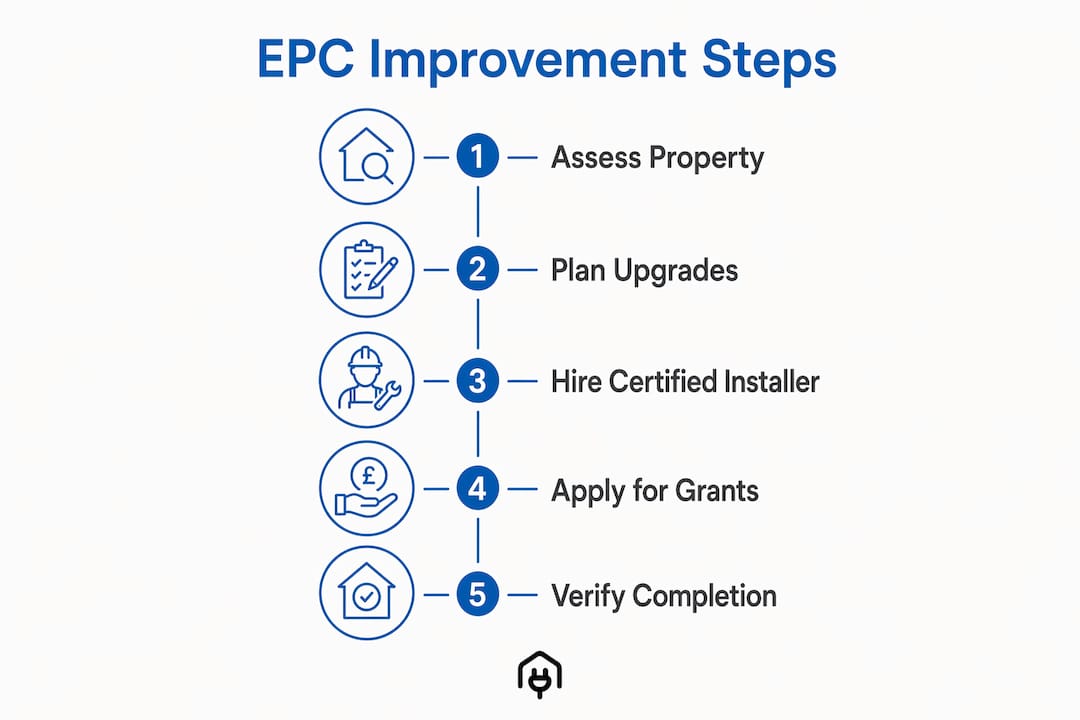
A structured planning approach avoids this waste. The recommended sequence is:
- Conduct a stock-condition audit. Inspect each property for existing insulation, boiler age, window glazing, and heating controls. This baseline prevents spending on measures already partially in place.
- Commission a retrofit assessment. A qualified retrofit assessor models the property’s specific fabric and systems. This produces a cost-per-point analysis showing the minimum spend path to EPC C.
- Rank measures by cost per SAP point. Divide the cost of each measure by the SAP points it adds. Prioritise the lowest cost-per-point options first.
- Bundle compatible measures. Combining loft insulation with cavity wall insulation in one contractor visit reduces labour costs and disruption compared to separate visits.
- Align works with tenancy voids. Major retrofit works like external wall insulation can take several weeks. Scheduling during a void period avoids tenant disruption and potential legal exposure under Awaab’s Law.
- Commission a new EPC after works. A post-works EPC confirms the rating improvement and provides the compliance documentation needed for letting.
The most common planning mistake is doing only the cheapest fixes first without modelling the full upgrade path. A landlord who installs LED lighting and a new thermostat may spend £500 and gain only 5 SAP points, leaving the property still at D. A retrofit assessment would have identified that cavity wall insulation at £800 delivers 15 points, reaching EPC C in a single measure.
Pro Tip: For landlords with multiple properties, portfolio-wide planning with a single contractor unlocks bulk pricing. Negotiating a fixed rate per property across ten or more units can reduce per-property costs by a meaningful margin.
What government funding supports EPC improvements?
Several government schemes reduce the net cost of EPC improvements, and stacking multiple schemes against a single property maximises the funding available.
Key schemes currently available:
- Boiler Upgrade Scheme (BUS): offers £7,500 grants for air source or ground source heat pump installations. Installations must be completed by MCS-certified contractors.
- Great British Insulation Scheme (GBIS): supports insulation upgrades for eligible households, including cavity wall and loft insulation. Eligibility is based on property EPC rating and household income.
- ECO4: local authority-administered grants covering insulation, heating upgrades, and low-carbon heating for low-income households. Landlords with eligible tenants can access this funding.
- Local authority grants: many councils offer supplementary funding for energy efficiency works. Eligibility and amounts vary by region.
The £10,000 cost cap set by government policy counts reasonable EPC improvement costs toward the landlord’s maximum spend obligation. Grant funding received reduces the net cost, but the cap applies to total eligible expenditure, not the landlord’s out-of-pocket contribution.
| Scheme | Maximum grant | Eligible measure |
|---|---|---|
| Boiler Upgrade Scheme | £7,500 | Heat pumps |
| Great British Insulation Scheme | Varies | Insulation |
| ECO4 | Varies | Multiple measures |
Stacking BUS with GBIS on the same property, where eligible, can cover a substantial portion of the upgrade cost. The critical requirement across all schemes is that installations must be completed by MCS or TrustMark certified contractors. Non-certified work disqualifies the property from grant claims and may invalidate warranties.
How to verify and document EPC improvements for compliance
Documentation is the final step that landlords most frequently overlook. Properly documented retrofits can add 3–5% to a property’s sale price. Uncertified work may invalidate warranties or cause compliance failure at the point of sale or re-letting.
The documentation checklist every landlord should maintain:
- Pre-works EPC: the baseline certificate confirming the starting rating.
- Post-works EPC: commissioned after all major upgrades are complete, confirming the new rating.
- Installer certificates: MCS or TrustMark completion certificates for each measure.
- Invoices and receipts: itemised records of all expenditure, needed to demonstrate compliance with the £10,000 cost cap.
- Warranties: manufacturer and installer warranties for boilers, insulation, and renewable systems.
- Exemption registration: where a property cannot reach EPC C within the cost cap, landlords must register an exemption on the PRS Exemptions Register before the compliance deadline.
The EPC exemption process has specific timelines and evidence requirements. Landlords should not assume exemption applies without formally registering it.
Pro Tip: Store all documentation in a single digital folder per property, labelled with the property address and compliance year. This makes it immediately accessible during tenancy checks, sales due diligence, or local authority inspections.
What are the common mistakes in EPC improvement projects?
EPC improvement projects fail most often because landlords treat the EPC report as a specification rather than a starting point. EPC software recommendations do not account for specific building defects, meaning a recommendation for cavity wall insulation may be unsuitable for a property with moisture ingress or non-standard wall construction.
Commissioning a dedicated retrofit assessment before spending any money is the single most effective way to avoid wasted capital. A human assessor identifies building-specific constraints that EPC software cannot detect, and models the interaction between measures to find the most cost-effective upgrade path.
Common pitfalls to avoid:
- Ignoring building defects. Damp, structural cracks, or non-standard construction can make standard insulation measures ineffective or damaging.
- Acting on EPC recommendations without a retrofit assessment. Generic software outputs do not reflect the specific property.
- Poor timing of works. Scheduling disruptive works during an active tenancy risks rent loss and legal exposure.
- Accepting the first quote. Multiple quotes and a value-per-point analysis identify the best contractor for the specific upgrade package.
- Underestimating the full upgrade path. Cheap fixes alone rarely reach EPC C. Modelling the full path before starting avoids partial spend that still leaves the property non-compliant.
For London landlords, the EPC improvement strategies relevant to older stock, including Victorian terraces and mansion flats, differ significantly from those for modern builds. Older properties often require solid wall insulation rather than cavity fill, which changes the cost and disruption profile considerably.
Key takeaways
Reaching EPC C by 2030 requires a planned, measure-specific approach that combines retrofit assessments, certified installations, and grant funding to minimise cost and maximise SAP point gains.
| Point | Details |
|---|---|
| Compliance deadline | UK privately rented properties must reach EPC C by 1 october 2030, with a £10,000 landlord spend cap. |
| Highest-impact measures | Cavity wall insulation and A-rated boilers each add 10–20 SAP points and deliver the best cost-per-point value. |
| Retrofit assessment first | Commission a retrofit assessment before spending, to avoid wasted capital on measures unsuitable for the specific property. |
| Stack grant funding | Combining the Boiler Upgrade Scheme, GBIS, and ECO4 reduces net landlord cost significantly. |
| Document everything | Full documentation of EPCs, certificates, and invoices adds 3–5% to sale price and protects compliance status. |
Why upfront planning is the real differentiator for landlords
I have seen landlords spend £3,000 on a new boiler and LED lighting, only to find their property is still rated D. The upgrades were real and the work was done properly. The problem was the order of operations. Without modelling the full upgrade path first, they spent money on measures that moved the needle, but not far enough.
The landlords who reach EPC C most efficiently are the ones who treat the retrofit assessment as a non-negotiable first step, not an optional extra. That assessment typically costs a few hundred pounds. It saves multiples of that by identifying the minimum-cost path to compliance and ruling out measures that look cheap but deliver poor SAP gains for that specific property.
Government schemes like the Boiler Upgrade Scheme and ECO4 will not be available indefinitely at current funding levels. Landlords who act now, while grants are accessible and certified contractors have capacity, will spend less than those who wait until 2029 when demand spikes. The EPC ratings guide from Homeenergymodel sets out the full compliance picture for UK landlords navigating the 2030 deadline.
The property value argument is equally compelling. Documented retrofits add 3–5% to sale price. For a £300,000 property, that is £9,000–£15,000 in added value, often exceeding the total cost of the upgrades themselves.
— Danny
How Homeenergymodel supports landlords with EPC planning
Homeenergymodel provides landlords and property owners with the technical guidance needed to plan EPC improvements without wasted spend. The platform covers retrofit modelling, grant eligibility, and the transition from SAP to the new Home Energy Model (HEM) methodology, which replaces SAP for new builds from 2025 onwards. Landlords managing multiple properties can use the home energy models guide to understand which assessment approach suits their portfolio. For those starting with a single property, the home energy assessment resource outlines the practical steps from baseline audit to post-works EPC, helping landlords reach EPC C on budget and on time.
FAQ
What is the minimum EPC rating required for rented properties in the UK?
UK government policy requires privately rented properties to reach a minimum EPC rating of C by 1 october 2030. Properties graded C or above under the legacy metric before that date remain compliant until their certificate expires.
How much can a landlord spend on EPC improvements before claiming an exemption?
The maximum landlord spend cap is £10,000 per property. If a property cannot reach EPC C within that spend, the landlord may register an exemption on the PRS Exemptions Register.
Which EPC improvement adds the most SAP points?
Solar PV panels add 15–25 SAP points, making them the highest single-measure gain. Cavity wall insulation and A-rated condensing boilers each add 10–20 points at lower cost, making them the better value option for most properties.
Do landlords need a new EPC after completing improvement works?
A new EPC must be commissioned after major works to confirm the updated rating. The post-works certificate is the primary compliance document for letting and sale purposes.
What grants are available to reduce EPC improvement costs?
The Boiler Upgrade Scheme offers £7,500 for heat pump installations. The Great British Insulation Scheme and ECO4 cover insulation and heating upgrades for eligible properties. All schemes require MCS or TrustMark certified installers.