

TL;DR:
- Approximately 15% of homes in England fail the Decent Homes Standard, with costs of upgrades running into billions of pounds.
- Local authorities face expanding enforcement duties, including acting against hazards and energy inefficiency, using significant penalties and discretion to accommodate technical and financial challenges.
- Effective enforcement requires integrated governance, strategic planning, community engagement, and access to technical resources, with leadership driven by data and proactive policies.
Around 15% of dwellings in England currently fail the Decent Homes Standard, and the combined cost of bringing those homes up to scratch runs into tens of billions of pounds. For local authority officers, this is not an abstract policy problem. It is a direct, operational responsibility that is growing more complex as national energy efficiency regulations evolve. With the Future Homes Standard and a reformed Decent Homes Standard reshaping the regulatory landscape, local authorities need precise clarity about their duties, their powers, and the practical strategies that will make enforcement both effective and legally sound.
Table of Contents
- Understanding the expanded duties under the Decent Homes Standard
- The scale of the challenge: compliance gaps and cost implications
- Flexible enforcement: recognising edge cases and emergency powers
- Overcoming governance barriers to effective enforcement
- A realistic blueprint for local authority leadership
- Take the next steps with expert energy support
- Frequently asked questions
Key Takeaways
| Point | Details |
|---|---|
| Expanded enforcement powers | Local authorities now hold significant powers and penalties to raise housing and energy standards. |
| Massive compliance gap | Nearly half of social and private rented homes need upgrades, requiring careful targeting of enforcement. |
| Flexibility is essential | Some properties may be exempt from standards due to feasibility or safety, with local discretion. |
| Governance challenges remain | Effective cross-department working and clear plans are vital for real progress on housing quality. |
| Leadership makes the difference | Proactive, innovative local authority leadership unlocks progress and system-wide improvement. |
Understanding the expanded duties under the Decent Homes Standard
With the stage set, it is crucial to clarify exactly what local authorities are being asked to deliver under new legislation. The reformed Decent Homes Standard (DHS) introduces significant changes to the obligations placed on local councils. Previously, enforcement activity was more narrowly focused on physical condition and hazards. The updated framework substantially widens the scope.
Local authorities now have a statutory duty to enforce against Category 1 hazards and failures relating to minimum energy efficiency, with EPC band C set as the target standard. This applies across both the social rented sector and the private rented sector, although timescales and specific requirements differ between the two.
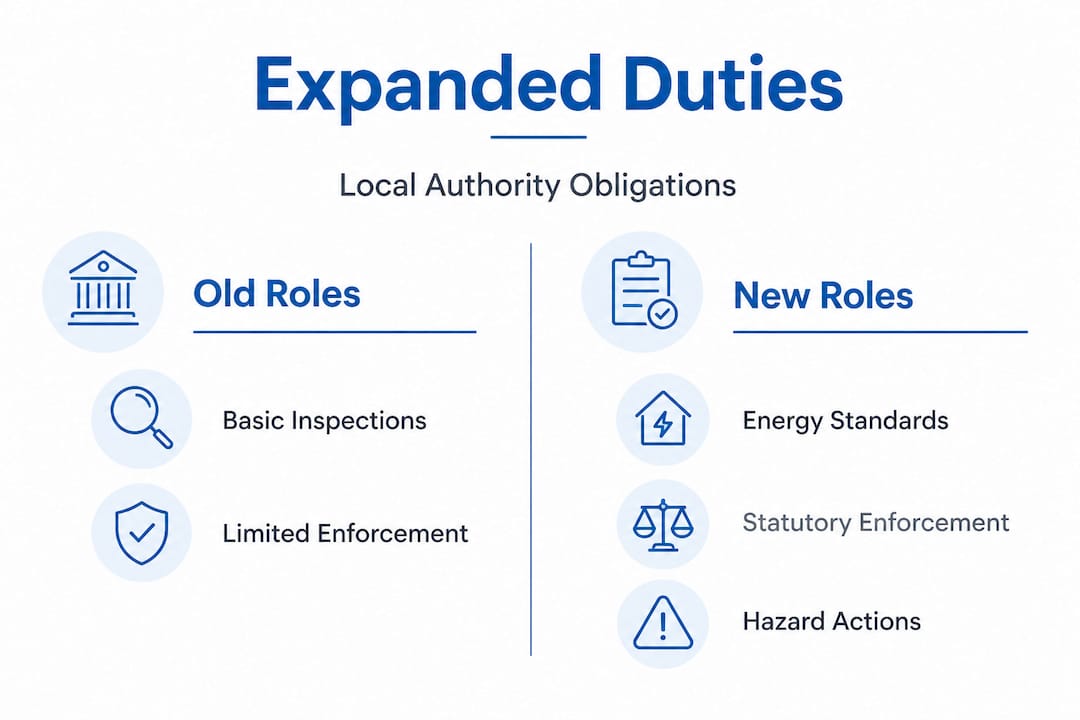
Understanding where accountability sits is essential. Social landlords, including local councils and housing associations, are responsible for ensuring their own stock meets the standard. For private rented homes, local authorities act as the enforcement body, investigating complaints and initiating action against non-compliant landlords. This dual role demands that councils have robust internal processes for both direct compliance and third-party enforcement.
The penalty structure is a significant deterrent for landlords and property managers. Key facts about enforcement powers include:
- On-the-spot fines of up to £7,000 for Category 1 hazard violations
- Civil penalties of up to £40,000 for other serious failures, including persistent non-compliance with energy efficiency requirements
- Rent repayment orders which allow tenants to recover rent paid during periods when a property was non-compliant
- Prohibition orders preventing a property from being let until remedial work is completed
A useful point of reference for officers navigating the connections between these new duties and broader energy policy and property standards can help frame the enforcement context within the wider 2030 compliance picture. Similarly, understanding the baseline of 2025 housing energy standards is a practical starting point for any authority building its enforcement strategy.
The scope in practice
| Sector | Minimum EPC target | Enforcement body | Primary accountability |
|---|---|---|---|
| Social rented | Band C | Social landlord | Housing association / council |
| Private rented | Band C | Local authority | Private landlord |
| Owner-occupied | Not currently mandated | N/A | Homeowner |
This table illustrates that the bulk of enforcement burden sits with local authorities when addressing private rented stock. The owner-occupied sector currently sits outside mandatory requirements, but councils should anticipate this changing as national targets tighten.
The scale of the challenge: compliance gaps and cost implications
Understanding the duties is only part of the picture. The sheer volume of homes requiring intervention introduces formidable resource and budget challenges for any council operating under financial constraints.
The 2023-24 English Housing Survey reveals the true scale of the task. Approximately 46% of social rented homes and 48% of private rented homes fail the current Decent Homes Standard, with estimated upgrade costs of £11.3 billion for the social sector and £26.5 billion for private rented stock. These are national figures. Translating them to a local level makes the challenge concrete.
Consider a mid-sized English local authority with approximately 80,000 households. If close to half of privately rented homes in that area fall below the required standard, the authority could be dealing with thousands of non-compliant properties. Prioritising inspection, issuing notices, and monitoring remediation across that caseload requires substantial staffing capacity and a clear triage system.
The financial implications for local authorities are layered. Direct costs include staffing enforcement teams, commissioning independent EPC assessments, and managing legal proceedings against non-compliant landlords. Indirect costs include the public health burden of poor housing, which creates demand for NHS services and social care. Investing in enforcement is genuinely cost-effective when viewed across departmental budgets, but this argument often needs to be made explicitly at leadership level.
Key cost and compliance considerations for local authority budgeting:
- Allocating ring-fenced budgets for housing enforcement, separate from general planning expenditure
- Investing in digital case management systems to track enforcement caseloads efficiently
- Establishing protocols for cost recovery from landlords following successful enforcement action
- Accessing government grant funding, such as the Warm Homes: Local Grant, to offset upgrade costs in the private rented sector
- Partnering with neighbouring authorities to share specialist staffing resources, particularly for complex technical assessments
Understanding why energy efficiency matters beyond compliance is equally important for officers making the internal case for enforcement investment. And for a grounding in how energy performance standards are measured and verified, officers benefit from knowing how EPC ratings are calculated before challenging disputed assessments.
Flexible enforcement: recognising edge cases and emergency powers
Given the size and complexity of the task, it is vital to recognise where the law itself allows a tailored and pragmatic approach. Not every property can or should be treated identically under the regulations.
Government guidance confirms that local authorities can relax or suspend energy efficiency requirements where standards are technically infeasible or financially unreasonable given the property’s characteristics. This might apply to listed buildings, properties with unusual construction types, or cases where the cost of upgrades would be disproportionate relative to the property’s value or rental income.
The circumstances under which discretion may be exercised include:
- Technical infeasibility where structural or heritage constraints make standard upgrades impossible without causing damage or loss of character
- Disproportionate cost where the investment required significantly exceeds what is reasonable relative to the property’s rental value
- Short remaining useful life of a building scheduled for demolition or major refurbishment within a defined timeframe
- Imminent safety risk requiring emergency intervention before any standard upgrade process can be completed
The emergency powers element deserves particular attention. Local authorities retain the right to act swiftly when there is an imminent risk of serious harm to occupants. This can include issuing Emergency Prohibition Orders, which immediately prevent occupation of a property, or taking direct action to remedy hazards and billing the costs to the landlord.
“Enforcement discretion is not a loophole. It is a mechanism to ensure regulations achieve their intended outcome without creating perverse incentives or undeliverable demands.”
Pro Tip: When applying discretion, always document the reasoning in writing. Clear records of why an exemption or postponement was granted protect the authority in the event of challenge and build an evidence base for future policy refinements.
Officers dealing with complex borderline cases will find practical guidance on EPC exemption criteria directly relevant to these decisions. For properties where the technical picture is genuinely uncertain, commissioning a thorough review using energy modelling for homes provides the robust evidence base that justifies enforcement decisions.
Overcoming governance barriers to effective enforcement
Embracing regulatory flexibility is important, but governance issues can be just as limiting as legal ones. Many local authorities find that their ability to enforce housing standards effectively is constrained not by the law, but by internal organisational structures.

Research published in academic energy literature confirms that siloed working and the absence of consistent post-project evaluation are among the most significant barriers to progress. Housing teams, planning departments, sustainability officers, and legal teams often operate independently, leading to duplicated effort and missed opportunities for joined-up enforcement action.
Common governance barriers and recommended strategies:
- Organisational silos: Create cross-departmental enforcement working groups with representatives from housing, legal, sustainability, and finance teams. This ensures that enforcement decisions are legally sound, financially viable, and aligned with local energy strategies
- Poor data sharing: Implement shared property databases that allow housing officers, planners, and energy assessors to access and update the same records, reducing duplication and improving case tracking
- Inconsistent evaluation: Establish post-project review processes for every completed enforcement case, capturing what worked and what required deviation from standard procedure
- Lack of local energy planning: Develop Local Area Energy Plans (LAEPs) that map current housing stock performance against future targets, enabling proactive prioritisation rather than reactive complaint-handling
- Capacity constraints: Explore regional consortia with neighbouring authorities to pool specialist energy assessment expertise, particularly for complex heritage or non-traditional construction cases
The introduction of LAEPs represents a genuine shift in how local authorities can approach housing energy efficiency. Rather than waiting for complaints to trigger enforcement, a LAEP identifies geographical clusters of poor-performing stock and allows councils to programme proactive intervention.
Pro Tip: Linking LAEP priorities to private sector rented licensing schemes creates a natural enforcement pipeline. Properties identified through data analysis as likely non-compliant can be inspected as part of licensing renewal, reducing the reliance on complaint-driven enforcement alone.
A structured home energy assessment process aligned with internal governance workflows gives housing officers the technical data they need to support decision-making at each stage of enforcement.
A realistic blueprint for local authority leadership
Compliance is the floor, not the ceiling. The most effective local authorities are those that go beyond meeting the legal minimum and actively shape their housing stock towards better energy outcomes. This is a point that deserves stronger emphasis in policy discussions.
The distinction between compliance-focused councils and genuinely leadership-driven councils is visible in outcomes. Compliance-focused authorities wait for the regulatory framework to mandate action. Leadership-driven authorities run pilot retrofit programmes before mandates arrive, test community-led enforcement models, and feed lessons back to national government. They treat their housing stock as an asset to be actively improved, not a liability to be minimally managed.
Data-driven decision-making is central to this leadership approach. Councils that invest in comprehensive property data, including current EPC ratings, heating system types, age of construction, and occupant vulnerability profiles, are able to target resources where they will deliver the greatest combined benefit. Social value, carbon reduction, fuel poverty relief, and enforcement efficiency all improve when decisions are informed by complete, accurate data.
Community engagement is another underutilised asset. Tenants and residents often have the most direct knowledge of a property’s condition and are more likely to report problems early when they trust the enforcement process. Councils that invest in accessible, multilingual reporting channels and provide transparent feedback on action taken build the trust that makes enforcement more effective over time.
The most forward-thinking authorities are already achieving higher energy ratings not just through enforcement but through incentive programmes that support landlords in making voluntary upgrades ahead of statutory deadlines. This approach reduces adversarial relationships and can accelerate improvement at scale.
Surfacing edge case learnings to national government is perhaps the most undervalued contribution local authorities can make. When an authority discovers that a particular construction type makes standard EPC methodology unreliable, or that a specific exemption category is being systematically misused by landlords, feeding this intelligence upward strengthens the national regulatory framework for everyone.
Take the next steps with expert energy support
Moving from regulatory understanding to operational delivery requires access to the right tools and technical guidance. Homeenergymodel.co.uk offers local authority officers and housing professionals a range of practical resources to support this transition. Whether the priority is understanding how energy assessments are structured, reviewing how the Home Energy Model will replace SAP methodologies, or accessing technical detail on EPC calculations, the site provides clear and actionable information. Officers can explore guidance on how to request a home energy assessment to support enforcement decisions, or review the practical detail available in the energy simulation guide to understand how modelling tools can underpin more robust and defensible enforcement action across complex property types.
Frequently asked questions
What enforcement powers do local authorities have under the new Decent Homes Standard?
Local authorities can fine property owners up to £7,000 for Category 1 hazard violations and up to £40,000 for other serious failures, including non-compliance with energy efficiency requirements.
Can local authorities exempt some properties from energy efficiency upgrades?
Yes. Authorities may relax or suspend requirements where upgrades are technically or financially unfeasible, or where genuine safety or heritage constraints exist.
What are the most common barriers to local authority enforcement of energy efficiency?
Siloed working and the absence of consistent post-project evaluation are the most significant governance barriers, making enforcement inconsistent and reducing learning across the sector.
How many UK homes currently fail the Decent Homes Standard?
Around 3.8 million homes, representing approximately 15% of the total housing stock, fail to meet the standard based on the most recent 2023-24 survey data.
Recommended
- Online SAP Calculations: London’s Fast Track to Energy Efficiency Compliance – Home Energy Model
- How energy use is measured: compliance guide for UK owners
- Home Energy Habits Workflow for UK Compliance Success
- Empowering London’s Homes: Energy Performance Certificates Leading the Way to Green Efficiency – Home Energy Model