

The most reliable energy saving ideas for business fall into three groups: no-cost habit changes, low-cost fixes to lighting, heating, cooling and equipment, and planned upgrades backed by an assessment of how the building actually uses energy. Government guidance for small and medium-sized enterprises (SMEs) puts the potential at 18 to 25% off the average energy bill, with an average payback of under 1.5 years. This guide sets out where to start, what each measure involves and how to confirm the savings are real.
TL;DR
- Start with no-cost actions: switch off equipment out of hours, review thermostat settings and clear vents. Nearly half of business electricity use happens outside standard operating hours.
- Lighting is usually the quickest upgrade. LEDs, daylight use and occupancy sensors cut consumption without changing how the space works.
- Heating, cooling and air conditioning respond to settings, servicing and sealing air leaks before any equipment is replaced.
- Measure a baseline first, then track results. Savings that are not recorded are hard to repeat or justify to a finance team.
- Larger projects, new builds and refurbishments benefit from formal calculations such as EPCs, SBEM and dynamic simulation.
Table of Contents
- Where energy is lost in a typical business
- Step one: measure before changing anything
- No-cost and low-cost ideas
- Lighting: the fastest upgrade
- Heating, cooling and the building fabric
- Equipment, refrigeration and industrial processes
- Smart controls and monitoring
- Putting measures in order
- Track and keep the savings
- Landlords, tenants and property investors
- Our perspective
- Getting an assessment
- FAQ
- Sources
Where energy is lost in a typical business
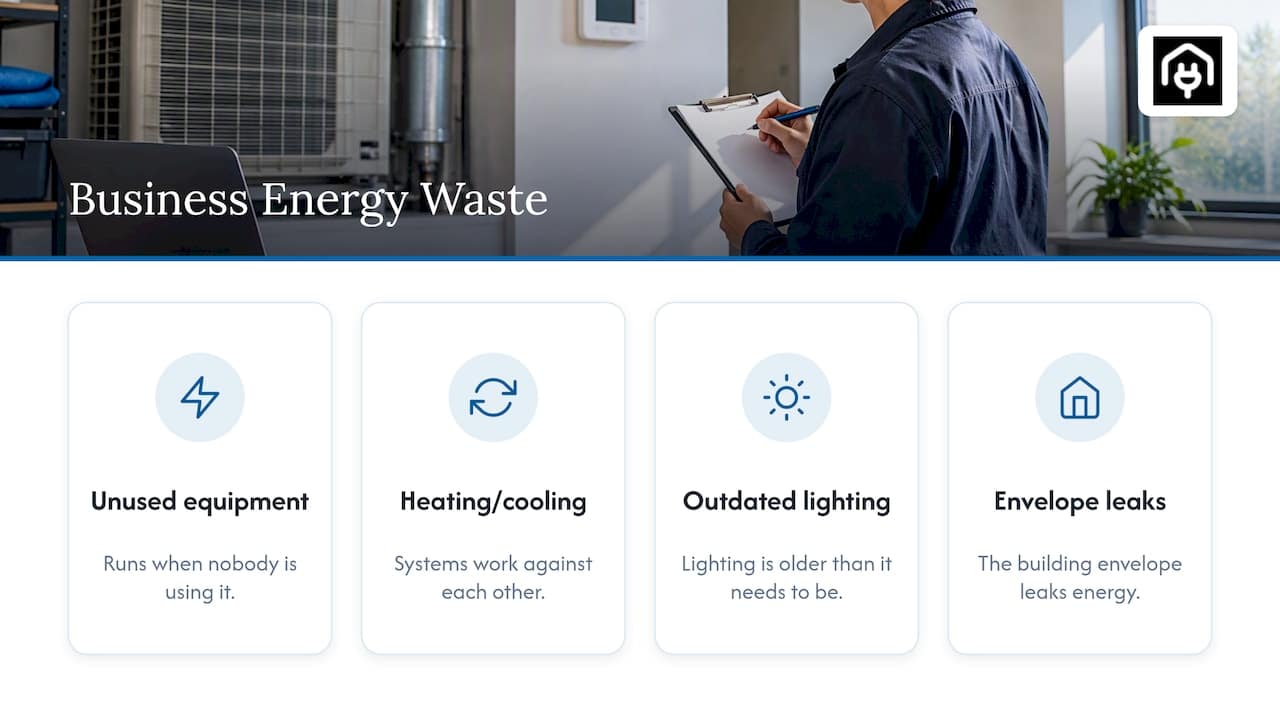
Every premises is different, but the pattern repeats. Energy is wasted when equipment runs with nobody using it, when heating and cooling work against each other, when lighting is older than it needs to be and when the building envelope leaks. Fixing these, in that order of effort, delivers most of the early gain.
Small business owners rarely have spare time or capital for complex projects. That is why simple operating, maintenance and behaviour changes carry so much weight: they cost little and can be done this week. Larger investments are then chosen on evidence, not guesswork.
A useful starting question is when the premises uses the most energy. If the answer is overnight or at weekends, the savings are in controls and switching off. If the answer is during trading hours, the savings are more likely in efficiency of heating, cooling, lighting and equipment.
Step one: measure before changing anything
A baseline turns energy saving from a set of opinions into a plan. Without one, there is no way to say whether a change worked.
- Collect 12 months of bills or meter readings. A full year captures seasonal heating and cooling loads.
- Read the meter at different times. Compare a reading at close of business with one before opening. The difference shows what the premises uses while empty.
- Walk the building. Note every item left on, every lamp type, every thermostat, every draught and every piece of plant that is noisy, hot or old.
- Do an after-hours check. ENERGY STAR, the US programme, suggests a night-time audit to find equipment left running that should be powered down. The method works in any UK office, shop or unit.
- Give someone responsibility. New Zealand’s energy efficiency authority recommends assigning energy management to named staff and keeping a live action list of opportunities. One owner and one list keep the work moving.
For a wider framework covering strategy, monitoring and investment, the guide on optimising business energy consumption goes further into planning.
No-cost and low-cost ideas
These measures need little or no budget. They are the right first move for any business, whatever its size.
Switch off what is not in use
Simple actions such as turning off lights in unoccupied rooms, clearing vents of debris and swapping space heaters for extra layers take little effort and add up to big savings. Put a short closing checklist by the door: lights, screens, printers, kettles, heaters, signage and server-room fans where safe to do so.
Set sensible temperatures
Government advice for UK businesses is to set office heating to 19°C and cooling to 24°C or higher, which keeps staff comfortable at a low running cost. Two further habits help:
- Set heating to start only shortly before opening and stop shortly before closing, not to run all day.
- Stop heating and cooling running at the same time in the same space. A thermostat dead band between the two set points prevents it.
Guidance on getting more from controls is in how to use a thermostat to save energy, which applies equally to small commercial units.
Use power-saving settings
Enable sleep modes on computers, monitors and printers, and set them to apply automatically. Smart power strips cut standby loads at desks and workstations. Where several staff share a printing area, one networked multifunction device can replace several stand-alone machines. ENERGY STAR’s checklist says consolidating to one networked device per 10 or more users can yield 30 to 40 percent savings across electricity, hardware, consumables and maintenance.
Keep equipment clean and maintained
Dirty or blocked equipment works harder. Victoria’s energy agency notes that refrigerated display cabinets that are not regularly cleaned can use up to 10% more energy. Clean condenser coils, replace worn door seals and keep air intakes clear on refrigeration, ventilation and air conditioning.

Use daylight
Arranging desks and work areas near windows reduces the hours artificial lighting is needed. Keep windows and roof lights clean and avoid blocking them with stock or partitions.
Lighting: the fastest upgrade
Lighting is often the first capital measure because it is simple, proven and quick to install. ENERGY STAR reports that turning lights off when not needed, or when daylight is enough, can reduce lighting costs by 10 to 40 percent.
| Measure | What it involves | Best suited to |
|---|---|---|
| LED replacement | Swap fluorescent, halogen and incandescent lamps for LED equivalents | Offices, shops, workshops, corridors |
| Occupancy sensors | Lights switch off in empty rooms | Toilets, storerooms, meeting rooms, stairwells |
| Daylight dimming | Lights reduce output near windows | Open-plan offices, showrooms |
| Task lighting | Light placed where work happens, not the whole room | Desks, benches, counters |
| Time controls | Scheduled switch-off outside trading hours | Signage, external and car-park lighting |
UK government advice also points to an easy win for older premises: T12 fluorescent lamps can be cheaply replaced with T8 lamps, and LED tubes save more again. For the wider case, see the real energy, cost and health benefits of LED lighting.
When specifying LEDs, check that the fittings are compatible with the lamps, that colour temperature suits the task and that dimmable circuits use dimmable lamps. Replace in the areas with the longest operating hours first, since those repay fastest.
Heating, cooling and the building fabric
Heating and cooling are typically the largest energy uses in an office, shop or hospitality venue. The approach is the same in each: reduce the demand, then make the supply efficient.
Reduce demand first
ENERGY STAR’s checklist for commercial buildings lists the basics: weather-strip and caulk air leaks, maintain HVAC systems and adjust thermostat set points. In UK premises the usual culprits are:
- Gaps around doors and windows, especially loading bays and shopfront entrances.
- Uninsulated roof voids and flat roofs.
- Single glazing, where secondary glazing or film may be a practical interim step.
- Loose or missing pipe and boiler insulation in plant rooms.
- Doors propped open while heating or cooling is on.
Then make the plant efficient
Service boilers, heat pumps and air handling units on a regular schedule. Check that time clocks and controls match the real occupancy pattern, as these settings drift over time. Natural Resources Canada observes that automated controls are often under-used, so setting them properly can improve performance even where an automation system is already installed. The same source stresses that scheduled recommissioning of building systems can extend equipment life, reduce maintenance costs and improve comfort.
Air conditioning
Air conditioning is easy to overuse. Raise set points, shut doors and blinds on sunny elevations, and keep filters and coils clean. Larger systems are also subject to inspection requirements, covered by TM44. Details of what an inspection involves are on the TM44 air conditioning inspection page, and an inspection report typically lists efficiency improvements to consider.
Equipment, refrigeration and industrial processes
Office and workshop equipment adds up across a year. Equipment left running is the obvious cost, but poor maintenance is the quiet one.
- Compressed air: check regularly for leaks, since leaking air systems waste energy around the clock. ENERGY STAR’s checklist includes this under industrial equipment servicing.
- Refrigeration: keep units clean, seals intact and doors closed; do not overload cabinets so air cannot circulate.
- Motors and pumps: switch off when idle and consider variable speed drives for loads that change through the day.
- Workstations: Australia’s energy site warns that a single computer and monitor left on around the clock can cost over $200 a year in Australian conditions, so the same habit costs a UK business real money at current tariffs.
Manufacturers have extra opportunities in heating and insulation, workshop lighting and equipment optimisation. Process-heavy sites usually justify a detailed audit before capital is committed.
Smart controls and monitoring
Smart meters, sub-meters and building management systems show where energy goes, hour by hour. That visibility makes out-of-hours waste obvious and turns anomalies, such as a heater running every weekend, into quick fixes. The overview of smart buildings energy efficiency covers the technologies that deliver in practice.
For smaller premises, a plain schedule on a programmable thermostat and timers on water heaters and signage provide a large share of the benefit at very low cost.
Putting measures in order
A simple way to rank ideas is to sort by cost, speed and effect on the baseline.
| Priority | Type of action | Typical examples | Effort |
|---|---|---|---|
| 1 | No cost | Switch-off routine, set points, closing checklist | Hours |
| 2 | Low cost | Power strips, draught-proofing, cleaning, servicing | Days |
| 3 | Moderate | LED upgrade, sensors, time controls, pipe insulation | Weeks |
| 4 | Planned capital | Insulation, glazing, heating plant, heat pumps, solar | Months |
The UK government’s SME guide quotes an average payback of less than 1.5 years across typical efficiency measures. Individual paybacks vary with tariff, operating hours and condition of the existing equipment, so calculate each project on the premises’ own figures. The method for doing so is explained in how to calculate energy savings for UK properties.
Track and keep the savings
Savings fade unless someone checks them. A simple routine keeps results in place:
- Compare monthly use with the baseline, adjusted for weather and trading volume.
- Record each measure with its date, cost and expected saving.
- Share results with staff and management. ENERGY STAR advises that documenting achievements and sharing them with stakeholders maintains momentum and supports further investment.
- Review the action list quarterly and add new items.
ENERGY STAR’s comprehensive guidance describes deep, sustained savings as coming from embedding energy management in organisational culture, through measuring, tracking and verifying. A one-page monthly summary is enough for most small businesses. The 7-step energy saving checklist offers a structure that can be adapted.
Landlords, tenants and property investors
In leased premises, split incentives are common: the tenant pays the bills, the landlord owns the building. Practical routes include agreeing lighting and controls upgrades in the lease, sharing metering data, and recording improvements in an Energy Performance Certificate. A commercial EPC documents the current rating of the building and lists recommendations, which gives both parties a shared reference point. For the wider rating system, see what an EPC rating means.
In residential lettings, the guidance on energy saving tips for your home covers measures that carry across to mixed-use properties.
Our perspective
Most businesses do not lack ideas. They lack a baseline, an owner and a sequence. The lists of tips available online are broadly the same, and they work when they are applied in the right order to a building that has been measured.
In our experience of the UK compliance landscape, the strongest results come where energy saving is linked to the documents the building already needs: the EPC, the TM44 report for air conditioning, SBEM calculations for new commercial builds and energy statements for planning. Each of these forces someone to look at how the building really performs, and each produces a list of recommendations that can be turned into a funded plan.
Our approach is practical and regulation-focused. For existing premises, start with the no-cost actions, then use an assessment to rank the larger upgrades. For new construction and major refurbishment, model the design early, because it is far cheaper to correct a specification on paper than a building on site.
Whatever the size of the premises, the principle is the same: measure, act, check and repeat.
Danny
Getting an assessment
When the quick wins are done, an independent assessment shows what remains. Homeenergymodel helps businesses and property owners request quotes from assessors and inspectors for:
- Commercial EPCs for offices, shops, warehouses and other non-domestic buildings.
- TM44 inspections for air conditioning systems.
- SBEM calculations for new commercial buildings.
- Dynamic simulation modelling for complex designs where overheating, daylight or HVAC performance matter.
Prices depend on the size and type of building, so a short online request is the way to get a figure for a specific property. Quote forms are available from each service page.
FAQ
What is the cheapest way for a business to save energy?
Behaviour and settings cost nothing. Switching off equipment when it is not in use, setting heating to around 19°C and cooling to 24°C or above, and clearing vents and filters all cut consumption without spending on equipment. UK government advice lists these steps for businesses.
How much can a small business save on energy?
Government guidance for SMEs says the average business could cut its bill by 18 to 25% with efficiency measures. The actual figure depends on the building, its equipment and how it is used. A baseline of 12 months of bills makes it possible to estimate a realistic target.
Is LED lighting worth installing in a commercial building?
Lighting is one of the most common first upgrades because LEDs use less electricity than older lamps and are quick to fit. Adding sensors and time controls extends the saving, as lights then run only when needed. More detail is in the guide to LED lamp advantages.
Do I need an EPC or an energy assessment to start saving?
No. The no-cost and low-cost measures can start at once. An EPC or other assessment becomes useful when planning larger upgrades, letting or selling a property, or needing a recognised record of the building’s performance.
Sources
- SME Guide to Energy Efficiency (UK government)
- Energy advice for businesses (UK government campaign)
- Checklists of Energy-Saving Measures (ENERGY STAR)
- ENERGY STAR Energy and Water Efficiency Toolkit for Small Business
- ENERGY STAR Action Workbook for Small Business
- Comprehensive Energy Management (ENERGY STAR)
- Commercial Building Checklist (EECA, New Zealand)
- Energy Management Best Practices Guide (Natural Resources Canada)
- Tips for managing business energy costs (Victoria, Australia)
- Implement energy savings (energy.gov.au)