

TL;DR:
- Energy guide ratings rank properties from A to G based on energy efficiency, influencing costs and compliance.
- Landlords who improve their properties early can extend certification validity and reduce future upgrade costs.
An energy guide rating is a letter-band score from A (most efficient) to G (least efficient) that measures how efficiently a property uses energy, directly affecting tenant running costs and landlord compliance obligations. In the UK, this rating appears on an Energy Performance Certificate (EPC), which every residential property in England and Wales must hold before being sold or let. The Standard Assessment Procedure (SAP) underpins the calculation, converting a numerical score into the familiar A–G band. With the Minimum Energy Efficiency Standards (MEES) tightening and new EPC metrics arriving in late 2026, landlords who understand their rating today are far better placed to comply and control costs tomorrow.
What does an energy guide rating actually measure?
The energy guide rating translates a SAP numerical score into one of seven letter bands, giving landlords and tenants an immediate read on a property’s energy performance. The SAP scoring system runs from 1 to over 100, with higher scores indicating greater efficiency. Each band covers a defined score range, and the gap between bands has real financial consequences for both landlord and tenant.
The A to G band score ranges

| Band | SAP score | Typical property characteristics |
|---|---|---|
| A | 92–100+ | New build, high insulation, renewable heating |
| B | 81–91 | Well insulated, modern boiler, double glazing |
| C | 69–80 | Average modern home, good insulation |
| D | 55–68 | Typical older property, some improvements made |
| E | 39–54 | Older stock, limited insulation, ageing systems |
| F | 21–38 | Poor insulation, inefficient heating |
| G | 1–20 | Unimproved older property, very high running costs |
A Band D property typically costs significantly more to heat than a Band C equivalent. That cost difference falls on tenants in most rental arrangements, which is precisely why the government links minimum rating requirements to the private rented sector.
Understanding energy ratings also means recognising what drives the score. Wall insulation, loft insulation, window glazing, heating system efficiency, and renewable energy all feed into the SAP calculation. A property with solid walls and no insulation will score far lower than a similar property with external wall insulation fitted, even if every other feature is identical.
Pro Tip: Request a breakdown of your SAP score from your EPC assessor, not just the final band. Knowing which individual elements drag the score down tells you exactly where to spend upgrade money.
What are the current legal minimum EPC requirements?
The current legal minimum EPC rating for landlords in the private rented sector is Band E. Letting a property below this threshold without a registered exemption is a breach of the Minimum Energy Efficiency Standards. Failing to comply with MEES can result in fines of up to £30,000 per property, per breach. That figure represents a significant financial risk for any landlord managing multiple properties.
The regulatory picture is about to change substantially:
- Current standard: Band E minimum for all privately rented properties in England and Wales.
- 2030 target: Band C minimum, with a compliance deadline of 1 October 2030.
- Scale of the challenge: An estimated 55% of existing private rented properties currently sit at Band D or below, meaning the majority of the sector requires upgrades.
- Exemptions: Landlords may register an exemption where the cost of improvements exceeds the cost cap, or where third-party consent cannot be obtained. Exemptions must be registered on the official PRS Exemptions Register.
- Penalties for non-compliance: Fines of up to £30,000 per property apply, with proposed increases signalling stricter enforcement ahead.
Landlords that achieve an EPC Band C or above before 1 October 2029 can remain compliant with that certificate until it expires, due to ‘grandparenting’ provisions. This effectively extends compliance deadlines by up to 10 years for proactive landlords who act early.
The grandparenting provision is one of the most underused tools available to landlords right now. A landlord who upgrades a property to Band C in 2027 and receives a new 10-year EPC will not need to reassess until 2037, well beyond the 2030 deadline. Acting early locks in compliance for a decade.
What EPC changes are coming in 2026?
New-style EPCs expected in late 2026 will replace the single A–G energy efficiency rating with dual headline metrics. These metrics will cover fabric performance and either smart readiness or heating system performance. The change aims to give a more thorough picture of building performance, but it adds complexity for landlords accustomed to a single letter grade.
Old vs new EPC metrics at a glance
| Feature | Current EPC | New-style EPC (from late 2026) |
|---|---|---|
| Primary metric | Single A–G energy efficiency rating | Dual metrics: fabric performance + heating/smart readiness |
| Basis | SAP score (1–100+) | Home Energy Model (HEM) methodology |
| Complexity | Single score, easy to compare | Multiple scores, more detailed |
| Compliance use | Band E minimum (Band C from 2030) | New minimum thresholds to be confirmed |
| Coexistence | Current EPCs valid for 10 years | Old and new systems run in parallel until at least 2030 |
The Home Energy Model replacing the single score with multiple metrics allows more nuanced advice on fabric efficiency versus smart technologies. That distinction matters because a property with excellent insulation but an older gas boiler will score differently across the two metrics. Landlords managing portfolios need to understand both dimensions, not just the headline band.
Pro Tip: Do not wait for new-style EPCs to arrive before acting. Properties assessed under the current SAP system before late 2026 will still hold valid certificates for 10 years. Getting assessed now under familiar rules gives landlords a clear, stable benchmark.
The government’s push to raise minimum ratings aligns with net zero commitments and aims to reduce fuel poverty among tenants. That policy direction is unlikely to reverse, which means the direction of travel for minimum standards is upward regardless of which metric system applies.
How can landlords use EPC ratings to improve buildings?
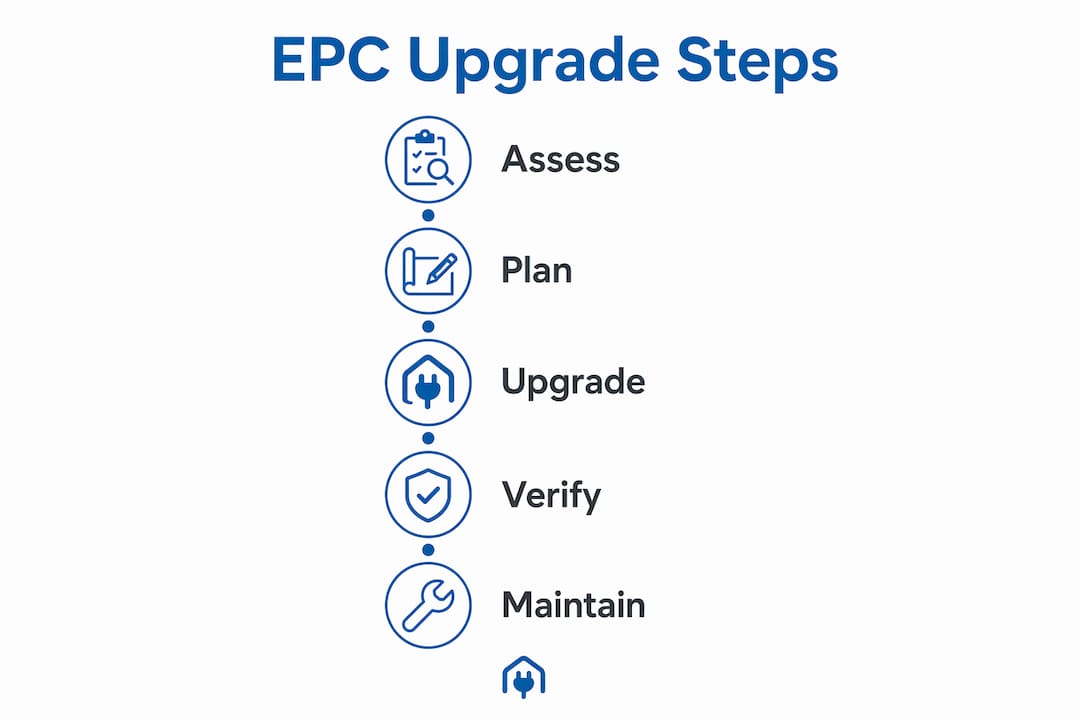
The recommendations section of an EPC certificate is the most underused part of the document. The recommendations section ranks improvement options by cost-effectiveness, showing estimated installation costs alongside potential savings. Treating this section as a stepwise upgrade roadmap is the most efficient way to raise a rating without overspending.
A practical upgrade sequence for a typical Band D or E property looks like this:
- Loft insulation: One of the cheapest improvements available. Upgrades such as loft insulation typically improve EPC scores by 5–20 points each. Fitting 270mm of mineral wool insulation in an uninsulated loft is frequently the single highest-return action available.
- Cavity wall insulation: Applicable to most properties built between 1930 and 1995. Cavity fill is relatively low cost and delivers consistent score improvements.
- Boiler replacement: Replacing an older G-rated boiler with an A-rated condensing boiler improves both the SAP score and tenant fuel bills. Heat pump installation scores even higher under the new Home Energy Model methodology.
- LED lighting throughout: A low-cost, high-impact change that assessors record during the EPC inspection. Full LED conversion across all fixed fittings contributes to the overall score.
- Smart heating controls: Programmable thermostats and zone controls improve the heating system metric under new-style EPCs. They also reduce actual energy consumption, which benefits tenants directly.
Balancing upgrade costs against expected score improvements requires a property-by-property approach. A Victorian terrace with solid walls faces higher insulation costs than a 1970s semi-detached with cavity walls. The energy performance guide from Homeenergymodel sets out how to prioritise improvements based on property type and current rating.
Landlords who plan upgrades across a portfolio in advance avoid the most expensive scenario: emergency retrofits in 2029 and 2030 when contractor demand peaks and prices rise. Experts warn that last-minute compliance efforts may be costly and difficult due to labour shortages and the increased complexity of new EPC metrics. Booking assessors and contractors now, while supply is available, is the practical response to that risk.
Key takeaways
Energy guide ratings determine both legal compliance and tenant running costs, making them one of the most consequential metrics a landlord manages.
| Point | Details |
|---|---|
| Band E is the current minimum | Letting below Band E without a registered exemption breaches MEES and risks fines up to £30,000. |
| Band C required by 2030 | The 1 October 2030 deadline affects an estimated 55% of privately rented properties currently rated D or below. |
| Grandparenting rewards early action | Achieving Band C before 1 October 2029 locks in compliance for up to 10 years under the existing certificate. |
| New metrics arrive in late 2026 | Dual headline metrics covering fabric performance and heating will replace the single A–G score on new-style EPCs. |
| EPC recommendations are a free roadmap | The ranked improvements section shows cost-effective upgrades by estimated cost and saving, guiding efficient spending. |
Why acting now beats waiting for the 2030 deadline
The most common mistake I see landlords make is treating the EPC as a box-ticking exercise rather than a portfolio management tool. A certificate gets filed, a band gets noted, and nothing changes until a compliance deadline forces the issue. That approach is expensive.
The grandparenting provision changes the calculus entirely. A landlord who upgrades three properties to Band C in 2027 does not face another compliance review until 2037. A landlord who waits until 2029 faces the same upgrade costs but in a market where every other landlord is competing for the same installers at the same time. Labour shortages in the retrofit sector are already visible. By 2029, they will be acute.
The shift to dual metrics in late 2026 adds another reason to act under the current system. SAP-based assessments are well understood. Assessors are trained on them, costs are predictable, and the outcome is a single number that maps cleanly to a band. The new Home Energy Model methodology introduces fabric performance and smart readiness as separate scores. Landlords who have already achieved Band C under SAP will not need to reassess immediately. Those who have not will face a more complex and potentially more expensive assessment process.
My advice is to commission a current EPC assessment now if the existing certificate is more than five years old. Ratings on older certificates often do not reflect improvements already made to a property. A fresh assessment may reveal a better starting position than expected, and the recommendations section will reflect current costs and technologies. Engaging a qualified EPC assessor who understands both the current SAP methodology and the incoming Home Energy Model is the single most useful step a landlord can take in 2026.
— Danny
How Homeenergymodel supports landlords with energy ratings
Homeenergymodel provides detailed guidance on EPC requirements, SAP calculations, and the incoming Home Energy Model for landlords and property owners across England and Wales. The site covers the full range of compliance questions, from understanding EPCs in London to planning upgrades across mixed portfolios. For landlords assessing their options under both current and new metrics, the types of home energy models page sets out the methodologies in plain terms, helping property owners make informed decisions before the 2030 deadline arrives. Homeenergymodel also offers resources on EPC exemptions, assessor selection, and sustainable improvement planning.
FAQ
What is an energy guide rating in the UK?
An energy guide rating is the A–G letter band on an Energy Performance Certificate, derived from a SAP numerical score. It measures how efficiently a property uses energy, with A being the most efficient and G the least.
What is the minimum EPC rating for rented properties?
The current minimum is Band E for privately rented properties in England and Wales. This rises to Band C by 1 October 2030, affecting the majority of the private rented sector.
What happens if a landlord ignores EPC requirements?
Failing to meet the Minimum Energy Efficiency Standards can result in fines of up to £30,000 per property, per breach, with proposed increases to enforcement penalties signalled by the government.
What are the new EPC metrics arriving in 2026?
New-style EPCs expected in late 2026 will feature dual headline metrics covering fabric performance and heating system or smart readiness performance, replacing the single A–G energy efficiency rating.
Which upgrades improve an EPC rating most cost-effectively?
Loft insulation, cavity wall insulation, boiler replacement, LED lighting, and smart heating controls each typically improve EPC scores by 5–20 points. The recommendations section of an existing EPC certificate ranks these by cost-effectiveness for each specific property.