

Many UK landlords feel caught off guard when their property’s Energy Performance Certificate rating falls short, despite having invested in upgrades. Building orientation is often the missing link, quietly controlling solar gain, daylight, and ventilation. As stricter HEM regulations approach, understanding how a building’s direction shapes energy performance will mean the difference between smooth compliance and costly retrofits. This overview offers clarity on why orientation matters now more than ever for property investment success.
Table of Contents
- Defining Building Orientation And Its Role
- Orientation Types And UK-Specific Impacts
- How Orientation Affects Energy Assessments
- Meeting HEM And EPC Compliance Standards
- Common Mistakes And Cost Implications
Key Takeaways
| Point | Details |
|---|---|
| Building Orientation Matters | The orientation of a building significantly impacts its energy performance, influencing heating and cooling demands throughout the year. |
| EPC Ratings Impacted | Properties with poor orientation may receive lower Energy Performance Certificate ratings, affecting rental income and property value. |
| Design Decisions are Permanent | Orientation is a fixed characteristic that cannot be changed post-construction, making it crucial for long-term energy costs. |
| Proactive Assessments Recommended | Investors should evaluate the orientation when assessing properties to identify potential energy performance challenges and improvement opportunities. |
Defining Building Orientation And Its Role
Building orientation refers to the direction a structure faces and how its windows, walls, and openings are positioned relative to the sun’s path. This seemingly simple feature has profound consequences for how much energy a building consumes throughout the year.
The sun’s position changes dramatically across seasons. In winter, a south-facing property captures valuable heat. In summer, the same exposure can cause problematic overheating. A well-oriented building uses these natural patterns to reduce heating and cooling demands.
Building Regulations in England recognise orientation as a key factor influencing energy performance. The way your property faces directly shapes its thermal behaviour and daylighting access.
How Orientation Affects Energy Performance
Orientation influences four critical energy factors:
- Solar heat gain: South-facing properties absorb more winter warmth; north-facing ones stay cooler year-round
- Natural light: Properties with optimised window placement need less artificial lighting during daylight hours
- Ventilation patterns: Wind direction and building layout affect how effectively air circulates
- Thermal comfort: Overheating risk increases with poor summer shading; excessive heat loss occurs with inadequate winter gains
Approved Documents under Building Regulations emphasise that orientation impacts solar shading, thermal performance, and daylighting—all critical for meeting energy compliance standards in the UK.
Why This Matters for Your Property
As a landlord or investor, orientation directly affects your Energy Performance Certificate (EPC) rating. Properties with poor orientation typically receive lower ratings, which impacts rental income and property value.
Correct orientation optimises solar gains in winter and reduces overheating in summer. This minimises the energy required for heating and cooling, lowering operational costs and making your property more attractive to tenants.
Building orientation isn’t something you can change post-construction, making it one of the most important design decisions in determining long-term energy costs.
When assessing potential properties or planning improvements, understanding how the building faces the sun helps you anticipate energy performance challenges and plan retrofits effectively.
Pro tip: Check the property’s aspect during site visits at different times of day—morning shadow patterns reveal winter sun access, whilst midday glare indicates potential summer overheating risks.
Orientation Types And UK-Specific Impacts
Building orientation in the UK falls into several distinct categories, each with measurable effects on energy performance. Understanding these types helps you assess how your property will perform throughout the year.
The main orientation types are south-facing, north-facing, east-facing, and west-facing. Each responds differently to the UK’s seasonal sun patterns and climate conditions.
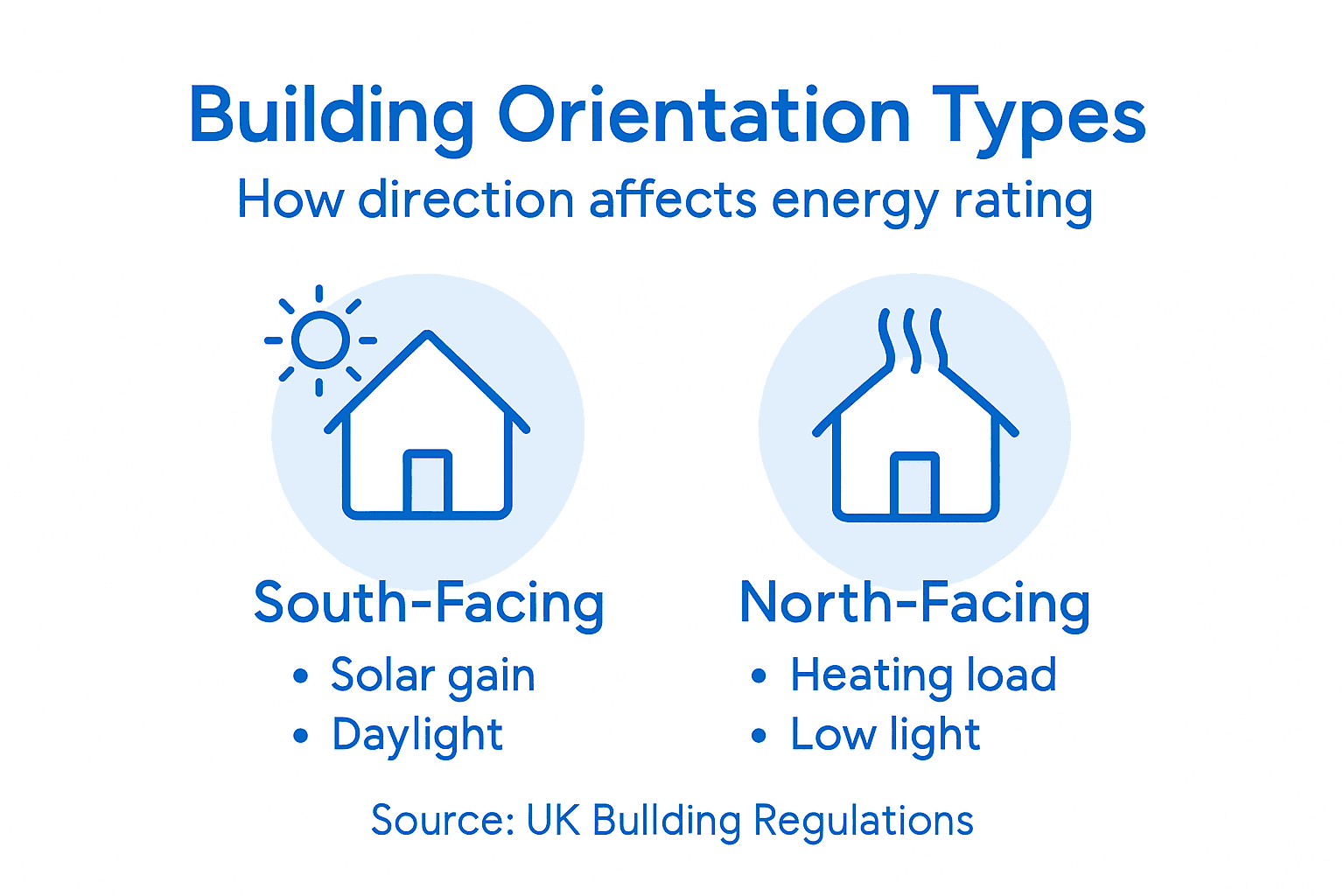
South-Facing Properties
South-facing buildings capture maximum solar energy during winter months when the sun sits lower in the sky. This natural heating reduces your reliance on mechanical systems during the coldest periods.
Benefits of south-facing orientation include:
- Passive solar heating: Windows and walls absorb winter warmth, lowering heating bills
- Reduced heating demand: Occupants feel warmer without increased thermostat settings
- Excellent daylighting: Natural light reaches deeper into rooms, cutting artificial lighting needs
The trade-off involves summer overheating risk. South-facing windows benefit from passive solar heating, reducing heating loads during colder months. However, without proper shading, summer temperatures can spike uncomfortably.
North-Facing Properties
North-facing properties receive minimal direct solar gain year-round. The sun never shines directly on north-facing walls or windows in the UK’s latitude.
Characteristics of north-facing orientation:
- Consistent cool temperatures: Less risk of summer overheating
- Higher heating demands: Mechanical systems work harder during winter
- Stable lighting: Soft, diffuse daylight without harsh glare
These properties typically show higher energy consumption for heating. North-facing sides have reduced solar input, affecting design choices for energy efficiency.
East And West-Facing Properties
East and west-facing properties occupy a middle ground. They receive moderate solar gain at different times of day.
East-facing buildings capture morning sun, warming spaces early in the day. West-facing properties experience afternoon heating, which can cause evening overheating in summer but provides useful winter gain.
Here is a comparison of the four main building orientations and their impact on key energy performance factors in the UK climate:
| Orientation Type | Winter Heating Needs | Summer Overheating Risk | Daylighting Quality |
|---|---|---|---|
| South-facing | Lower, benefits from sun | Higher, needs shading | Excellent, bright interiors |
| North-facing | Higher, less solar input | Very low, stays cool | Even, mild daylight |
| East-facing | Moderate, morning sun | Moderate, early day warmth | Good, morning light dominates |
| West-facing | Moderate, afternoon gain | High, evening overheating | Good, strong afternoon light |
Climate Considerations For UK Properties
Traditional UK buildings respond distinctly to orientation due to their materials and construction methods. Solid walls, single-glazed windows, and thermal mass in older properties behave differently from modern construction.
As UK weather evolves due to climate changes, orientation-informed design becomes increasingly crucial. Warmer summers mean overheating now poses greater risk than decades ago. Conversely, winters remain cold enough to benefit from solar gain.
The UK’s temperate maritime climate means orientation strategy differs significantly from continental or Mediterranean climates—south-facing gain remains valuable, but summer shading has become essential.
Your property’s specific location within the UK matters too. Scottish properties benefit more from winter solar gain than Southern English ones. Coastal properties experience different wind patterns affecting ventilation strategy.
Pro tip: When evaluating a property’s energy potential, check both its orientation and its surrounding context—nearby buildings, trees, and terrain can dramatically reduce or enhance the theoretical benefits of facing south.
How Orientation Affects Energy Assessments
Orientation directly influences how your property is evaluated under Energy Performance Certificate (EPC) methodology. The assessor’s calculations depend heavily on how your building faces the sun.
When an EPC assessment is conducted, orientation affects three measurable variables in the energy calculation:
- Solar gain: How much passive heating the property receives from winter sunlight
- Natural light availability: Whether rooms require less artificial lighting due to daylight access
- Ventilation patterns: How wind direction interacts with building position and openings
These factors determine your building’s predicted heating and cooling demand. Orientation affects natural light, solar gain, and ventilation, which are critical variables in energy calculations.
How SAP Calculations Use Orientation Data
Current SAP (Standard Assessment Procedure) calculations require orientation input as a mandatory field. The assessor must specify your building’s primary façade direction—south, south-east, east, and so forth.
SAP then adjusts heating load predictions based on this orientation. A south-facing property receives credit for passive solar gain. A north-facing equivalent shows higher heating requirements, lowering the overall energy rating.
The Impact On Your EPC Rating
A poor orientation can reduce your EPC rating by one or two bands. This happens because assessments for home energy loss account for seasonal temperature variations caused by sun exposure.
Propertys with better orientation scores achieve:
- Lower predicted energy consumption figures
- Higher energy ratings (better A-G bands)
- Improved marketability to tenants and buyers
- Better compliance positioning for upcoming regulations
Future Home Energy Model Considerations
When the Home Energy Model (HEM) replaces SAP in 2025, orientation will remain equally critical. The new methodology will use more sophisticated solar modelling, potentially rewarding well-oriented properties even more significantly.
However, HEM will also account for shading from nearby buildings and trees. A theoretically south-facing property in shadow receives less benefit than one with clear sun exposure.
Orientation is one of the few building characteristics you cannot change post-construction, making it permanently influential on your property’s energy rating throughout its lifespan.
When investors assess potential acquisitions, orientation should factor heavily into energy performance predictions and long-term running costs.
Pro tip: Request the EPC assessor’s orientation calculation during your property survey—understanding whether the rating reflects optimal sun exposure or shading from adjacent structures helps you identify realistic improvement opportunities.
The following table summarises the significance of orientation in current and future UK energy compliance models:
| Assessment Model | Orientation Data Used | Assessment Impact | Future Changes |
|---|---|---|---|
| EPC (SAP methodology) | Primary façade direction | Adjusts heating/cooling load | Limited shading consideration |
| Home Energy Model (HEM) | Orientation and shading | Refines solar and ventilation | Models nearby obstructions |
Meeting HEM And EPC Compliance Standards
Complying with UK energy standards means understanding how orientation influences your ability to meet mandatory EPC ratings and upcoming Home Energy Model (HEM) requirements. These regulations directly impact whether you can legally let your property.
Current rules require all rental properties to achieve at least EPC band E. This baseline standard affects thousands of landlords across the UK. By 2030, the government plans to raise this target to band C, making orientation strategy crucial for future-proofing your investment.
The Minimum Energy Efficiency Standard (MEES)
Landlords must ensure rented properties meet minimum EPC standards to comply with MEES regulations. Properties below band E cannot be legally let, with only limited exemptions available.
Orientation affects whether you can achieve this baseline without major works. A well-oriented property naturally scores higher, potentially avoiding costly retrofits. A poorly oriented one may require substantial insulation upgrades or heating system improvements to comply.
Non-compliance carries serious consequences:
- Letting prohibition: You cannot legally rent the property
- Financial penalties: Fines up to £30,000 per breach
- Enforcement action: Local authorities can take legal proceedings
- Reputational damage: Non-compliant status appears on property records
The 2025 And 2030 Trajectory
The UK government’s energy performance roadmap sets increasingly stringent targets. By 2025, new standards begin applying. By 2030, band C becomes mandatory for all rental properties. This represents a significant shift from current expectations.
Dual-metric standards for 2025 include both fabric performance and heating efficiency. Orientation influences both metrics because it affects wall temperature (fabric) and heating demand (systems).
Properties with poor orientation face steeper upgrade costs to reach band C. Those with excellent orientation may achieve compliance through targeted, cost-effective improvements.
HEM And Future Assessment Changes
The Home Energy Model will replace SAP in 2025, introducing more sophisticated calculations. HEM will better account for actual occupant behaviour and local climate conditions.
Orientation assessments under HEM will become more precise. Shading analysis will improve, and seasonal variations will be modelled more accurately. This means orientation advantages become even more valuable—and disadvantages harder to offset through other measures.
Properties with unfavourable orientation face compounding challenges under stricter 2030 standards, making early assessment and strategic improvement planning essential for landlord compliance.
Proactive investors should assess their portfolios now. Understanding which properties will struggle to meet 2030 targets allows time for planned improvements rather than expensive emergency works.
Pro tip: Commission an HEM pre-assessment on properties now, even before 2025 regulations apply—this reveals exactly which orientation-related upgrades will be necessary and helps you budget strategically for compliance deadlines.
Common Mistakes And Cost Implications
Many property owners and investors misunderstand how building orientation affects energy costs. These missteps lead to expensive retrofits, compliance failures, and missed opportunities for cost savings.
The most costly mistakes emerge during design phases or retrofit planning. By the time problems surface, thousands of pounds have already been spent on ineffective measures.
Neglecting Solar Path And Wind Patterns
A fundamental error involves ignoring the building’s solar path and prevailing wind directions during assessment or planning. Neglecting the building’s solar path leads to increased energy consumption due to poor passive solar heat gain or inadequate natural ventilation.
This oversight results in:
- Higher heating bills: Missing winter solar gains forces reliance on mechanical heating
- Increased cooling costs: Poor ventilation pathways mean summer overheating requires air conditioning
- Inefficient artificial lighting: Rooms without optimised daylight need constant electric lighting
- Wasted retrofit investments: Expensive upgrades fail to deliver expected energy savings
A property facing north with no south-facing windows cannot benefit from winter warmth, yet owners sometimes invest in insulation alone—fixing only part of the problem at full cost.
Retrofit Mistakes On Traditional Buildings
Applying modern energy-saving measures without considering original building orientation causes hidden problems. Modern interventions can cause moisture accumulation and structural damage if orientation and fabric performance aren’t respected.
Common retrofit errors include:
- Incompatible insulation: Adding internal insulation without considering how orientation affects drying
- Window replacements: Installing modern double-glazing without accounting for orientation-specific thermal behaviour
- HVAC upgrades: Installing mechanical ventilation that conflicts with natural ventilation patterns
- Moisture problems: Disrupting traditional moisture management, leading to expensive repairs
These mistakes compound costs dramatically. A £15,000 window replacement might fail to deliver promised energy savings if the building’s north-facing orientation wasn’t factored in. Worse, moisture damage could necessitate £30,000 remedial work.
Assessment And EPC Rating Errors
Incorrect orientation input during EPC assessments leads to inaccurate ratings. Some assessors oversimplify or misrecord building direction, resulting in misleading energy predictions.
This causes landlords to pursue unnecessary upgrades or miss legitimate compliance opportunities. A property mistakenly recorded as north-facing might receive a lower rating than justified, prompting expensive improvements.
Orientation errors during assessment create cascading financial consequences—wrong ratings lead to wrong improvement strategies, consuming budgets on ineffective measures.
Understanding orientation’s precise role helps target investments where they’ll deliver measurable returns.
Pro tip: Before commissioning any retrofit work, request a detailed orientation analysis from your assessor showing solar gain calculations and seasonal heating/cooling predictions—this reveals which improvements will genuinely reduce costs versus which address unrelated issues.
Optimise Your Property’s Energy Performance by Understanding Orientation
Building orientation is a critical factor that shapes your property’s energy rating and long-term running costs. If you are a landlord or property investor concerned about the impact of poor solar gain, ventilation, and daylighting on your EPC rating, it is essential to take proactive steps now. Understanding how your building’s façade direction influences heating and cooling demands can save you from costly retrofits and compliance failures, especially with the upcoming Home Energy Model (HEM) replacing SAP in 2025.
At homeenergymodel.co.uk, we provide clear guidance on how orientation affects Energy Performance Certificates and what this means under future UK regulations. Don’t wait until non-compliance restricts your letting options or forces expensive upgrades. Learn how to assess your building’s solar exposure and ventilation potential early, plan effective improvements, and keep your property competitive in a market moving towards tighter energy efficiency standards. Visit homeenergymodel.co.uk today to explore our resources on HEM features and benefits and start future-proofing your investment with confidence.
Frequently Asked Questions
How does building orientation affect energy consumption?
Building orientation influences solar heat gain, natural light availability, ventilation patterns, and thermal comfort, all of which directly impact energy consumption for heating and cooling.
What are the benefits of a south-facing property?
South-facing properties capture maximum solar energy during winter, reducing heating costs and providing excellent daylighting, but they can also be at risk of overheating in summer without proper shading.
How might poor building orientation impact my Energy Performance Certificate (EPC) rating?
A poorly oriented building can result in a lower EPC rating, as less efficient solar gain and higher heating demands lead to higher predicted energy consumption figures.
What should I consider when assessing a property’s orientation?
When assessing a property’s orientation, consider solar access throughout the day and year, the potential for shading from nearby structures or vegetation, and how these factors impact energy performance and comfort.