
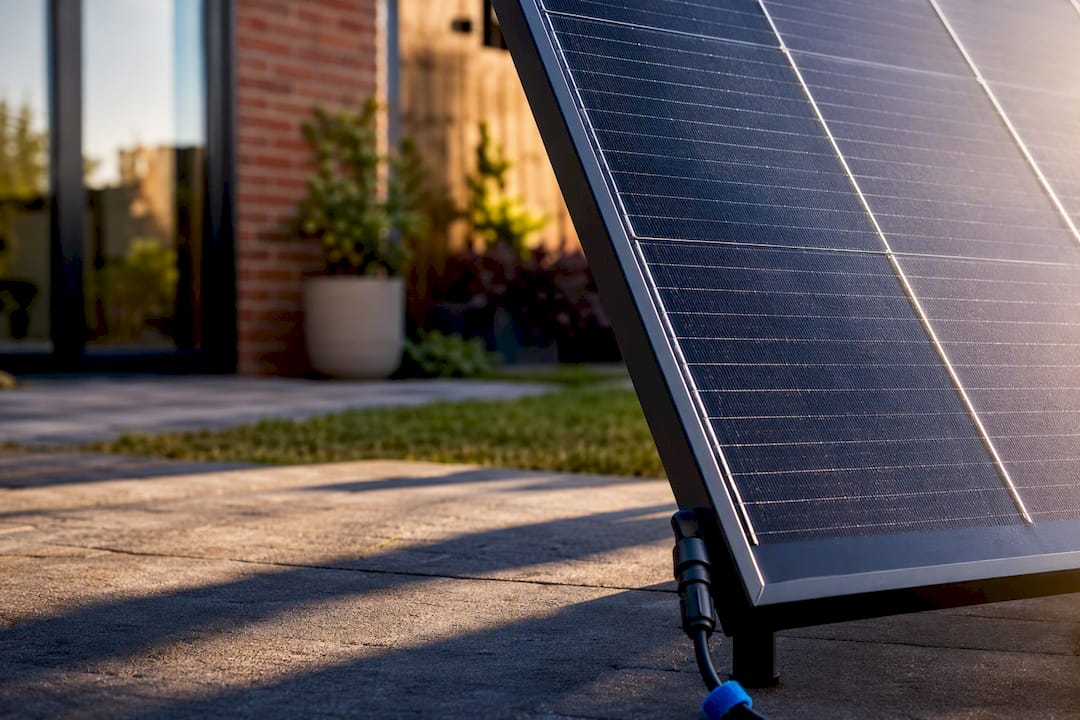
Yes, plug-in solar panels are now legal in Great Britain and available to buy from late August 2026. For many households, they can cut electricity bills by roughly £70 to £110 a year, generating up to around 800W from a device that plugs straight into a standard socket. Before buying, check the product meets the interim specification and confirm whether your network operator needs notifying.
TL;DR:
- Most households can save between £70 and £110 annually by using plug-in solar panels during daylight hours, with higher savings possible in sunnier, south-facing locations.
- The devices typically cost around £450, with a payback period of five to ten years depending on sunlight exposure and usage patterns.
- Plug-in solar panels are only effective for those home during the day and cannot store excess energy or export power to the grid.
- Legal compliance requires checking the product against specific interim standards and notifying the network operator before installation.
- They are best suited for renters, flat dwellers, and households with limited roof access, but require landlord permission and circuit assessment prior to installation.
Table of Contents
- How plug-in solar panels work and what they will run
- How much households can save: evidence and worked examples
- Safety, regulations and registration: what the law requires
- Who plug-in solar suits, and who it doesn’t
- Costs, payback and where to buy in the UK
- How to install a plug-in solar panel safely
- Does plug-in solar affect your EPC or HEM rating?
- An honest take on plug-in solar’s promise
- How Homeenergymodel supports homeowners after adding solar generation
- Sources
- FAQ
How plug-in solar panels work and what they will run
A plug-in solar panel, sometimes called a plug-in microgenerator, is a small solar unit that connects directly to a normal UK mains socket rather than being wired into the consumer unit by an electrician. Point it at a window, balcony rail, or garden wall, and it feeds electricity straight into the home circuit whenever daylight hits the panel.
Output tops out at a level defined by the government’s newly permitted specification, and the Department for Energy Security and Net Zero says a device can cover a notable portion of an average home’s electricity use in the right conditions. That is enough to run several everyday items simultaneously:
- A fridge-freezer running continuously
- A television and set-top box in use
- A broadband router and a laptop on charge
- Small kitchen appliances used briefly during the day
Generation only happens in daylight, and output drops sharply on overcast days or in winter. Most plug-in units sold at launch have no built-in battery, so any electricity generated but not used immediately is simply lost rather than stored for the evening. That is the central trade-off against rooftop photovoltaic (PV) systems, which typically generate several kilowatts, can be paired with a battery, and can export surplus power back to the grid for payment. Plug-in panels are a smaller, cheaper, and far less permanent proposition. They cannot export power and are designed purely to offset what a household is already drawing from the grid at that moment.
How much households can save: evidence and worked examples
Energy Saving Trust estimates plug-in solar panels can save a household £70 to £100 a year, while government modelling puts the figure as high as £100 to £110 a year depending on location and usage patterns.
Those figures assume the household is actually home to use the electricity as it’s generated, since nothing gets stored for later. Carbon Brief’s analysis extends the picture further, estimating a typical household could save around £1,100 over a 15 year device lifetime under reasonable assumptions about sunlight hours and usage.
Two scenarios show why the range is so wide:
- Home during the day: a retired couple or remote worker runs the fridge, router, and laptop off solar generation for six or more daylight hours. They capture close to the maximum saving, landing near the £100 to £110 mark.
- Out at work all day: a household away from 8am to 6pm only benefits from panel output on weekends and during any daytime appliance cycles they can shift, such as a dishwasher on a timer. Savings tend to sit nearer the £70 lower bound, or lower still in winter.
Location matters too. A south-facing balcony in Cornwall will outperform a north-facing wall in Aberdeen, and Ofgem’s household consumption data is a useful reference point for working out what proportion of your own usage a device might realistically offset.
Safety, regulations and registration: what the law requires
Plug-in solar only became legal because of a specific legislative change. The 2026 Statutory Instrument amends the Plugs and Sockets etc. (Safety) Regulations 1994 and the Electricity Safety, Quality and Continuity Regulations 2002 (ESQCR), permitting approved plug-in microgenerators that meet a new interim product specification. Before this change, feeding self-generated power into a standard socket sat in a legal grey area, largely because of concerns about circuit loading and electric shock risk during fault conditions.
The technical rationale is straightforward: a socket circuit is designed to carry power one way, from the grid to your appliances. A device pushing power the other way can, if poorly designed, create dangerous conditions on that circuit or on the wider local network if many households do it uncoordinated. That’s why registration matters.
- Confirm the device is listed against the interim product specification before buying
- Register or notify your distribution network operator (DNO) where required, a process the ENA Connect Direct platform has streamlined by automating much of the approval workflow for low-carbon technology connections
- Avoid unbranded imports sold without UK compliance documentation
- Keep proof of purchase and compliance paperwork in case of a future property sale or insurance query
Pro Tip: Check the retailer’s own compliance statement against the interim product specification before you buy, not after. A device that looks identical to an approved model can still be a non-compliant import sold through the same marketplace listing.
Who plug-in solar suits, and who it doesn’t
Plug-in solar panels were designed with a specific gap in mind: the huge number of UK households who cannot fit rooftop PV. That includes flat-dwellers with a south-facing balcony, renters who want to lower bills without a permanent installation, and daytime home-workers who can genuinely use the power as it’s generated.
They suit these households well:
- Renters and leaseholders with balcony or garden access but no roof rights
- Flats and maisonettes where rooftop PV installation isn’t physically or legally possible
- Anyone home during daylight hours who can use power as it’s generated
They’re a poorer fit for others. Older properties with ageing wiring should have a qualified electrician check circuit capacity first. Homes on a shared meter or communal supply raise billing complications that a single plug-in device can’t resolve alone. And critically, being legal to buy does not override a leaseholder’s tenancy agreement or a landlord’s permission requirements. Anyone renting or in a leasehold flat should get written consent before plugging in, since a freeholder or landlord can still object even where the device itself is entirely lawful.
Costs, payback and where to buy in the UK
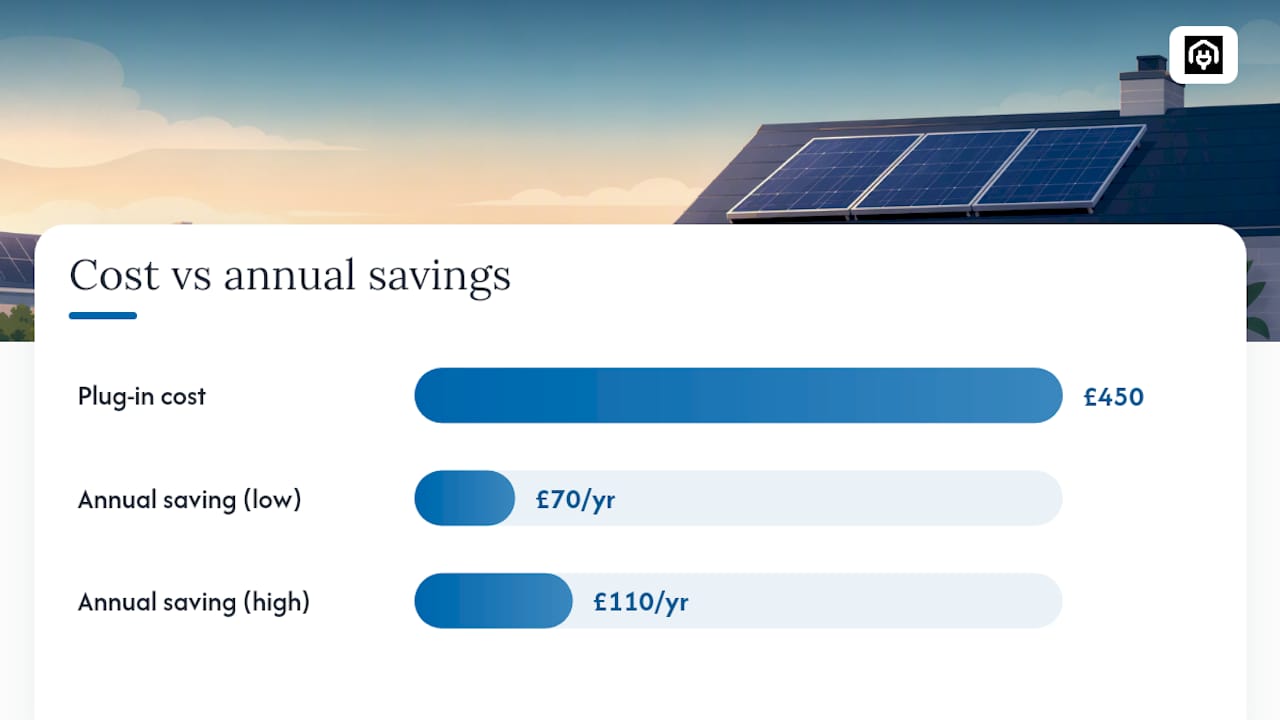
Compliant plug-in devices typically start from around £450, considerably less than a rooftop PV system, which usually runs into several thousand pounds once installation and any battery storage are included. At an annual saving of £70 to £110, a straightforward payback calculation puts most households somewhere between five and ten years, depending on how much daylight-hours usage they can capture.
Several variables shift that figure in either direction: how sunny and south-facing your panel position is, whether you’re home during the day, and how many hours the device actually spends generating rather than sitting idle in shade or cloud cover.
- Major electrical retailers are expected to stock compliant models following the change in the law
- Specialist renewables retailers, who already sell rooftop PV components, are a natural first stop
- Always cross-check any product against the published approved list rather than relying on marketplace listings alone
- Confirm the seller’s returns policy and warranty terms before buying, particularly for online marketplace purchases
Non-compliant cheap imports remain a real risk. A device that looks similar to an approved model but lacks the correct certification could create the exact circuit-loading and shock risks the new regulations were designed to prevent, so treat unusually low prices as a warning sign rather than a bargain.
How to install a plug-in solar panel safely
- Before buying, confirm the specific model is listed against the interim product specification and check the retailer’s warranty and returns terms.
- Assess your circuit, ideally with a qualified electrician if your property has older wiring, to confirm the ring can safely take the additional load.
- Avoid stacking multiple devices on a single circuit unless an electrician has confirmed the wiring supports it.
- Register the connection where required. Many installers now use the ENA Connect Direct system, which automates much of the DNO notification process and speeds up approval compared with older paper-based routes.
- Position the panel for maximum daylight exposure, typically a south-facing balcony, wall, or garden fence.
- Monitor performance in the first few weeks against your expected output, and keep all compliance paperwork somewhere accessible.
Pro Tip: If you’re planning a broader home renovation, our step-by-step guide to renewable energy for UK homes covers how plug-in solar fits alongside other efficiency upgrades you might be considering at the same time.
Does plug-in solar affect your EPC or HEM rating?
A single 800W plug-in panel is unlikely to shift an Energy Performance Certificate rating in any meaningful way. EPC and the incoming Home Energy Model assessment methodology are built around a property’s fixed installed systems, insulation, heating, and fabric performance, not small, removable devices a tenant could unplug and take with them.
That said, landlords should still take the change seriously from a reporting standpoint:
- Log any plug-in generation a tenant installs, since disputes over who owns removable equipment are easier to avoid with a written record
- Don’t assume a plug-in device changes minimum energy efficiency standard compliance, since fixed-system upgrades carry far more weight in an assessment
- Book a fresh EPC if you’re separately upgrading fixed systems such as insulation or heating alongside any plug-in generation, so the certificate reflects the property accurately
An honest take on plug-in solar’s promise
The savings are real but modest, and that’s precisely the point people miss. Plug-in solar was never designed to replace rooftop PV. It was designed to give the millions of UK households who can’t fit rooftop panels, renters, flat-dwellers, leaseholders, a genuine foothold in generating their own electricity for the first time.
The paperwork around registration and product compliance isn’t bureaucratic friction for its own sake. It exists because pushing power backward through a socket circuit carries real risk if the device is badly made. Treat the compliance checks as seriously as the savings pitch, and this becomes a sound, low-risk way to shave a modest but genuine amount off an energy bill.
— Danny
How Homeenergymodel supports homeowners after adding solar generation
Adding any form of home generation, plug-in or rooftop, is a good moment to check where your property actually stands on energy performance. Homeenergymodel provides domestic EPC assessments that give homeowners and landlords a clear, documented picture of a property’s current rating, useful whether you’re planning to sell, let, or simply want a paper trail showing what’s changed. For anyone weighing up larger fixed installations alongside a plug-in device, our SAP calculation service models the combined impact of insulation, heating, and generation changes on formal compliance figures, rather than leaving you to guess. If you’re a landlord juggling multiple properties and reporting obligations, it is possible to request a quote and find out which assessment fits your situation.
Sources
- Households can save as plug-in solar panels come to market (Department for Energy Security and Net Zero)
- Plug-in solar panels – Energy Saving Trust
- Plugs and Sockets etc. (Safety) Regulations 1994 and Electricity Safety, Quality and Continuity Regulations 2002 (Amendment) Regulations 2026
- Analysis: How ‘plug-in solar’ can save UK homes £1,100 on energy bills (Carbon Brief)
FAQ
Are plug-in solar panels worth buying?
For most households, yes, provided you’re home enough during daylight hours to actually use the electricity as it’s generated. Savings typically run £70 to £110 a year, against a device cost from around £450, putting payback somewhere between five and ten years.
What does Martin Lewis think about solar panels?
Consumer finance commentators have generally urged caution around solar payback timeframes and pushed for buyers to compare real device costs against realistic savings estimates rather than marketing claims. The safest approach is to check the government and Energy Saving Trust figures directly rather than relying on any single retailer’s projection.
How much do plug-in solar panels cost?
Compliant plug-in solar devices typically start from around £450, considerably cheaper than a full rooftop PV installation. Prices vary by output capacity and retailer, so it’s worth comparing a few approved models before buying.
Where can I buy plug-in solar panels in the UK?
Major electrical retailers and specialist renewables retailers are expected to stock compliant models following the 2026 legal change. Always check any product against the approved list tied to the interim product specification before purchasing, particularly through online marketplaces.
Do I need permission to install a plug-in solar panel?
If you’re a leaseholder or tenant, yes. Being legal to buy nationally doesn’t override a landlord’s or freeholder’s own consent requirements, so get written permission before plugging one in, even on a private balcony.