
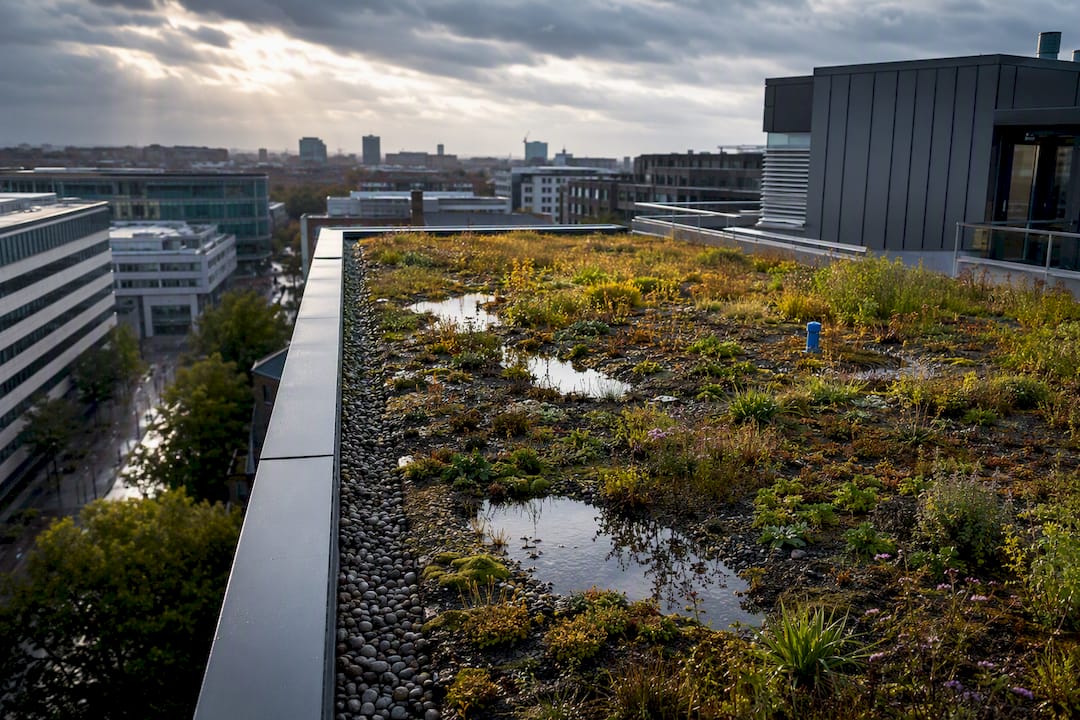
A living roof delivers measurable, evidence-backed benefits: it retains 70 to 80% of summer rainfall runoff, cuts cooling demand through shading and evapotranspiration, supports biodiversity, and shields the waterproof membrane beneath it. It costs more upfront and needs a structural check before installation. For most UK buildings undergoing planned roof replacement, the trade-off favours going green.
TL;DR:
- Living roofs can retain up to 80% of summer rainfall runoff, significantly easing urban drainage pressure, especially when combined with brownfield strategies to support biodiversity.
- The thermal benefits, including reduced cooling costs and extended membrane lifespan, depend heavily on plant choice, substrate depth, and roof orientation, with costs typically recouped in 12 to 22 years.
- Installing a living roof requires a structural survey and should ideally coincide with planned roof replacement to offset higher upfront costs and avoid structural limitations.
- Plant selection impacts ecosystem services: dense, hairy-leafed species like Stachys outperform Sedum in particulate matter capture, but often need irrigation, increasing maintenance demands.
- Structural constraints and maintenance needs are the main downsides, with many roofs needing reinforcement and regular upkeep to preserve benefits over their decades-long lifespan.
Table of Contents
- What benefits does a living roof actually offer?
- How do living roofs support biodiversity, air quality and urban resilience?
- Do living roofs actually lower energy bills and extend roof life?
- Which plants, substrate and irrigation setup work best?
- What does a living roof cost to install and maintain?
- What UK planning rules and standards apply to a living roof?
- What are the downsides of a green roof?
- How should UK owners apply these benefits in practice?
- Editorial take: the evidence says design choice matters more than the headline pitch
- Sources
- FAQ
What benefits does a living roof actually offer?
A living roof stacks several distinct performance gains on top of a conventional roof, and the strongest of these are quantifiable rather than anecdotal.
- Stormwater and SuDS performance: typical systems retain 70 to 80% of summer rainfall run-off, easing pressure on urban drainage networks.
- Thermal moderation: vegetation and substrate reduce heat gain through the roof deck, lowering summer cooling loads.
- Biodiversity uplift: roofs planted with varied species create habitat where none previously existed, particularly valuable in dense urban blocks.
- Air-quality filtering: foliage captures airborne particulate matter, with capture rates varying by species.
- Acoustic dampening: substrate and plant layers absorb sound, useful near flight paths or busy roads.
- Membrane protection and roof longevity: shielding from UV and thermal cycling extends the working life of the waterproofing beneath.
- Amenity and property value: accessible green roofs add usable outdoor space, a factor that increasingly shows up in valuations.
- Urban cooling: shading and moisture loss from plants help offset the urban heat-island effect at street level.
Pro Tip: Don’t treat these benefits as a package deal. A Sedum mat and a wildflower substrate roof deliver very different results on stormwater retention, biodiversity and maintenance demand, so match the system to the outcome you actually want.
How do living roofs support biodiversity, air quality and urban resilience?
Living roofs work as substitute habitat in places where ground-level green space has been built over. Brown-roof strategies, which use recycled rubble and low-nutrient substrate rather than imported topsoil, deliberately mimic post-industrial brownfield conditions to attract invertebrates and ground-nesting birds that would otherwise struggle in a city centre.
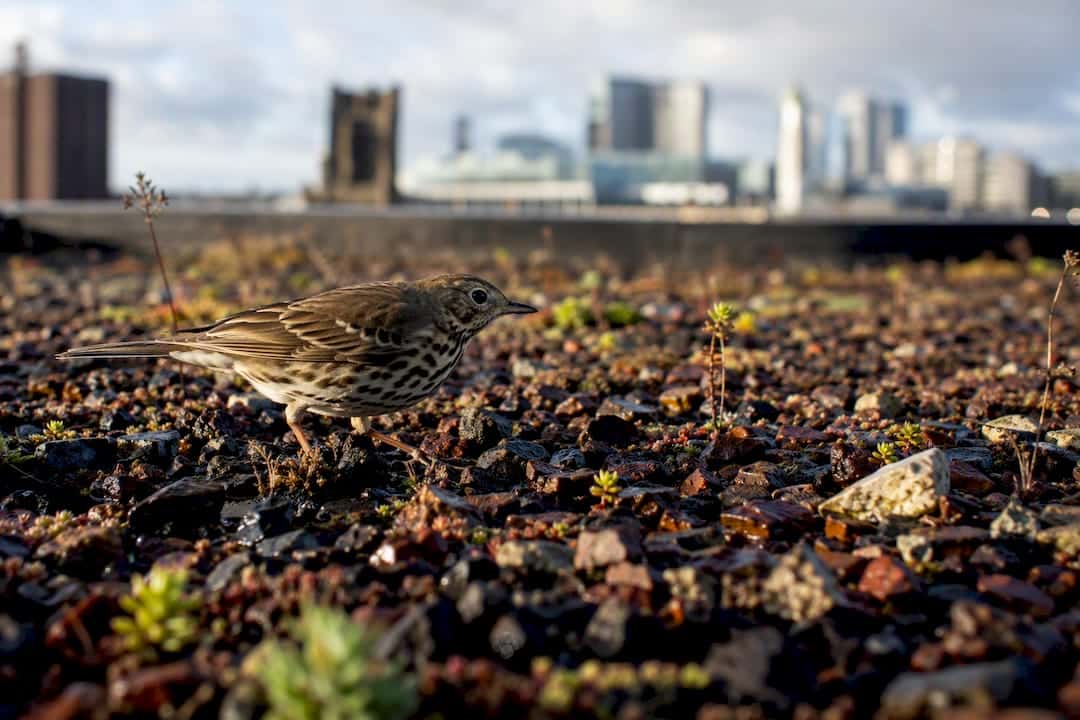
Species choice changes the air-quality outcome. Research on four species of green roof vegetation in a UK city found that plants capture particulate matter, including PM10, at rates that vary noticeably depending on leaf structure and canopy density. A dense, hairy-leafed species captures more particulate than a low, waxy Sedum mat, which matters if the roof sits near a busy road rather than a quiet courtyard.
Evapotranspiration, the process by which plants release moisture through their leaves, cools the surrounding air and contributes to urban heat-island mitigation at a district scale. Within stormwater management, the same roofs perform double duty: they retain the bulk of summer rainfall on-site rather than sending it straight to the drain, which is precisely why living roofs feature so often in Sustainable Drainage Systems (SuDS) planning.
- Habitat roofs can support invertebrate and bird biodiversity net gain targets.
- Denser, larger-leaved species generally capture more particulate matter than low-growing Sedum.
- Evapotranspiration measurably lowers local air and surface temperature.
- Retained rainfall reduces peak flow into combined sewers during storm events.
Statistic to note: summer run-off retention of 70 to 80% is the figure most consistently cited across UK and US technical guidance, though performance drops in winter when substrate is already saturated.
Do living roofs actually lower energy bills and extend roof life?
Thermal moderation is where a living roof earns its keep financially. The substrate and vegetation layer buffer the roof deck against extreme surface temperature swings, which reduces the cooling load in summer and can soften heat loss in winter, depending on build-up and insulation beneath.
The membrane protection effect is arguably underrated. Waterproofing shielded from direct UV exposure and daily thermal cycling ages more slowly, and technical reports on living roofs point to significantly extended membrane service life compared with an exposed felt or single-ply roof left bare. Given that reroofing is one of the largest capital costs a property owner faces, doubling or tripling membrane life changes the maths considerably.
- Reduced summer surface temperature swings ease cooling demand on the floors below.
- Shielded membranes experience less UV degradation and thermal fatigue.
- Combined energy, wastewater and amenity value gains can shorten payback, though pilot evidence on commercial buildings suggests total payback typically lands somewhere between roughly 12 and 22 years, varying heavily by ownership structure and how easily each benefit converts into cash.
- Split-incentive problems arise when a landlord pays for the roof but a tenant captures the energy savings, which weakens the business case unless service charges are structured to share the benefit.
Caveat worth flagging: results vary by climate, roof orientation and accessibility. A north-facing flat roof gains less thermal benefit than a south-facing one, and a heavily planted roof can complicate later solar panel installation unless the layout is planned around it from the outset, as explained in this EV charger installation cost for UK workplaces and fleets guide. For a fuller breakdown of how these thermal effects interact with wider retrofit planning, see this guide to living roof benefits for UK owners.
Which plants, substrate and irrigation setup work best?
Three broad system types dominate UK practice, and the choice between them dictates almost everything downstream.
- Extensive systems use shallow substrate (typically 80 to 150mm) and low-maintenance species like Sedum. Cheapest and lightest, but lower biodiversity and retention value.
- Semi-intensive systems use deeper substrate and a wider species mix, balancing cost against ecosystem-service delivery.
- Intensive systems support deep soil, shrubs and even small trees, delivering the strongest biodiversity and stormwater outcomes but at far higher structural and cost demands.
Plant choice inside any of these categories shifts performance meaningfully. Research comparing species with different evapotranspiration rates found that plants like Salvia and Stachys, which lose more water through their leaves, increase rainfall retention but often need supplementary irrigation to stay healthy through dry spells. Sedum needs almost no irrigation but retains less water overall, a straightforward trade-off between maintenance burden and ecosystem-service output.
Greywater can work as an irrigation source for some species without harming run-off quality, though responses vary by plant and need monitoring over time. On the substrate side, keeping added organic matter low avoids the boom-bust cycle where an initial growth surge is followed by die-back once nutrients are exhausted.
Pro Tip: If biodiversity is the priority, resist the urge to enrich the substrate with extra compost. A leaner mix produces a more stable, longer-lived plant community than a nutrient-rich one that burns out within a few seasons.
What does a living roof cost to install and maintain?
Budgeting for a living roof means accounting for both the capital outlay and an ongoing, if modest, maintenance commitment.
- Capital cost varies widely by system type and access, with extensive Sedum roofs sitting at the lower end and intensive, accessible roof gardens at the upper end. Get a site-specific quote rather than relying on a headline figure, since structural strengthening, access equipment and waterproofing upgrades all move the number.
- Annual maintenance typically covers two inspections a year, weeding, checking drainage outlets are clear, and topping up substrate where erosion has occurred.
- Inspection intervals: check drainage outlets before and after the winter storm season, and inspect plant establishment closely in the first two growing seasons, when failure risk is highest.
- Timing with roof replacement: fitting a living roof when a conventional roof is due for replacement anyway folds the new waterproofing cost into a project that was happening regardless, which is the single most effective way to improve the financial case.
Skipping maintenance is the most common way a living roof underperforms, since neglected drainage outlets and unchecked plant die-back erode most of the benefits within a few years.
What UK planning rules and standards apply to a living roof?
Planning policy in England increasingly treats green roofs as a recognised tool rather than a novelty. The National Planning Policy Framework’s section on the natural environment references SuDS and biodiversity net gain as considerations local authorities weigh when assessing development proposals, and a living roof can count towards both.
- Most domestic living roofs fall under permitted development, but check locally if the property is listed, in a conservation area, or the roof pitch or height changes.
- Building regulations always apply, since structural loading, fire performance and waterproofing detailing must be signed off regardless of planning status.
- The Green Roof Organisation’s technical code sets minimum performance criteria for drainage, substrate depth and vegetation establishment that most UK installers work to.
- On developments where a planning obligation or biodiversity net gain condition applies, a living roof can become one of the more straightforward ways to satisfy it.
What are the downsides of a green roof?
The biggest constraint is structural: many existing flat roofs weren’t designed for the extra load, and retrofitting the structure to carry it can dwarf the cost of the roof build-up itself. Upfront capital is higher than a conventional roof, and for landlords or leaseholders, the benefits (energy savings, amenity value) don’t always convert into cash for whoever pays the bill, the split-incentive problem again. Neglected maintenance causes drainage blockages and plant die-back that erode most benefits within a few years. Where a roof can’t take the load, or the building is due for demolition soon, a conventional roof or ground-level greening is the more sensible choice.
How should UK owners apply these benefits in practice?
Start with a structural survey before committing to any design, since load capacity determines whether an extensive, semi-intensive or intensive system is even viable. Time the project to coincide with a planned roof replacement where possible, folding new waterproofing into a job that was needed anyway. Bring your designer or installer details on existing loading, drainage outlets and any EPC improvement targets you’re working towards, since these shape substrate depth and species choice.
For a structured way to check whether a living roof fits your building’s wider energy plan, a home energy assessment will flag where roof-level upgrades sit against insulation, glazing and heating measures. Homeenergymodel’s guidance on green home upgrades covers how roof-level changes interact with the rest of a retrofit plan.
Editorial take: the evidence says design choice matters more than the headline pitch
The conventional pitch for living roofs treats them as a single product with one set of benefits. That’s misleading. The evidence shows a Sedum extensive roof and a biodiverse intensive roof are close to different products entirely: one is cheap and low-maintenance but delivers modest stormwater and air-quality returns, the other costs more, needs irrigation and monitoring, and delivers far stronger ecosystem-service outcomes.
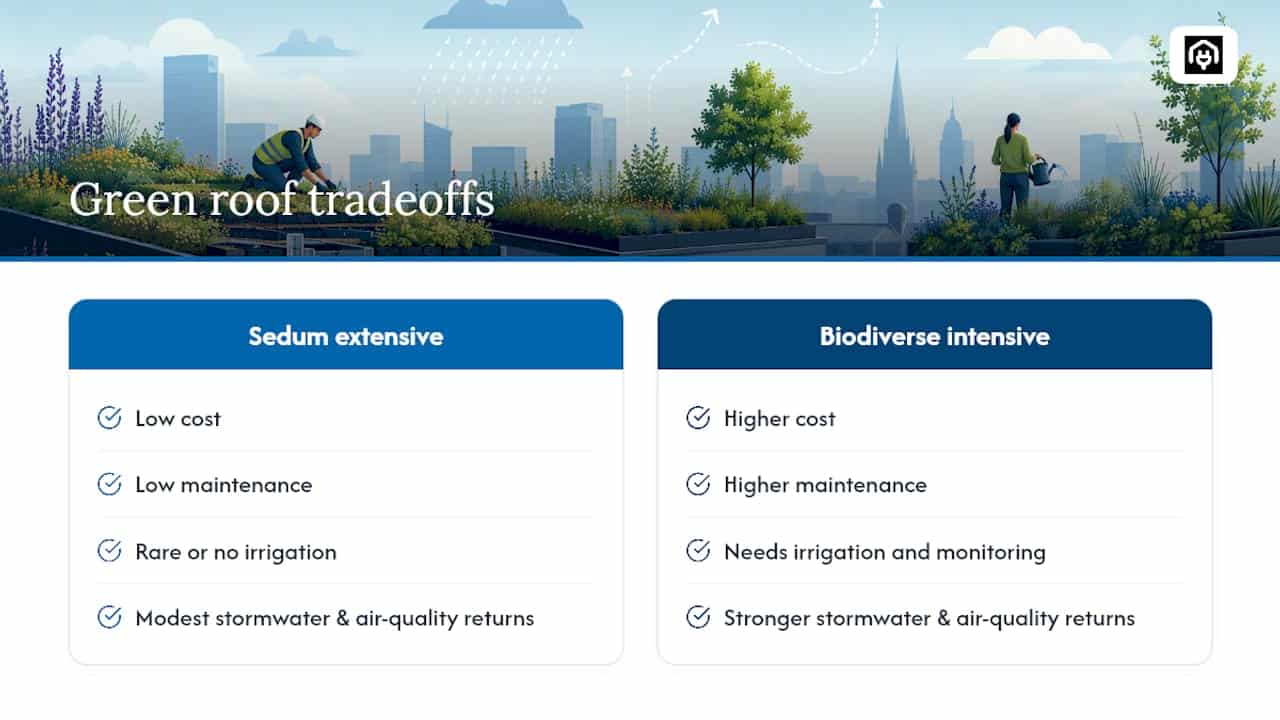
Where conventional advice falls short is in treating cost and benefit as fixed. The GRO code’s own framing makes clear that folding a green roof into planned reroofing work, rather than treating it as a bolt-on extra, is what actually makes the economics work for most owners.
If you’re weighing this up, prioritise the structural survey and the reroofing timeline before the plant list. Species selection is where the ecosystem-service detail lives, but it’s the second decision, not the first. Get the load capacity and the timing right, and the plant choice becomes a genuinely interesting design problem rather than a constraint fighting against structural limitations.
— Danny
Sources
- Green roofs: benefits and design considerations
- Impact of plant choice and water management on the provision of ecosystem services by green roofs
- Urban particulate pollution reduction by four species of green roof vegetation in a UK city
FAQ
What is the average lifespan of a living roof?
A well-maintained living roof can last several decades, largely because it shields the waterproof membrane from UV exposure and thermal cycling that would otherwise degrade it faster on an exposed roof.
Is a living roof expensive?
Capital costs are higher than a conventional roof, with the final figure depending on system type, access and any structural strengthening required, so a site-specific quote is essential; the financial case improves considerably when the roof is installed alongside a planned reroofing project.
Do you need planning permission for a living roof?
Many domestic living roofs fall under permitted development, but building regulations always apply for structural loading and waterproofing, and listed buildings or conservation areas may need separate consent.
What are the downsides of having a green roof?
The main downsides are the structural load a roof must carry, higher upfront cost, and the maintenance needed to stop drainage blockages and plant die-back from eroding the benefits over time.