
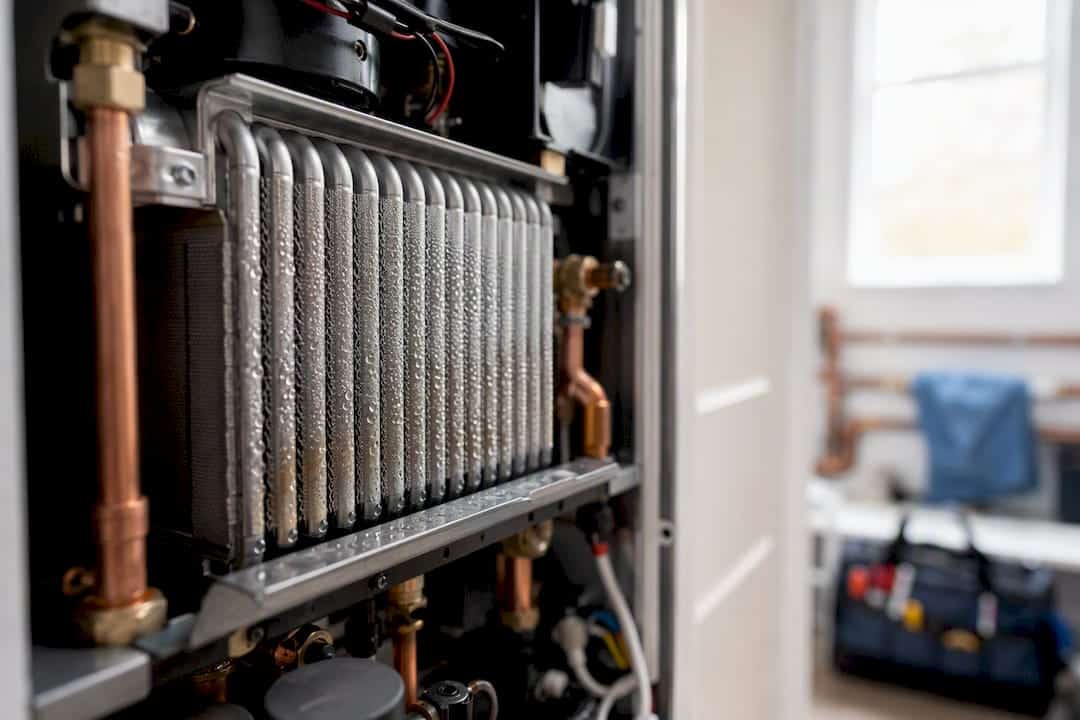
A heat exchanger transfers thermal energy from one fluid or air stream to another without letting the two mix. It’s the component that lets a boiler, water heater or HVAC unit move heat exactly where it’s needed. You’ll find one inside every combi or system boiler, most water heaters, HVAC air handlers, and heat-recovery ventilation units.
TL;DR:
- The efficiency of condensing boilers heavily depends on the condition, material, and correct sizing of the heat exchanger, which are often overlooked.
- Regular maintenance, including checking for corrosion, blockages, and proper condensate drainage, can significantly extend the lifespan of exchanger components.
- A faulty heat exchanger often shows early signs such as loss of heat, rusty water, or unusual noises, and requires prompt professional inspection.
- Accurate recording of exchanger type, material, and condition is vital for precise energy assessments and proper property energy performance ratings.
- Most boiler literature treats exchangers as technical details, but they are central to energy efficiency and are the most vulnerable part to corrosion and fouling.
Table of Contents
- What does a heat exchanger do? The physics behind heat transfer
- Heat exchanger types you’ll find in homes and HVAC systems
- How the heat exchanger works inside a boiler
- Signs your heat exchanger is failing, and how big a job replacement is
- Materials, corrosion and simple maintenance checks
- Why exchanger performance matters for EPCs and building compliance
- Why accurate exchanger details sharpen a Home Energy Model assessment
- The industry treats exchangers as an afterthought. That’s a mistake.
- Sources
What does a heat exchanger do? The physics behind heat transfer
A heat exchanger works by moving thermal energy across a barrier, usually a metal wall, using three physical mechanisms working together. Understanding each one explains why exchangers are shaped the way they are.
Conduction happens when heat moves through a solid material, such as the metal plate or tube wall separating hot combustion gas from cold water. Metal is chosen specifically because it conducts heat efficiently while keeping the two fluids apart.
Convection carries heat through a moving fluid or gas. Inside a boiler, hot water circulates past the exchanger surface and carries absorbed heat onward to radiators; in an HVAC air handler, moving air picks up or sheds heat as it passes across a coil.
Radiation plays a smaller but real role, particularly near a boiler’s combustion chamber, where hot flue gases radiate heat directly onto exchanger surfaces before convection takes over.
The way fluids flow past each other changes how much heat actually transfers, as HVAC365 explains in its overview of heat-transfer principles:
- Counterflow, where fluids move in opposite directions, generally achieves the highest heat transfer because a temperature difference is maintained along the whole exchanger length.
- Parallel flow, where both fluids move the same way, is simpler mechanically but less efficient because the temperature gap narrows quickly.
- Crossflow, common in air-handling coils, balances practicality and performance where ducting constraints rule out a true counterflow design.
Poor insulation or blocked airflow around any of these arrangements drags efficiency down, regardless of how well the exchanger itself is built.
Heat exchanger types you’ll find in homes and HVAC systems
Not every exchanger looks the same, because the job it does dictates its shape. Recognising the type in your own system helps you understand what an engineer means when they diagnose a fault.
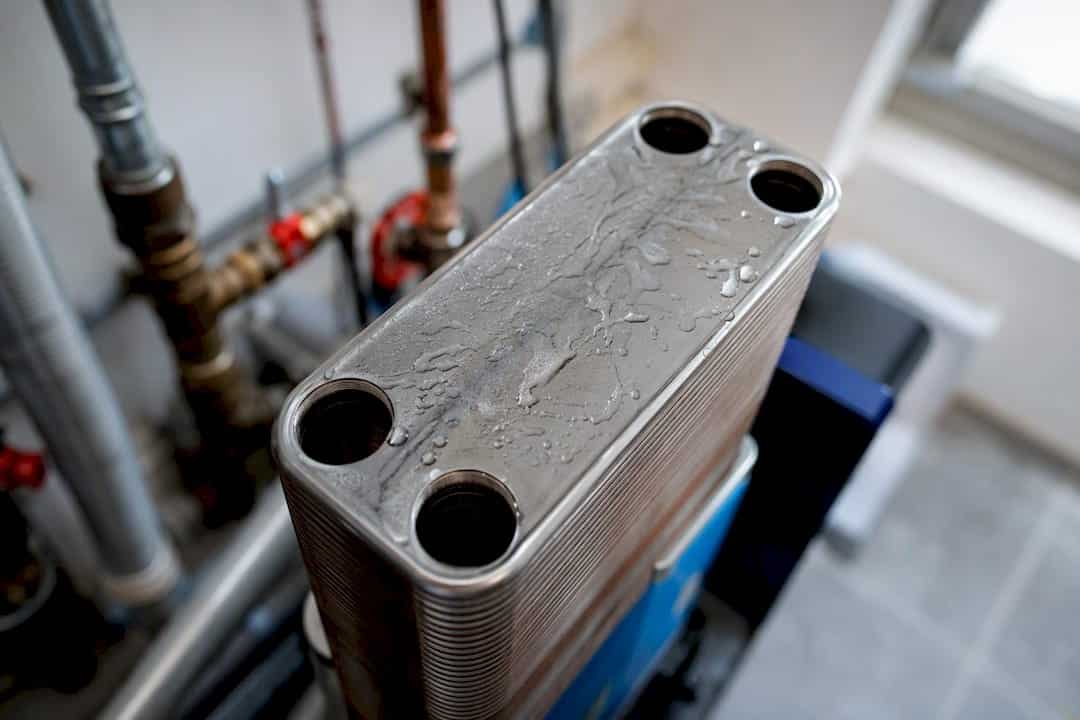
Plate heat exchangers stack thin metal plates to create a large surface area in a compact footprint. They’re the standard choice for a combi boiler’s secondary exchanger, heating tap water instantly as it passes through, and they also appear inside mechanical ventilation with heat recovery (MVHR) units, where they transfer warmth from outgoing stale air to incoming fresh air.
Shell-and-tube and finned-tube exchangers handle larger heat loads or rely on air-side convection. You’ll see coil and finned-tube designs in commercial boiler plant, air handlers and radiator-style heating coils, where fins increase surface area to compensate for air’s relatively poor heat-carrying capacity compared with water.
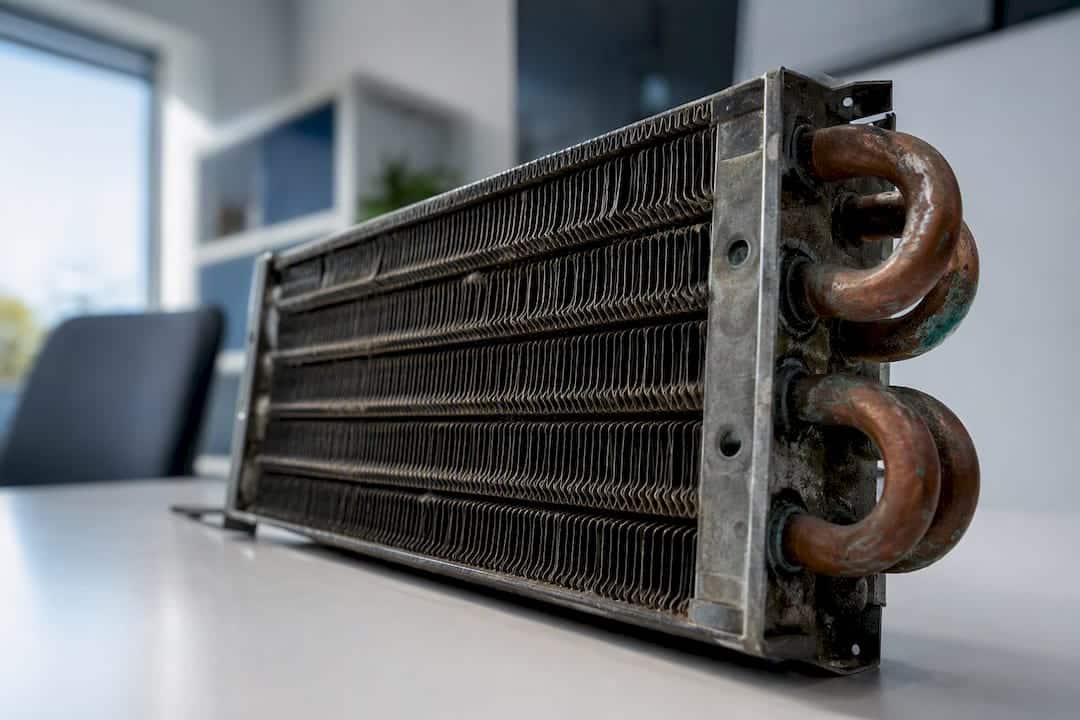
Air-cooled and microchannel exchangers appear where liquid cooling isn’t practical, such as some heat pump outdoor units, or where space is extremely tight. Compact microchannel designs pack more surface area into a smaller volume, useful in modern condensing units where every centimetre of casing counts.
A few practical patterns worth knowing:
- Plate exchangers dominate combi boilers and MVHR units because of their compactness.
- Shell-and-tube and coil designs suit larger commercial systems and air handlers.
- Air-cooled and microchannel variants turn up in space-constrained or outdoor-mounted equipment.
How the heat exchanger works inside a boiler
A typical gas boiler doesn’t rely on one exchanger; it usually runs two, each doing a distinct job. The primary heat exchanger sits closest to the burner and transfers combustion heat into the water circulating around your central-heating loop, the water that eventually reaches your radiators or underfloor pipework. In a combi boiler, a secondary plate heat exchanger then takes some of that heated primary water and uses it to instantly warm fresh mains water for your taps and shower, rather than storing hot water in a cylinder.
Condensing boilers add a further twist. Instead of letting hot flue gases escape up the flue while still carrying useful heat, a condensing design pulls the flue-gas temperature down below 100°C so that water vapour inside the gases condenses back into liquid, releasing latent heat that the exchanger recovers, according to BPEC’s guidance for boiler installers. That condensate has to be drained away safely, which is why condensing boilers need a condensate pipe.
Condensing efficiency: Capturing that latent heat pushes condensing boiler efficiency above 90%, compared with typical efficiencies for older non-condensing designs, according to Gov.
That efficiency gain comes with a materials trade-off. The wet side of a condensing exchanger sits in slightly acidic condensate for long periods, so manufacturers use corrosion-resistant materials such as stainless steel or aluminium rather than the cast iron common in older non-condensing units. Get the material wrong and you shorten the exchanger’s working life considerably.
- Primary exchanger: heats the central-heating circuit.
- Secondary plate exchanger: heats tap water on demand in combi boilers.
- Condensing exchanger: recovers latent heat from flue gases, requires drainage and corrosion-resistant construction.
Signs your heat exchanger is failing, and how big a job replacement is
Most exchanger failures give warning signs before they cause a complete breakdown. Catching them early usually keeps the repair smaller and cheaper.
- Loss of heat or hot water, particularly if the boiler fires up but radiators stay cool, often points to a blocked or cracked primary exchanger.
- Rusty or brown water from taps or radiators suggests internal corrosion, sometimes inside the exchanger itself, sometimes elsewhere in the system feeding debris through it.
- Unusual noises, kettling or banging sounds, typically mean limescale or sludge has built up on exchanger surfaces, restricting flow and causing localised overheating.
- Odd smells or a triggered carbon monoxide alarm are the most serious signs. A cracked heat exchanger can allow combustion gases to escape into a room rather than up the flue, which is why the EPA recommends CO detectors as a standard safety layer around any combustion appliance.
The usual causes are thermal fatigue from repeated heating and cooling cycles, corrosion driven by acidic condensate on the wet side of condensing units, and fouling from limescale or system sludge that insulates the exchanger and forces it to work harder than it should.
Pro Tip: If you smell anything unusual near your boiler or a CO alarm sounds, turn the appliance off, ventilate the room, and call a Gas Safe registered engineer immediately rather than waiting for a scheduled service.
Replacing a heat exchanger on its own is possible on many boiler models, but labour is often involved because the exchanger sits deep inside the casing. On older or heavily corroded units, engineers frequently recommend a full boiler replacement instead, since a failing exchanger is often accompanied by wear elsewhere in the system.
Materials, corrosion and simple maintenance checks
Material choice determines how long an exchanger survives contact with condensate, hard water and thermal cycling. Stainless steel and aluminium dominate condensing designs because both resist the mild acidity of flue-gas condensate, while cast iron remains common in older non-condensing primary exchangers, where corrosion risk is lower.
A short annual routine catches most problems early:
- Book an annual service so an engineer can inspect the exchanger, burner and condensate trap.
- Check the condensate drain isn’t blocked, especially after a cold spell, since freezing is a common winter fault.
- Look for damp patches, drips or discolouration around the boiler casing, an early sign of an internal leak.
- Ask about a chemical system flush if you’re on hard water or the system is more than a few years old.
Pro Tip: A simple visual check of the condensate trap and a listen for kettling noises takes two minutes and often flags trouble before it becomes an emergency call-out.
Water treatment or a full flush becomes worthwhile once you notice reduced radiator heat output or hear persistent noise, both signs that fouling is already reducing exchanger performance.
Why exchanger performance matters for EPCs and building compliance
A boiler’s heat exchanger efficiency feeds directly into how much fuel a home uses to reach a comfortable temperature, which is exactly the kind of input that energy assessments rely on. Get the exchanger type and condition wrong on a certificate and the whole calculation drifts.
Condensing designs recovering latent heat routinely exceed high efficiency levels, surpassing those of the non-condensing exchangers they replaced, per GOV.UK’s building regulations guidance. UK building regulations have required condensing boilers for new gas installations for this reason.
Beyond the boiler itself, other exchanger-based measures shape a property’s overall energy performance:
- Lower central-heating return temperatures let a condensing exchanger spend more time actually condensing, improving real-world efficiency.
- Passive flue-gas heat-recovery devices use a small heat exchanger and heat store to pre-heat incoming cold water, according to BPEC’s installer guidance.
- Correctly sized hot-water cylinders with large internal coils recover heat faster and reduce the energy wasted on reheating.
These details all belong on an accurate energy performance certificate, and the same logic carries through to the Home Energy Model that will shape future assessments.
Why accurate exchanger details sharpen a Home Energy Model assessment
Energy models are only as good as what goes into them, and heat exchanger data is one of the inputs assessors get wrong most often. Exchanger type, age, material, and condensing versus non-condensing status all influence how much heat a boiler actually delivers per unit of fuel burned. Feed an assessment a vague or outdated guess and the modelled heating demand drifts from reality, sometimes significantly.
Providing accurate boiler and exchanger information reduces that uncertainty, tightening the Home Energy Model’s output for a given property. Landlords and homeowners who can show a recent service record, exchanger material, and condensing status tend to get sharper, more defensible assessments than those relying on default assumptions.
If you’re preparing for an EPC or a Home Energy Model assessment and aren’t sure how your boiler’s exchanger details should be recorded, Homeenergymodel’s team can help you book a home energy assessment or explore the different Home Energy Model reports available to landlords.
The industry treats exchangers as an afterthought. That’s a mistake.
Most boiler literature buries the heat exchanger somewhere in the technical appendix, as if it’s a component only engineers need to think about. That framing gets the priority backwards. The exchanger is where the entire efficiency gain of condensing technology actually happens, and it’s also the single part most likely to end a boiler’s working life prematurely through corrosion or fouling.
What gets underestimated, consistently, is how much water quality and duty cycle shape exchanger lifespan compared with the boiler brand printed on the casing. Two identical boilers on different water hardness will age at different rates, and the exchanger is almost always where that difference shows up first. Homeowners fixate on brand and price when the material spec, stainless steel versus aluminium versus older cast iron, and the condensate handling around it matter more for longevity.
The energy-assessment angle gets underestimated too. An EPC or Home Energy Model output built on a guessed boiler efficiency rather than a recorded exchanger type and condition isn’t just slightly off, it can misrepresent a property’s actual running costs to a landlord, a buyer, or a mortgage lender relying on that certificate. Getting the exchanger detail right isn’t a technicality. It’s the difference between an assessment that reflects reality and one that doesn’t.
— Danny
Sources
- Domestic heating by gas: boiler systems – guidance for installers and specifiers (BPEC)
- HVAC 101: The basics of heat-transfer principles – HVAC365
- What about carbon monoxide detectors? – EPA