
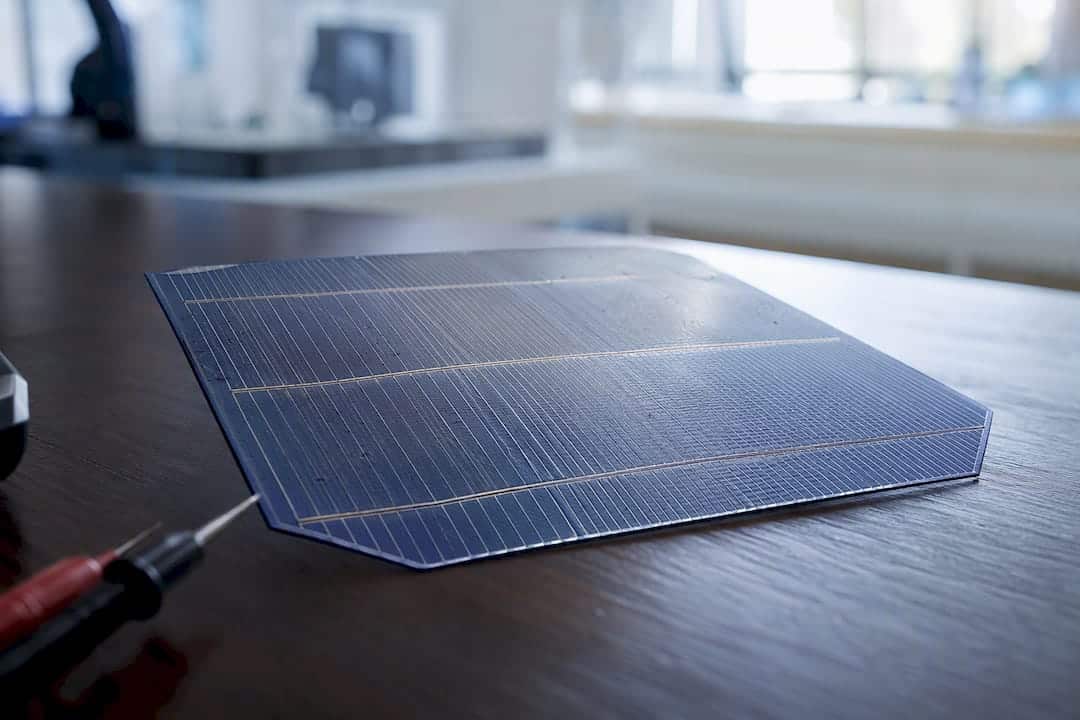
A photovoltaic (PV) cell is a semiconductor device that converts sunlight directly into electricity through the photovoltaic effect. No moving parts, no combustion, no fuel. Light goes in, electric current comes out.
The process happens in three stages:
- Absorption: photons strike the semiconductor and knock electrons loose, creating electron–hole pairs.
- Separation: a built-in electric field at the p–n junction pushes these charges apart before they can recombine.
- Collection: metal contacts gather the separated charges and export them as usable current.
That current leaves the cell as direct current (DC). In practice, one cell produces very little power on its own, so manufacturers wire hundreds together into panels, which are combined into arrays. Because household appliances and the UK grid run on alternating current (AC), an inverter sits between the panels and the property, converting the DC output into something a kettle or a heat pump can actually use.
Key Takeaways
Photovoltaic cells generate electricity by absorbing photons, separating the resulting charge at a p–n junction, and exporting current through an inverter to power a home.
| Point | Details |
|---|---|
| Core mechanism | Photons free electrons, the p–n junction separates the charge, and contacts collect it as current. |
| Crystalline silicon dominates | It dominates commercial modules due to manufacturing maturity, not peak efficiency. |
| Efficiency has a ceiling | Single-junction cells have a theoretical maximum near 33%; commercial panels achieve efficiencies well below that. |
| Night generation is impossible | No photons means no current, so batteries or grid export are the only ways to stay powered after dark. |
| Installation factors dictate real yield | Tilt, shading, temperature, and soiling all shift actual output away from a panel’s rated capacity. |
Table of Contents
- What is a photovoltaic cell?
- The photovoltaic effect, step by step
- From cell to panel to a working home system
- Which PV cell technology is actually best?
- Why can’t a solar cell reach 100% efficiency?
- What determines actual solar output at home?
- Do solar panels work at night?
- How solar panels affect your home’s energy rating
- Why the panel matters less than people think
- Frequently asked questions
- Sources
What is a photovoltaic cell?
A PV cell is the smallest working unit in a solar power system, a wafer-thin slice of semiconductor material, usually only a few hundred microns thick, designed to respond to light. It is not the same thing as a solar panel. A single cell might be a 15 or 16 centimetre square and generate only a few watts under standard test conditions. That is barely enough to run a calculator, which is precisely why cells are never sold or installed alone.
Wire dozens of cells together and you get a module, which most people call a panel. A typical residential panel today carries a few hundred watts of rated output, built from dozens of individual cells connected in a grid pattern. Group several panels together on a roof or a field and you have an array, the term for the complete generating system.
Look closely at a panel and the anatomy becomes obvious:
- Front glass: tempered and coated with an antireflective layer so more light gets through instead of bouncing off.
- Bus bars and fingers: the thin metallic lines you see etched across each cell, which carry collected current to the panel’s edge connectors.
- Encapsulant: a clear polymer layer, usually ethylene vinyl acetate, that bonds the cell to the glass and back sheet while keeping moisture out.
- Back sheet: a weatherproof polymer layer that seals the rear of the panel.
- Frame: the aluminium border that gives the panel structural rigidity and a mounting point.
Every one of these components exists to protect the semiconductor and get its current out efficiently. The cell does the physics. The panel makes that physics durable enough to survive twenty-five years on a British roof.
The photovoltaic effect, step by step
This is the part most explanations rush through, which is a shame, because the mechanism itself is genuinely elegant once you slow down and follow it in order.
1. A photon hits the semiconductor.
Sunlight arrives as a stream of photons, individual packets of light energy. Most PV cells are made from silicon that has been deliberately “doped” with other elements to create two distinct layers: an n-type layer with a surplus of free electrons, and a p-type layer with a deficit of electrons (creating what physicists call “holes”). Where these two layers meet is the p–n junction, and it is the single most important feature of the entire cell.
2. The photon’s energy creates an electron–hole pair.
When a photon carries enough energy, defined by the semiconductor’s bandgap, it can knock an electron loose from its atomic bond. This leaves behind a hole (an absence where the electron used to be) and frees the electron to move. Physicists call this an electron–hole pair, and it is the raw material of solar electricity. Silicon’s bandgap sits at around 1.1 electron volts, which means photons below that energy threshold simply pass through without doing any useful work, no matter how much sunlight is falling on the cell.
3. The p–n junction’s electric field separates the charges.
Left alone, that freed electron would quickly fall back into a hole and release its energy as useless heat, a process called recombination. The p–n junction prevents most of this from happening. At the junction, a natural electric field forms because of the imbalance between the two doped layers, and this field sweeps electrons toward the n-type side and holes toward the p-type side. The U.S. Department of Energy’s explanation of solar photovoltaic cell basics describes this separation as the step that makes the charges collectable rather than just briefly existing.
4. Metal contacts collect the current and send it into a circuit.
Once electrons accumulate on the n-type side and holes on the p-type side, the cell behaves like a tiny battery with two terminals. Connect an external circuit, a wire, a load, or a string of other cells, and electrons flow out through the front contacts, through the circuit, and back in through the rear contact, completing the loop as usable electric current.
A quick glossary, because these terms get thrown around loosely elsewhere:
- Photon: a discrete packet of light energy; the trigger for the entire process.
- Bandgap: the minimum photon energy needed to free an electron in a given semiconductor.
- Electron–hole pair: the freed electron plus the vacancy it leaves behind.
- P-type / n-type: the two doped semiconductor layers that create the junction’s internal electric field.
- Open-circuit voltage: the maximum voltage a cell produces with no load connected.
A single crystalline silicon cell typically produces an open-circuit voltage of about half a volt, as noted by the U.S. Energy Information Administration. That is roughly a third of a standard AA battery. It is also why panels connect dozens of cells in series: stacking voltage is the only way to reach anything a household appliance can use. Picture the whole process as a relay race: the photon hands off energy to the electron, the junction hands the electron toward the contact, and the contact hands the current into your wiring. Each stage exists purely to keep that handoff moving forward rather than backward.
From cell to panel to a working home system
A single cell’s half-volt output is nearly useless on its own, so manufacturers wire cells together deliberately. Series connections add voltages together (say, 60 cells at 0.5 V each producing 30 V), while parallel connections add current capacity. Panel designers combine both approaches to hit target voltage and current ratings that match inverter specifications.
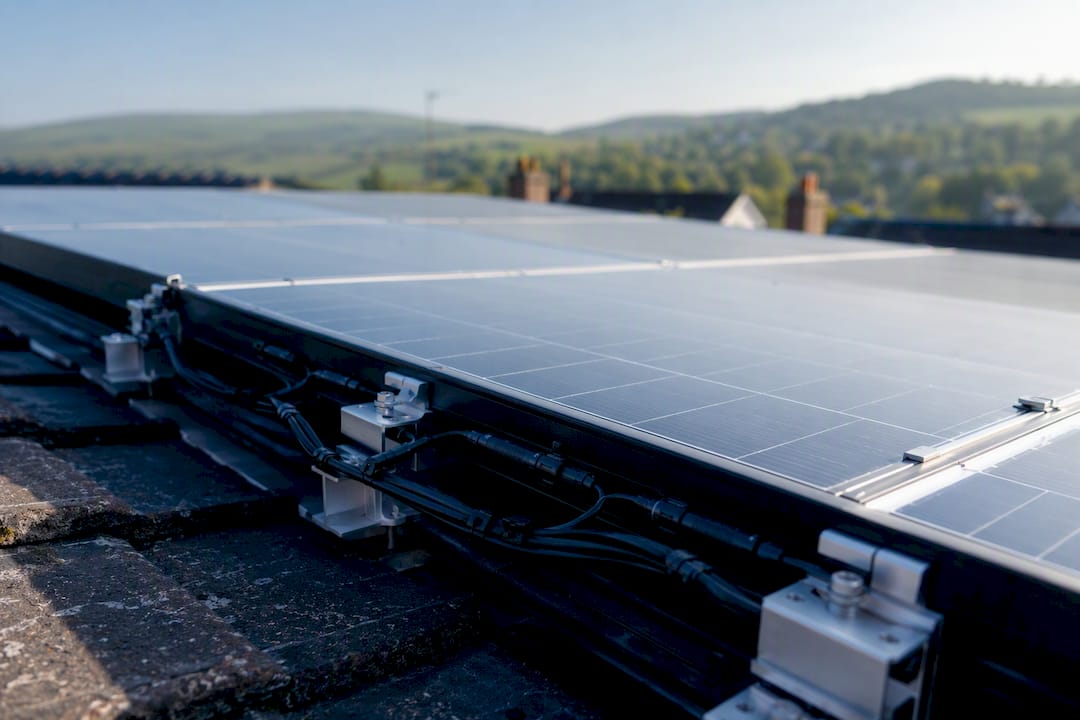
The finished module packages this cell string inside tempered glass, encapsulant, and a frame, as covered above, and the result is what actually gets bolted to a roof. Commercial panels today typically range from 250 to 400 watts, though larger commercial-grade panels can exceed that. Crystalline silicon dominates this market, accounting for the vast majority of modules sold globally according to EIA data, largely because manufacturing has matured to the point where it beats newer materials on cost and reliability, not necessarily on raw efficiency.
From the panel, DC electricity travels to an inverter, arguably the least glamorous but most operationally important component in the whole system. The inverter converts DC into grid-compatible AC, and it is also where system monitoring, safety shutoffs, and (in hybrid setups) battery management typically live. Homeowners planning an installation should treat the inverter as a genuine maintenance item rather than a set-and-forget box. Inverters generally have a shorter service life than the panels themselves and often need replacement partway through a system’s lifetime, a point worth factoring into any long-term cost projection.
System architecture varies by household need:
- Grid-tied: the most common domestic setup, exporting surplus generation to the grid and importing power when the array isn’t producing enough.
- Off-grid: fully independent, relying entirely on batteries and generation with no grid connection at all, common in remote locations.
- Hybrid: grid-connected but with battery storage layered in, letting a household use its own stored generation during evening peak demand rather than exporting it cheaply and buying it back later at a higher price.
Sizing an array against household consumption is its own calculation, one that weighs roof space, local irradiance, and appliance load, and it is where a proper energy simulation earns its keep rather than guesswork.
Which PV cell technology is actually best?
Not every solar cell is built the same way, and the differences matter more than most sales literature admits. Here is how the main technologies stack up against each other on the dimensions that actually affect a buying or specifying decision.
| Technology | Typical efficiency (lab vs commercial) | Cost / complexity | Lifespan / degradation | Best use case |
|---|---|---|---|---|
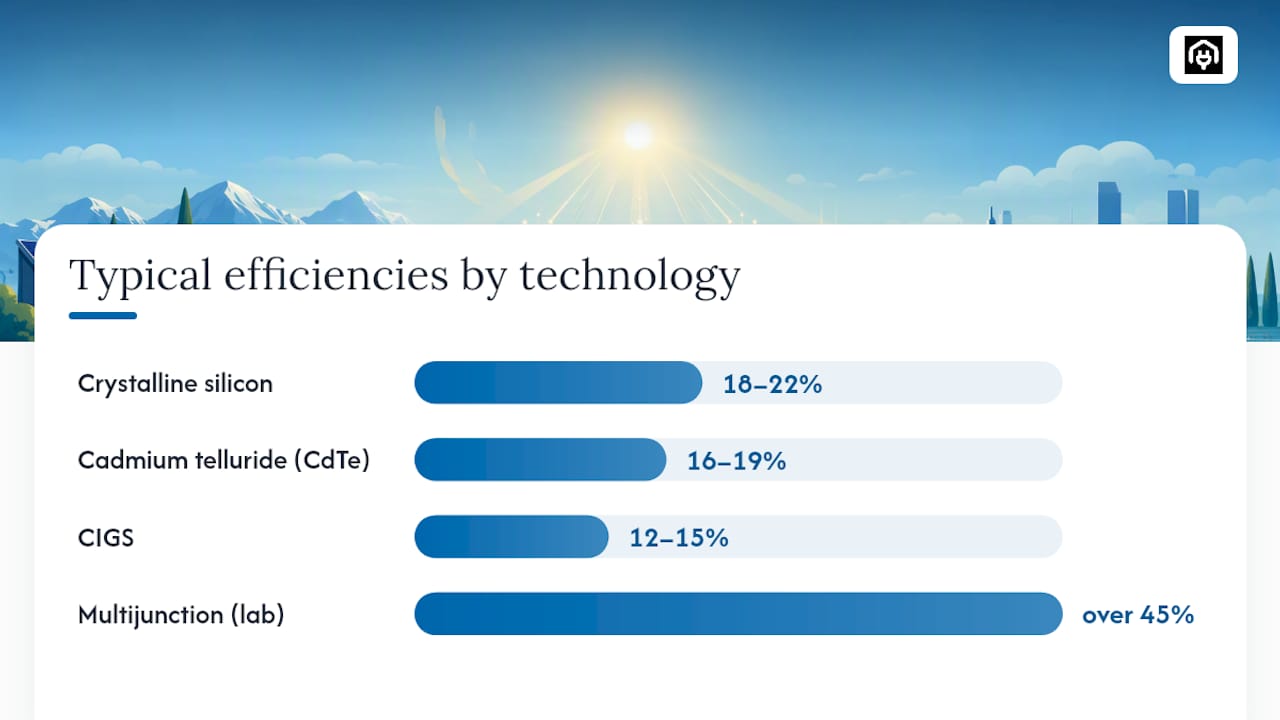
| Crystalline silicon | Lab ~27%, commercial 18–22% | Low to moderate; mature manufacturing | Long service life with gradual degradation | Rooftop residential and commercial |
| Cadmium telluride (CdTe) | Lab ~22%, commercial 16–19% | Lower material and energy cost to produce | Comparable to silicon, well-established | Large-scale utility installations |
| CIGS (copper indium gallium diselenide) | Lab ~23%, commercial 12–15% | Higher complexity, flexible substrates possible | Good, though less field data than silicon | Flexible and lightweight applications |
| Perovskite | Laboratory efficiencies exceeding typical commercial values | Potentially very low cost, still pre-commercial at scale | Weak; stability under heat and moisture remains unresolved | Emerging, tandem cells with silicon |
| Multijunction | Lab over 45% | Very high, expensive materials and fabrication | Strong, but built for niche high-value use | Satellites, space power systems |
| Concentrator PV (CPV) | Lab efficiencies rival multijunction | High; needs precision tracking hardware | Good in stable, high-sun climates | Utility-scale desert installations |
Crystalline silicon remains the default choice for nearly every rooftop installation you will encounter in the UK, not because it is the most efficient material available, but because decades of manufacturing refinement have made it dependable and comparatively cheap. Cadmium telluride (CdTe) and CIGS fall under the “thin-film” category, using far less semiconductor material per watt, which suits large flat installations where weight and flexibility matter more than squeezing out maximum efficiency. Perovskite cells are the technology everyone in the industry is watching, with laboratory efficiencies climbing past silicon’s ceiling, but they still degrade faster under heat and humidity than manufacturers would like, which is why they have not yet reached your local roofer’s product list.
Multijunction cells stack several semiconductor layers, each tuned to a different bandgap, so the cell captures a wider slice of the solar spectrum than any single-junction design ever could. This is how they surpass efficiency limits that silicon simply cannot beat, and it is why multijunction cells dominate space applications where every watt per kilogram counts and cost is a secondary concern. Concentrator PV (CPV) takes a related approach on Earth, using lenses or mirrors to focus sunlight onto a small, highly efficient cell, trading the need for precise sun-tracking hardware for a meaningful efficiency gain in consistently sunny climates.
None of this changes the practical answer for a typical homeowner: crystalline silicon remains the sensible, proven choice, and the technologies above matter more as context for where the industry is heading than as options actually available on your roof today.
Why can’t a solar cell reach 100% efficiency?
Physics sets a hard ceiling here, and it has a name: the Shockley–Queisser limit. For a single-junction silicon cell, this theoretical maximum sits at around 33%, a figure derived from the fundamental mismatch between the broad spectrum of sunlight and a semiconductor’s fixed bandgap, as explained in TU Delft’s coursework on solar cell principles. Commercial panels today typically achieve efficiency percentages well below the theoretical maximum, because real-world manufacturing introduces further losses on top of the physics.
Where does the rest of the sunlight’s energy go? Several loss mechanisms eat into the theoretical maximum:
- Sub-bandgap photons: light with too little energy to free an electron passes straight through, contributing nothing.
- Thermalisation: high-energy photons free an electron but waste their excess energy as heat rather than usable current.
- Recombination: some freed electrons fall back into holes before the junction’s field can separate them.
- Optical and reflective losses: a portion of incoming light simply bounces off the cell surface, despite antireflective coatings.
- Resistive losses: internal resistance in the semiconductor and contacts dissipates a small amount of power as heat.
There is a genuine trade-off buried in bandgap selection. A wider bandgap captures higher voltage per photon but excludes more of the lower-energy spectrum; a narrower bandgap captures more photons but at lower voltage each. Silicon’s bandgap represents a compromise, not an optimum, which is exactly why multijunction designs stack multiple bandgaps to capture more of the spectrum than any one material manages alone.
Pro Tip: Tilt and orientation matter more than most homeowners assume. A panel angled and facing away from true south (in the northern hemisphere) can lose a meaningful share of its potential annual output, and temperature works against you too: silicon cells actually lose efficiency as they get hotter, which is why a scorching August afternoon rarely produces the year’s best output despite the abundance of sunlight.
What determines actual solar output at home?
Cell-level physics only tells half the story. What a household actually generates each year depends heavily on installation-specific factors that no efficiency percentage captures on its own.
The main variables at play:
- Tilt and orientation: how the array faces the sun across the day and across the seasons.
- Local irradiance and weather: the UK’s cloud cover reduces output compared with consistently sunny climates, though panels still generate at reduced output on cloudy days rather than shutting off entirely.
- Shading: even partial shading on one panel in a series string can disproportionately reduce the whole string’s output.
- Temperature: as noted above, heat reduces cell efficiency even while boosting available sunlight.
- Soiling: dust, pollen, and bird droppings gradually reduce light transmission through the front glass.
- Inverter efficiency: even a well-specified inverter loses a small percentage of power during DC to AC conversion.
A rough estimating framework helps put this in context: multiply the array’s rated capacity in kilowatts-peak (kWp) by the local annual peak sun hours to approximate annual output in kilowatt-hours. For example, a few kilowatt array in a typical UK location receiving a moderate number of peak sun hours a year might generate several thousand kilowatt-hours annually, though actual figures always depend on the specific site and system losses described above. Solar calculation methodology built for energy performance assessments accounts for these variables far more precisely than a back-of-envelope estimate ever can.
Pro Tip: If your roof has partial shading from a chimney, tree, or neighbouring building, microinverters or power optimisers fitted to individual panels can prevent one shaded panel from dragging down the output of the entire string, a genuine improvement over a single central inverter on complex roofs.
Do solar panels work at night?
No, and the physics behind that answer is straightforward. Photovoltaic cells generate electricity only when photons strike the semiconductor and free electrons. After dark, there are no photons to absorb, so no electron excitation and no current generation occurs, regardless of how sophisticated the panel technology is.
This is not a flaw to be engineered around at the cell level. It is a straightforward consequence of relying on sunlight as the energy source, and households have three realistic ways to keep the lights on after sunset:
- Grid-tied export and import: send surplus daytime generation to the grid and draw power back after dark, the simplest and most common UK approach.
- Battery storage: store daytime surplus in a home battery system, such as those built around Sungrow storage solutions, for use overnight rather than exporting it cheaply.
- Hybrid inverters with demand shifting: run high-consumption appliances during daylight hours when generation is highest, reducing reliance on stored or imported power altogether.
Export tariffs, storage incentives, and connection rules vary considerably by country and even by regional network operator, so check local schemes before assuming a particular payback figure applies to your property.
How solar panels affect your home’s energy rating
Installing PV does more than cut a household’s electricity bill. It directly affects how that property performs on paper, and property owners preparing for an Energy Performance Certificate or navigating the incoming Home Energy Model methodology need to understand how.
Energy models account for PV generation, export behaviour, and even thermal effects from panel-covered roof areas within their assessment inputs:
- Generation offset: modelled PV output reduces a property’s calculated energy demand from imported grid electricity.
- Export credit: surplus generation sent back to the grid can factor positively into overall performance scoring.
- Thermal interaction: panel arrays can subtly affect roof heat gain and loss, a detail proper modelling accounts for rather than ignores.
The Home Energy Model, which is set to replace SAP for assessing building energy performance, treats these inputs with more granularity than older methodologies, which matters directly for landlords and investors planning upgrades ahead of the Future Homes Standard. Anyone weighing a PV installation against EPC or compliance targets should check how PV specifically factors into UK energy ratings before assuming a simple like-for-like efficiency gain translates into a certificate improvement.
Homeenergymodel offers guidance and assessment support for property owners navigating exactly this intersection between physical installation and regulatory modelling, worth exploring before committing to a system sized purely on rooftop capacity.
Why the panel matters less than people think
Most homeowners fixate on panel wattage and efficiency percentages when comparing quotes, and honestly, that focus is slightly misplaced. Crystalline silicon panels from reputable manufacturers perform within a narrow band of each other these days. The bigger variables sit elsewhere: how well the installer accounts for shading and orientation, whether the inverter is sized correctly, and whether the system gets modelled properly against the property’s actual consumption pattern rather than a generic assumption.
The inverter, in particular, deserves more scrutiny than it usually gets. It is the component most likely to need replacement within a system’s working life, and a poorly matched inverter quietly caps output for years without anyone noticing.
The other gap worth naming: property owners rarely connect their PV installation back to their energy rating. A well-sized array can meaningfully improve how a property scores under the Home Energy Model, but only if the generation and export data actually get captured in the assessment correctly. Getting the physics right on the roof and getting the paperwork right on the certificate are two separate jobs, and skipping the second one leaves value on the table.
Frequently asked questions
How do photovoltaic cells actually generate electricity?
Photovoltaic cells absorb photons from sunlight, which free electrons inside the semiconductor and create electron–hole pairs. A p–n junction’s internal electric field separates these charges, and metal contacts collect the result as usable direct current.
What is the difference between a PV cell, a panel, and an array?
A cell is the smallest working unit, typically producing 1 to 3 watts. A panel (or module) wires many cells together, usually rated between 250 and 400 watts. An array is the complete collection of panels installed on a property.
Why do solar panels produce DC instead of AC?
The photovoltaic effect inherently produces direct current because electrons flow in one direction across the p–n junction. An inverter converts this DC into the alternating current that UK homes and the grid require.
Do photovoltaic cells work on cloudy days?
Yes, though at reduced output. Cells still absorb diffuse light on overcast days; they simply generate less current than under direct, clear-sky sunlight.
What is the theoretical maximum efficiency of a solar cell?
For a single-junction cell, the Shockley–Queisser limit sets a theoretical ceiling of roughly 33%.
Is crystalline silicon still the best PV technology available?
Sources
- Solar photovoltaic cell basics — U.S. Department of Energy
- Photovoltaics and electricity — U.S. Energy Information Administration (EIA)
- Multijunction and advanced PV strategies — PMC article
- Solar panels: costs, savings and benefits explained — Energy Saving Trust