

TL;DR:
- EPC in construction refers to both Engineering, Procurement, and Construction contracts and Energy Performance Certificates. Confusing these meanings can result in costly legal and compliance errors during project delivery and property transactions. Proper understanding and clear documentation of each meaning are essential for risk management and regulatory compliance in UK construction projects.
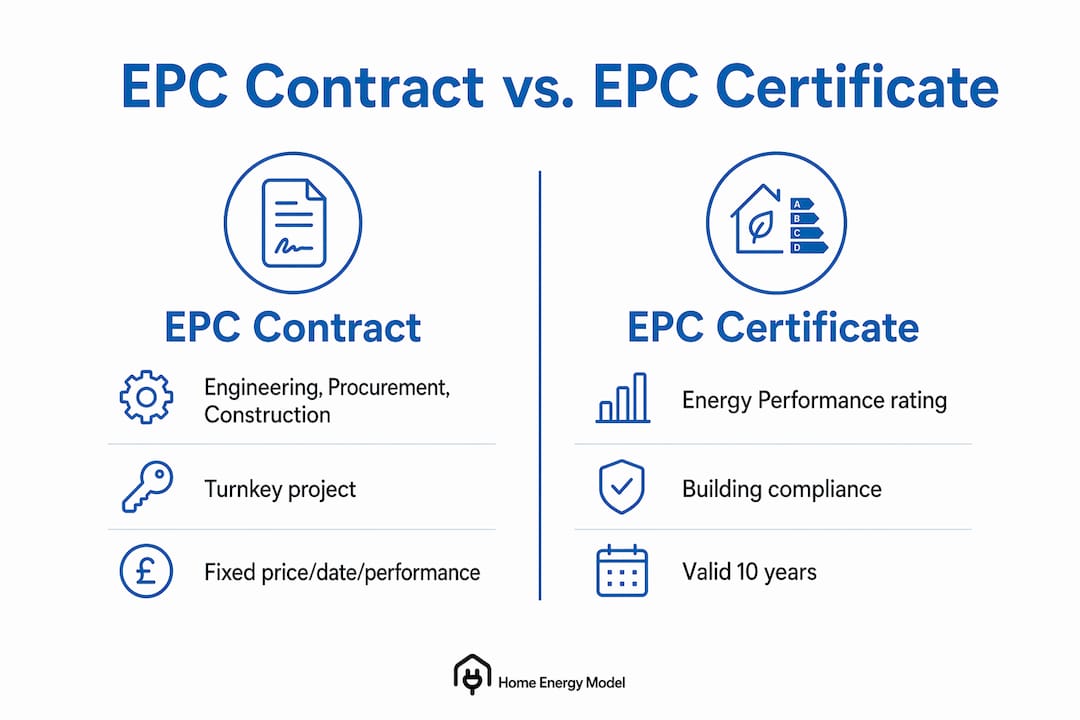
EPC in construction stands for two distinct things: Engineering, Procurement, and Construction, a turnkey project delivery contract, and Energy Performance Certificate, a mandatory energy efficiency rating for UK buildings. Both meanings carry serious legal and financial weight. Confusing them in a tender document or project brief can lead to costly errors. This guide explains both EPC meanings clearly, covering the contractual model used on large infrastructure projects and the compliance certificate required under UK Building Regulations, with practical guidance for builders and property developers working in 2026.
What does EPC stand for in construction contracts?
EPC most commonly stands for Engineering, Procurement, and Construction. Under this contract model, a single contractor takes full responsibility for designing the facility, sourcing all materials and equipment, and completing the build. The client simply turns the key to begin operations. This is why EPC contracts are also called turnkey contracts.
The EPC contract model is the standard delivery vehicle for large infrastructure projects: power stations, oil refineries, water treatment plants, and major industrial facilities. The appeal to project owners is straightforward. One contractor owns the entire scope, which removes the coordination risk that arises when separate design and construction firms work under different agreements.
Fixed price, fixed date, and performance guarantees
EPC contracts carry fixed price, fixed completion date, and specified performance levels. Failure to meet any of these requirements typically triggers monetary liabilities for the contractor. That risk transfer is the defining feature of the EPC model.
FIDIC, the international federation of consulting engineers, codified this approach in its Silver Book, which is designed around EPC turnkey project principles. Lenders and project finance banks rely on the Silver Book structure because it creates enforceable milestones and liquidated damages terms, which are essential for bankability.
EPC contract variants worth knowing
Several related contract types are used alongside or instead of a standard EPC agreement:
- LSTK (Lump Sum Turnkey): Similar to EPC but emphasises the lump sum payment structure rather than the delivery process.
- EPCC (Engineering, Procurement, Construction, and Commissioning): Extends contractor responsibility through to commissioning and handover testing.
- EPIC (Engineering, Procurement, Installation, and Construction): Common in offshore and subsea projects where installation is a distinct phase.
- EPCM (Engineering, Procurement, and Construction Management): The contractor manages the process but does not hold direct contracts with subcontractors. Risk stays with the client. This is a fundamentally different risk profile from a standard EPC arrangement.
Pro Tip: Always confirm whether a contract is EPC or EPCM before pricing. The risk exposure for the contractor differs substantially between the two models.
What is an Energy Performance Certificate in UK building projects?
In the UK, EPC stands for Energy Performance Certificate, a document that rates a building’s energy efficiency on a scale from A (most efficient) to G (least efficient). An EPC is legally required whenever a building is constructed, sold, or let. Certificates remain valid for 10 years.

The scale of EPC activity in England and Wales reflects just how embedded this requirement has become. Over 460,000 EPC certificates were lodged in Q1 2026 alone. That volume represents a 2% decrease compared to Q1 2025, but the numbers confirm that EPC compliance is a routine part of property transactions at scale.
How EPC ratings are calculated
UK government-approved methodologies determine EPC ratings for compliance with Building Regulations. SAP (Standard Assessment Procedure) applies to dwellings. SBEM (Simplified Building Energy Model) applies to non-domestic buildings. Both methodologies assess factors including insulation, heating systems, glazing, and air permeability.
The table below summarises the two primary EPC certificate methodologies:
| Methodology | Building type | Key inputs assessed |
|---|---|---|
| SAP | Residential dwellings | Insulation, heating, hot water, glazing, renewables |
| SBEM | Non-domestic buildings | HVAC systems, lighting, fabric, occupancy patterns |
The UK government views EPC certificates as a disclosure and compliance mechanism, reflecting carbon and cost transparency goals. Reforms to the Energy Performance of Buildings regime are ongoing, with updated guidance published in march 2026.
Pro Tip: For new residential builds, engage a SAP assessor at design stage, not after practical completion. Late engagement frequently results in specification changes that delay handover.
How do EPC contracts and Energy Performance Certificates differ?
Confusing EPC contracting with EPC certificates can lead to costly errors in bidding and project management. The two meanings share an acronym but describe entirely different obligations. One is a project delivery structure. The other is a regulatory compliance document.
The comparison below clarifies the key differences:
| Feature | EPC contract | Energy Performance Certificate |
|---|---|---|
| Full name | Engineering, Procurement, and Construction | Energy Performance Certificate |
| Primary purpose | Project delivery and risk allocation | Building energy efficiency rating |
| Who holds responsibility | Main contractor | Accredited energy assessor |
| Regulatory framework | Contract law, FIDIC Silver Book | UK Building Regulations, Part L |
| Validity period | Duration of project | 10 years from issue |
| Applies to | Infrastructure and industrial projects | All buildings on construction, sale, or let |
In practice, both EPC meanings can apply simultaneously on the same project. A developer commissioning a new commercial building under an EPC turnkey contract will also need an EPC certificate at practical completion. The contractor’s design decisions, including insulation specification, glazing ratios, and mechanical and electrical systems, directly affect the eventual EPC certificate rating the building achieves.
This intersection creates a practical obligation. Contractors working under an EPC turnkey agreement must understand that their procurement choices affect the client’s regulatory compliance position. A building that fails to achieve the required EPC rating at handover may trigger disputes under the performance guarantee provisions of the contract itself.
Practical implications for UK builders and property developers
Builders and property developers who understand both EPC meanings are better placed to manage risk, meet deadlines, and avoid disputes. The following steps reflect current best practice for UK construction projects in 2026.
-
Clarify the meaning of EPC in every document. When EPC appears in a tender, contract, or brief, confirm whether it refers to the Engineering, Procurement, and Construction delivery model or to an Energy Performance Certificate requirement. Never assume context makes the meaning obvious.
-
Align design decisions with EPC certificate targets from the outset. Integrating SAP and SBEM knowledge early in design reduces the risk of non-compliance at handover and improves market positioning. Specifying insulation and heating systems without reference to SAP or SBEM outputs is a common and avoidable error.
-
Build EPC certificate requirements into EPC contract performance guarantees. If a project requires a minimum EPC rating at completion, that requirement should appear explicitly in the contract’s performance specification. Leaving it implied creates ambiguity that benefits neither party.
-
Understand MEES obligations for let properties. The Minimum Energy Efficiency Standards require rental properties in England and Wales to meet minimum EPC ratings. Developers building to let must factor this into their design brief from day one.
-
Use the official EPC register to verify certificates. The UK government’s Energy Performance of Buildings Register holds all lodged EPC certificates for England and Wales. Developers and contractors can check existing ratings before acquisition or refurbishment.
-
Manage risk and stakeholder expectations on EPC turnkey contracts. Enforceable milestones and liquidated damages terms are essential for bankability. Scope boundaries and performance terms must be unambiguous before contract execution.
Key takeaways
EPC in construction carries two distinct meanings, and treating them as interchangeable creates real legal and financial risk for builders and developers.
| Point | Details |
|---|---|
| Dual EPC meanings | EPC stands for Engineering, Procurement, and Construction (contract) and Energy Performance Certificate (compliance document). |
| EPC contract risk transfer | Fixed price, fixed date, and performance guarantees place consolidated risk on the main contractor. |
| EPC certificate requirement | UK law requires an EPC rating from A to G on construction, sale, or let, valid for 10 years. |
| SAP and SBEM methodologies | SAP applies to dwellings; SBEM applies to non-domestic buildings; both determine Building Regulations compliance. |
| Design decisions affect both | Procurement choices under an EPC contract directly influence the EPC certificate rating at handover. |
Why the dual EPC meaning matters more than most people realise
I have reviewed construction briefs and tender documents where EPC appeared three times in the same paragraph, referring to two different things simultaneously. Nobody had flagged it. The contractor priced the job assuming a management contract structure. The client expected a full turnkey delivery. The dispute that followed was entirely avoidable.
The construction industry has lived with this acronym collision for years, and the problem is getting worse, not better. As the UK government tightens energy performance requirements under the Future Homes Standard and the ongoing reforms to the Energy Performance of Buildings regime, EPC certificates are appearing in more project documents than ever before. Meanwhile, EPC turnkey contracts remain the default structure for major infrastructure delivery. The overlap is constant.
My view is that the solution is not complicated. Every project document that uses the term EPC should define it on first use. That single discipline would prevent most of the confusion I see. The deeper lesson is that energy performance is no longer a compliance afterthought. It is a design and procurement constraint that belongs in the EPC contract scope from the earliest stages. Contractors who treat the EPC certificate as someone else’s problem at handover are taking on risk they have not priced.
— Danny
How Homeenergymodel supports EPC compliance for UK developers
Homeenergymodel provides practical guidance for UK builders, landlords, and property developers navigating both EPC meanings. The site covers the full range of energy assessment approaches, from SAP calculations for new residential builds to SBEM assessments for commercial properties. Developers working under EPC turnkey contracts can find clear explanations of how design and procurement decisions affect final certificate ratings. For landlords managing existing stock, resources on home energy models for landlords explain the different assessment types and their compliance implications. Homeenergymodel also covers the latest government reforms to the Energy Performance of Buildings regime, keeping professionals current with 2026 regulatory requirements.
FAQ
What does EPC stand for in construction?
EPC stands for either Engineering, Procurement, and Construction, a turnkey project delivery contract, or Energy Performance Certificate, a mandatory energy efficiency rating for UK buildings. The correct meaning depends entirely on the context in which the term appears.
What is an EPC contract in construction?
An EPC contract is a turnkey agreement where one contractor handles design, procurement, and construction under a fixed price, fixed completion date, and agreed performance levels. FIDIC’s Silver Book is the internationally recognised framework for this contract type.
When is an Energy Performance Certificate required in the UK?
An EPC is required whenever a building is constructed, sold, or let in the UK. Certificates are valid for 10 years and must be produced by an accredited energy assessor using SAP or SBEM methodology.
What is the difference between EPC and EPCM contracts?
Under an EPC contract, the contractor holds full risk and direct contracts with subcontractors. Under an EPCM (Engineering, Procurement, and Construction Management) contract, the contractor manages the process but risk remains with the client.
How does an EPC contract affect the Energy Performance Certificate rating?
Design and procurement decisions made under an EPC contract, including insulation specification, glazing, and mechanical systems, directly determine the SAP or SBEM score and therefore the EPC certificate rating at practical completion. Contractors should treat the target EPC rating as a performance requirement within the contract scope.