

TL;DR:
- A house energy rating calculator estimates a property’s energy efficiency based on inputs like insulation, heating, and glazing to aid planning. However, professional SAP assessments are necessary for compliance, as they involve detailed onsite testing and verification. Using online tools for screening and planning, combined with verified audits, ensures accurate ratings and effective upgrade strategies.
A house energy rating calculator is a digital tool that estimates a property’s energy efficiency by analysing inputs such as insulation levels, heating systems, glazing, and floor area, enabling UK property owners and landlords to identify improvement opportunities and meet compliance requirements. The industry standard for formal assessments in the UK is the Standard Assessment Procedure (SAP), which underpins Energy Performance Certificates (EPCs). Online home energy efficiency calculators offer a faster, lower-cost alternative for initial screening, though they differ significantly from a full SAP assessment. With the government’s Home Energy Model set to replace SAP from 2025 onwards, understanding how these tools work has never been more relevant for landlords and property investors.
How does a house energy rating calculator work?

Online calculators estimate energy consumption by modelling heating and cooling loads based on home size, insulation quality, and climate zone, then adding major appliance usage to produce a total annual kilowatt-hour figure. This figure is then translated into a rating band, typically A to G, mirroring the EPC scale. The process gives landlords a rapid indication of where a property sits before committing to a full professional assessment.
The core inputs that drive these calculations include:
- Floor area and property age: Older properties generally have thicker walls but poorer insulation, directly affecting heat loss estimates.
- Insulation levels: Loft, wall, and floor insulation values are the single largest determinant of heat loss in most UK homes.
- Heating system type: Gas boiler, heat pump, electric storage heaters, and oil boilers each carry different efficiency coefficients.
- Glazing specification: Single, double, or triple glazing affects both heat loss and solar gain calculations.
- Renewable energy systems: Solar photovoltaic panels and solar thermal collectors reduce net energy demand and improve the rating.
The key distinction is between simplified screening tools and advanced simulation. Simplified tools apply fixed waste factors and standard assumptions. Research shows that older homes with poor insulation waste between 30% and 45% of their total annual energy expenditure, and calculators apply similar waste factors based on age and insulation data. Advanced simulation tools, such as those used in SAP calculations, model the property hour by hour using regional climate data and detailed construction specifications. The gap between these two approaches matters when the result will be used for compliance rather than planning.
Pro Tip: Before entering data into any online calculator, gather your property’s EPC lodgement reference from the EPC register. The existing certificate contains verified floor area, construction type, and heating system data that will improve the accuracy of any online estimate.
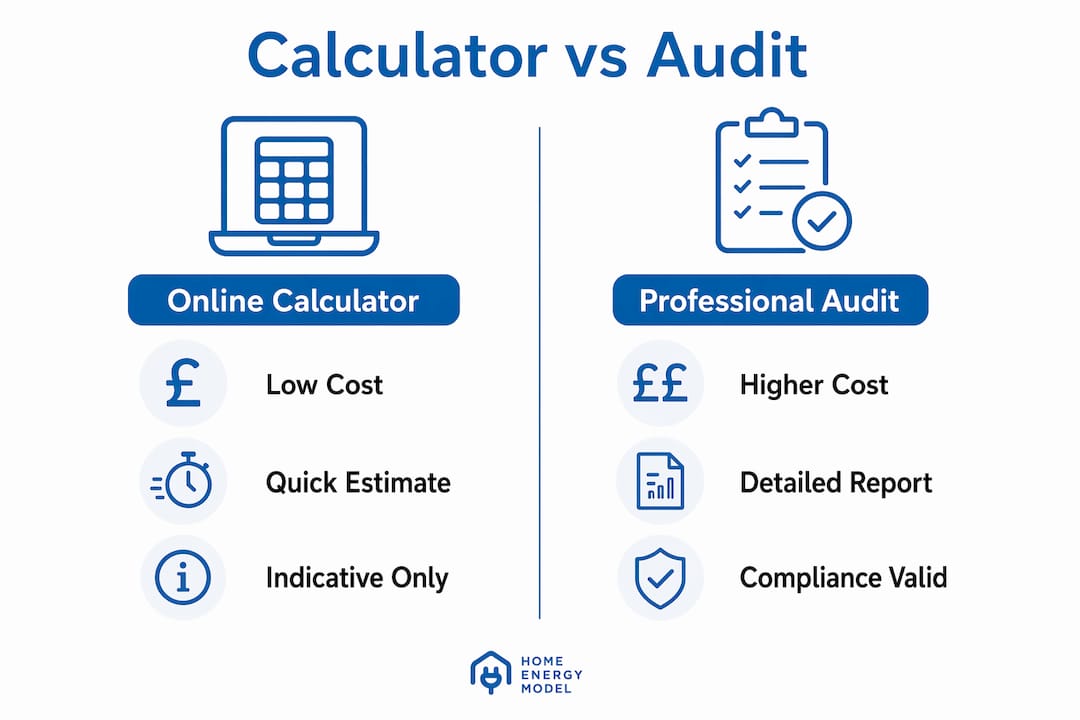
Online calculators vs professional energy audits: which do you need?
The choice between an online energy performance rating tool and a professional audit depends on the purpose of the assessment. The table below summarises the key differences.
| Feature | Online calculator | Professional audit (SAP/EPC) |
|---|---|---|
| Cost | Free to low cost | £60–£300+ depending on property size |
| Time required | 10–30 minutes | 1–3 hours on site plus reporting |
| Accuracy | Indicative only | Verified and legally recognised |
| Compliance use | No | Yes, for lettings and sales |
| Diagnostic depth | Limited | Full, including fabric and systems |
| Physical testing | None | Blower door tests, thermographic scans |
Professional assessments include physical diagnostic testing such as blower door tests and thermographic scans that online calculators cannot replicate. A blower door test pressurises the building to measure air leakage rates, revealing draughts that no questionnaire can detect. Thermographic imaging identifies cold bridges and insulation gaps invisible to the naked eye. These methods are the reason professional audits are the only route to a legally valid EPC.
Online tools are best used in three specific scenarios:
- Pre-purchase screening: Estimating the likely rating of a property before instructing a formal assessment.
- Upgrade planning: Modelling the impact of proposed improvements before spending on a surveyor’s report.
- Portfolio prioritisation: Ranking multiple properties by estimated efficiency to decide where to invest first.
Professional audits also deliver three structured outputs that online tools cannot match: a verifiable baseline for future comparison, a detailed map of energy consumption by system, and a ranked measure matrix with financial metrics attached to each upgrade. For landlords managing compliance with the Minimum Energy Efficiency Standards (MEES), only the professional route counts.
What upgrades do energy rating calculators typically recommend?
Most home energy audit tools surface the same shortlist of high-impact measures, ranked by their effect on the rating score. Understanding the typical costs and rating impacts helps landlords sequence investment sensibly.
| Upgrade measure | Typical gross cost | Net cost after grants | Rating improvement |
|---|---|---|---|
| Loft insulation | £800–£1,500 | £0–£800 | 1–2 sub-bands |
| Cavity wall insulation | £500–£1,500 | £0–£700 | 1–2 sub-bands |
| Double glazing (full house) | £4,000–£10,000 | £3,000–£8,000 | 1 sub-band |
| Air-to-water heat pump | £8,000–£15,000 | £5,000–£10,000 | 3–5 sub-bands |
| Solar PV (3kWp system) | £5,000–£8,000 | £4,000–£7,000 | 1–3 sub-bands |
Upgrading a D-rated property to a B rating typically costs between £15,000 and £25,000 gross before grants, reducing to £8,000 to £15,000 net after subsidies. That range makes grant eligibility a critical factor in any upgrade plan. Landlords should check the Great British Insulation Scheme and the Boiler Upgrade Scheme before finalising a budget.
Replacing an oil boiler with an air-to-water heat pump typically improves the energy rating by three to five sub-bands, making it the single largest upgrade impact available. However, sequencing matters. Installing a heat pump into a poorly insulated property increases running costs because the system must work harder to maintain comfort temperatures. Insulation should always come first.
Pro Tip: When using a home energy efficiency calculator to model upgrade scenarios, run the insulation measures first, then add the heat pump, then add solar PV. This sequence reflects the correct installation order and produces a more accurate cumulative rating estimate.
How to use an energy rating assessment tool and interpret the results
Using a residential energy consumption calculator effectively requires accurate input data and a clear understanding of what the output means. The following steps apply to most online tools.
- Gather property data first. Collect floor area, construction year, wall type (solid or cavity), loft insulation depth, heating system make and fuel type, and glazing specification. Inaccurate inputs produce unreliable outputs.
- Enter data systematically. Work through the calculator section by section rather than estimating. Where data is unknown, use the tool’s default for the property age, but note that defaults reduce accuracy.
- Record the baseline score. The tool will produce an estimated energy rating, typically expressed as a SAP score between 1 and 100 or a letter band. This is your starting point for planning.
- Model upgrade scenarios. Most calculators allow users to toggle individual measures on or off to see their rating impact. Test each measure independently before combining them.
- Cross-reference with utility bills. Ghost consumption and atypical operational hours can distort calculator accuracy without detailed load data. Comparing the calculator’s estimated annual consumption against 12 months of actual bills reveals how closely the model reflects reality.
- Commission a professional assessment when compliance is required. Online results are not legally valid for lettings, sales, or grant applications. Use the calculator output to brief the assessor and reduce assessment time.
Understanding the output score is straightforward. A SAP score above 81 corresponds to band A or B, the target for most landlords under proposed MEES tightening. A score below 55 is band E or worse, which already triggers compliance issues for rented properties. The SAP calculation process translates these scores into the EPC rating that appears on the certificate lodged with the government register.
Why ongoing measurement matters after an energy upgrade
A single rating assessment, whether from an online tool or a professional audit, captures a snapshot. Energy efficiency is a lifecycle management process, and the rating at installation does not guarantee the same performance five years later.
Measurement and verification over at least 12 months of utility data are critical to accurately track energy savings and confirm they persist over time. The best-performing projects retain over 85% of initial savings after five years through structured monitoring and operator training. Projects without ongoing verification often see savings erode within two to three years as equipment degrades or occupant behaviour changes.
Practical steps for ongoing management include:
- Smart meter data review: Monthly review of half-hourly consumption data identifies unexpected spikes that signal equipment faults or behavioural changes.
- Annual utility billing analysis: Comparing year-on-year consumption, adjusted for degree days, confirms whether savings are persisting.
- Tenant briefing: Occupants who understand how to operate heating controls and ventilation systems correctly maintain savings that uninformed tenants erode.
- Scheduled maintenance: Heat pumps, mechanical ventilation systems, and solar inverters require periodic servicing to maintain rated efficiency.
Simple payback is an unreliable sole metric for energy investment decisions. Professionals prefer Internal Rate of Return or Net Present Value for projects with lifespans of ten years or more. Landlords who track actual post-upgrade consumption can calculate these metrics accurately and make better decisions about the next round of improvements.
Key takeaways
A house energy rating calculator is a useful screening tool, but its value depends entirely on the accuracy of inputs and the rigour of follow-up action.
| Point | Details |
|---|---|
| Calculators are screening tools | Use online tools for planning and prioritisation, not for legally valid compliance evidence. |
| Sequencing upgrades correctly | Insulate before installing a heat pump to avoid higher running costs and wasted investment. |
| Professional audits are irreplaceable | Only SAP-based EPC assessments satisfy MEES compliance requirements for rented properties. |
| Ongoing verification sustains savings | Track utility data for at least 12 months post-upgrade to confirm savings are persisting. |
| Grants reduce net upgrade costs significantly | Check the Great British Insulation Scheme and Boiler Upgrade Scheme before finalising any budget. |
Why calculators are a starting point, not a finishing line
I’ve spent considerable time working with UK landlords who arrive at energy assessments having already run multiple online calculators and convinced themselves they know exactly what their property needs. The calculators are not wrong, but they are incomplete, and the gap between the two matters more than most landlords expect.
The most common mistake I see is treating the calculator’s ranked upgrade list as a shopping list rather than a hypothesis. A calculator cannot detect a missing layer of loft insulation that a previous owner claimed to have installed, or a heat pump that was sized for a different property configuration. These are the details that a professional assessor finds on site and that change the investment case entirely.
For landlords managing multiple properties, the most practical approach is to use a home energy audit tool to rank the portfolio by estimated rating, then commission professional assessments starting with the worst-performing properties. This concentrates professional fees where the compliance risk is highest and the improvement potential is greatest.
The shift from SAP to the Home Energy Model also changes the calculation. HEM uses more granular climate data and a more detailed fabric model, which means some properties that currently sit comfortably in band C may find their rating recalculated under the new methodology. Landlords who rely solely on their existing EPC without understanding the underlying model are carrying more regulatory risk than they realise.
— Danny
How Homeenergymodel can support your energy rating assessment
Homeenergymodel provides UK property owners and landlords with clear, authoritative guidance on energy performance assessment, from understanding how SAP and the Home Energy Model work to planning upgrade pathways that satisfy MEES requirements. The platform covers the full range of energy modelling approaches for landlords, helping portfolio owners select the right assessment method for each property type. Whether the priority is securing a compliant EPC for a London rental or planning a phased upgrade programme across multiple properties, Homeenergymodel offers the technical context and practical guidance needed to make informed decisions. Explore the resources available on the site to move from calculator estimates to verified, compliant energy ratings.
FAQ
What is a house energy rating calculator?
A house energy rating calculator is a digital tool that estimates a property’s energy efficiency rating by analysing inputs such as floor area, insulation, heating system type, and glazing. It produces an indicative score or band, typically mirroring the A to G EPC scale, to guide improvement planning.
Can an online calculator replace a professional EPC assessment?
No. Online calculators produce indicative estimates only and are not legally valid for compliance purposes. A professionally conducted SAP assessment is required to produce an EPC for lettings, sales, or grant applications under UK regulations.
How accurate are home energy efficiency calculators?
Accuracy depends on the quality of inputs. Calculators that rely on default assumptions for unknown data can deviate significantly from a professional assessment. Cross-referencing the estimated annual consumption against 12 months of actual utility bills is the most reliable way to gauge how closely the model reflects the property’s real performance.
What is the biggest single upgrade for improving an energy rating?
Replacing an oil boiler with an air-to-water heat pump typically improves the energy rating by three to five sub-bands, making it the highest-impact single measure available. However, the property should be well insulated before installation to avoid increased running costs.
How does the Home Energy Model differ from SAP?
The Home Energy Model is the UK government’s replacement for SAP, using more granular climate data and a more detailed fabric model to assess building energy performance. It underpins the Future Homes Standard and will affect how EPCs are calculated for new and existing properties from 2025 onwards.