

TL;DR:
- The term “EPC business” can refer to either the Energy Performance Certificate industry or the Engineering, Procurement, and Construction sector, each growing in importance by 2026. Understanding these meanings helps property owners comply with regulations, improve energy efficiency, and plan proactively for tightening standards. Early engagement with accredited assessors and strategic planning are essential for meeting compliance deadlines and maximizing property value in a shifting regulatory landscape.
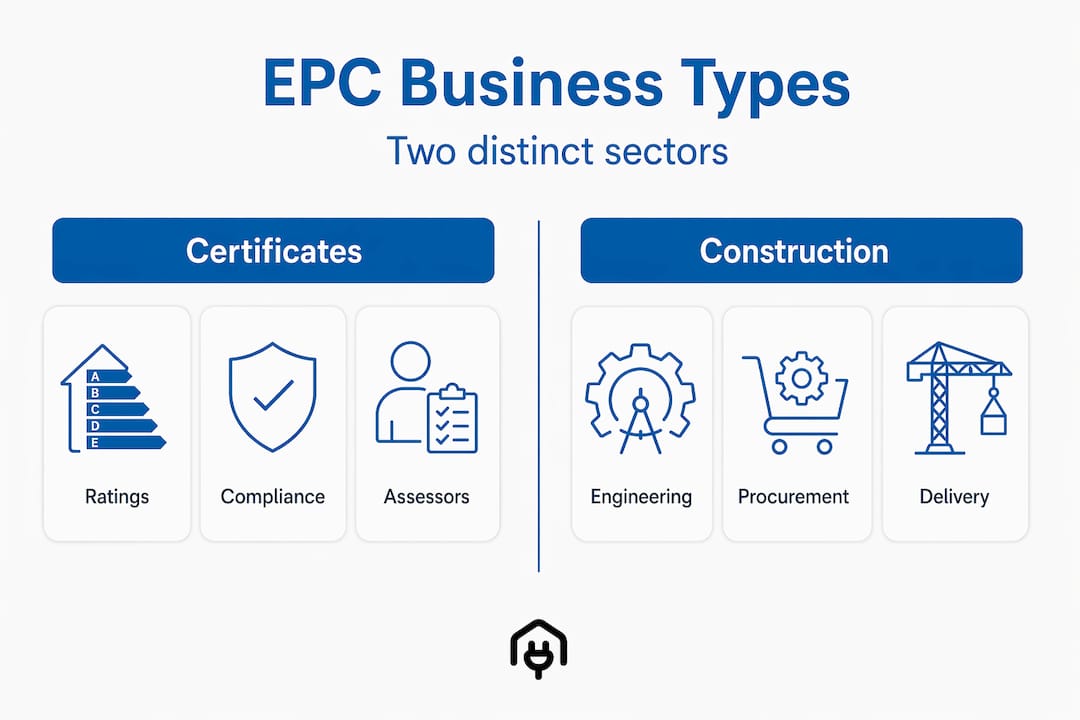
The term “EPC business” trips up more people than it should, and understandably so. It carries two distinct meanings that operate in entirely different sectors, yet both are growing in regulatory weight and commercial significance in 2026. Understanding what is EPC business means recognising whether you are dealing with the Energy Performance Certificate industry, which governs how buildings are rated for energy efficiency, or the Engineering, Procurement, and Construction contract model used in large infrastructure projects. This article covers both meanings clearly, explains the latest regulatory shifts affecting each, and gives property owners and businesses the context they need to act with confidence.
Table of Contents
- Key takeaways
- What is EPC business: the certificate side
- EPC reforms reshaping the sector in 2026
- EPC in construction: a separate business entirely
- Practical steps for engaging with EPC services
- EPCs, sustainability, and property value
- My perspective on EPC compliance
- How Homeenergymodel can help
- FAQ
Key takeaways
| Point | Details |
|---|---|
| Two meanings of EPC | “EPC business” refers to both the Energy Performance Certificate industry and Engineering, Procurement, and Construction contracts. |
| Legal compliance deadlines | Commercial properties must meet a minimum E rating now, with C by 2028 and B by 2030 targets on the horizon. |
| Regulatory reforms in 2026 | Domestic EPCs are shifting to a multi-metric system from late 2026, affecting how properties are assessed and rated. |
| Penalties for non-compliance | Failing to hold a valid EPC can result in fines ranging from £500 to £5,000 depending on property rateable value. |
| Early planning reduces cost | Staged improvement plans ahead of tightening standards save significantly more than last-minute retrofit work. |
What is EPC business: the certificate side
At its core, the EPC business refers to the commercial and regulatory ecosystem built around Energy Performance Certificates. An EPC is an official document that rates a building’s energy efficiency, providing property owners, tenants, and buyers with a standardised measure of how much energy a building uses and how costly it is to run.
For commercial properties, EPC ratings run from A+ to G, where A+ represents the highest efficiency and G the lowest. This rating system applies to non-domestic buildings across offices, retail units, warehouses, and other commercial premises. It is not a voluntary document. A commercial EPC is mandatory for selling, leasing, or constructing non-domestic properties in the UK, and has been valid for 10 years since its introduction.
The legal requirements carry real weight. Since April 2023, landlords of commercial properties cannot legally grant or renew a lease if their building holds an F or G rating. The minimum required standard is now E, and this threshold is only going to tighten. Understanding your EPC rating is therefore not just good practice. It is a legal obligation.
Key legal and practical points about commercial EPCs include:
- A valid EPC must be obtained before a property is marketed for sale or rent
- Ratings are valid for 10 years but may need updating after significant renovations
- The minimum E rating applies to all existing tenancies as well as new leases
- Non-domestic EPCs assess carbon emissions, not just energy cost
- An EPC must be accompanied by a recommendations report outlining potential improvements
Penalties for non-compliance range from £500 to £5,000 depending on the rateable value of the property. For larger commercial buildings, this can reach the upper end quickly, making compliance a straightforward financial decision as much as a legal one.
The EPC business as an industry has grown substantially as these obligations have multiplied. Accredited domestic and commercial energy assessors, software providers, compliance consultants, and retrofit contractors all form part of this broader sector. For property owners and landlords, knowing how to engage with these services is as important as understanding the certificate itself.
Pro Tip: Check whether your current EPC was produced using the correct assessment methodology for your property type. Commercial and domestic assessments use different tools, and an incorrectly typed assessment can invalidate your certificate.
EPC reforms reshaping the sector in 2026
The regulatory environment surrounding the EPC business is undergoing significant change, and 2026 marks a pivotal year for both domestic and commercial properties.
For domestic properties, the current single-metric EPC system, which primarily rates on energy cost per square metre, is being replaced. New domestic EPCs expected from late 2026 will adopt a multi-metric approach covering four areas: energy cost, fabric performance, heating system type, and smart readiness. This staged system allows a property to demonstrate compliance across multiple dimensions rather than relying on a single score, which is a meaningful shift for how landlords and developers plan improvement works.
For commercial properties, the focus remains on carbon-based metrics, but the Minimum Energy Efficiency Standards are tightening considerably. The current roadmap targets EPC C for commercial properties by 2028 and EPC B by 2030. These are not aspirational targets. They represent binding compliance thresholds that will affect the ability to let or sell commercial property.
| Standard | Target year | Who it affects |
|---|---|---|
| EPC E (current minimum) | In force since April 2023 | All commercial landlords letting or renewing leases |
| EPC C | 2028 | Commercial landlords with existing tenancies |
| EPC B | 2030 | All commercial properties in the letting market |
| Multi-metric domestic EPC | Late 2026 or 2027 | Residential landlords and homeowners |
Scotland’s EPC reforms have followed a different timeline. Scotland postponed its planned October 2026 EPC reforms to align with delays at the UK government level, maintaining the current system until further notice. A new Scottish EPC Accreditation Scheme has been introduced in 2026 but with delayed enforcement. Property owners and developers operating across both jurisdictions must track these regional differences carefully to avoid misaligned compliance plans.
Pro Tip: If you manage a portfolio spanning England and Scotland, treat each jurisdiction’s EPC obligations separately. A compliance plan that satisfies MEES in England may not meet future Scottish requirements, and vice versa. Review MEES regulatory guidance for the latest obligations in each territory.
Proactive staged planning is the consistently recommended approach from compliance specialists. Property owners who wait until the 2028 or 2030 deadlines are closer will face a construction and retrofit market under enormous pressure, driving up costs and limiting contractor availability.
EPC in construction: a separate business entirely
The second major meaning of EPC business refers to Engineering, Procurement, and Construction, a contract model widely used in large-scale infrastructure and industrial projects. Understanding what are EPC companies in this context requires a completely different frame of reference.
An EPC contractor takes on integrated responsibility for the full lifecycle of a project from technical engineering design through procurement of materials and equipment to the physical construction and handover. EPC contracts offer a single point of contact, fixed pricing, turnkey delivery, and specialist expertise for complex builds. The client engages one entity that carries accountability for cost, schedule, and quality across all phases.
The sectors that most commonly use EPC contracts include:
- Oil, gas, and petrochemical plants
- Renewable energy installations, including solar farms and wind projects
- Power generation facilities
- Water treatment infrastructure
- Large-scale manufacturing plants
What is an EPC firm in this context? It is a specialist contractor with the engineering capability, procurement networks, and construction management systems to deliver projects at scale under a single contractual wrapper. The risk profile is substantially different from traditional construction contracts, as the EPC contractor absorbs the majority of cost overrun and schedule risk.
There is a point of overlap worth noting. As the UK accelerates its renewable energy buildout, EPC contractors are increasingly involved in delivering the very assets that improve the built environment’s energy performance. A solar installation or heat pump network delivered under an EPC contract will directly affect the EPC rating of the properties it serves. The two meanings of EPC business are therefore not always operating in separate worlds.
Practical steps for engaging with EPC services
Whether the concern is compliance for a commercial property or preparation for an upcoming assessment, engaging with EPC services effectively requires some structured thinking. Choosing a qualified EPC assessor is the starting point, and the selection criteria matter more than many property owners initially assume.
A structured approach to engaging EPC services for property compliance:
- Verify accreditation. All domestic and commercial EPC assessors in England, Wales, and Scotland must be accredited through a government-approved scheme. Check the accreditation register before commissioning any assessment.
- Commission early. Do not wait until a property is going on the market. Obtaining an EPC ahead of time gives room to act on the recommendations report and potentially improve the rating before it is made public.
- Review the recommendations report. Every EPC comes with a list of suggested improvements. These range from low-cost measures such as loft insulation to more significant interventions such as replacing a heating system. Prioritise measures that offer the best rating improvement per pound spent.
- Obtain multiple quotes. EPC assessment costs vary. For domestic properties, assessments typically range from £60 to £120. Commercial assessments vary widely based on property size and complexity.
- Plan for the rating you need, not just the one you have. With MEES tightening, a current E rating may be compliant today but non-compliant in 2028. Assess the gap and build a costed improvement plan now.
Pro Tip: Ask your assessor to provide a provisional rating before the formal assessment is lodged. Many assessors will model different improvement scenarios so you can see which interventions move the needle most efficiently before committing to works.
Property owners can find local, qualified EPC assessors using Homeenergymodel’s guidance resources, which cover both residential and commercial property requirements.
EPCs, sustainability, and property value
The EPC business does not exist in isolation from broader policy goals. Energy performance assessments directly influence long-term property values, tenant comfort, and national net zero targets. A building with a strong EPC rating is increasingly a more attractive asset in the commercial property market, not simply because of compliance, but because of what the rating signals about operational costs and future adaptability.
Key ways in which EPC compliance connects to wider property and sustainability goals:
- Lower energy bills for tenants, which supports stronger lease retention and lower void periods for landlords
- Improved building fabric ratings, which align with climate resilience and occupant wellbeing
- Increased asset value as lenders and investors apply greater scrutiny to energy performance
- Alignment with institutional sustainability frameworks, including ESG reporting requirements for larger property portfolios
- Compliance with the UK government’s net zero by 2050 trajectory, of which the built environment is a significant component
For property developers and investors, energy efficiency is no longer a secondary consideration. It sits alongside location, lease length, and covenant strength as a factor that affects finance availability and exit strategy. The EPC business, in both its meanings, is central to how the UK’s built environment will evolve over the next decade.
My perspective on EPC compliance
I have spoken with enough landlords and property managers to know that the most common mistake is treating EPC compliance as an administrative task rather than a strategic one. The paperwork gets filed, the certificate gets renewed every decade, and the recommendations report is rarely opened. That approach worked when the minimum standard was F or G. It will not work when the target is B by 2030.
What I find genuinely useful, and what I wish more property owners would act on, is integrating EPC planning into capital expenditure cycles at the point of acquisition or lease renewal. If a commercial property is being refinanced, that is the moment to commission a new EPC assessment and a costed upgrade plan. The improvement works can often be structured alongside other capital investment, spreading the cost rather than facing it all at once.
The multi-metric domestic EPC reform is also more significant than many landlords currently appreciate. A property that currently holds a D rating on energy cost alone may find that its fabric performance or heating system score pulls it down under the new system. Early assessment under the new methodology, once it is available, will be revealing for many portfolios.
The EPC business, in both its forms, rewards those who engage early, plan honestly, and treat compliance as an asset management discipline rather than a tick-box exercise.
— Danny
How Homeenergymodel can help
Homeenergymodel provides clear, practical guidance on EPC requirements, energy modelling methodologies, and the regulatory changes reshaping the UK property sector. Whether you are a landlord preparing for the 2028 MEES deadline, a developer working through the implications of multi-metric EPC reform, or a business owner seeking your first commercial EPC, the resources available cover the full picture. Explore Homeenergymodel’s detailed breakdown of home energy models for landlords to understand how energy assessment methodologies affect your compliance position. For a comprehensive overview of certificate requirements and ratings, the EPC guide for London properties offers property-specific context alongside practical next steps.
FAQ
What does EPC mean in business?
EPC in a business context can refer to either an Energy Performance Certificate, which rates a building’s energy efficiency, or an Engineering, Procurement, and Construction contract used in large infrastructure projects. The relevant meaning depends on the industry context in which the term is used.
Is a commercial EPC legally required?
Yes. A commercial EPC is mandatory when selling, leasing, or constructing non-domestic properties in the UK, and properties must hold at least an E rating to be legally let as of April 2023.
What are EPC companies?
EPC companies are either accredited energy assessment firms that produce Energy Performance Certificates for buildings, or specialist contractors in the Engineering, Procurement, and Construction sector who deliver complex infrastructure projects under a single integrated contract.
When will EPC rules change in the UK?
Domestic EPC reform introducing a multi-metric assessment system is expected from late 2026 or 2027. Commercial properties face tightening MEES standards requiring EPC C by 2028 and EPC B by 2030.
What happens if a business does not have a valid EPC?
Businesses that fail to provide a valid EPC when required face fines between £500 and £5,000, scaled according to the rateable value of the property involved.