

TL;DR:
- A single letter on an EPC can determine whether a landlord can legally rent out a property, emphasizing the importance of accurate assessments. Upcoming reforms to EPC methodology and the introduction of the Home Energy Model in 2026 will require landlords to focus on detailed metrics rather than just the band it falls into. Proper documentation and understanding of these changes are essential to maintain compliance and optimize energy efficiency improvements.
A single letter on an Energy Performance Certificate can determine whether a landlord may legally rent out their property at all. That fact alone signals why EPCs deserve far more attention than the paperwork they are often treated as. With the UK government planning significant regulatory changes in 2026, including a wholesale reform of how EPC scores are structured and calculated, property owners and landlords face a pivotal moment. This guide moves from basic definitions through to legal obligations and the coming reforms, giving you the clarity needed to act with confidence.
Table of Contents
- What is an EPC and how is it created?
- How EPCs are scored: The RdSAP approach and evidence
- Legal implications for landlords: The MEES regulations
- The coming changes: Home Energy Model and new-style EPCs
- Our take: What most landlords miss when planning for EPC changes
- Get expert help navigating EPCs and Home Energy Model changes
- Frequently asked questions
Key Takeaways
| Point | Details |
|---|---|
| EPCs are legally critical | Your property’s EPC rating can decide whether it can be let under UK law. |
| Evidence improves accuracy | Supplying construction details during assessment can help you achieve a better EPC score. |
| Major changes ahead | The Home Energy Model will introduce new metrics and change how EPCs are scored starting in 2026. |
| Prepare for compliance shifts | Landlords should follow official guidance as further EPC reforms roll out this year. |
What is an EPC and how is it created?
An Energy Performance Certificate is an official document that rates the energy efficiency of a residential or commercial property on a scale from A (most efficient) to G (least efficient). The certificate exists to give buyers, tenants, and owners a reliable, standardised view of how much energy a building uses and what it costs to run. Every property sold, let, or newly constructed in England and Wales must have a valid EPC in place before the transaction can proceed.
An EPC is produced by an approved domestic energy assessor who visits the home, collects data about the building and services, and then generates both a current energy efficiency score and recommendations that could improve the rating. The assessor is not simply ticking boxes. They examine wall construction, insulation levels, roof type, glazing, heating systems, hot water provision, and any renewable energy installations present. All of this data feeds into a calculation that produces two scores: the current rating and a potential rating that reflects what the property could achieve if the recommended improvements were made.
The key items an assessor reviews during a visit include:
- Wall type and insulation: cavity, solid, or timber-frame, and whether insulation has been fitted
- Loft and roof insulation: depth and type of material used
- Windows and glazing: single, double, or triple glazed, and the age of the installation
- Heating system: boiler type, age, controls, and fuel source
- Hot water provision: cylinder insulation, solar thermal, or heat pump contribution
- Lighting: proportion of energy-efficient fittings throughout the property
- Renewable technologies: solar panels, heat pumps, or mechanical ventilation heat recovery systems
Understanding the role of EPC assessor is important before scheduling an inspection. A well-prepared assessor visit, where relevant documentation is available, will almost always produce a more favourable and accurate result than one where details must be estimated.
Pro Tip: Before booking an EPC, gather any paperwork relating to past insulation installations, boiler replacements, or window upgrades. Certificates, invoices, and building control completion notices can all serve as valid evidence to overwrite default assumptions in the calculation.
For a broader look at the process, the EPC guide for UK owners covers common questions about certificate validity, costs, and where to find a registered assessor.
How EPCs are scored: The RdSAP approach and evidence
Once the assessor has collected the property data, the information is processed through a government-approved calculation methodology. For existing homes, this is called RdSAP, which stands for Reduced Data Standard Assessment Procedure. It is distinct from the full SAP calculation used for new-build properties, which relies on detailed construction drawings and specifications that simply do not exist for older stock.

For existing dwellings in England and Wales, EPCs are currently based on RdSAP, which uses an approved reduced-data approach and defaults when detailed construction information cannot be confirmed. Evidence is required to overwrite defaults, for example for thermal element U-values. A U-value measures how quickly heat passes through a building element such as a wall or roof. Lower U-values indicate better insulation performance. When an assessor cannot confirm the insulation standard, the software applies a conservative default that typically reflects a worse-performing construction, potentially dragging the overall rating down.
The steps in the RdSAP scoring process are as follows:
- Data collection: The assessor records physical characteristics of the property on site, supported by any documentary evidence provided.
- Default assignment: Where evidence is absent, the software applies pre-set defaults based on the property’s age, construction type, and region.
- Energy demand calculation: The software estimates annual space heating, water heating, and lighting energy consumption based on the collected and assumed data.
- Cost conversion: Energy demand figures are converted into costs using standard fuel tariffs, producing the Energy Efficiency Rating (EER) and Environmental Impact Rating (EIR).
- Band allocation: The numerical score is converted into an A to G band, with a score of 92 or above achieving band A and below 39 falling into band G.
- Recommendation generation: The software identifies which measures would deliver the greatest uplift in score, listing them in cost-effectiveness order.
“Using default values where detailed construction information cannot be confirmed can result in a lower EPC rating than the property genuinely warrants. Owners who have installed cavity wall insulation, upgraded their loft, or fitted modern glazing should always provide supporting evidence during the assessment.”
This is one of the most practical insights for any landlord or property owner. A property may have been insulated in 2015, but if the paperwork was discarded, the assessor has no alternative but to apply a default that assumes standard older construction. That default could be the difference between a band C and a band D rating. Maintaining an understanding of SAP calculations helps owners appreciate why documentation is not merely administrative detail but a direct influence on the certificate outcome.
Pro Tip: Keep a property file with dated certificates, contractor invoices, and any building control notices relating to insulation, glazing, and heating upgrades. This file becomes directly useful at every future EPC reassessment and can improve the rating without spending a penny on new improvements.
For properties in London or other urban areas where older housing stock is common, the SAP calculation explained resource offers additional context on how these calculations apply in practice.
Legal implications for landlords: The MEES regulations
The Minimum Energy Efficiency Standards, commonly referred to as MEES, create a direct legal link between an EPC rating and the right to let a property. These regulations have been in force since 2018 and have been progressively tightened. The core principle is straightforward: a property must meet a minimum EPC standard before it can be lawfully rented out.
The EPC rating affects whether a property can be legally let under the current MEES framework. Properties with an EPC rating of F or G are currently prohibited from being let to tenants unless a valid exemption applies. Letting a property in breach of MEES can result in financial penalties of up to £5,000 per property.
| EPC band | Current lettings status | Notes |
|---|---|---|
| A | Fully compliant | Highest efficiency rating |
| B | Fully compliant | Exceeds minimum standard |
| C | Fully compliant | Meets minimum and proposed future target |
| D | Fully compliant | Meets current minimum |
| E | Fully compliant | Meets current minimum threshold |
| F | Non-compliant | Cannot be let without exemption |
| G | Non-compliant | Cannot be let without exemption |
Exemptions do exist and are recorded on a national register. The key circumstances where an exemption may apply include:
- All improvements made: The landlord has made all cost-effective improvements but the property still does not reach band E.
- Third-party consent refused: Required consent from a tenant, superior landlord, or local authority has been withheld.
- Temporary exemption: A new landlord who has recently acquired a non-compliant property is given a six-month grace period.
- Devaluation: A surveyor’s report confirms that making improvements would reduce the market value of the property by more than 5%.
Detailed guidance on EPC exemptions explained sets out the application process and how long each exemption type remains valid. It is important to note that exemptions are personal to the landlord. They do not transfer to a new owner upon sale. Anyone purchasing a property with an active exemption on the register must reassess their own situation.
For a full overview of the legal framework, the MEES regulations guide covers enforcement, penalty structures, and the government’s longer-term trajectory for raising the minimum standard. Landlords with properties currently rated E should monitor developments closely, as band C has been widely discussed as the direction of travel for future minimum thresholds.
Looking at EPC tips for success provides targeted advice on the most cost-effective improvements for properties sitting near band boundaries.
The coming changes: Home Energy Model and new-style EPCs
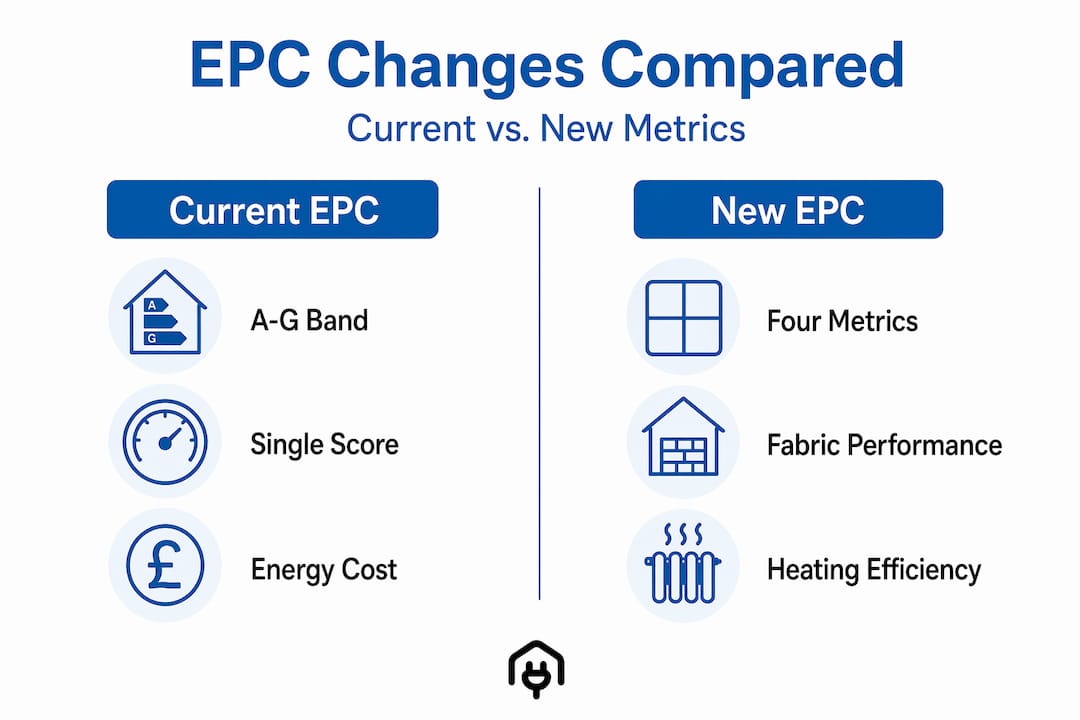
The most significant shift in EPC methodology in over a decade is now in progress. The government is replacing the familiar single A to G band system with a more detailed, four-metric approach under the Home Energy Model, or HEM. This reform affects how properties are assessed, how results are presented, and ultimately how landlords and owners will need to think about energy improvement priorities.
New-style domestic EPCs in England and Wales will show four headline metrics covering fabric performance, heating system, smart readiness, and energy cost, rather than a single A to G energy efficiency band as currently used. Each metric tells a different story about the property.
| Metric | What it measures | Why it matters |
|---|---|---|
| Fabric performance | Insulation, windows, and air tightness | Determines baseline heat loss |
| Heating system | Boiler, heat pump, or other system type and efficiency | Reflects running costs and carbon output |
| Smart readiness | Ability to respond to grid signals and time-of-use tariffs | Increasingly relevant with smart meters and EVs |
| Energy cost | Estimated annual energy expenditure | Most directly comparable to household bills |
Key points about the 2026 regulatory timeline:
- Regulations are intended to be brought forward in 2026 ahead of implementing new-style domestic EPCs, with further government responses expected throughout the year.
- The transition arrangements between current RdSAP-based EPCs and new HEM-based certificates are still being finalised.
- Existing valid EPCs will likely remain in use for a period, but the rules around when a new assessment is triggered may change.
- Landlords planning significant refurbishment work in 2026 should seek assessments timed to capture improvements under whichever methodology is most beneficial.
The shift to four metrics changes the upgrade decision process considerably. Under the current system, fitting a new boiler and adding loft insulation might both contribute to lifting a band D rating to band C. Under the new system, a landlord might find that the fabric performance metric is already satisfactory but the heating system metric is pulling down the overall assessment. Targeted action becomes more important, and generic “improve everything” approaches become less efficient.
For landlords preparing now, navigating EPC changes offers a practical framework for timing assessments, prioritising improvements, and understanding what the new metrics mean for specific property types.
Our take: What most landlords miss when planning for EPC changes
After supporting UK landlords through several rounds of EPC and MEES updates, one pattern stands out repeatedly: landlords consistently underestimate the value of documentation and overestimate the value of expensive retrofits. A landlord who spends £8,000 fitting external wall insulation to a solid-wall terrace might achieve a one-band improvement. A landlord who simply locates the original installer certificates for cavity fill done in 2012 can achieve the same result at zero cost, simply by ensuring the assessor has the evidence to apply accurate rather than default values.
There is also a widespread assumption that the upcoming four-metric system will reward the same improvements that currently move an EPC band. That is not necessarily true. Smart readiness, for example, is a metric most landlords have never needed to consider. A property with a basic gas boiler, no smart thermostat, and no ability to respond to time-of-use electricity tariffs may score well on fabric and heating but perform poorly on smart readiness. That is a different kind of improvement project than insulation or boiler replacement.
The importance of energy efficiency for long-term property value is well documented, but the specific pathway to achieving it will look different under HEM than it does today. Staying informed through reliable energy policy insights is not optional for landlords who wish to remain compliant and competitive. The regulatory timeline for 2026 remains subject to finalisation, and acting on incomplete information, either too early or too late, carries real financial risk. The prudent approach is to understand the direction of travel clearly, prepare documentation thoroughly, and resist making capital-intensive decisions until the transition rules are confirmed.
Get expert help navigating EPCs and Home Energy Model changes
For landlords seeking a smoother path through EPC compliance and the transition to the Home Energy Model, practical, tailored resources are available. Whether a portfolio contains one property or fifty, understanding which types of home energy models for landlords apply to specific circumstances helps owners invest time and money in the right areas. From detailed guidance on assessment methodologies to step-by-step compliance planning, the resources at homeenergymodel.co.uk are designed to support property owners at every stage. For those managing London properties specifically, EPCs explained for London provides localised insight into how the capital’s diverse housing stock interacts with current and upcoming EPC requirements. Getting informed now, before 2026 regulations are finalised, is the most effective way to stay ahead.
Frequently asked questions
Who produces an EPC for my property?
An approved domestic energy assessor visits the property, collects data on the building fabric and services, and generates the certificate. Assessors must be registered with an accreditation scheme to produce valid EPCs.
What does the new Home Energy Model change in the EPC?
Rather than a single A to G band, new-style EPCs will display four metrics covering fabric performance, heating system, smart readiness, and energy cost. This gives a more detailed picture of where a property performs well and where improvement is needed.
Can default values affect my EPC score?
Yes. Where detailed construction information cannot be confirmed, RdSAP applies default values that often reflect older, less efficient construction standards, which can lower a property’s rating below its actual performance level.
Will I need a new EPC in 2026?
Regulations are planned for 2026 to introduce new-style EPCs, but the precise trigger points and transition arrangements for existing certificates will be confirmed through further government guidance later in the year.
What happens if my property is rated F or G?
MEES currently prohibits letting domestic buildings with an EPC rating of F or G unless the landlord qualifies for a registered exemption. Letting a non-compliant property without an exemption in place carries financial penalties.